M E H W I S H B U K H A R I
EDUCATIONAL ADMINISTRATION:
EVALUATION OF PROGRAM /
LEARNERS
OBJECTIVES
• Define evaluation.
• Explain purpose of evaluation
• Interpret Krickpatrick,s model of evaluation.
• Discuss the steps while doing an evaluation.
• Challenges while performing an evaluation
DEFINITION
Evaluation is defined as a systematic process that
judges the worth or value of something___ in this case
teaching and learning.
EVALUATION OF PROGRAM
Purpose of evaluation
1.Used to make decisions about selection, adoption, value and
modification of training program.
Based on instructional objectives derived from needs assessment.
Barriers :
• Lack of trained personnel
• Resistance to evaluation
 Outcomes of negative evaluations?
 Evaluation not expected or rewarded.
Lack of clarity
Lack of ability
Fear of punishment or loss of self esteem
KIRKPATRICK EVALUATION MODEL
• What is the Kirkpatrick Evaluation Model?
• The Kirkpatrick Model is a popular method for evaluating
the effectiveness of a training, e-learning, or educational
program.
• This analytic tool helps professionals assess training
programs based on four criteria: reaction, learning,
behavior, and results.
KIRKPATRICK EVALUATION MODEL
• The method was developed by Donald Kirkpatrick in
1954 as part of his PhD dissertation.
• the most widely used method for evaluating the
effectiveness of training programs and instructional
design.
KIRKPATRICK EVALUATION MODEL
• When Donald first came up with the model, he thought
that learning professionals should follow these checklists
in a linear fashion, starting with assessing employees’
reactions to an educational program and working up the
ladder to finish with results.
• The model is composed of four levels of criteria:
reaction, learning, behavior, and results.
CONTI…
these four levels are described as follows:
 Reaction – It analyses the engagement of the learners.
• It determines the level of satisfaction learners feel about the training
program.
• How have they contributed?
• How have they responded?
• What did learner think about the training?
• These questions will help to analyse this level 1 – Reaction.
 Learning – This level determines the knowledge, skills, and values
developed by the learners from the program. Learning level
evaluates what the learners think they will be able to execute the
likely shift. The confidence and drive to perform is all measured
under this level. Considering if the learners truly understood the
program and acquired skills out of it is the main aim of this
level.
CONTI…
 Impact – This level measure the level by which the training
has influenced the behaviour of the learner and measure the
level how they apply this knowledge in the given workplace.
• It is the degree to which learners apply what they learned
during training when they are back on the job. This is quite
powerful level and truly decides the success of the training
program in long term aspect.
• It involves a process to obtain both quantitative and qualitative
feedback from participants later they have left the training
program – at times weeks or months after.
• It also needs promise from all stakeholders – training provider,
training admin and learner – to ensure enough data is
gathered and that the data is high quality.
CONTI…
 Results – Results level analyses the functional results
that determine a good return on investment and can be
attached to the training program.
• This level 4 is the most time taking costly method to
evaluate the overall results from all possible angles.
• The greatest and most important aspect is to look for
the outcome that closely linked to the training and will
work effectively in the long term.
• This level is specifically designed to measure the
impact the training program created for the
organisation in terms of Return of Investment (ROI).
CONTI…
• Overview of the Kirkpatrick Model
• There are certain strengths and weaknesses associated with all types of evaluation
methods and Kirkpatrick model is not an exception. Some find it not so relevant in
some characteristics, yet many find it simple and easy to evaluate.
 Most of the time this model works fine and provides the best possible outcomes. Its
highly popular but again its success depends on the execution in the right
direction.
 There are some limitations with this model as the basic structure is around 60 years
old and its not at all completely applicable in current organisational and training
structure. The training term is now learning and development (L&D)
 The non-formal workplace training is more popular now compared to old formal,
personalised training and Kirkpatrick model is not essentially appropriate to this new
approach of learning.
CONTI…
 One another limitation is the time consumption with level 3 & 4 of Kirkpatrick model
and authenticity of data for level 1 & 2.
 Overall Kirkpatrick model is fantastic for evaluating training in a systematic way and
an internationally recognised tool for evaluating the results of educational
training programs.
 the results they want to see and then developing the training that could likely to
deliver it to them. This approach is getting popular as it directly emphasises on the
results at first and then check the Impact, Learning and Reaction in a downward way
of the model.
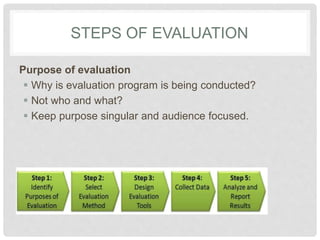
STEPS OF EVALUATION
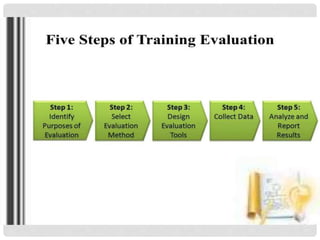
Purpose of evaluation
 Why is evaluation program is being conducted?
 Not who and what?
 Keep purpose singular and audience focused.
STEPS OF EVALUATION
Evaluation method
Most appropriate and feasible method can be select by:
 Type of data will be collected?
 What and by whom data will be collected?
 How, when and where?
 Who will collect data?
STEPS OF EVALUATION
Design Evaluation Tool
Initial step_______ conduct a literature research
1. Relevant
2. Reliable
3. Valid
4. Affordable
5. Feasible
6. Easy to use
STEPS OF EVALUATION
Collect data/ Conducting the evaluation
Success of implementation of an evaluation depends upon :
 How carefully and thoroughly that evaluation i planned
 How carefully an instrument for data collection is selected
Methods to achieve successful achievement of process:
1. Conduct a pilot test
2. Include extra time to complete all the evaluation steps.
3. Keep a sense of humor throughout the experience.
STEPS OF EVALUATION
Analyze And Report Results
Purpose of conducting data analysis are
1. To organize data so that they can provide meaningful information.
2. To provide answer to evaluation questions
 Data analysis should be consistent with type of data collected
Reporting evaluation results
 Be audience focused
 stick to evaluation process
 Use data as intended
evaluation of program.pptx

evaluation of program.pptx

  • 1.
    M E HW I S H B U K H A R I EDUCATIONAL ADMINISTRATION: EVALUATION OF PROGRAM / LEARNERS
  • 2.
    OBJECTIVES • Define evaluation. •Explain purpose of evaluation • Interpret Krickpatrick,s model of evaluation. • Discuss the steps while doing an evaluation. • Challenges while performing an evaluation
  • 3.
    DEFINITION Evaluation is definedas a systematic process that judges the worth or value of something___ in this case teaching and learning.
  • 4.
    EVALUATION OF PROGRAM Purposeof evaluation 1.Used to make decisions about selection, adoption, value and modification of training program. Based on instructional objectives derived from needs assessment. Barriers : • Lack of trained personnel • Resistance to evaluation  Outcomes of negative evaluations?  Evaluation not expected or rewarded. Lack of clarity Lack of ability Fear of punishment or loss of self esteem
  • 6.
    KIRKPATRICK EVALUATION MODEL •What is the Kirkpatrick Evaluation Model? • The Kirkpatrick Model is a popular method for evaluating the effectiveness of a training, e-learning, or educational program. • This analytic tool helps professionals assess training programs based on four criteria: reaction, learning, behavior, and results.
  • 7.
    KIRKPATRICK EVALUATION MODEL •The method was developed by Donald Kirkpatrick in 1954 as part of his PhD dissertation. • the most widely used method for evaluating the effectiveness of training programs and instructional design.
  • 8.
    KIRKPATRICK EVALUATION MODEL •When Donald first came up with the model, he thought that learning professionals should follow these checklists in a linear fashion, starting with assessing employees’ reactions to an educational program and working up the ladder to finish with results. • The model is composed of four levels of criteria: reaction, learning, behavior, and results.
  • 9.
    CONTI… these four levelsare described as follows:  Reaction – It analyses the engagement of the learners. • It determines the level of satisfaction learners feel about the training program. • How have they contributed? • How have they responded? • What did learner think about the training? • These questions will help to analyse this level 1 – Reaction.  Learning – This level determines the knowledge, skills, and values developed by the learners from the program. Learning level evaluates what the learners think they will be able to execute the likely shift. The confidence and drive to perform is all measured under this level. Considering if the learners truly understood the program and acquired skills out of it is the main aim of this level.
  • 10.
    CONTI…  Impact –This level measure the level by which the training has influenced the behaviour of the learner and measure the level how they apply this knowledge in the given workplace. • It is the degree to which learners apply what they learned during training when they are back on the job. This is quite powerful level and truly decides the success of the training program in long term aspect. • It involves a process to obtain both quantitative and qualitative feedback from participants later they have left the training program – at times weeks or months after. • It also needs promise from all stakeholders – training provider, training admin and learner – to ensure enough data is gathered and that the data is high quality.
  • 11.
    CONTI…  Results –Results level analyses the functional results that determine a good return on investment and can be attached to the training program. • This level 4 is the most time taking costly method to evaluate the overall results from all possible angles. • The greatest and most important aspect is to look for the outcome that closely linked to the training and will work effectively in the long term. • This level is specifically designed to measure the impact the training program created for the organisation in terms of Return of Investment (ROI).
  • 14.
    CONTI… • Overview ofthe Kirkpatrick Model • There are certain strengths and weaknesses associated with all types of evaluation methods and Kirkpatrick model is not an exception. Some find it not so relevant in some characteristics, yet many find it simple and easy to evaluate.  Most of the time this model works fine and provides the best possible outcomes. Its highly popular but again its success depends on the execution in the right direction.  There are some limitations with this model as the basic structure is around 60 years old and its not at all completely applicable in current organisational and training structure. The training term is now learning and development (L&D)  The non-formal workplace training is more popular now compared to old formal, personalised training and Kirkpatrick model is not essentially appropriate to this new approach of learning.
  • 16.
    CONTI…  One anotherlimitation is the time consumption with level 3 & 4 of Kirkpatrick model and authenticity of data for level 1 & 2.  Overall Kirkpatrick model is fantastic for evaluating training in a systematic way and an internationally recognised tool for evaluating the results of educational training programs.  the results they want to see and then developing the training that could likely to deliver it to them. This approach is getting popular as it directly emphasises on the results at first and then check the Impact, Learning and Reaction in a downward way of the model.
  • 24.
    STEPS OF EVALUATION Purposeof evaluation  Why is evaluation program is being conducted?  Not who and what?  Keep purpose singular and audience focused.
  • 25.
    STEPS OF EVALUATION Evaluationmethod Most appropriate and feasible method can be select by:  Type of data will be collected?  What and by whom data will be collected?  How, when and where?  Who will collect data?
  • 26.
    STEPS OF EVALUATION DesignEvaluation Tool Initial step_______ conduct a literature research 1. Relevant 2. Reliable 3. Valid 4. Affordable 5. Feasible 6. Easy to use
  • 27.
    STEPS OF EVALUATION Collectdata/ Conducting the evaluation Success of implementation of an evaluation depends upon :  How carefully and thoroughly that evaluation i planned  How carefully an instrument for data collection is selected Methods to achieve successful achievement of process: 1. Conduct a pilot test 2. Include extra time to complete all the evaluation steps. 3. Keep a sense of humor throughout the experience.
  • 28.
    STEPS OF EVALUATION AnalyzeAnd Report Results Purpose of conducting data analysis are 1. To organize data so that they can provide meaningful information. 2. To provide answer to evaluation questions  Data analysis should be consistent with type of data collected Reporting evaluation results  Be audience focused  stick to evaluation process  Use data as intended