PARTICLE THEORY OR  KINETIC THEORY OF MATTER HOW TO DEAL WITH THINGS WE DON’T REALLY SEE!!
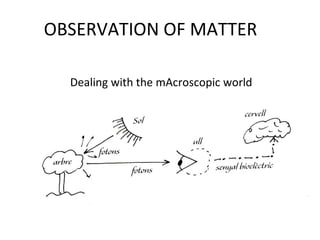
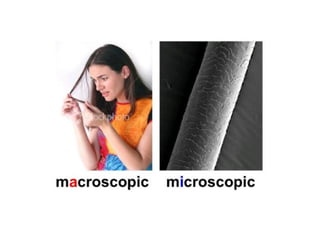
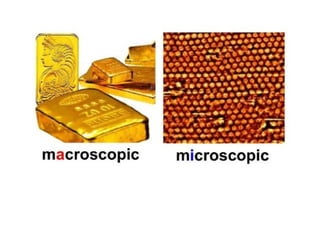
OBSERVATION OF MATTER  Dealing with the mAcroscopic world
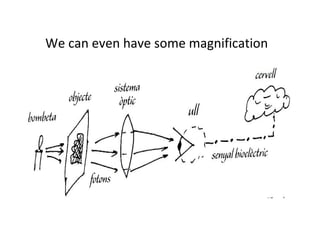
We can even have some magnification
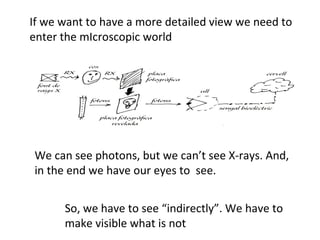
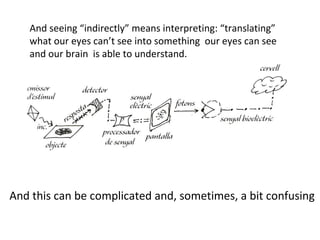
If we want to have a more detailed view we need to enter the mIcroscopic world We can see photons, but we can’t see X-rays. And, in the end we have our eyes to  see.  So, we have to see “indirectly”. We have to make visible what is not
And seeing “indirectly” means interpreting: “translating” what our eyes can’t see into something  our eyes can see and our brain  is able to understand. And this can be complicated and, sometimes, a bit confusing
 
 
Remember the definition I gave you at the very beginning ...
Definition It is the study of MATTER, what it is made of, how it behaves, and the changes it is subjected to. It trys to observe phenomena and explain them through laws that can be applied to the world around us.
How to travel from the MACROSCOPIC to the MICROSCOPIC  world without getting lost?
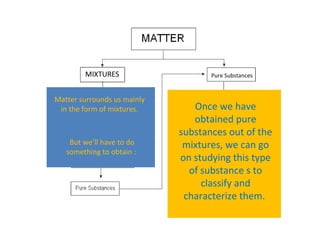
MIXTURES Pure Substances Matter surrounds us mainly in the form of mixtures. But we’ll have to do something to obtain :  Once we have obtained pure substances out of the mixtures, we can go on studying this type of substance s to classify and characterize them.
To study MATTER (Mixtures and Pure Substances) we’ll have to construct MODELS. These models always do some simplifications to help us understand how matter is and why it behaves the way it does.  The first model we have to consider is :  The particle theory  (or kinetic theory of matter)
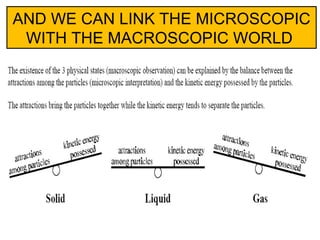
Particle theory helps to explain properties and behaviour of materials by providing a  model  which enables us to  visualise  what is happening on a  very small scale  inside those materials.  As a model it is useful because it appears to explain many phenomena but as with all models it does have limitations.  The model can be used to help explain: 1.-  The properties of matter  2.- What happens during physical changes such as melting, boiling and evaporating. 3.- What temperature is. 4.- What pressure of gas in a container is.
And what does this theory say?  It says that all matter consists of many, very small  particles  which are constantly moving. The degree to which the particles move is determined by the amount of energy and the forces of attraction with other particles. The forces between particles are always attractive. The closer the particles, the stronger the force.  So, we just have to move in the  MICROSCOPIC 1 level !
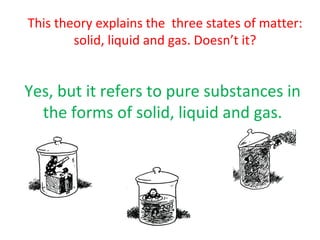
This theory explains the  three states of matter: solid, liquid and gas. Doesn’t it? Yes, but it refers to pure substances in the forms of solid, liquid and gas.
I know it’s difficult to try and find pure substances at home !!  Even bottled water is not a pure substance  (from the microscopic 1 point of view) !!
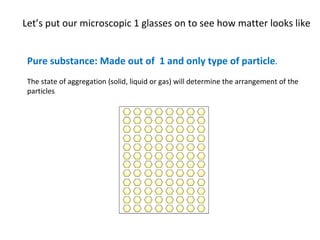
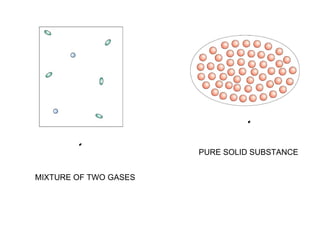
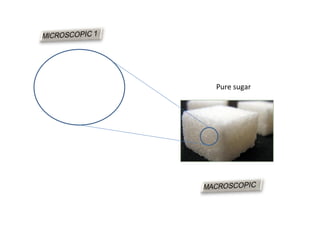
Let’s put our microscopic 1 glasses on to see how matter looks like Pure substance: Made out of  1 and only type of particle .  The state of aggregation (solid, liquid or gas) will determine the arrangement of the particles
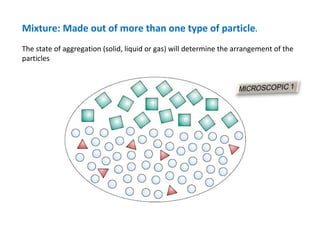
Mixture: Made out of more than one type of particle .  The state of aggregation (solid, liquid or gas) will determine the arrangement of the particles


? ? MIXTURE OF TWO GASES PURE SOLID SUBSTANCE
 
Pure sugar
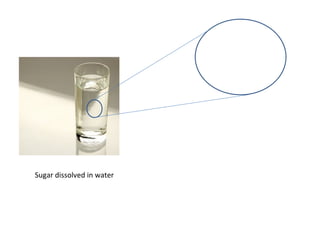
Sugar dissolved in water
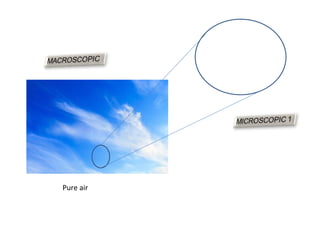
Pure air
Remember that it is very important to know the point of view we take.  In the MACROSCOPIC level of observation we can’t talk about PARTICLES .  PARTICLES ARE WHAT WE SAY MATTER IS MADE OUT OF.  AN ENORMOUS SET OF PARTICLES IS WHAT OUR EYES CAN SEE AND OUR HANDS CAN HANDLE.  AN INCREDIBLE NUMBER OF PARTICLES OF EACH PURE SUBSTANCE IS WHAT GIVES THIS SUBSTANCE ITS MACROSCOPIC PROPERTIES.  THIS MACROSCOPIC PROPERTIES DEPEND ON MANY TYPES OF MICROSCOPIC INTERACTIONS
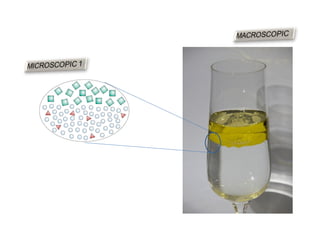
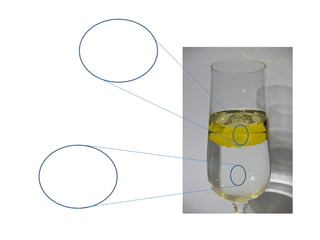
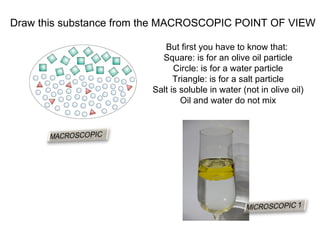
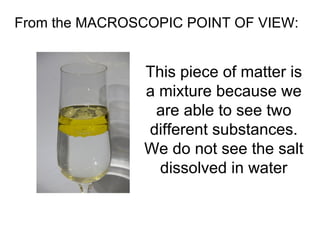
Draw this substance from the MACROSCOPIC POINT OF VIEW But first you have to know that:  Square: is for an olive oil particle Circle: is for a water particle Triangle: is for a salt particle Salt is soluble in water (not in olive oil) Oil and water do not mix
From the MACROSCOPIC POINT OF VIEW:  This piece of matter is a mixture because we are able to see two different substances. We do not see the salt dissolved in water
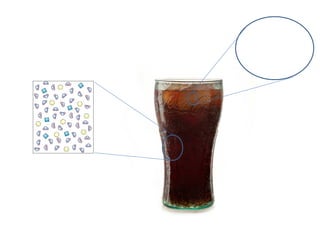
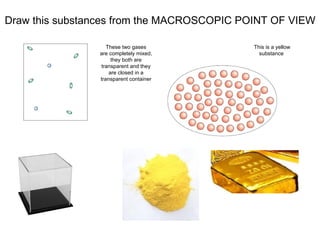
Draw this substances from the MACROSCOPIC POINT OF VIEW These two gases are completely mixed, they both are transparent and they are closed in a transparent container This is a yellow substance
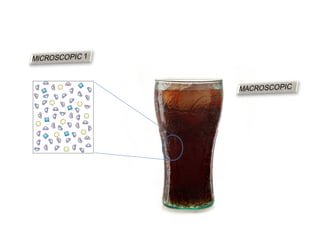
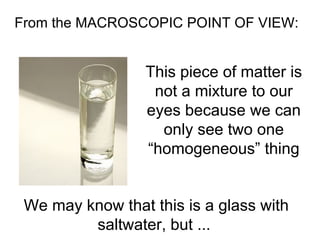
From the MACROSCOPIC POINT OF VIEW:  This piece of matter is not a mixture to our eyes because we can only see two one “homogeneous” thing We may know that this is a glass with saltwater, but ...
A way to tell a PURE substance from a MIXTURE (from the macroscopic point of view) is …  to measure its properties ONLY PURE SUBSTANCES HAVE FIXED PHYSICAL AND CHEMICAL PROPERTIES.
PURE WATER SOLIDIFIES  AT 0Âş C .   WATER WITH SALT DISSOLVED IN IT SOLIDIFIES AT A LOWER TEMPERATURE
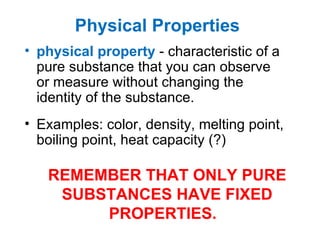
Physical Properties   physical   property   - characteristic of a pure substance that you can observe or measure without changing the identity of the substance.  Examples: color, density, melting point, boiling point, heat capacity (?) REMEMBER THAT ONLY PURE SUBSTANCES HAVE FIXED PROPERTIES.
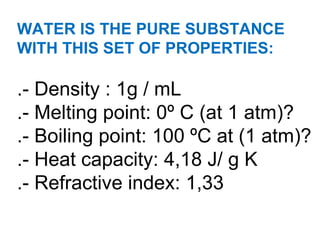
WATER IS THE PURE SUBSTANCE WITH THIS SET OF PROPERTIES:  .- Density : 1g / mL .- Melting point: 0Âş C (at 1 atm)? .- Boiling point: 100 ÂşC at (1 atm)? .- Heat capacity: 4,18 J/ g K .- Refractive index: 1,33
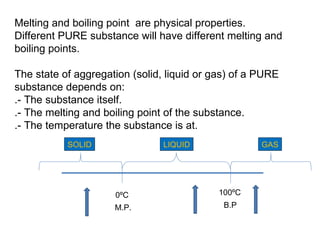
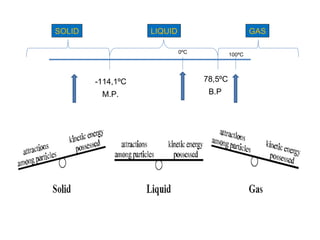
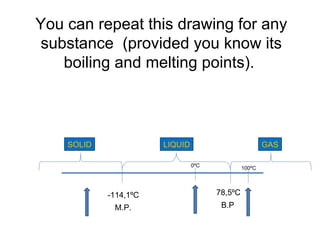
Melting and boiling point  are physical properties.  Different PURE substance will have different melting and boiling points.  The state of aggregation (solid, liquid or gas) of a PURE substance depends on:  .- The substance itself. .- The melting and boiling point of the substance. .- The temperature the substance is at. 0ÂşC 100ÂşC M.P. B.P SOLID LIQUID GAS
-114,1ÂşC 78,5ÂşC M.P. B.P SOLID LIQUID GAS You can repeat this drawing for any substance  (provided you know its boiling and melting points).  0ÂşC 100ÂşC
CONCLUDING:  A substance is in the solid state if its temperature is lower than its melting point.  This substance will be in the liquid state if its temperature is in between its melting and boiling points.  And the substance will be in the gas state for temperatures higher than its boiling point.
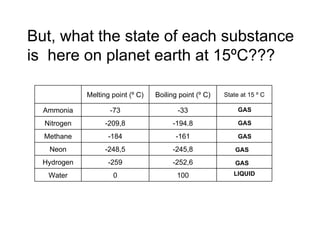
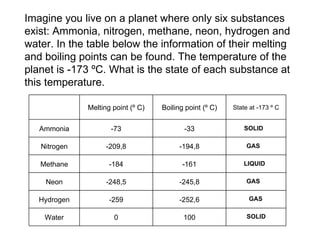
Imagine you live on a planet where only six substances exist: Ammonia, nitrogen, methane, neon, hydrogen and water. In the table below the information of their melting and boiling points can be found. The temperature of the planet is -173 ÂşC. What is the state of each substance at this temperature. SOLID SOLID LIQUID GAS GAS GAS Melting point (Âş C) Boiling point (Âş C) State at -173 Âş C Ammonia -73 -33 Nitrogen -209,8 -194,8 Methane -184 -161 Neon -248,5 -245,8 Hydrogen -259 -252,6 Water 0 100
But, what the state of each substance is  here on planet earth at 15ÂşC??? GAS LIQUID GAS GAS GAS GAS Melting point (Âş C) Boiling point (Âş C) State at 15 Âş C Ammonia -73 -33 Nitrogen -209,8 -194.8 Methane -184 -161 Neon -248,5 -245,8 Hydrogen -259 -252,6 Water 0 100
AND WE CAN LINK THE MICROSCOPIC WITH THE MACROSCOPIC WORLD
-114,1ÂşC 78,5ÂşC M.P. B.P SOLID LIQUID GAS 0ÂşC 100ÂşC
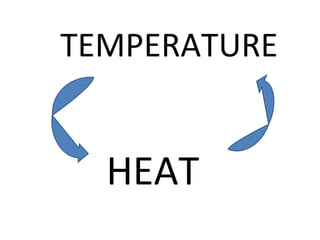
TEMPERATURE HEAT
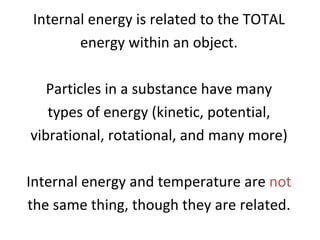
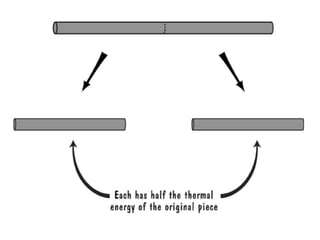
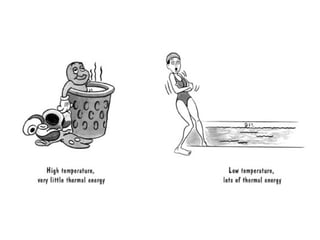
Internal energy is related to the TOTAL energy within an object. Particles in a substance have many types of energy (kinetic, potential, vibrational, rotational, and many more) Internal energy and temperature are  not the same thing, though they are related.
 
 
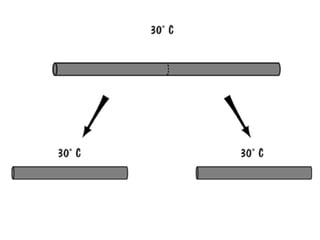
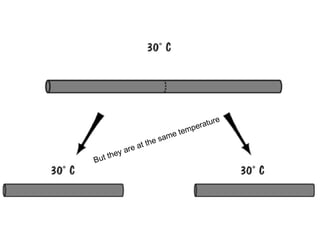
But they are at the same temperature
 
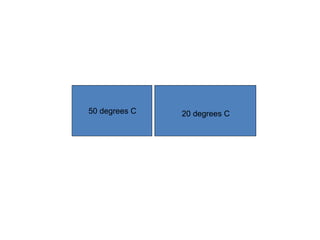
50 degrees C 20 degrees C
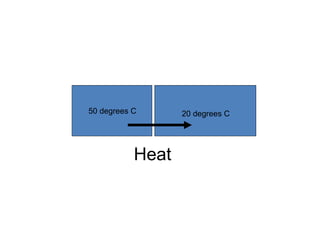
50 degrees C 20 degrees C Heat
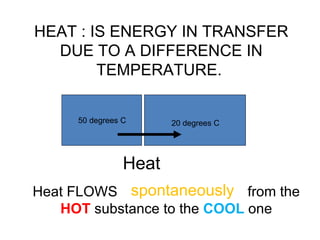
HEAT : IS ENERGY IN TRANSFER DUE TO A DIFFERENCE IN TEMPERATURE.  50 degrees C 20 degrees C Heat Heat FLOWS  from the  HOT  substance to the  COOL  one spontaneously
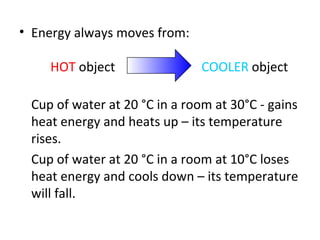
Energy always moves from:   HOT  object  COOLER  object Cup of water at 20  °C in a room at 30°C - gains heat energy and heats up – its temperature rises. Cup of water at 20 °C in a room at 10°C loses heat energy and cools down – its temperature will fall.
The temperature of a substance depends on the speed and mass (KINETIC ENERGY) of the particles of a substance.  Even in a extremely small piece of matter there are millions of millions of millions of particles. These particles are always moving (or vibrating)
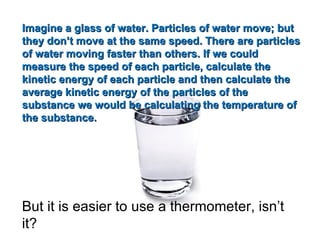
Imagine a glass of water. Particles of water move; but they don’t move at the same speed. There are particles of water moving faster than others. If we could measure the speed of each particle, calculate the kinetic energy of each particle and then calculate the average kinetic energy of the particles of the substance we would be calculating the temperature of the substance. But it is easier to use a thermometer, isn’t it?
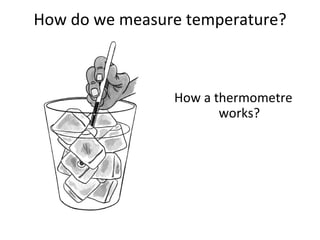
How do we measure temperature? How a thermometre works?
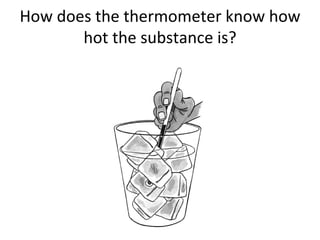
How does the thermometer know how hot the substance is?
The PARTICLES of the substance bump into the thermometer and transfer energy. How often and how hard they bump into the thermometer are directly related to their speed.  Temperature  turns out to be related to the  average speed   of the molecules in a substance.
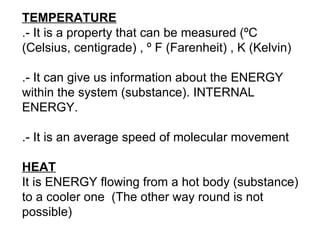
TEMPERATURE .- It is a property that can be measured (ÂşC (Celsius, centigrade) , Âş F (Farenheit) , K (Kelvin) .- It can give us information about the ENERGY within the system (substance). INTERNAL ENERGY. .- It is an average speed of molecular movement HEAT It is ENERGY flowing from a hot body (substance) to a cooler one  (The other way round is not possible)

Kinetic theory 11_12

  • 1.
    PARTICLE THEORY OR KINETIC THEORY OF MATTER HOW TO DEAL WITH THINGS WE DON’T REALLY SEE!!
  • 2.
    OBSERVATION OF MATTER Dealing with the mAcroscopic world
  • 3.
    We can evenhave some magnification
  • 4.
    If we wantto have a more detailed view we need to enter the mIcroscopic world We can see photons, but we can’t see X-rays. And, in the end we have our eyes to see. So, we have to see “indirectly”. We have to make visible what is not
  • 5.
    And seeing “indirectly”means interpreting: “translating” what our eyes can’t see into something our eyes can see and our brain is able to understand. And this can be complicated and, sometimes, a bit confusing
  • 6.
  • 7.
  • 8.
    Remember the definitionI gave you at the very beginning ...
  • 9.
    Definition It isthe study of MATTER, what it is made of, how it behaves, and the changes it is subjected to. It trys to observe phenomena and explain them through laws that can be applied to the world around us.
  • 10.
    How to travelfrom the MACROSCOPIC to the MICROSCOPIC world without getting lost?
  • 11.
    MIXTURES Pure SubstancesMatter surrounds us mainly in the form of mixtures. But we’ll have to do something to obtain : Once we have obtained pure substances out of the mixtures, we can go on studying this type of substance s to classify and characterize them.
  • 12.
    To study MATTER(Mixtures and Pure Substances) we’ll have to construct MODELS. These models always do some simplifications to help us understand how matter is and why it behaves the way it does. The first model we have to consider is : The particle theory (or kinetic theory of matter)
  • 13.
    Particle theory helpsto explain properties and behaviour of materials by providing a model which enables us to visualise what is happening on a very small scale inside those materials. As a model it is useful because it appears to explain many phenomena but as with all models it does have limitations. The model can be used to help explain: 1.- The properties of matter 2.- What happens during physical changes such as melting, boiling and evaporating. 3.- What temperature is. 4.- What pressure of gas in a container is.
  • 14.
    And what doesthis theory say? It says that all matter consists of many, very small particles which are constantly moving. The degree to which the particles move is determined by the amount of energy and the forces of attraction with other particles. The forces between particles are always attractive. The closer the particles, the stronger the force. So, we just have to move in the MICROSCOPIC 1 level !
  • 15.
    This theory explainsthe three states of matter: solid, liquid and gas. Doesn’t it? Yes, but it refers to pure substances in the forms of solid, liquid and gas.
  • 16.
    I know it’sdifficult to try and find pure substances at home !! Even bottled water is not a pure substance (from the microscopic 1 point of view) !!
  • 17.
    Let’s put ourmicroscopic 1 glasses on to see how matter looks like Pure substance: Made out of 1 and only type of particle . The state of aggregation (solid, liquid or gas) will determine the arrangement of the particles
  • 18.
    Mixture: Made outof more than one type of particle . The state of aggregation (solid, liquid or gas) will determine the arrangement of the particles
  • 19.
  • 20.
  • 21.
  • 22.
    ? ? MIXTUREOF TWO GASES PURE SOLID SUBSTANCE
  • 23.
  • 24.
  • 25.
  • 26.
  • 27.
    Remember that itis very important to know the point of view we take. In the MACROSCOPIC level of observation we can’t talk about PARTICLES . PARTICLES ARE WHAT WE SAY MATTER IS MADE OUT OF. AN ENORMOUS SET OF PARTICLES IS WHAT OUR EYES CAN SEE AND OUR HANDS CAN HANDLE. AN INCREDIBLE NUMBER OF PARTICLES OF EACH PURE SUBSTANCE IS WHAT GIVES THIS SUBSTANCE ITS MACROSCOPIC PROPERTIES. THIS MACROSCOPIC PROPERTIES DEPEND ON MANY TYPES OF MICROSCOPIC INTERACTIONS
  • 28.
    Draw this substancefrom the MACROSCOPIC POINT OF VIEW But first you have to know that: Square: is for an olive oil particle Circle: is for a water particle Triangle: is for a salt particle Salt is soluble in water (not in olive oil) Oil and water do not mix
  • 29.
    From the MACROSCOPICPOINT OF VIEW: This piece of matter is a mixture because we are able to see two different substances. We do not see the salt dissolved in water
  • 30.
    Draw this substancesfrom the MACROSCOPIC POINT OF VIEW These two gases are completely mixed, they both are transparent and they are closed in a transparent container This is a yellow substance
  • 31.
    From the MACROSCOPICPOINT OF VIEW: This piece of matter is not a mixture to our eyes because we can only see two one “homogeneous” thing We may know that this is a glass with saltwater, but ...
  • 32.
    A way totell a PURE substance from a MIXTURE (from the macroscopic point of view) is … to measure its properties ONLY PURE SUBSTANCES HAVE FIXED PHYSICAL AND CHEMICAL PROPERTIES.
  • 33.
    PURE WATER SOLIDIFIES AT 0Âş C . WATER WITH SALT DISSOLVED IN IT SOLIDIFIES AT A LOWER TEMPERATURE
  • 34.
    Physical Properties physical property - characteristic of a pure substance that you can observe or measure without changing the identity of the substance. Examples: color, density, melting point, boiling point, heat capacity (?) REMEMBER THAT ONLY PURE SUBSTANCES HAVE FIXED PROPERTIES.
  • 35.
    WATER IS THEPURE SUBSTANCE WITH THIS SET OF PROPERTIES: .- Density : 1g / mL .- Melting point: 0Âş C (at 1 atm)? .- Boiling point: 100 ÂşC at (1 atm)? .- Heat capacity: 4,18 J/ g K .- Refractive index: 1,33
  • 36.
    Melting and boilingpoint are physical properties. Different PURE substance will have different melting and boiling points. The state of aggregation (solid, liquid or gas) of a PURE substance depends on: .- The substance itself. .- The melting and boiling point of the substance. .- The temperature the substance is at. 0ÂşC 100ÂşC M.P. B.P SOLID LIQUID GAS
  • 37.
    -114,1ÂşC 78,5ÂşC M.P.B.P SOLID LIQUID GAS You can repeat this drawing for any substance (provided you know its boiling and melting points). 0ÂşC 100ÂşC
  • 38.
    CONCLUDING: Asubstance is in the solid state if its temperature is lower than its melting point. This substance will be in the liquid state if its temperature is in between its melting and boiling points. And the substance will be in the gas state for temperatures higher than its boiling point.
  • 39.
    Imagine you liveon a planet where only six substances exist: Ammonia, nitrogen, methane, neon, hydrogen and water. In the table below the information of their melting and boiling points can be found. The temperature of the planet is -173 ÂşC. What is the state of each substance at this temperature. SOLID SOLID LIQUID GAS GAS GAS Melting point (Âş C) Boiling point (Âş C) State at -173 Âş C Ammonia -73 -33 Nitrogen -209,8 -194,8 Methane -184 -161 Neon -248,5 -245,8 Hydrogen -259 -252,6 Water 0 100
  • 40.
    But, what thestate of each substance is here on planet earth at 15ÂşC??? GAS LIQUID GAS GAS GAS GAS Melting point (Âş C) Boiling point (Âş C) State at 15 Âş C Ammonia -73 -33 Nitrogen -209,8 -194.8 Methane -184 -161 Neon -248,5 -245,8 Hydrogen -259 -252,6 Water 0 100
  • 41.
    AND WE CANLINK THE MICROSCOPIC WITH THE MACROSCOPIC WORLD
  • 42.
    -114,1ÂşC 78,5ÂşC M.P.B.P SOLID LIQUID GAS 0ÂşC 100ÂşC
  • 43.
  • 44.
    Internal energy isrelated to the TOTAL energy within an object. Particles in a substance have many types of energy (kinetic, potential, vibrational, rotational, and many more) Internal energy and temperature are not the same thing, though they are related.
  • 45.
  • 46.
  • 47.
    But they areat the same temperature
  • 48.
  • 49.
    50 degrees C20 degrees C
  • 50.
    50 degrees C20 degrees C Heat
  • 51.
    HEAT : ISENERGY IN TRANSFER DUE TO A DIFFERENCE IN TEMPERATURE. 50 degrees C 20 degrees C Heat Heat FLOWS from the HOT substance to the COOL one spontaneously
  • 52.
    Energy always movesfrom: HOT object COOLER object Cup of water at 20 °C in a room at 30°C - gains heat energy and heats up – its temperature rises. Cup of water at 20 °C in a room at 10°C loses heat energy and cools down – its temperature will fall.
  • 53.
    The temperature ofa substance depends on the speed and mass (KINETIC ENERGY) of the particles of a substance. Even in a extremely small piece of matter there are millions of millions of millions of particles. These particles are always moving (or vibrating)
  • 54.
    Imagine a glassof water. Particles of water move; but they don’t move at the same speed. There are particles of water moving faster than others. If we could measure the speed of each particle, calculate the kinetic energy of each particle and then calculate the average kinetic energy of the particles of the substance we would be calculating the temperature of the substance. But it is easier to use a thermometer, isn’t it?
  • 55.
    How do wemeasure temperature? How a thermometre works?
  • 56.
    How does thethermometer know how hot the substance is?
  • 57.
    The PARTICLES ofthe substance bump into the thermometer and transfer energy. How often and how hard they bump into the thermometer are directly related to their speed. Temperature turns out to be related to the average speed of the molecules in a substance.
  • 58.
    TEMPERATURE .- Itis a property that can be measured (ÂşC (Celsius, centigrade) , Âş F (Farenheit) , K (Kelvin) .- It can give us information about the ENERGY within the system (substance). INTERNAL ENERGY. .- It is an average speed of molecular movement HEAT It is ENERGY flowing from a hot body (substance) to a cooler one (The other way round is not possible)