
S.N.Saravanamoorthy Assistant Professor of Physics Devanga Arts College Aruppukottai MATTER
 
All matter, regardless of state, undergoes physical and chemical changes.  These changes can be microscopic or macroscopic.
 
A physical change occurs when the substance changes state but does not change its chemical composition.  For example:  water freezing into ice, cutting a piece of wood into smaller pieces, etc.  The form or appearance has changed, but the properties of that substance are the same (i.e. it has the same melting point, boiling point, chemical composition, etc.)
Melting point Boiling point Vapor pressure Color State of matter Density  Electrical conductivity Solubility Adsorption to a surface Hardness
A chemical change occurs when a substance changes into something new.  This occurs due to heating, chemical reaction, etc.  You can tell a chemical change has occurred if the density, melting point or freezing point of the original substance changes.  Many common signs of a chemical change can be seen (bubbles forming, mass changed, etc).
Reaction with acids Reaction with bases (alkalis) Reaction with oxygen (combustion) Ability to act as oxidizing agent Ability to act as reducing agent Reaction with other elements Decomposition into simpler substances Corrosion Characteristics
Intensive properties such as density, color, and boiling point do not depend on the size of the sample of matter and can be used to identify substances.
Extensive properties such as  mass  and  volume  do depend on the quantity of the sample.
Physical properties are those that we can determine without changing the identity of the substance we are studying.
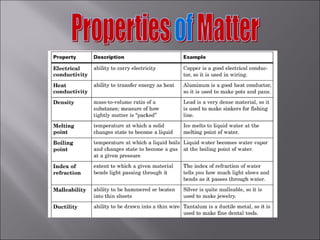
The physical properties of sodium metal can be observed or measured.  It is a soft, lustrous, silver-colored metal with a relatively low melting point and low density.  Hardness, color, melting point and density are all physical properties. Examples of physical properties:
Chemical properties describe the way a substance can change or react to form other substances. These properties, then, must be determined using a process that changes the identity of the substance of interest.
One of the chemical properties of alkali metals such as sodium and potassium is that they react with water. To determine this,  we would have to combine an alkali metal with water and observe what happens. In other words, we have to define chemical properties of a substance by the chemical changes it undergoes. How can chemical properties  be identified?
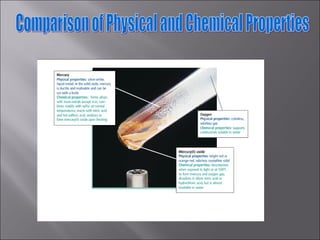
Comparison of Physical and Chemical Properties
What are "substances"? Substances can be identified as either an element, compound, or a mixture.
So, what is a substance? A substance cannot be further broken down or purified by physical means.  A substance is matter of a particular kind.  Each substance has its own characteristic properties that are different from the set of properties of any other substance.
Fixed composition Cannot be separated into simpler substances by physical methods (physical changes) Can only be changed in identity and properties by chemical methods Properties do not vary Characteristics of Pure Substances
Compounds Can be decomposed into simpler substances by chemical changes, always in a definite ratio Elements Cannot be decomposed into simpler substances by chemical changes What is a pure substance?
What is a mixture? Mixtures are two or more substances that are NOT  chemically combined. Mixtures do not:         Have constant boiling points         Have constant melting points
Variable composition Components retain their characteristic properties May be separated into pure substances by physical methods Mixtures of different compositions may have widely different properties Characteristics of Mixtures
Homogenous mixtures look the same throughout but can be separated by physical means (dissolution, centrifuge, gravimetric filtering, etc.).  Examples:  milk, yogurt Homogenous Mixtures
Have the same composition throughout Components are indistinguishable May or may not scatter light Examples:  milk, yogurt, etc. Indicators of Homogenous Mixtures
Solutions are homogenous mixtures that do not scatter light.  These mixtures are created when something is completely dissolved in pure water.  Therefore, they are easily separated by distillation or evaporation. Examples:  sugar water, salt water
Heterogeneous mixtures are composed of large pieces that are easily separated by physical means (ie. density, polarity, metallic properties).  Heterogenous Mixtures
Do not have same composition throughout Components are distinguishable Examples:  fruit salad, vegetable soup, etc.
Law of  Conservation of Matter There is no observable change in the quantity of matter during a chemical reaction or a physical change. In other words, matter cannot be created nor destroyed.  It is just converted from one form to another
Colloids? Colloids are solutions.  They can be described as a substance trapped inside another substance.  They can be identified by their characteristic scattering of light. For example:  air trapped inside the fat molecules in whipped cream.
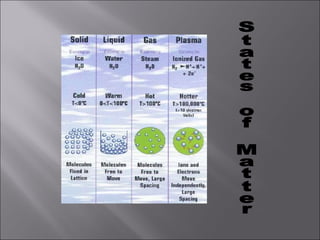
States of Matter Solids Liquids Gases Plasma Others (And how the Kinetic Molecular Theory affects each)
States of Matter
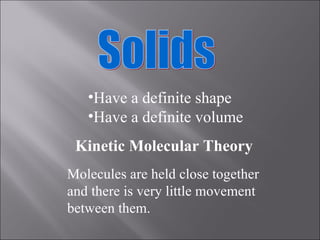
Solids Have a definite shape Have a definite volume Molecules are held close together and there is very little movement between them.  Kinetic Molecular Theory
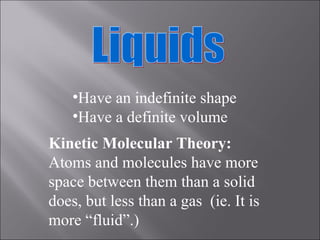
Liquids Have an indefinite shape Have a definite volume Kinetic Molecular Theory: Atoms and molecules have more space between them than a solid does, but less than a gas  (ie. It is more “fluid”.)
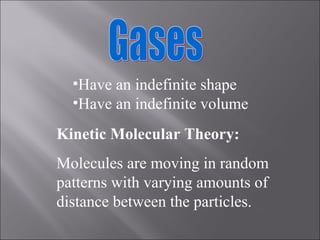
Gases Have an indefinite shape Have an indefinite volume Kinetic Molecular Theory: Molecules are moving in random patterns with varying amounts of distance between the particles.
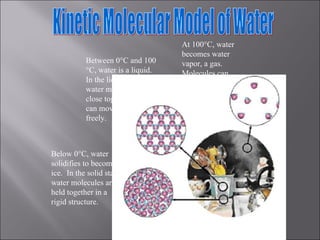
Kinetic Molecular Model of Water  At 100 °C, water becomes water vapor, a gas.  Molecules can move randomly over large distances. Below 0 °C, water solidifies to become ice.  In the solid state, water molecules are held together in a rigid structure. Between 0 °C and 100 °C, water is a liquid.  In the liquid state, water molecules are close together, but can move about freely.
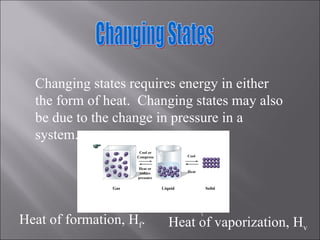
Changing States Changing states requires energy in either the form of heat.  Changing states may also be due to the change in pressure in a system. Heat of formation, H f . Heat of vaporization, H v
Plasma Plasma is by far the most common form of matter. Plasma in the stars and in the tenuous space between them makes up over 99% of the visible universe and perhaps most of that which is not visible.
On earth we live upon an island of "ordinary" matter. The different states of matter generally found on earth are solid, liquid, and gas. We have learned to work, play, and rest using these familiar states of matter. Sir William Crookes, an English physicist, identified a fourth state of matter, now called plasma, in 1879 .
Plasma temperatures and densities range from relatively cool and tenuous (like aurora) to very hot and dense (like the central core of a star). Ordinary solids, liquids, and gases are both electrically neutral and too cool or dense to be in a plasma state.  The word "PLASMA" was first applied to ionized gas by Dr. Irving Langmuir, an American chemist and physicist, in 1929 .
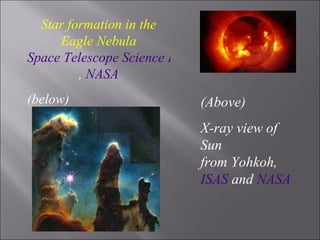
(Above) X-ray view of Sun  from Yohkoh,  ISAS  and  NASA Star formation in the Eagle Nebula Space Telescope Science Institute ,  NASA (below)
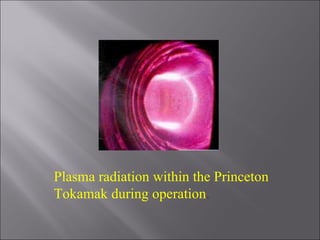
Plasma radiation within the Princeton Tokamak during operation .
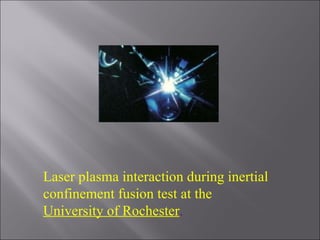
Laser plasma interaction during inertial confinement fusion test at the  University of Rochester .
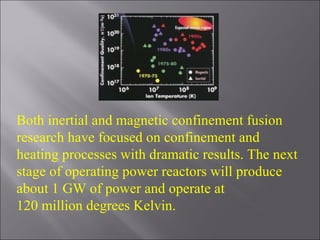
Both inertial and magnetic confinement fusion research have focused on confinement and heating processes with dramatic results. The next stage of operating power reactors will produce about 1 GW of power and operate at  120 million degrees Kelvin.                                                
Plasma consists of a collection of free-moving electrons and ions - atoms that have lost electrons. Energy is needed to strip electrons from atoms to make plasma. The energy can be of various origins: thermal, electrical, or light (ultraviolet light or intense visible light from a laser). With insufficient sustaining power, plasmas recombine into neutral gas.
Plasma can be accelerated and steered by electric and magnetic fields which allows it to be controlled and applied. Plasma research is yielding a greater understanding of the universe. It also provides  many practical uses : new manufacturing techniques, consumer products, and the prospect of abundant energy.
Products manufactured using plasmas impact our daily lives:
EXAMPLES: Computer chips and integrated circuits  Computer hard drives  Electronics  Machine tools  Medical implants and prosthetics  Audio and video tapes  Aircraft and automobile engine parts  Printing on plastic food containers  Energy-efficient window coatings  High-efficiency window coatings  Safe drinking water  Voice and data communications components  Anti-scratch and anti-glare coatings on eyeglasses and other optics
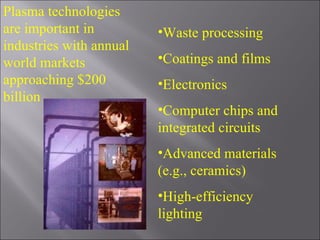
Waste processing  Coatings and films  Electronics  Computer chips and integrated circuits  Advanced materials  (e.g., ceramics)  High-efficiency lighting  Plasma technologies are important in industries with annual world markets approaching $200 billion
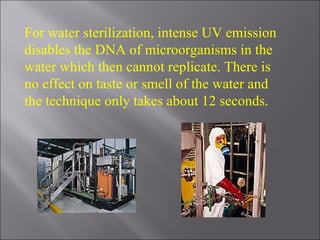
Water Purification Systems Plasma-based sources can emit intense beams of UV & X ray radiation or electron beams for a variety of environmental applications.                              
For water sterilization, intense UV emission disables the DNA of microorganisms in the water which then cannot replicate. There is no effect on taste or smell of the water and the technique only takes about 12 seconds.                     
This plasma-based UV method is effective against all water-born bacteria and viruses. Intense UV water purification systems are especially relevant to the needs of developing countries because they can be made simple to use and have low maintenance, high throughput and low cost .  Plasma-based UV water treatment systems use about 20,000 times less energy than boiling water!
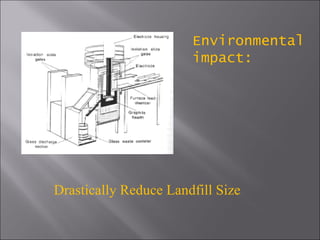
Drastically Reduce Landfill Size Environmental impact:
High-temperature plasmas in arc furnaces can convert, in principle, any combination of materials to a vitrified or glassy substance with separation of molten metal. Substantial recycling is made possible with such furnaces and the highly stable, nonleachable, vitrified material can be used in landfills with essentially no environmental impact.
Electron-beam generated plasma reactors can clean up hazardous chemical waste or enable soil remediation. Such systems are highly efficient and reasonably portable, can treat very low concentrations of toxic substances, and can treat a wide range of substances.  Environmental impact:

Matter

  • 1.
    S.N.Saravanamoorthy Assistant Professorof Physics Devanga Arts College Aruppukottai MATTER
  • 2.
  • 3.
    All matter, regardlessof state, undergoes physical and chemical changes. These changes can be microscopic or macroscopic.
  • 4.
  • 5.
    A physical changeoccurs when the substance changes state but does not change its chemical composition. For example: water freezing into ice, cutting a piece of wood into smaller pieces, etc. The form or appearance has changed, but the properties of that substance are the same (i.e. it has the same melting point, boiling point, chemical composition, etc.)
  • 6.
    Melting point Boilingpoint Vapor pressure Color State of matter Density Electrical conductivity Solubility Adsorption to a surface Hardness
  • 7.
    A chemical changeoccurs when a substance changes into something new. This occurs due to heating, chemical reaction, etc. You can tell a chemical change has occurred if the density, melting point or freezing point of the original substance changes. Many common signs of a chemical change can be seen (bubbles forming, mass changed, etc).
  • 8.
    Reaction with acidsReaction with bases (alkalis) Reaction with oxygen (combustion) Ability to act as oxidizing agent Ability to act as reducing agent Reaction with other elements Decomposition into simpler substances Corrosion Characteristics
  • 9.
    Intensive properties suchas density, color, and boiling point do not depend on the size of the sample of matter and can be used to identify substances.
  • 10.
    Extensive properties suchas mass and volume do depend on the quantity of the sample.
  • 11.
    Physical properties arethose that we can determine without changing the identity of the substance we are studying.
  • 12.
    The physical propertiesof sodium metal can be observed or measured. It is a soft, lustrous, silver-colored metal with a relatively low melting point and low density. Hardness, color, melting point and density are all physical properties. Examples of physical properties:
  • 13.
    Chemical properties describethe way a substance can change or react to form other substances. These properties, then, must be determined using a process that changes the identity of the substance of interest.
  • 14.
    One of thechemical properties of alkali metals such as sodium and potassium is that they react with water. To determine this, we would have to combine an alkali metal with water and observe what happens. In other words, we have to define chemical properties of a substance by the chemical changes it undergoes. How can chemical properties be identified?
  • 15.
    Comparison of Physicaland Chemical Properties
  • 16.
    What are "substances"?Substances can be identified as either an element, compound, or a mixture.
  • 17.
    So, what isa substance? A substance cannot be further broken down or purified by physical means. A substance is matter of a particular kind. Each substance has its own characteristic properties that are different from the set of properties of any other substance.
  • 18.
    Fixed composition Cannotbe separated into simpler substances by physical methods (physical changes) Can only be changed in identity and properties by chemical methods Properties do not vary Characteristics of Pure Substances
  • 19.
    Compounds Can bedecomposed into simpler substances by chemical changes, always in a definite ratio Elements Cannot be decomposed into simpler substances by chemical changes What is a pure substance?
  • 20.
    What is amixture? Mixtures are two or more substances that are NOT chemically combined. Mixtures do not:        Have constant boiling points        Have constant melting points
  • 21.
    Variable composition Componentsretain their characteristic properties May be separated into pure substances by physical methods Mixtures of different compositions may have widely different properties Characteristics of Mixtures
  • 22.
    Homogenous mixtures lookthe same throughout but can be separated by physical means (dissolution, centrifuge, gravimetric filtering, etc.). Examples: milk, yogurt Homogenous Mixtures
  • 23.
    Have the samecomposition throughout Components are indistinguishable May or may not scatter light Examples: milk, yogurt, etc. Indicators of Homogenous Mixtures
  • 24.
    Solutions are homogenousmixtures that do not scatter light. These mixtures are created when something is completely dissolved in pure water. Therefore, they are easily separated by distillation or evaporation. Examples: sugar water, salt water
  • 25.
    Heterogeneous mixtures arecomposed of large pieces that are easily separated by physical means (ie. density, polarity, metallic properties). Heterogenous Mixtures
  • 26.
    Do not havesame composition throughout Components are distinguishable Examples: fruit salad, vegetable soup, etc.
  • 27.
    Law of Conservation of Matter There is no observable change in the quantity of matter during a chemical reaction or a physical change. In other words, matter cannot be created nor destroyed. It is just converted from one form to another
  • 28.
    Colloids? Colloids aresolutions. They can be described as a substance trapped inside another substance. They can be identified by their characteristic scattering of light. For example: air trapped inside the fat molecules in whipped cream.
  • 29.
    States of MatterSolids Liquids Gases Plasma Others (And how the Kinetic Molecular Theory affects each)
  • 30.
  • 31.
    Solids Have adefinite shape Have a definite volume Molecules are held close together and there is very little movement between them. Kinetic Molecular Theory
  • 32.
    Liquids Have anindefinite shape Have a definite volume Kinetic Molecular Theory: Atoms and molecules have more space between them than a solid does, but less than a gas (ie. It is more “fluid”.)
  • 33.
    Gases Have anindefinite shape Have an indefinite volume Kinetic Molecular Theory: Molecules are moving in random patterns with varying amounts of distance between the particles.
  • 34.
    Kinetic Molecular Modelof Water At 100 °C, water becomes water vapor, a gas. Molecules can move randomly over large distances. Below 0 °C, water solidifies to become ice. In the solid state, water molecules are held together in a rigid structure. Between 0 °C and 100 °C, water is a liquid. In the liquid state, water molecules are close together, but can move about freely.
  • 35.
    Changing States Changingstates requires energy in either the form of heat. Changing states may also be due to the change in pressure in a system. Heat of formation, H f . Heat of vaporization, H v
  • 36.
    Plasma Plasma isby far the most common form of matter. Plasma in the stars and in the tenuous space between them makes up over 99% of the visible universe and perhaps most of that which is not visible.
  • 37.
    On earth welive upon an island of "ordinary" matter. The different states of matter generally found on earth are solid, liquid, and gas. We have learned to work, play, and rest using these familiar states of matter. Sir William Crookes, an English physicist, identified a fourth state of matter, now called plasma, in 1879 .
  • 38.
    Plasma temperatures anddensities range from relatively cool and tenuous (like aurora) to very hot and dense (like the central core of a star). Ordinary solids, liquids, and gases are both electrically neutral and too cool or dense to be in a plasma state. The word "PLASMA" was first applied to ionized gas by Dr. Irving Langmuir, an American chemist and physicist, in 1929 .
  • 39.
    (Above) X-ray viewof Sun from Yohkoh, ISAS and NASA Star formation in the Eagle Nebula Space Telescope Science Institute , NASA (below)
  • 40.
    Plasma radiation withinthe Princeton Tokamak during operation .
  • 41.
    Laser plasma interactionduring inertial confinement fusion test at the University of Rochester .
  • 42.
    Both inertial andmagnetic confinement fusion research have focused on confinement and heating processes with dramatic results. The next stage of operating power reactors will produce about 1 GW of power and operate at 120 million degrees Kelvin.                                               
  • 43.
    Plasma consists ofa collection of free-moving electrons and ions - atoms that have lost electrons. Energy is needed to strip electrons from atoms to make plasma. The energy can be of various origins: thermal, electrical, or light (ultraviolet light or intense visible light from a laser). With insufficient sustaining power, plasmas recombine into neutral gas.
  • 44.
    Plasma can beaccelerated and steered by electric and magnetic fields which allows it to be controlled and applied. Plasma research is yielding a greater understanding of the universe. It also provides many practical uses : new manufacturing techniques, consumer products, and the prospect of abundant energy.
  • 45.
    Products manufactured usingplasmas impact our daily lives:
  • 46.
    EXAMPLES: Computer chipsand integrated circuits Computer hard drives Electronics Machine tools Medical implants and prosthetics Audio and video tapes Aircraft and automobile engine parts Printing on plastic food containers Energy-efficient window coatings High-efficiency window coatings Safe drinking water Voice and data communications components Anti-scratch and anti-glare coatings on eyeglasses and other optics
  • 47.
    Waste processing Coatings and films Electronics Computer chips and integrated circuits Advanced materials (e.g., ceramics) High-efficiency lighting Plasma technologies are important in industries with annual world markets approaching $200 billion
  • 48.
    Water Purification SystemsPlasma-based sources can emit intense beams of UV & X ray radiation or electron beams for a variety of environmental applications.                              
  • 49.
    For water sterilization,intense UV emission disables the DNA of microorganisms in the water which then cannot replicate. There is no effect on taste or smell of the water and the technique only takes about 12 seconds.                    
  • 50.
    This plasma-based UVmethod is effective against all water-born bacteria and viruses. Intense UV water purification systems are especially relevant to the needs of developing countries because they can be made simple to use and have low maintenance, high throughput and low cost . Plasma-based UV water treatment systems use about 20,000 times less energy than boiling water!
  • 51.
    Drastically Reduce LandfillSize Environmental impact:
  • 52.
    High-temperature plasmas inarc furnaces can convert, in principle, any combination of materials to a vitrified or glassy substance with separation of molten metal. Substantial recycling is made possible with such furnaces and the highly stable, nonleachable, vitrified material can be used in landfills with essentially no environmental impact.
  • 53.
    Electron-beam generated plasmareactors can clean up hazardous chemical waste or enable soil remediation. Such systems are highly efficient and reasonably portable, can treat very low concentrations of toxic substances, and can treat a wide range of substances. Environmental impact:

Editor's Notes

  • #3 Basic definition of matter.
  • #6 Definition of physical changes.
  • #7 Physical changes are characterized by the following:
  • #8 Definition of chemical change.
  • #9 Chemical Changes are characterized by the following:
  • #18 Definition of a substance.
  • #19 Basic characteristics of pure substance:
  • #20 The two categories of pure chemical substances.
  • #22 Basic identification of a mixture.
  • #24 Brainstorm more examples of homogenous mixtures.
  • #27 Brainstorm more examples of heterogenous mixtures.
  • #28 Definition of Conservation of matter.
  • #29 Brainstorm more ideas of colloids: fog, egg merangue, jello, smoke, etc.