JAIPURIA SCHOOL
eCONTENT PREPARATION
FOR CLASS 9TH
SCIENCE
CHAPTER-: MATTER IN OUR
SURROUNDINGS
BY
ANAND SINGH, PGT CHEMISTRY
MSc. university of Allahabad
LEARNING OUTCOMES AND GOALS
Students will be able to:
1)Discuss the physical nature of mater
2)List out the characteristics of particles of matter
3)Explain the states of matter
4)Identify the shape and volume of solids, liquids
and gases
5)List out the characteristics and properties of
matter
6)Discuss the diffusion states of matter
7)Explain the forces of attraction between the
particles of matter
8)Describe the effect of temperature on matter
1a) Matter:
Matter is anything which occupies
space and has mass.
Examples : Air, Rice. Water. Chair, etc.
Non examples : Feelings like love,
Smell, etc.
b) Classification of matter:
i) Early Indian philosophers classified in the
form of five basic elements as air, earth, fire,
sky and water called Panch Tatva.
ii) On the basis of the physical state matter is
classified as solids, liquids and gases.
iii) On the basis of chemical composition
matter is classified as pure substances and
mixtures.
Pure substances may be elements or
compounds.
Mixtures may be homogeneous mixtures or
heterogeneous mixtures.
2) Physical nature of matter :-
i) Matter is made up of particles.
ii) The particles of matter are very tiny.
iii) The particles of matter have space
between them.
iii) The particles of matter are continuously
moving.
iv) The particles of matter attract each
other.
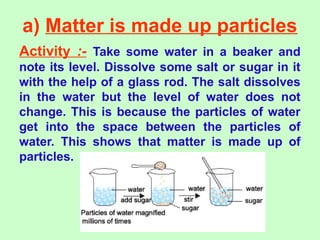
a) Matter is made up particles
Activity :- Take some water in a beaker and
note its level. Dissolve some salt or sugar in it
with the help of a glass rod. The salt dissolves
in the water but the level of water does not
change. This is because the particles of water
get into the space between the particles of
water. This shows that matter is made up of
particles.
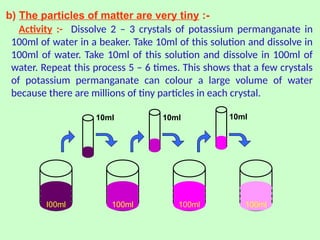
b) The particles of matter are very tiny :-
Activity :- Dissolve 2 – 3 crystals of potassium permanganate in
100ml of water in a beaker. Take 10ml of this solution and dissolve in
100ml of water. Take 10ml of this solution and dissolve in 100ml of
water. Repeat this process 5 – 6 times. This shows that a few crystals
of potassium permanganate can colour a large volume of water
because there are millions of tiny particles in each crystal.
10ml 10ml 10ml
I00ml 100ml 100ml 100ml
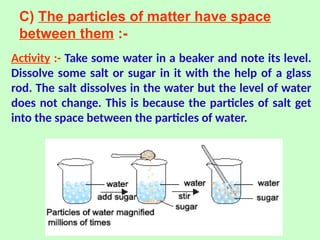
C) The particles of matter have space
between them :-
Activity :- Take some water in a beaker and note its level.
Dissolve some salt or sugar in it with the help of a glass
rod. The salt dissolves in the water but the level of water
does not change. This is because the particles of salt get
into the space between the particles of water.
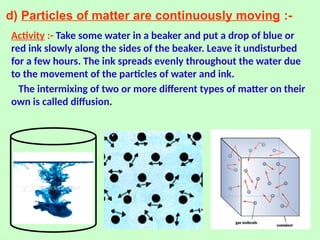
d) Particles of matter are continuously moving :-
Activity :- Take some water in a beaker and put a drop of blue or
red ink slowly along the sides of the beaker. Leave it undisturbed
for a few hours. The ink spreads evenly throughout the water due
to the movement of the particles of water and ink.
The intermixing of two or more different types of matter on their
own is called diffusion.
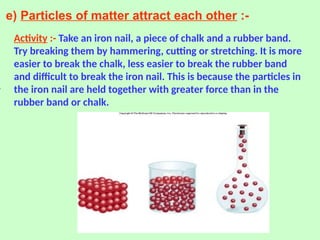
e) Particles of matter attract each other :-
Activity :- Take an iron nail, a piece of chalk and a rubber band.
Try breaking them by hammering, cutting or stretching. It is more
easier to break the chalk, less easier to break the rubber band
and difficult to break the iron nail. This is because the particles in
the iron nail are held together with greater force than in the
rubber band or chalk.
3) States of matter
• Matter exists in three different
states.
They are :-
i) Solid
ii) Liquid
iii) Gas
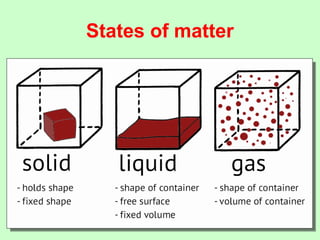
States of matter
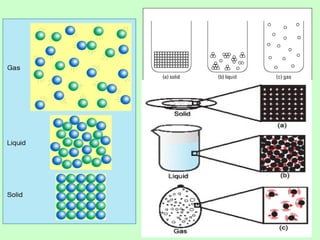
Solid
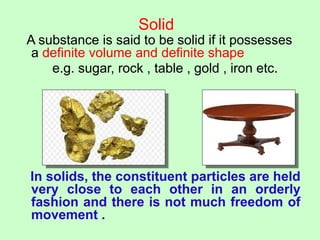
A substance is said to be solid if it possesses
a definite volume and definite shape
e.g. sugar, rock , table , gold , iron etc.
In solids, the constituent particles are held
very close to each other in an orderly
fashion and there is not much freedom of
movement .
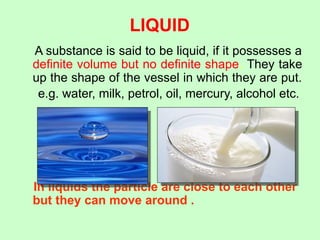
LIQUID
A substance is said to be liquid, if it possesses a
definite volume but no definite shape. They take
up the shape of the vessel in which they are put.
e.g. water, milk, petrol, oil, mercury, alcohol etc.
In liquids the particle are close to each other
but they can move around .
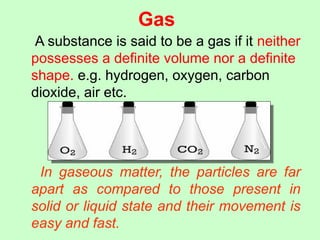
Gas
A substance is said to be a gas if it neither
possesses a definite volume nor a definite
shape. e.g. hydrogen, oxygen, carbon
dioxide, air etc.
In gaseous matter, the particles are far
apart as compared to those present in
solid or liquid state and their movement is
easy and fast.
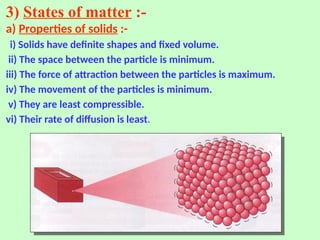
3) States of matter :-
a) Properties of solids :-
i) Solids have definite shapes and fixed volume.
ii) The space between the particle is minimum.
iii) The force of attraction between the particles is maximum.
iv) The movement of the particles is minimum.
v) They are least compressible.
vi) Their rate of diffusion is least.
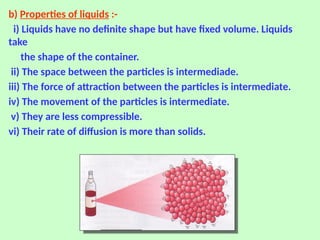
b) Properties of liquids :-
i) Liquids have no definite shape but have fixed volume. Liquids
take
the shape of the container.
ii) The space between the particles is intermediade.
iii) The force of attraction between the particles is intermediate.
iv) The movement of the particles is intermediate.
v) They are less compressible.
vi) Their rate of diffusion is more than solids.
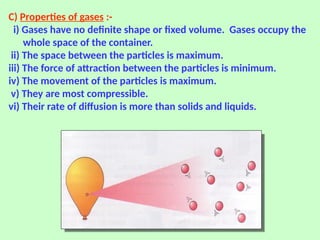
C) Properties of gases :-
i) Gases have no definite shape or fixed volume. Gases occupy the
whole space of the container.
ii) The space between the particles is maximum.
iii) The force of attraction between the particles is minimum.
iv) The movement of the particles is maximum.
v) They are most compressible.
vi) Their rate of diffusion is more than solids and liquids.
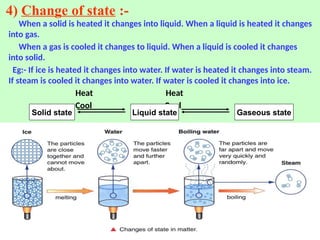
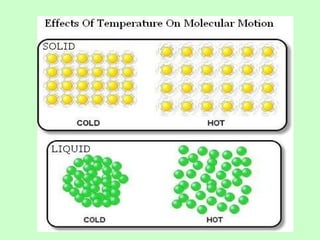
4) Change of state :-
When a solid is heated it changes into liquid. When a liquid is heated it changes
into gas.
When a gas is cooled it changes to liquid. When a liquid is cooled it changes
into solid.
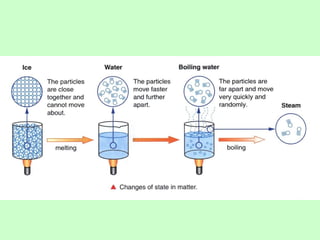
Eg:- If ice is heated it changes into water. If water is heated it changes into steam.
If steam is cooled it changes into water. If water is cooled it changes into ice.
Heat Heat
Cool Cool
Solid state Liquid state Gaseous state
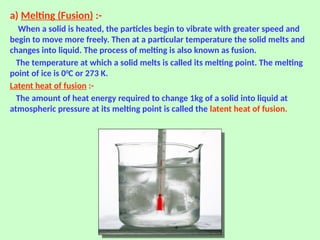
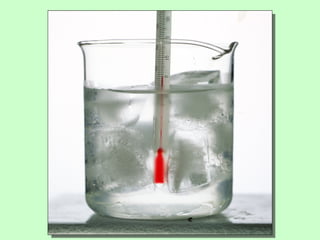
a) Melting (Fusion) :-
When a solid is heated, the particles begin to vibrate with greater speed and
begin to move more freely. Then at a particular temperature the solid melts and
changes into liquid. The process of melting is also known as fusion.
The temperature at which a solid melts is called its melting point. The melting
point of ice is 00
C or 273 K.
Latent heat of fusion :-
The amount of heat energy required to change 1kg of a solid into liquid at
atmospheric pressure at its melting point is called the latent heat of fusion.
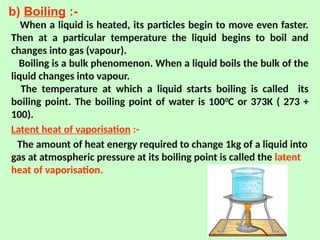
b) Boiling :-
When a liquid is heated, its particles begin to move even faster.
Then at a particular temperature the liquid begins to boil and
changes into gas (vapour).
Boiling is a bulk phenomenon. When a liquid boils the bulk of the
liquid changes into vapour.
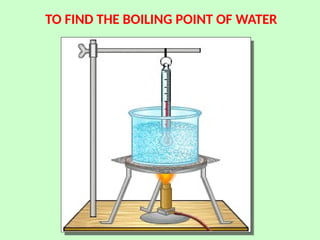
The temperature at which a liquid starts boiling is called its
boiling point. The boiling point of water is 1000
C or 373K ( 273 +
100).
Latent heat of vaporisation :-
The amount of heat energy required to change 1kg of a liquid into
gas at atmospheric pressure at its boiling point is called the latent
heat of vaporisation.
TO FIND THE BOILING POINT OF WATER
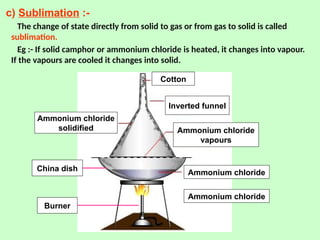
c) Sublimation :-
The change of state directly from solid to gas or from gas to solid is called
sublimation.
Eg :- If solid camphor or ammonium chloride is heated, it changes into vapour.
If the vapours are cooled it changes into solid.
Ammonium chloride
Ammonium chloride
Ammonium chloride
vapours
Ammonium chloride
solidified
Inverted funnel
Cotton
China dish
Burner
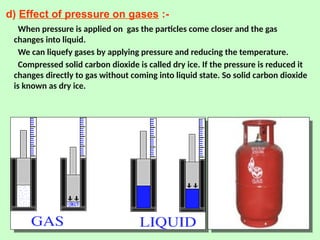
d) Effect of pressure on gases :-
When pressure is applied on gas the particles come closer and the gas
changes into liquid.
We can liquefy gases by applying pressure and reducing the temperature.
Compressed solid carbon dioxide is called dry ice. If the pressure is reduced it
changes directly to gas without coming into liquid state. So solid carbon dioxide
is known as dry ice.
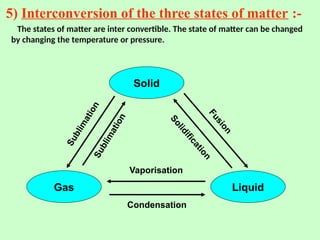
5) Interconversion of the three states of matter :-
The states of matter are inter convertible. The state of matter can be changed
by changing the temperature or pressure.
Solid
Gas Liquid
F
u
s
i
o
n
S
o
l
i
d
i
f
i
c
a
t
i
o
n
S
u
b
l
i
m
a
t
i
o
n
S
u
b
l
i
m
a
t
i
o
n
Vaporisation
Condensation
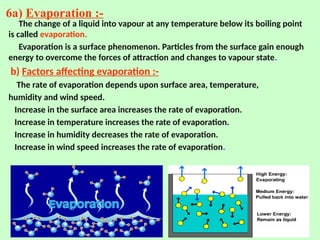
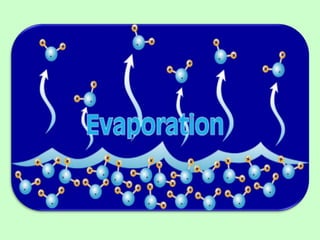
6a) Evaporation :-
The change of a liquid into vapour at any temperature below its boiling point
is called evaporation.
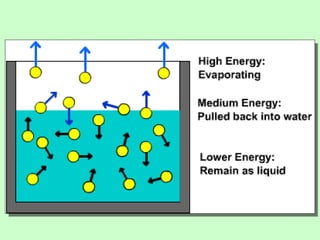
Evaporation is a surface phenomenon. Particles from the surface gain enough
energy to overcome the forces of attraction and changes to vapour state.
b) Factors affecting evaporation :-
The rate of evaporation depends upon surface area, temperature,
humidity and wind speed.
Increase in the surface area increases the rate of evaporation.
Increase in temperature increases the rate of evaporation.
Increase in humidity decreases the rate of evaporation.
Increase in wind speed increases the rate of evaporation.
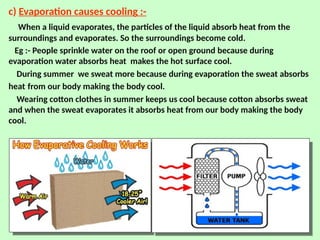
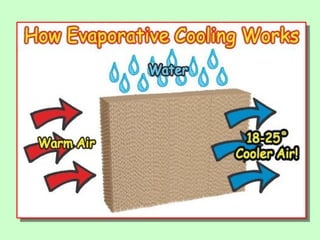
c) Evaporation causes cooling :-
When a liquid evaporates, the particles of the liquid absorb heat from the
surroundings and evaporates. So the surroundings become cold.
Eg :- People sprinkle water on the roof or open ground because during
evaporation water absorbs heat makes the hot surface cool.
During summer we sweat more because during evaporation the sweat absorbs
heat from our body making the body cool.
Wearing cotton clothes in summer keeps us cool because cotton absorbs sweat
and when the sweat evaporates it absorbs heat from our body making the body
cool.
Desert Cooler
THE
END

Matter in Our Surrounding class ninth for

  • 1.
    JAIPURIA SCHOOL eCONTENT PREPARATION FORCLASS 9TH SCIENCE CHAPTER-: MATTER IN OUR SURROUNDINGS BY ANAND SINGH, PGT CHEMISTRY MSc. university of Allahabad
  • 2.
    LEARNING OUTCOMES ANDGOALS Students will be able to: 1)Discuss the physical nature of mater 2)List out the characteristics of particles of matter 3)Explain the states of matter 4)Identify the shape and volume of solids, liquids and gases 5)List out the characteristics and properties of matter 6)Discuss the diffusion states of matter 7)Explain the forces of attraction between the particles of matter 8)Describe the effect of temperature on matter
  • 3.
    1a) Matter: Matter isanything which occupies space and has mass. Examples : Air, Rice. Water. Chair, etc. Non examples : Feelings like love, Smell, etc.
  • 4.
    b) Classification ofmatter: i) Early Indian philosophers classified in the form of five basic elements as air, earth, fire, sky and water called Panch Tatva. ii) On the basis of the physical state matter is classified as solids, liquids and gases. iii) On the basis of chemical composition matter is classified as pure substances and mixtures. Pure substances may be elements or compounds. Mixtures may be homogeneous mixtures or heterogeneous mixtures.
  • 5.
    2) Physical natureof matter :- i) Matter is made up of particles. ii) The particles of matter are very tiny. iii) The particles of matter have space between them. iii) The particles of matter are continuously moving. iv) The particles of matter attract each other.
  • 6.
    a) Matter ismade up particles Activity :- Take some water in a beaker and note its level. Dissolve some salt or sugar in it with the help of a glass rod. The salt dissolves in the water but the level of water does not change. This is because the particles of water get into the space between the particles of water. This shows that matter is made up of particles.
  • 7.
    b) The particlesof matter are very tiny :- Activity :- Dissolve 2 – 3 crystals of potassium permanganate in 100ml of water in a beaker. Take 10ml of this solution and dissolve in 100ml of water. Take 10ml of this solution and dissolve in 100ml of water. Repeat this process 5 – 6 times. This shows that a few crystals of potassium permanganate can colour a large volume of water because there are millions of tiny particles in each crystal. 10ml 10ml 10ml I00ml 100ml 100ml 100ml
  • 8.
    C) The particlesof matter have space between them :- Activity :- Take some water in a beaker and note its level. Dissolve some salt or sugar in it with the help of a glass rod. The salt dissolves in the water but the level of water does not change. This is because the particles of salt get into the space between the particles of water.
  • 9.
    d) Particles ofmatter are continuously moving :- Activity :- Take some water in a beaker and put a drop of blue or red ink slowly along the sides of the beaker. Leave it undisturbed for a few hours. The ink spreads evenly throughout the water due to the movement of the particles of water and ink. The intermixing of two or more different types of matter on their own is called diffusion.
  • 10.
    e) Particles ofmatter attract each other :- Activity :- Take an iron nail, a piece of chalk and a rubber band. Try breaking them by hammering, cutting or stretching. It is more easier to break the chalk, less easier to break the rubber band and difficult to break the iron nail. This is because the particles in the iron nail are held together with greater force than in the rubber band or chalk.
  • 11.
    3) States ofmatter • Matter exists in three different states. They are :- i) Solid ii) Liquid iii) Gas
  • 12.
  • 13.
    Solid A substance issaid to be solid if it possesses a definite volume and definite shape e.g. sugar, rock , table , gold , iron etc. In solids, the constituent particles are held very close to each other in an orderly fashion and there is not much freedom of movement .
  • 14.
    LIQUID A substance issaid to be liquid, if it possesses a definite volume but no definite shape. They take up the shape of the vessel in which they are put. e.g. water, milk, petrol, oil, mercury, alcohol etc. In liquids the particle are close to each other but they can move around .
  • 15.
    Gas A substance issaid to be a gas if it neither possesses a definite volume nor a definite shape. e.g. hydrogen, oxygen, carbon dioxide, air etc. In gaseous matter, the particles are far apart as compared to those present in solid or liquid state and their movement is easy and fast.
  • 16.
    3) States ofmatter :- a) Properties of solids :- i) Solids have definite shapes and fixed volume. ii) The space between the particle is minimum. iii) The force of attraction between the particles is maximum. iv) The movement of the particles is minimum. v) They are least compressible. vi) Their rate of diffusion is least.
  • 17.
    b) Properties ofliquids :- i) Liquids have no definite shape but have fixed volume. Liquids take the shape of the container. ii) The space between the particles is intermediade. iii) The force of attraction between the particles is intermediate. iv) The movement of the particles is intermediate. v) They are less compressible. vi) Their rate of diffusion is more than solids.
  • 18.
    C) Properties ofgases :- i) Gases have no definite shape or fixed volume. Gases occupy the whole space of the container. ii) The space between the particles is maximum. iii) The force of attraction between the particles is minimum. iv) The movement of the particles is maximum. v) They are most compressible. vi) Their rate of diffusion is more than solids and liquids.
  • 20.
    4) Change ofstate :- When a solid is heated it changes into liquid. When a liquid is heated it changes into gas. When a gas is cooled it changes to liquid. When a liquid is cooled it changes into solid. Eg:- If ice is heated it changes into water. If water is heated it changes into steam. If steam is cooled it changes into water. If water is cooled it changes into ice. Heat Heat Cool Cool Solid state Liquid state Gaseous state
  • 22.
    a) Melting (Fusion):- When a solid is heated, the particles begin to vibrate with greater speed and begin to move more freely. Then at a particular temperature the solid melts and changes into liquid. The process of melting is also known as fusion. The temperature at which a solid melts is called its melting point. The melting point of ice is 00 C or 273 K. Latent heat of fusion :- The amount of heat energy required to change 1kg of a solid into liquid at atmospheric pressure at its melting point is called the latent heat of fusion.
  • 24.
    b) Boiling :- Whena liquid is heated, its particles begin to move even faster. Then at a particular temperature the liquid begins to boil and changes into gas (vapour). Boiling is a bulk phenomenon. When a liquid boils the bulk of the liquid changes into vapour. The temperature at which a liquid starts boiling is called its boiling point. The boiling point of water is 1000 C or 373K ( 273 + 100). Latent heat of vaporisation :- The amount of heat energy required to change 1kg of a liquid into gas at atmospheric pressure at its boiling point is called the latent heat of vaporisation.
  • 25.
    TO FIND THEBOILING POINT OF WATER
  • 27.
    c) Sublimation :- Thechange of state directly from solid to gas or from gas to solid is called sublimation. Eg :- If solid camphor or ammonium chloride is heated, it changes into vapour. If the vapours are cooled it changes into solid. Ammonium chloride Ammonium chloride Ammonium chloride vapours Ammonium chloride solidified Inverted funnel Cotton China dish Burner
  • 28.
    d) Effect ofpressure on gases :- When pressure is applied on gas the particles come closer and the gas changes into liquid. We can liquefy gases by applying pressure and reducing the temperature. Compressed solid carbon dioxide is called dry ice. If the pressure is reduced it changes directly to gas without coming into liquid state. So solid carbon dioxide is known as dry ice.
  • 29.
    5) Interconversion ofthe three states of matter :- The states of matter are inter convertible. The state of matter can be changed by changing the temperature or pressure. Solid Gas Liquid F u s i o n S o l i d i f i c a t i o n S u b l i m a t i o n S u b l i m a t i o n Vaporisation Condensation
  • 30.
    6a) Evaporation :- Thechange of a liquid into vapour at any temperature below its boiling point is called evaporation. Evaporation is a surface phenomenon. Particles from the surface gain enough energy to overcome the forces of attraction and changes to vapour state. b) Factors affecting evaporation :- The rate of evaporation depends upon surface area, temperature, humidity and wind speed. Increase in the surface area increases the rate of evaporation. Increase in temperature increases the rate of evaporation. Increase in humidity decreases the rate of evaporation. Increase in wind speed increases the rate of evaporation.
  • 33.
    c) Evaporation causescooling :- When a liquid evaporates, the particles of the liquid absorb heat from the surroundings and evaporates. So the surroundings become cold. Eg :- People sprinkle water on the roof or open ground because during evaporation water absorbs heat makes the hot surface cool. During summer we sweat more because during evaporation the sweat absorbs heat from our body making the body cool. Wearing cotton clothes in summer keeps us cool because cotton absorbs sweat and when the sweat evaporates it absorbs heat from our body making the body cool.
  • 35.
  • 36.