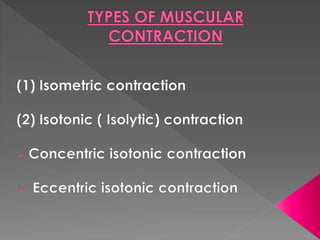
(1) The operator’s force may exactly match the effort of the patient
allowing no movement to occur ( isometric contraction). This
isometric contraction in combination of:
a. RI of antagonist of the muscle being contracted.
b. PIR of agonist of the muscle being contracted.
(2) The operator force may overcome the effort of the patient, thus
moving the area or joint in the direction opposite to that in which
the patient is attempting to move it (isotonic eccentric
contraction, also known as an isolytic contraction).
(3) The effort of the patient is 20% of strength.
(4) The length of time the effort is held 7-10 seconds.
Muscle energy technique

Muscle energy technique

  • 5.
    (1) The operator’sforce may exactly match the effort of the patient allowing no movement to occur ( isometric contraction). This isometric contraction in combination of: a. RI of antagonist of the muscle being contracted. b. PIR of agonist of the muscle being contracted. (2) The operator force may overcome the effort of the patient, thus moving the area or joint in the direction opposite to that in which the patient is attempting to move it (isotonic eccentric contraction, also known as an isolytic contraction). (3) The effort of the patient is 20% of strength. (4) The length of time the effort is held 7-10 seconds.