2-2
1. Describe theusefulness of a
conceptual framework and the
objective of financial reporting.
2. Identify the qualitative
characteristics of accounting
information and the basic
elements of financial
statements.
3. Review the basic
assumptions of accounting.
4. Explain the application of the
basic principles of
accounting.
After studying this chapter, you should be able to:
Conceptual Framework
for Financial Reporting
CHAPTER 2
LEARNING OBJECTIVES
2-4
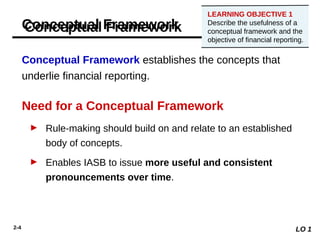
Need for aConceptual Framework
► Rule-making should build on and relate to an established
body of concepts.
► Enables IASB to issue more useful and consistent
pronouncements over time.
Conceptual Framework establishes the concepts that
underlie financial reporting.
LO 1
Conceptual Framework
LEARNING OBJECTIVE 1
Describe the usefulness of a
conceptual framework and the
objective of financial reporting.
5.
2-5
Development of aConceptual Framework
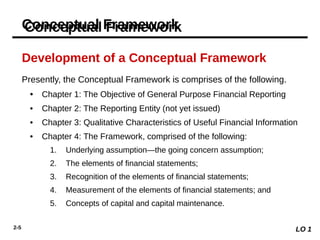
Presently, the Conceptual Framework is comprises of the following.
• Chapter 1: The Objective of General Purpose Financial Reporting
• Chapter 2: The Reporting Entity (not yet issued)
• Chapter 3: Qualitative Characteristics of Useful Financial Information
• Chapter 4: The Framework, comprised of the following:
1. Underlying assumption—the going concern assumption;
2. The elements of financial statements;
3. Recognition of the elements of financial statements;
4. Measurement of the elements of financial statements; and
5. Concepts of capital and capital maintenance.
LO 1
Conceptual Framework
6.
2-6
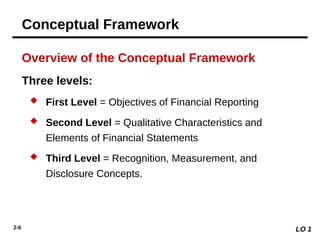
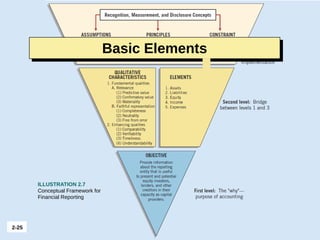
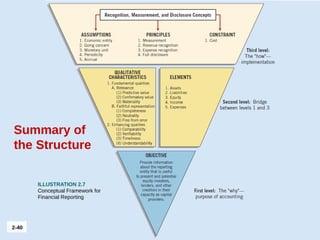
Three levels:
Overview ofthe Conceptual Framework
First Level = Objectives of Financial Reporting
Second Level = Qualitative Characteristics and
Elements of Financial Statements
Third Level = Recognition, Measurement, and
Disclosure Concepts.
LO 1
Conceptual Framework
7.
2-7
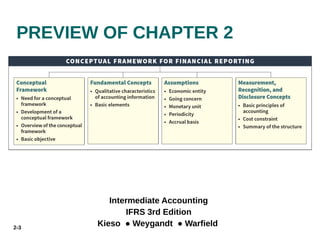
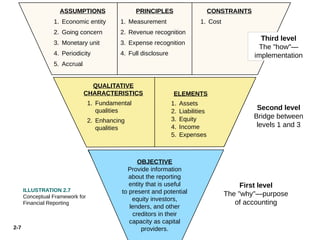
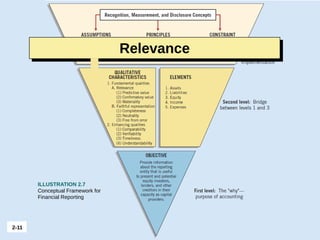
ASSUMPTIONS
1. Economic entity
2.Going concern
3. Monetary unit
4. Periodicity
5. Accrual
PRINCIPLES
1. Measurement
2. Revenue recognition
3. Expense recognition
4. Full disclosure
CONSTRAINTS
1. Cost
OBJECTIVE
Provide information
about the reporting
entity that is useful
to present and potential
equity investors,
lenders, and other
creditors in their
capacity as capital
providers.
ELEMENTS
1. Assets
2. Liabilities
3. Equity
4. Income
5. Expenses
ILLUSTRATION 2.7
Conceptual Framework for
Financial Reporting
First level
The "why"—purpose
of accounting
Second level
Bridge between
levels 1 and 3
Third level
The "how"—
implementation
QUALITATIVE
CHARACTERISTICS
1. Fundamental
qualities
2. Enhancing
qualities
8.
2-8
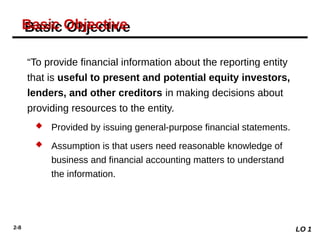
“To provide financialinformation about the reporting entity
that is useful to present and potential equity investors,
lenders, and other creditors in making decisions about
providing resources to the entity.
Provided by issuing general-purpose financial statements.
Assumption is that users need reasonable knowledge of
business and financial accounting matters to understand
the information.
Basic Objective
LO 1
9.
2-9
IASB identified theQualitative Characteristics of
accounting information that distinguish better (more useful)
information from inferior (less useful) information for
decision-making purposes.
Qualitative Characteristics
of Accounting Information
LO 2
Fundamental Concepts
LEARNING OBJECTIVE 2
Identify the qualitative
characteristics of accounting
information and the elements
of financial statements.
2-13
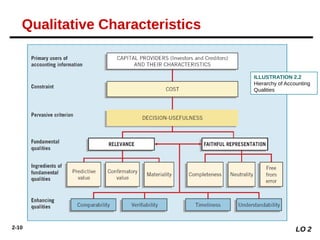
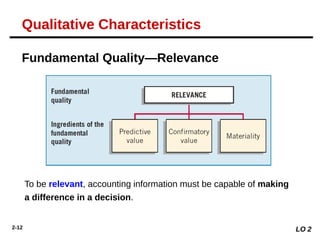
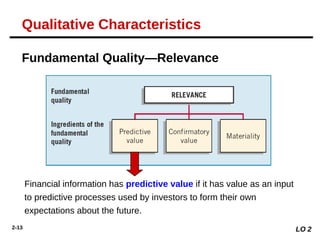
Financial information haspredictive value if it has value as an input
to predictive processes used by investors to form their own
expectations about the future.
Fundamental Quality—Relevance
LO 2
Qualitative Characteristics
14.
2-14
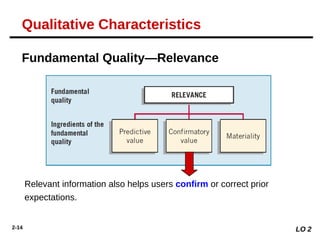
Relevant information alsohelps users confirm or correct prior
expectations.
Fundamental Quality—Relevance
LO 2
Qualitative Characteristics
15.
2-15
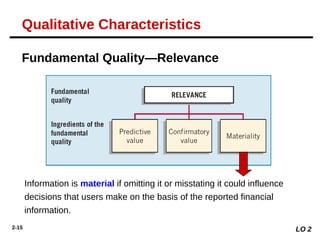
Information is materialif omitting it or misstating it could influence
decisions that users make on the basis of the reported financial
information.
Fundamental Quality—Relevance
LO 2
Qualitative Characteristics
16.
2-16 LO 2
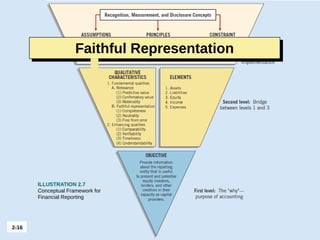
ILLUSTRATION2.7
Conceptual Framework for
Financial Reporting
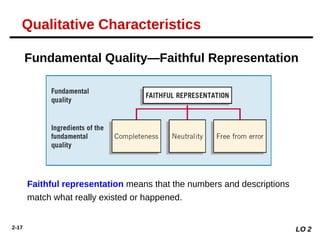
Faithful Representation
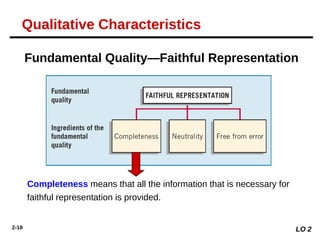
2-18
Completeness means thatall the information that is necessary for
faithful representation is provided.
Fundamental Quality—Faithful Representation
LO 2
Qualitative Characteristics
19.
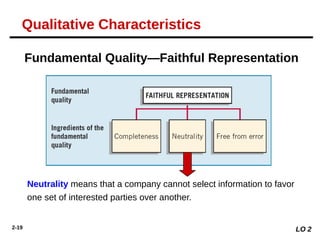
2-19
Neutrality means thata company cannot select information to favor
one set of interested parties over another.
Fundamental Quality—Faithful Representation
LO 2
Qualitative Characteristics
20.
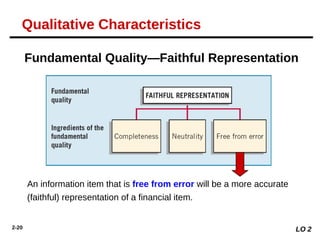
2-20
An information itemthat is free from error will be a more accurate
(faithful) representation of a financial item.
Fundamental Quality—Faithful Representation
LO 2
Qualitative Characteristics
21.
2-21
Enhancing Qualities
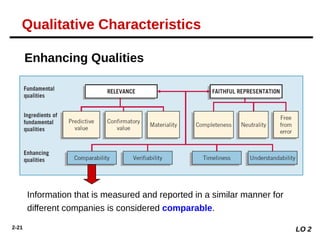
Information thatis measured and reported in a similar manner for
different companies is considered comparable.
LO 2
Qualitative Characteristics
2-23
Enhancing Qualities
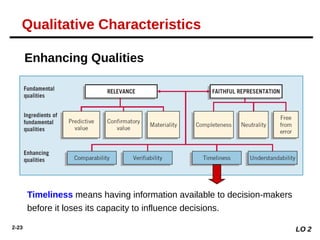
Timeliness meanshaving information available to decision-makers
before it loses its capacity to influence decisions.
LO 2
Qualitative Characteristics
2-26
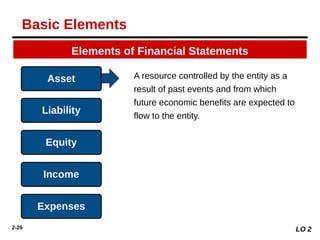
A resource controlledby the entity as a
result of past events and from which
future economic benefits are expected to
flow to the entity.
Elements of Financial Statements
Asset
Liability
Equity
Income
Expenses
LO 2
Basic Elements
27.
2-27
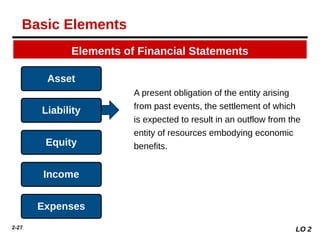
A present obligationof the entity arising
from past events, the settlement of which
is expected to result in an outflow from the
entity of resources embodying economic
benefits.
Elements of Financial Statements
Asset
Liability
Equity
Income
Expenses
LO 2
Basic Elements
28.
2-28
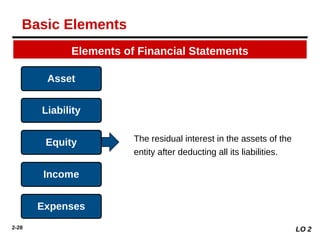
The residual interestin the assets of the
entity after deducting all its liabilities.
Elements of Financial Statements
Asset
Liability
Equity
Income
Expenses
LO 2
Basic Elements
29.
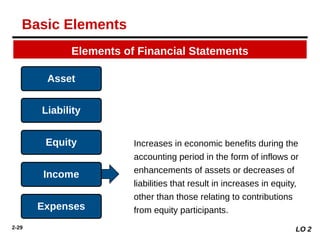
2-29
Increases in economicbenefits during the
accounting period in the form of inflows or
enhancements of assets or decreases of
liabilities that result in increases in equity,
other than those relating to contributions
from equity participants.
Elements of Financial Statements
Asset
Liability
Equity
Income
Expenses
LO 2
Basic Elements
30.
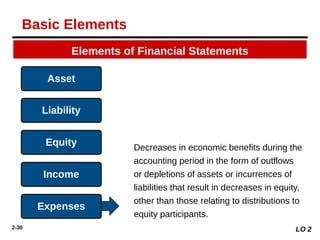
2-30
Decreases in economicbenefits during the
accounting period in the form of outflows
or depletions of assets or incurrences of
liabilities that result in decreases in equity,
other than those relating to distributions to
equity participants.
Elements of Financial Statements
Asset
Liability
Equity
Income
Expenses
LO 2
Basic Elements
31.
2-31
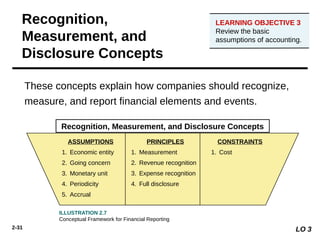
These concepts explainhow companies should recognize,
measure, and report financial elements and events.
ASSUMPTIONS
1. Economic entity
2. Going concern
3. Monetary unit
4. Periodicity
5. Accrual
PRINCIPLES
1. Measurement
2. Revenue recognition
3. Expense recognition
4. Full disclosure
CONSTRAINTS
1. Cost
Recognition, Measurement, and Disclosure Concepts
ILLUSTRATION 2.7
Conceptual Framework for Financial Reporting
LO 3
Recognition,
Measurement, and
Disclosure Concepts
LEARNING OBJECTIVE 3
Review the basic
assumptions of accounting.
32.
2-32
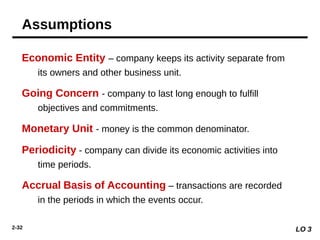
Economic Entity –company keeps its activity separate from
its owners and other business unit.
Going Concern - company to last long enough to fulfill
objectives and commitments.
Monetary Unit - money is the common denominator.
Periodicity - company can divide its economic activities into
time periods.
Accrual Basis of Accounting – transactions are recorded
in the periods in which the events occur.
LO 3
Assumptions
33.
2-33
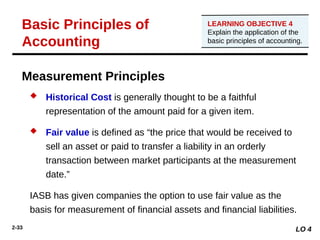
Measurement Principles
HistoricalCost is generally thought to be a faithful
representation of the amount paid for a given item.
Fair value is defined as “the price that would be received to
sell an asset or paid to transfer a liability in an orderly
transaction between market participants at the measurement
date.”
IASB has given companies the option to use fair value as the
basis for measurement of financial assets and financial liabilities.
LO 4
Basic Principles of
Accounting
LEARNING OBJECTIVE 4
Explain the application of the
basic principles of accounting.
34.
2-34
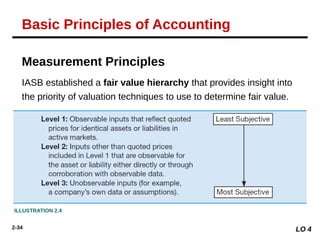
Measurement Principles
IASB establisheda fair value hierarchy that provides insight into
the priority of valuation techniques to use to determine fair value.
ILLUSTRATION 2.4
LO 4
Basic Principles of Accounting
35.
2-35
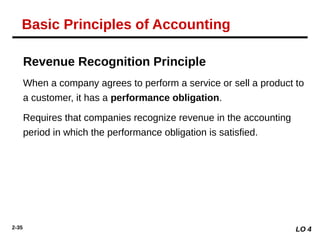
Revenue Recognition Principle
Whena company agrees to perform a service or sell a product to
a customer, it has a performance obligation.
Requires that companies recognize revenue in the accounting
period in which the performance obligation is satisfied.
LO 4
Basic Principles of Accounting
36.
2-36
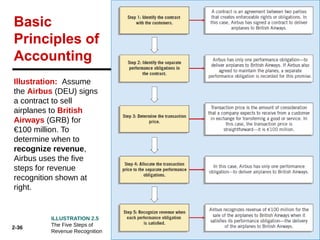
ILLUSTRATION 2.5
The FiveSteps of
Revenue Recognition
Basic
Principles of
Accounting
Illustration: Assume
the Airbus (DEU) signs
a contract to sell
airplanes to British
Airways (GRB) for
€100 million. To
determine when to
recognize revenue,
Airbus uses the five
steps for revenue
recognition shown at
right.
37.
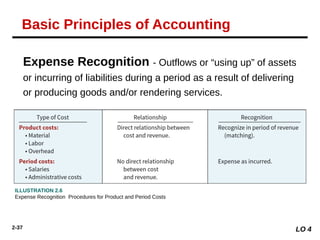
2-37
Expense Recognition -Outflows or “using up” of assets
or incurring of liabilities during a period as a result of delivering
or producing goods and/or rendering services.
ILLUSTRATION 2.6
Expense Recognition Procedures for Product and Period Costs
LO 4
Basic Principles of Accounting
38.
2-38
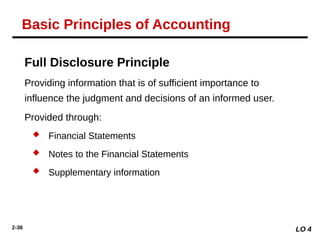
Full Disclosure Principle
Providinginformation that is of sufficient importance to
influence the judgment and decisions of an informed user.
Provided through:
Financial Statements
Notes to the Financial Statements
Supplementary information
LO 4
Basic Principles of Accounting
39.
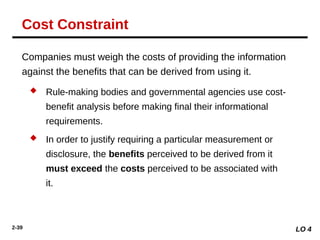
2-39
Companies must weighthe costs of providing the information
against the benefits that can be derived from using it.
Rule-making bodies and governmental agencies use cost-
benefit analysis before making final their informational
requirements.
In order to justify requiring a particular measurement or
disclosure, the benefits perceived to be derived from it
must exceed the costs perceived to be associated with
it.
LO 4
Cost Constraint
40.
2-40 LO 2
ILLUSTRATION2.7
Conceptual Framework for
Financial Reporting
Summary of
the Structure
41.
2-41
The IASB andthe FASB originally planned to develop a common conceptual
framework. The Boards converged on two subjects: Objectives of Financial
Reporting and Qualitative Characteristics of Accounting Information. However,
the IASB decided it was important to move forward and complete other parts of
the conceptual framework. The FASB did not join in on this e ort although it
ff
now appears likely it will start soon on adding to and modifying its existing
conceptual framework as well.
GLOBAL ACCOUNTING INSIGHTS
LO 5
LEARNING OBJECTIVE 5
Compare the conceptual frameworks underlying IFRS and U.S. GAAP.
42.
2-42
Relevant Facts
Following arethe key similarities and differences between U.S. GAAP and
IFRS related to the Conceptual Framework for Financial Reporting.
Similarities
• In 2010, the IASB and FASB completed the first phase of a jointly created
conceptual framework. In this first phase, they agreed on the objective of
financial reporting and a common set of desired qualitative characteristics.
These were presented in the Chapter 2 discussion. Note that prior to this
converged phase, the Conceptual Framework gave more emphasis to the
objective of providing information on management’s performance
(stewardship).
GLOBAL ACCOUNTING INSIGHTS
LO 5
43.
2-43
Relevant Facts
Similarities
• Theexisting conceptual frameworks underlying U.S. GAAP and IFRS are
very similar. That is, they are organized in a similar manner (objective,
elements, qualitative characteristics, etc.). There is no real need to change
many aspects of the existing frameworks other than to converge different
ways of discussing essentially the same concepts.
• Both the IASB and FASB have similar measurement principles, based on
historical cost and fair value. In 2011, the Boards issued a converged
standard on fair value measurement so that the definition of fair value,
measurement techniques, and disclosures are the same between U.S.
GAAP and IFRS when fair value is used in financial statements.
GLOBAL ACCOUNTING INSIGHTS
LO 5
44.
2-44
Relevant Facts
Differences
• Althoughboth U.S. GAAP and IFRS are increasing the use of fair value to
report assets, at this point IFRS has adopted it more broadly. As examples,
under IFRS, companies can apply fair value to property, plant, and
equipment; natural resources; and, in some cases, intangible assets.
• U.S. GAAP has a concept statement to guide estimation of fair values when
market-related data is not available (Statement of Financial Accounting
Concepts No. 7, “Using Cash Flow Information and Present Value in
Accounting”). The IASB has not issued a similar concept statement; it has
issued a fair value standard (IFRS 13) that is converged with U.S. GAAP.
GLOBAL ACCOUNTING INSIGHTS
LO 5
45.
2-45
Relevant Facts
Differences
• Themonetary unit assumption is part of each framework. However, the unit
of measure will vary depending on the currency used in the country in which
the company is incorporated (e.g., Chinese yuan, Japanese yen, and British
pound).
• The economic entity assumption is also part of each framework although
some cultural differences result in differences in its application. For
example, in Japan many companies have formed alliances that are so
strong that they act similar to related corporate divisions although they are
not actually part of the same company.
GLOBAL ACCOUNTING INSIGHTS
LO 5
46.
2-46
About The Numbers
Whilethe conceptual framework that underlies U.S. GAAP is very similar to that
used to develop IFRS, the elements identified and their definitions under U.S.
GAAP are different.
GLOBAL ACCOUNTING INSIGHTS
LO 5
47.
2-47
On the Horizon
TheIASB and the FASB face a difficult task in attempting to update, modify,
and complete a converged conceptual framework. There are many challenging
issues to overcome. For example, how do we trade off characteristics such as
highly relevant information that is difficult to verify? How do we define control
when we are developing a definition of an asset? Is a liability the future
sacrifice itself or the obligation to make the sacrifice? Should a single
measurement method, such as historical cost or fair value, be used, or does it
depend on whether it is an asset or liability that is being measured? We are
optimistic that the new converged conceptual framework will be a significant
improvement over its predecessors and will lead to standards that will help
financial statement users to make better decisions.
GLOBAL ACCOUNTING INSIGHTS
LO 5
#26 Assets are economic resources that provide a future benefit for a business. Most firms use the following asset accounts:
Cash: money and any medium of exchange including bank account balances, paper currency, coins, certificates of deposit, and checks.
Accounts receivable: a company sells its goods and services and receives a promise for future collection of cash. The agreement to allow customers to pay in the future is informal and usually for a short period of time. The Accounts receivable account holds these amounts.
Notes receivable: a company may receive a note receivable from a customer, who signed the note promising to pay. A note receivable is similar to an account receivable, but a note receivable is more binding because the customer signed the note. Notes receivable usually specify an interest rate.
#27 Assets are economic resources that provide a future benefit for a business. Most firms use the following asset accounts:
Cash: money and any medium of exchange including bank account balances, paper currency, coins, certificates of deposit, and checks.
Accounts receivable: a company sells its goods and services and receives a promise for future collection of cash. The agreement to allow customers to pay in the future is informal and usually for a short period of time. The Accounts receivable account holds these amounts.
Notes receivable: a company may receive a note receivable from a customer, who signed the note promising to pay. A note receivable is similar to an account receivable, but a note receivable is more binding because the customer signed the note. Notes receivable usually specify an interest rate.
#28 Assets are economic resources that provide a future benefit for a business. Most firms use the following asset accounts:
Cash: money and any medium of exchange including bank account balances, paper currency, coins, certificates of deposit, and checks.
Accounts receivable: a company sells its goods and services and receives a promise for future collection of cash. The agreement to allow customers to pay in the future is informal and usually for a short period of time. The Accounts receivable account holds these amounts.
Notes receivable: a company may receive a note receivable from a customer, who signed the note promising to pay. A note receivable is similar to an account receivable, but a note receivable is more binding because the customer signed the note. Notes receivable usually specify an interest rate.
#29 Assets are economic resources that provide a future benefit for a business. Most firms use the following asset accounts:
Cash: money and any medium of exchange including bank account balances, paper currency, coins, certificates of deposit, and checks.
Accounts receivable: a company sells its goods and services and receives a promise for future collection of cash. The agreement to allow customers to pay in the future is informal and usually for a short period of time. The Accounts receivable account holds these amounts.
Notes receivable: a company may receive a note receivable from a customer, who signed the note promising to pay. A note receivable is similar to an account receivable, but a note receivable is more binding because the customer signed the note. Notes receivable usually specify an interest rate.
#30 Assets are economic resources that provide a future benefit for a business. Most firms use the following asset accounts:
Cash: money and any medium of exchange including bank account balances, paper currency, coins, certificates of deposit, and checks.
Accounts receivable: a company sells its goods and services and receives a promise for future collection of cash. The agreement to allow customers to pay in the future is informal and usually for a short period of time. The Accounts receivable account holds these amounts.
Notes receivable: a company may receive a note receivable from a customer, who signed the note promising to pay. A note receivable is similar to an account receivable, but a note receivable is more binding because the customer signed the note. Notes receivable usually specify an interest rate.