Chapter
2-1
Chapter
2-2
C H A P T E R 2
CONCEPTUAL FRAMEWORK FOR
FINANCIAL REPORTING
Intermediate Accounting
IFRS Edition
Kieso, Weygandt, and Warfield
Chapter
2-3
1. Describe the usefulness of a conceptual framework.
2. Describe efforts to construct a conceptual framework.
3. Understand the objective of financial reporting.
4. Identify the qualitative characteristics of accounting information.
5. Define the basic elements of financial statements.
6. Describe the basic assumptions of accounting.
7. Explain the application of the basic principles of accounting.
8. Describe the impact that constraints have on reporting
accounting information.
Learning Objectives
Chapter
2-4
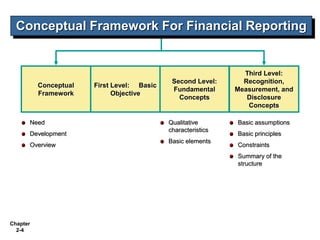
Conceptual
Framework
First Level: Basic
Objective
Second Level:
Fundamental
Concepts
Third Level:
Recognition,
Measurement, and
Disclosure
Concepts
Need
Development
Overview
Qualitative
characteristics
Basic elements
Basic assumptions
Basic principles
Constraints
Summary of the
structure
Conceptual Framework For Financial Reporting
Chapter
2-5
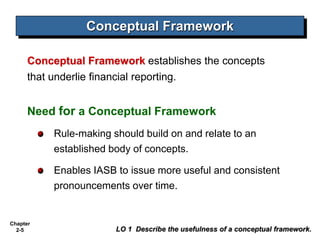
Need for a Conceptual Framework
Rule-making should build on and relate to an
established body of concepts.
Enables IASB to issue more useful and consistent
pronouncements over time.
Conceptual Framework
LO 1 Describe the usefulness of a conceptual framework.
Conceptual Framework establishes the concepts
that underlie financial reporting.
Chapter
2-6
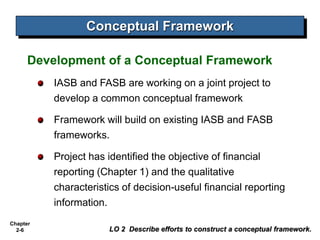
Development of a Conceptual Framework
IASB and FASB are working on a joint project to
develop a common conceptual framework
Framework will build on existing IASB and FASB
frameworks.
Project has identified the objective of financial
reporting (Chapter 1) and the qualitative
characteristics of decision-useful financial reporting
information.
Conceptual Framework
LO 2 Describe efforts to construct a conceptual framework.
Chapter
2-7
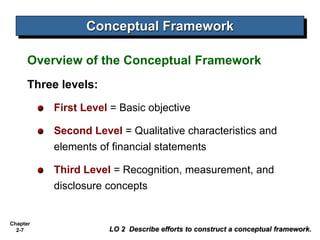
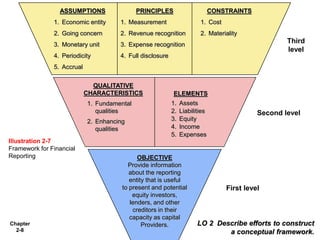
Three levels:
First Level = Basic objective
Second Level = Qualitative characteristics and
elements of financial statements
Third Level = Recognition, measurement, and
disclosure concepts
Conceptual Framework
LO 2 Describe efforts to construct a conceptual framework.
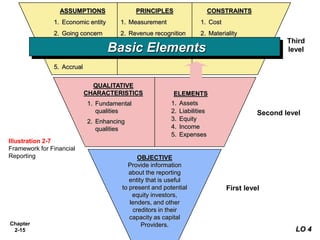
Overview of the Conceptual Framework
Chapter
2-8
LO 2 Describe efforts to construct
a conceptual framework.
ASSUMPTIONS
1. Economic entity
2. Going concern
3. Monetary unit
4. Periodicity
5. Accrual
PRINCIPLES
1. Measurement
2. Revenue recognition
3. Expense recognition
4. Full disclosure
CONSTRAINTS
1. Cost
2. Materiality
OBJECTIVE
Provide information
about the reporting
entity that is useful
to present and potential
equity investors,
lenders, and other
creditors in their
capacity as capital
Providers.
ELEMENTS
1. Assets
2. Liabilities
3. Equity
4. Income
5. Expenses
Illustration 2-7
Framework for Financial
Reporting
First level
Second level
Third
level
QUALITATIVE
CHARACTERISTICS
1. Fundamental
qualities
2. Enhancing
qualities
Chapter
2-9
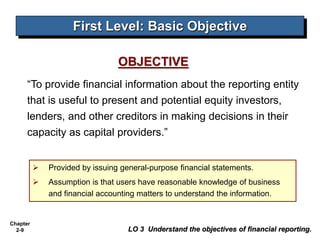
“To provide financial information about the reporting entity
that is useful to present and potential equity investors,
lenders, and other creditors in making decisions in their
capacity as capital providers.”
First Level: Basic Objective
LO 3 Understand the objectives of financial reporting.
OBJECTIVE
 Provided by issuing general-purpose financial statements.
 Assumption is that users have reasonable knowledge of business
and financial accounting matters to understand the information.
Chapter
2-10
IASB identified the Qualitative Characteristics of
accounting information that distinguish better (more
useful) information from inferior (less useful)
information for decision-making purposes.
Second Level: Fundamental Concepts
LO 4 Identify the qualitative characteristics of accounting information.
Qualitative Characteristics of Accounting
Information
Chapter
2-11
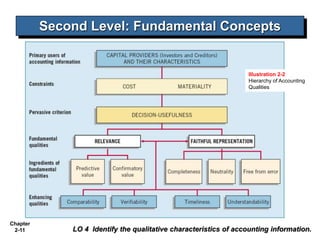
Illustration 2-2
Hierarchy of Accounting
Qualities
Second Level: Fundamental Concepts
LO 4 Identify the qualitative characteristics of accounting information.
Chapter
2-12
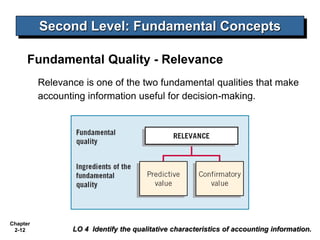
Fundamental Quality - Relevance
Relevance is one of the two fundamental qualities that make
accounting information useful for decision-making.
Second Level: Fundamental Concepts
LO 4 Identify the qualitative characteristics of accounting information.
Chapter
2-13
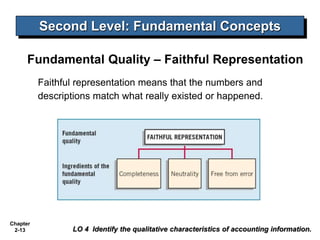
Fundamental Quality – Faithful Representation
Faithful representation means that the numbers and
descriptions match what really existed or happened.
Second Level: Fundamental Concepts
LO 4 Identify the qualitative characteristics of accounting information.
Chapter
2-14
Enhancing Qualities
Distinguish more-useful information from less-useful
information.
Second Level: Fundamental Concepts
LO 4 Identify the qualitative characteristics of accounting information.
Chapter
2-15
ASSUMPTIONS
1. Economic entity
2. Going concern
3. Monetary unit
4. Periodicity
5. Accrual
PRINCIPLES
1. Measurement
2. Revenue recognition
3. Expense recognition
4. Full disclosure
CONSTRAINTS
1. Cost
2. Materiality
OBJECTIVE
Provide information
about the reporting
entity that is useful
to present and potential
equity investors,
lenders, and other
creditors in their
capacity as capital
Providers.
ELEMENTS
1. Assets
2. Liabilities
3. Equity
4. Income
5. Expenses
Illustration 2-7
Framework for Financial
Reporting
First level
Second level
Third
level
QUALITATIVE
CHARACTERISTICS
1. Fundamental
qualities
2. Enhancing
qualities
Basic Elements
LO 4
Chapter
2-16
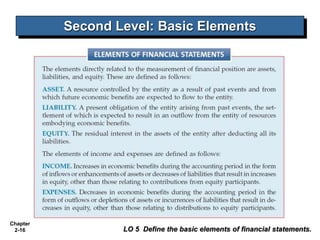
Second Level: Basic Elements
LO 5 Define the basic elements of financial statements.
Chapter
2-17
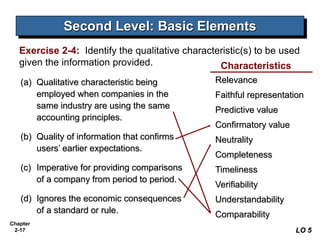
Second Level: Basic Elements
Exercise 2-4: Identify the qualitative characteristic(s) to be used
given the information provided.
(a) Qualitative characteristic being
employed when companies in the
same industry are using the same
accounting principles.
(b) Quality of information that confirms
users’ earlier expectations.
(c) Imperative for providing comparisons
of a company from period to period.
(d) Ignores the economic consequences
of a standard or rule.
LO 5
Characteristics
Relevance
Faithful representation
Predictive value
Confirmatory value
Neutrality
Completeness
Timeliness
Verifiability
Understandability
Comparability
Chapter
2-18
Second Level: Basic Elements
Exercise 2-4: Identify the qualitative characteristic(s) to be used
given the information provided.
(e) Requires a high degree of consensus
among individuals on a given
measurement.
(f) Predictive value is an ingredient of this
fundamental quality of information.
(g) Qualitative characteristics that
enhance both relevance and faithful
representation.
LO 5
Characteristics
Relevance
Faithful representation
Predictive value
Confirmatory value
Neutrality
Completeness
Timeliness
Verifiability
Understandability
Comparability
Chapter
2-19
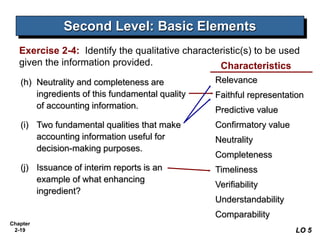
Second Level: Basic Elements
Exercise 2-4: Identify the qualitative characteristic(s) to be used
given the information provided.
(h) Neutrality and completeness are
ingredients of this fundamental quality
of accounting information.
(i) Two fundamental qualities that make
accounting information useful for
decision-making purposes.
(j) Issuance of interim reports is an
example of what enhancing
ingredient?
LO 5
Characteristics
Relevance
Faithful representation
Predictive value
Confirmatory value
Neutrality
Completeness
Timeliness
Verifiability
Understandability
Comparability
Chapter
2-20
Third Level: Recognition, Measurement, and
Disclosure Concepts
These concepts explain how companies should recognize,
measure, and report financial elements and events.
ASSUMPTIONS
1. Economic entity
2. Going concern
3. Monetary unit
4. Periodicity
5. Accrual
PRINCIPLES
1. Measurement
2. Revenue recognition
3. Expense recognition
4. Full disclosure
CONSTRAINTS
1. Cost
2. Materiality
LO 6 Describe the basic assumptions of accounting.
Recognition, Measurement, and Disclosure Concepts
Illustration 2-7
Framework for
Financial Reporting
Chapter
2-21
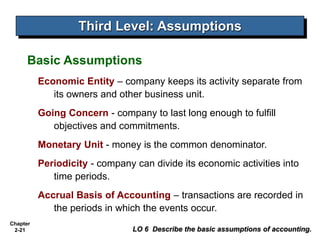
Economic Entity – company keeps its activity separate from
its owners and other business unit.
Going Concern - company to last long enough to fulfill
objectives and commitments.
Monetary Unit - money is the common denominator.
Periodicity - company can divide its economic activities into
time periods.
Accrual Basis of Accounting – transactions are recorded in
the periods in which the events occur.
LO 6 Describe the basic assumptions of accounting.
Third Level: Assumptions
Basic Assumptions
Chapter
2-22
Third Level: Assumptions
LO 6 Describe the basic assumptions of accounting.
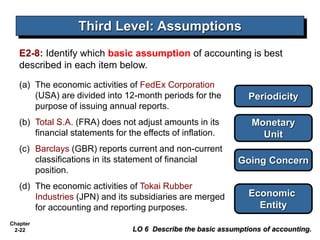
E2-8: Identify which basic assumption of accounting is best
described in each item below.
(a) The economic activities of FedEx Corporation
(USA) are divided into 12-month periods for the
purpose of issuing annual reports.
(b) Total S.A. (FRA) does not adjust amounts in its
financial statements for the effects of inflation.
(c) Barclays (GBR) reports current and non-current
classifications in its statement of financial
position.
(d) The economic activities of Tokai Rubber
Industries (JPN) and its subsidiaries are merged
for accounting and reporting purposes.
Periodicity
Going Concern
Monetary
Unit
Economic
Entity
Chapter
2-23
Measurement
Cost is generally thought to be a faithful representation of the
amount paid for a given item.
Fair value is “the amount for which an asset could be exchanged,
a liability settled, or an equity instrument granted could be
exchanged, between knowledgeable, willing parties in an arm’s
length transaction.”
IASB has taken the step of giving companies the option to use fair
value as the basis for measurement of financial assets and
financial liabilities.
Third Level: Principles
LO 7 Explain the application of the basic principles of accounting.
Principles
Chapter
2-24
Revenue Recognition - revenue is to be recognized when it
is probable that future economic benefits will flow to the company
and reliable measurement of the amount of revenue is possible.
Third Level: Principles
LO 7 Explain the application of the basic principles of accounting.
Illustration 2-3
Timing of Revenue Recognition
Chapter
2-25
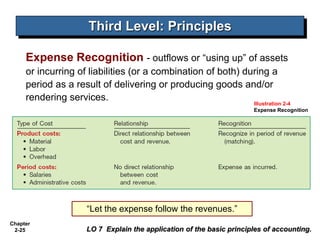
Expense Recognition - outflows or “using up” of assets
or incurring of liabilities (or a combination of both) during a
period as a result of delivering or producing goods and/or
rendering services.
Third Level: Principles
LO 7 Explain the application of the basic principles of accounting.
Illustration 2-4
Expense Recognition
“Let the expense follow the revenues.”
Chapter
2-26
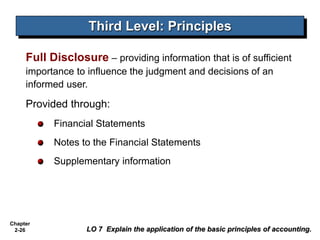
Full Disclosure – providing information that is of sufficient
importance to influence the judgment and decisions of an
informed user.
Provided through:
Financial Statements
Notes to the Financial Statements
Supplementary information
Third Level: Principles
LO 7 Explain the application of the basic principles of accounting.
Chapter
2-27
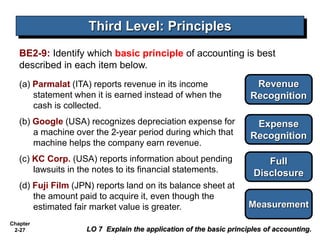
Third Level: Principles
LO 7 Explain the application of the basic principles of accounting.
BE2-9: Identify which basic principle of accounting is best
described in each item below.
(a) Parmalat (ITA) reports revenue in its income
statement when it is earned instead of when the
cash is collected.
(b) Google (USA) recognizes depreciation expense for
a machine over the 2-year period during which that
machine helps the company earn revenue.
(c) KC Corp. (USA) reports information about pending
lawsuits in the notes to its financial statements.
(d) Fuji Film (JPN) reports land on its balance sheet at
the amount paid to acquire it, even though the
estimated fair market value is greater.
Revenue
Recognition
Expense
Recognition
Full
Disclosure
Measurement
Chapter
2-28
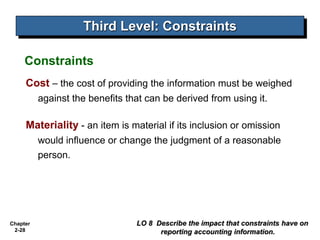
Cost – the cost of providing the information must be weighed
against the benefits that can be derived from using it.
Materiality - an item is material if its inclusion or omission
would influence or change the judgment of a reasonable
person.
Third Level: Constraints
LO 8 Describe the impact that constraints have on
reporting accounting information.
Constraints
Chapter
2-29
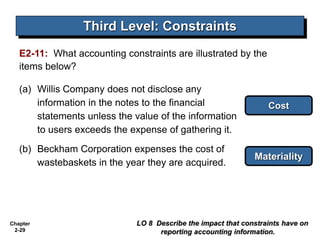
E2-11: What accounting constraints are illustrated by the
items below?
(a) Willis Company does not disclose any
information in the notes to the financial
statements unless the value of the information
to users exceeds the expense of gathering it.
(b) Beckham Corporation expenses the cost of
wastebaskets in the year they are acquired.
Cost
Third Level: Constraints
Materiality
LO 8 Describe the impact that constraints have on
reporting accounting information.
Chapter
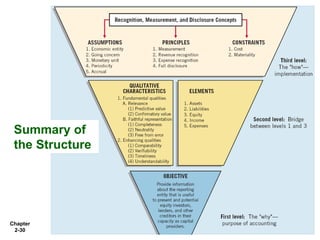
2-30
Summary of
the Structure
Chapter
2-31
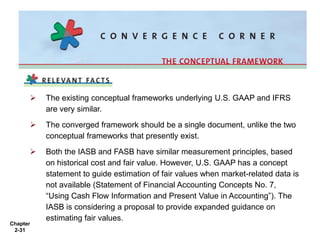
 The existing conceptual frameworks underlying U.S. GAAP and IFRS
are very similar.
 The converged framework should be a single document, unlike the two
conceptual frameworks that presently exist.
 Both the IASB and FASB have similar measurement principles, based
on historical cost and fair value. However, U.S. GAAP has a concept
statement to guide estimation of fair values when market-related data is
not available (Statement of Financial Accounting Concepts No. 7,
“Using Cash Flow Information and Present Value in Accounting”). The
IASB is considering a proposal to provide expanded guidance on
estimating fair values.
Chapter
2-32
Copyright © 2011 John Wiley & Sons, Inc. All rights reserved.
Reproduction or translation of this work beyond that permitted in
Section 117 of the 1976 United States Copyright Act without the
express written permission of the copyright owner is unlawful.
Request for further information should be addressed to the
Permissions Department, John Wiley & Sons, Inc. The purchaser
may make back-up copies for his/her own use only and not for
distribution or resale. The Publisher assumes no responsibility for
errors, omissions, or damages, caused by the use of these
programs or from the use of the information contained herein.
Copyright

ch02 - Conceptual Framework for Financial Reporting.ppt

  • 1.
  • 2.
    Chapter 2-2 C H AP T E R 2 CONCEPTUAL FRAMEWORK FOR FINANCIAL REPORTING Intermediate Accounting IFRS Edition Kieso, Weygandt, and Warfield
  • 3.
    Chapter 2-3 1. Describe theusefulness of a conceptual framework. 2. Describe efforts to construct a conceptual framework. 3. Understand the objective of financial reporting. 4. Identify the qualitative characteristics of accounting information. 5. Define the basic elements of financial statements. 6. Describe the basic assumptions of accounting. 7. Explain the application of the basic principles of accounting. 8. Describe the impact that constraints have on reporting accounting information. Learning Objectives
  • 4.
    Chapter 2-4 Conceptual Framework First Level: Basic Objective SecondLevel: Fundamental Concepts Third Level: Recognition, Measurement, and Disclosure Concepts Need Development Overview Qualitative characteristics Basic elements Basic assumptions Basic principles Constraints Summary of the structure Conceptual Framework For Financial Reporting
  • 5.
    Chapter 2-5 Need for aConceptual Framework Rule-making should build on and relate to an established body of concepts. Enables IASB to issue more useful and consistent pronouncements over time. Conceptual Framework LO 1 Describe the usefulness of a conceptual framework. Conceptual Framework establishes the concepts that underlie financial reporting.
  • 6.
    Chapter 2-6 Development of aConceptual Framework IASB and FASB are working on a joint project to develop a common conceptual framework Framework will build on existing IASB and FASB frameworks. Project has identified the objective of financial reporting (Chapter 1) and the qualitative characteristics of decision-useful financial reporting information. Conceptual Framework LO 2 Describe efforts to construct a conceptual framework.
  • 7.
    Chapter 2-7 Three levels: First Level= Basic objective Second Level = Qualitative characteristics and elements of financial statements Third Level = Recognition, measurement, and disclosure concepts Conceptual Framework LO 2 Describe efforts to construct a conceptual framework. Overview of the Conceptual Framework
  • 8.
    Chapter 2-8 LO 2 Describeefforts to construct a conceptual framework. ASSUMPTIONS 1. Economic entity 2. Going concern 3. Monetary unit 4. Periodicity 5. Accrual PRINCIPLES 1. Measurement 2. Revenue recognition 3. Expense recognition 4. Full disclosure CONSTRAINTS 1. Cost 2. Materiality OBJECTIVE Provide information about the reporting entity that is useful to present and potential equity investors, lenders, and other creditors in their capacity as capital Providers. ELEMENTS 1. Assets 2. Liabilities 3. Equity 4. Income 5. Expenses Illustration 2-7 Framework for Financial Reporting First level Second level Third level QUALITATIVE CHARACTERISTICS 1. Fundamental qualities 2. Enhancing qualities
  • 9.
    Chapter 2-9 “To provide financialinformation about the reporting entity that is useful to present and potential equity investors, lenders, and other creditors in making decisions in their capacity as capital providers.” First Level: Basic Objective LO 3 Understand the objectives of financial reporting. OBJECTIVE  Provided by issuing general-purpose financial statements.  Assumption is that users have reasonable knowledge of business and financial accounting matters to understand the information.
  • 10.
    Chapter 2-10 IASB identified theQualitative Characteristics of accounting information that distinguish better (more useful) information from inferior (less useful) information for decision-making purposes. Second Level: Fundamental Concepts LO 4 Identify the qualitative characteristics of accounting information. Qualitative Characteristics of Accounting Information
  • 11.
    Chapter 2-11 Illustration 2-2 Hierarchy ofAccounting Qualities Second Level: Fundamental Concepts LO 4 Identify the qualitative characteristics of accounting information.
  • 12.
    Chapter 2-12 Fundamental Quality -Relevance Relevance is one of the two fundamental qualities that make accounting information useful for decision-making. Second Level: Fundamental Concepts LO 4 Identify the qualitative characteristics of accounting information.
  • 13.
    Chapter 2-13 Fundamental Quality –Faithful Representation Faithful representation means that the numbers and descriptions match what really existed or happened. Second Level: Fundamental Concepts LO 4 Identify the qualitative characteristics of accounting information.
  • 14.
    Chapter 2-14 Enhancing Qualities Distinguish more-usefulinformation from less-useful information. Second Level: Fundamental Concepts LO 4 Identify the qualitative characteristics of accounting information.
  • 15.
    Chapter 2-15 ASSUMPTIONS 1. Economic entity 2.Going concern 3. Monetary unit 4. Periodicity 5. Accrual PRINCIPLES 1. Measurement 2. Revenue recognition 3. Expense recognition 4. Full disclosure CONSTRAINTS 1. Cost 2. Materiality OBJECTIVE Provide information about the reporting entity that is useful to present and potential equity investors, lenders, and other creditors in their capacity as capital Providers. ELEMENTS 1. Assets 2. Liabilities 3. Equity 4. Income 5. Expenses Illustration 2-7 Framework for Financial Reporting First level Second level Third level QUALITATIVE CHARACTERISTICS 1. Fundamental qualities 2. Enhancing qualities Basic Elements LO 4
  • 16.
    Chapter 2-16 Second Level: BasicElements LO 5 Define the basic elements of financial statements.
  • 17.
    Chapter 2-17 Second Level: BasicElements Exercise 2-4: Identify the qualitative characteristic(s) to be used given the information provided. (a) Qualitative characteristic being employed when companies in the same industry are using the same accounting principles. (b) Quality of information that confirms users’ earlier expectations. (c) Imperative for providing comparisons of a company from period to period. (d) Ignores the economic consequences of a standard or rule. LO 5 Characteristics Relevance Faithful representation Predictive value Confirmatory value Neutrality Completeness Timeliness Verifiability Understandability Comparability
  • 18.
    Chapter 2-18 Second Level: BasicElements Exercise 2-4: Identify the qualitative characteristic(s) to be used given the information provided. (e) Requires a high degree of consensus among individuals on a given measurement. (f) Predictive value is an ingredient of this fundamental quality of information. (g) Qualitative characteristics that enhance both relevance and faithful representation. LO 5 Characteristics Relevance Faithful representation Predictive value Confirmatory value Neutrality Completeness Timeliness Verifiability Understandability Comparability
  • 19.
    Chapter 2-19 Second Level: BasicElements Exercise 2-4: Identify the qualitative characteristic(s) to be used given the information provided. (h) Neutrality and completeness are ingredients of this fundamental quality of accounting information. (i) Two fundamental qualities that make accounting information useful for decision-making purposes. (j) Issuance of interim reports is an example of what enhancing ingredient? LO 5 Characteristics Relevance Faithful representation Predictive value Confirmatory value Neutrality Completeness Timeliness Verifiability Understandability Comparability
  • 20.
    Chapter 2-20 Third Level: Recognition,Measurement, and Disclosure Concepts These concepts explain how companies should recognize, measure, and report financial elements and events. ASSUMPTIONS 1. Economic entity 2. Going concern 3. Monetary unit 4. Periodicity 5. Accrual PRINCIPLES 1. Measurement 2. Revenue recognition 3. Expense recognition 4. Full disclosure CONSTRAINTS 1. Cost 2. Materiality LO 6 Describe the basic assumptions of accounting. Recognition, Measurement, and Disclosure Concepts Illustration 2-7 Framework for Financial Reporting
  • 21.
    Chapter 2-21 Economic Entity –company keeps its activity separate from its owners and other business unit. Going Concern - company to last long enough to fulfill objectives and commitments. Monetary Unit - money is the common denominator. Periodicity - company can divide its economic activities into time periods. Accrual Basis of Accounting – transactions are recorded in the periods in which the events occur. LO 6 Describe the basic assumptions of accounting. Third Level: Assumptions Basic Assumptions
  • 22.
    Chapter 2-22 Third Level: Assumptions LO6 Describe the basic assumptions of accounting. E2-8: Identify which basic assumption of accounting is best described in each item below. (a) The economic activities of FedEx Corporation (USA) are divided into 12-month periods for the purpose of issuing annual reports. (b) Total S.A. (FRA) does not adjust amounts in its financial statements for the effects of inflation. (c) Barclays (GBR) reports current and non-current classifications in its statement of financial position. (d) The economic activities of Tokai Rubber Industries (JPN) and its subsidiaries are merged for accounting and reporting purposes. Periodicity Going Concern Monetary Unit Economic Entity
  • 23.
    Chapter 2-23 Measurement Cost is generallythought to be a faithful representation of the amount paid for a given item. Fair value is “the amount for which an asset could be exchanged, a liability settled, or an equity instrument granted could be exchanged, between knowledgeable, willing parties in an arm’s length transaction.” IASB has taken the step of giving companies the option to use fair value as the basis for measurement of financial assets and financial liabilities. Third Level: Principles LO 7 Explain the application of the basic principles of accounting. Principles
  • 24.
    Chapter 2-24 Revenue Recognition -revenue is to be recognized when it is probable that future economic benefits will flow to the company and reliable measurement of the amount of revenue is possible. Third Level: Principles LO 7 Explain the application of the basic principles of accounting. Illustration 2-3 Timing of Revenue Recognition
  • 25.
    Chapter 2-25 Expense Recognition -outflows or “using up” of assets or incurring of liabilities (or a combination of both) during a period as a result of delivering or producing goods and/or rendering services. Third Level: Principles LO 7 Explain the application of the basic principles of accounting. Illustration 2-4 Expense Recognition “Let the expense follow the revenues.”
  • 26.
    Chapter 2-26 Full Disclosure –providing information that is of sufficient importance to influence the judgment and decisions of an informed user. Provided through: Financial Statements Notes to the Financial Statements Supplementary information Third Level: Principles LO 7 Explain the application of the basic principles of accounting.
  • 27.
    Chapter 2-27 Third Level: Principles LO7 Explain the application of the basic principles of accounting. BE2-9: Identify which basic principle of accounting is best described in each item below. (a) Parmalat (ITA) reports revenue in its income statement when it is earned instead of when the cash is collected. (b) Google (USA) recognizes depreciation expense for a machine over the 2-year period during which that machine helps the company earn revenue. (c) KC Corp. (USA) reports information about pending lawsuits in the notes to its financial statements. (d) Fuji Film (JPN) reports land on its balance sheet at the amount paid to acquire it, even though the estimated fair market value is greater. Revenue Recognition Expense Recognition Full Disclosure Measurement
  • 28.
    Chapter 2-28 Cost – thecost of providing the information must be weighed against the benefits that can be derived from using it. Materiality - an item is material if its inclusion or omission would influence or change the judgment of a reasonable person. Third Level: Constraints LO 8 Describe the impact that constraints have on reporting accounting information. Constraints
  • 29.
    Chapter 2-29 E2-11: What accountingconstraints are illustrated by the items below? (a) Willis Company does not disclose any information in the notes to the financial statements unless the value of the information to users exceeds the expense of gathering it. (b) Beckham Corporation expenses the cost of wastebaskets in the year they are acquired. Cost Third Level: Constraints Materiality LO 8 Describe the impact that constraints have on reporting accounting information.
  • 30.
  • 31.
    Chapter 2-31  The existingconceptual frameworks underlying U.S. GAAP and IFRS are very similar.  The converged framework should be a single document, unlike the two conceptual frameworks that presently exist.  Both the IASB and FASB have similar measurement principles, based on historical cost and fair value. However, U.S. GAAP has a concept statement to guide estimation of fair values when market-related data is not available (Statement of Financial Accounting Concepts No. 7, “Using Cash Flow Information and Present Value in Accounting”). The IASB is considering a proposal to provide expanded guidance on estimating fair values.
  • 32.
    Chapter 2-32 Copyright © 2011John Wiley & Sons, Inc. All rights reserved. Reproduction or translation of this work beyond that permitted in Section 117 of the 1976 United States Copyright Act without the express written permission of the copyright owner is unlawful. Request for further information should be addressed to the Permissions Department, John Wiley & Sons, Inc. The purchaser may make back-up copies for his/her own use only and not for distribution or resale. The Publisher assumes no responsibility for errors, omissions, or damages, caused by the use of these programs or from the use of the information contained herein. Copyright