Made & Presented by-
Mayank Maheshwari, Vibhu Ashok, Aslam
Meamuna, Xamin Ali
First Aid Presentation
Nº 1
0
1
0
3
Topics of presentation
0
2
0
4
Healthcare services comprise medical
professionals, organizations, and ancillary health
care workers who provide medical care to those
in need. Healthcare services serve patients,
families, communities, and populations. They
cover an emergency, preventative,
rehabilitative, long-term, hospital,primary,
palliative, and home care. These services are
centered on making health care accessible, high
quality, and patient centered. Many types of
care and providers are necessary in order to
offer successful healthcare services.
What are Healthcare
facilities?
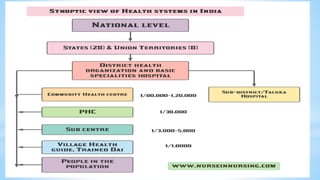
The Healthcare system is organised into primary, secondary, and tertiary levels. At the primary level are Sub
Centres and Primary Health Centres (PHCs). At the secondary level there are Community Health Centres (CHCs)
and smaller Sub-District hospitals. Finally, the top level of public care provided by the government is the tertiary
level, which consists of Medical Colleges and District/General Hospitals.
Sub Centres- A Sub Centre is designed to serve extremely rural areas with the expenses fully covered by the
national government. Mandates require health staff to be at least two workers (male and female) to serve a
population of 5000 people (or 3000 in a remote or hilly areas). Sub Centres also work to educate rural people
about healthy habits for a more long-term impact.
Primary Health Centres- Primary Health Centres exist in more developed rural areas of 30,000 or more (20,000 in
remote areas) and serve as larger health clinics staffed with doctors and paramedics. Patients can be referred
from local sub centres to PHCs for more complex cases. A major difference from Sub Centres is that state
governments fund PHCs, not the national government. PHCs also function to improve health education with a
larger emphasis on preventative measures.
Community Health Centres- A Community Health Centre is also funded by state governments and accepts patients
referred from Primary Health Centres. It serves 120,000 people in urban areas or 80,000 people in remote
areas.Patients from these agencies can be transferred to general hospitals for further treatments. Thus, CHC's are
also first referral units, or FRUs, which are required to have obstetric care, new born/childcare, and blood storage
capacities at all hours everyday of the week.
Types of Health Facilities in India
District Hospitals - District Hospitals are the final referral
centres for the primary and secondary levels of the public health
system. It is expected that at least one hospital is in each district of
India, although in 2010 it was recorded that only 605 hospitals exist
when there are 640 districts.There are normally anywhere between
75 and 500 beds, depending on population demand. These district
hospitals often lack modern equipment and relations with local
blood banks.
Medical colleges and Research Institutes - All India Institutes of
Medical Sciences is owned and controlled by the central
government. These are referral hospitals with specialized facilities.
All India Institutes presently functional are AIMS New Delhi, Bhopal,
AIIMS Bhubaneshwar, AIIMS Jodhpur, AIIMS Raipur, AIIMS Patna
and AIIMS Rishiksh. A Regional Cancer Centre is a cancer care
hospital and research institute controlled jointly by the central and
the respective state governments. Government Medical Colleges
are owned and controlled by the respective state governments and
also function as referral hospitals.
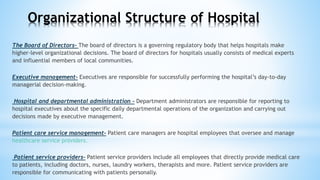
The Board of Directors- The board of directors is a governing regulatory body that helps hospitals make
higher-level organizational decisions. The board of directors for hospitals usually consists of medical experts
and influential members of local communities.
Executive management- Executives are responsible for successfully performing the hospital’s day-to-day
managerial decision-making.
Hospital and departmental administration - Department administrators are responsible for reporting to
hospital executives about the specific daily departmental operations of the organization and carrying out
decisions made by executive management.
Patient care service management- Patient care managers are hospital employees that oversee and manage
healthcare service providers.
Patient service providers- Patient service providers include all employees that directly provide medical care
to patients, including doctors, nurses, laundry workers, therapists and more. Patient service providers are
responsible for communicating with patients personally.
Organizational Structure of Hospital
What is Functional
status of Patient?
Functional status assessment is fundamental to
geriatric care. Function, the ability to manage
daily routines, can not be well-correlated with
medical diagnoses or length of the problem list. A
change in functional status is often the only or the
first sign of illness or exacerbation of a chronic
condition.
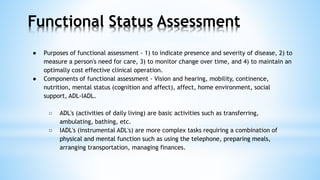
● Purposes of functional assessment - 1) to indicate presence and severity of disease, 2) to
measure a person's need for care, 3) to monitor change over time, and 4) to maintain an
optimally cost effective clinical operation.
● Components of functional assessment - Vision and hearing, mobility, continence,
nutrition, mental status (cognition and affect), affect, home environment, social
support, ADL-IADL.
○ ADL's (activities of daily living) are basic activities such as transferring,
ambulating, bathing, etc.
○ IADL's (instrumental ADL's) are more complex tasks requiring a combination of
physical and mental function such as using the telephone, preparing meals,
arranging transportation, managing finances.
Functional Status Assessment
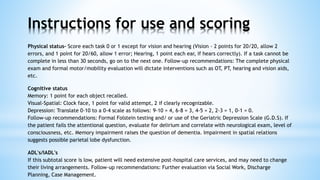
Physical status- Score each task 0 or 1 except for vision and hearing (Vision - 2 points for 20/20, allow 2
errors, and 1 point for 20/60, allow 1 error; Hearing, 1 point each ear, if hears correctly). If a task cannot be
complete in less than 30 seconds, go on to the next one. Follow-up recommendations: The complete physical
exam and formal motor/mobility evaluation will dictate interventions such as OT, PT, hearing and vision aids,
etc.
Cognitive status
Memory: 1 point for each object recalled.
Visual-Spatial: Clock face, 1 point for valid attempt, 2 if clearly recognizable.
Depression: Translate 0-10 to a 0-4 scale as follows: 9-10 = 4, 6-8 = 3, 4-5 = 2, 2-3 = 1, 0-1 = 0.
Follow-up recommendations: Formal Folstein testing and/ or use of the Geriatric Depression Scale (G.D.S). If
the patient fails the attentional question, evaluate for delirium and correlate with neurological exam, level of
consciousness, etc. Memory impairment raises the question of dementia. Impairment in spatial relations
suggests possible parietal lobe dysfunction.
ADL's/IADL's
If this subtotal score is low, patient will need extensive post-hospital care services, and may need to change
their living arrangements. Follow-up recommendations: Further evaluation via Social Work, Discharge
Planning, Case Management.
Instructions for use and scoring
Environmental/Social
These are crucial risk factors. For post-hospital care and preventing readmission, contact Social
Work/Case Management for follow-up.
Conclusions
Total score should be recorded, and any of the four domains with especially poor performance noted.
Consultations or interventions need to be designed and initiated specifically for the individual
patient after thorough evaluation. A score of 30-36 suggests significant functional impairment with
need for further assessment and measures to prevent further decline. For this group it is especially
important to identify home and social support systems. A score of 25 or below indicates that the
patient will likely have a prolonged hospital stay, will use increased inpatient resources and is at high
risk for iatrogenesis. The lower the score, the more likely it is
that nursing home placement will be the outcome of hospitalization unless early interventions are
mobilized to address deficits.
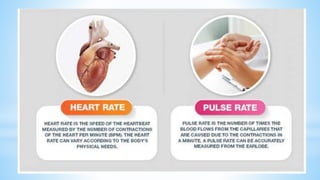
Pulse Rate- A pulse can be felt most easily on the side of the neck, the inside of the wrist (the
radial pulse), and the inside of the elbow—areas where arteries are located close to the
surface of the skin. Using the tips of your first and second fingers (never your thumb), press
firmly but gently on the inside of your wrist until you feel a pulse. Once you’ve located the
pulse, keep an eye on your watch; when the second hand reaches 12, start counting each
throb (pulse) continuously for 60 seconds (until the second hand reaches 12 again).
Alternatively, you can count for 15 seconds and multiply the result by four.
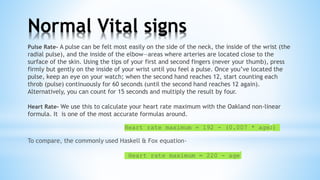
Heart Rate- We use this to calculate your heart rate maximum with the Oakland non-linear
formula. It is one of the most accurate formulas around.
Heart rate maximum = 192 - (0.007 * age2)
To compare, the commonly used Haskell & Fox equation-
Heart rate maximum = 220 - age
Normal Vital signs
Respiration Rate- refers to the number of breaths taken per minute while at rest. It’s one of
the easiest vital signs to measure, as you only need a clock or timer.
To determine your respiration rate, set a timer for one minute and count the number of times
your chest rises and falls until the timer goes off. It may be helpful to enlist a loved one or
care provider to help you measure your respiration, as observing your own breath may cause
you to breathe more slowly than you naturally would, leading to an inaccurate result.
The normal number of breaths per minute for an adult at rest is 12 to 18.
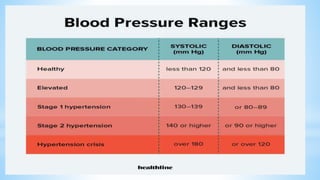
Blood Pressure- Blood pressure refers to the force of blood pushing against the walls of the
arteries every time the heart beats. Blood pressure readings contain two numbers (e.g.,
120/80 millimeters of mercury, or mmHg). The first (top) is the systolic pressure. This is the
highest number, as it is the pressure when the heart contracts. The second (bottom) number
is the diastolic pressure. This is the lowest number, as this is the pressure when the heart
relaxes.
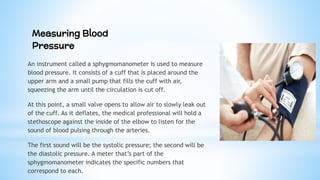
An instrument called a sphygmomanometer is used to measure
blood pressure. It consists of a cuff that is placed around the
upper arm and a small pump that fills the cuff with air,
squeezing the arm until the circulation is cut off.
At this point, a small valve opens to allow air to slowly leak out
of the cuff. As it deflates, the medical professional will hold a
stethoscope against the inside of the elbow to listen for the
sound of blood pulsing through the arteries.
The first sound will be the systolic pressure; the second will be
the diastolic pressure. A meter that’s part of the
sphygmomanometer indicates the specific numbers that
correspond to each.
Measuring Blood
Pressure
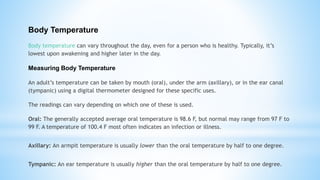
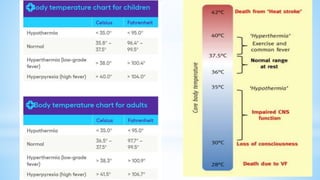
Body Temperature
Body temperature can vary throughout the day, even for a person who is healthy. Typically, it’s
lowest upon awakening and higher later in the day.
Measuring Body Temperature
An adult’s temperature can be taken by mouth (oral), under the arm (axillary), or in the ear canal
(tympanic) using a digital thermometer designed for these specific uses.
The readings can vary depending on which one of these is used.
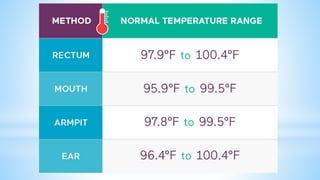
Oral: The generally accepted average oral temperature is 98.6 F, but normal may range from 97 F to
99 F. A temperature of 100.4 F most often indicates an infection or illness.
Axillary: An armpit temperature is usually lower than the oral temperature by half to one degree.
Tympanic: An ear temperature is usually higher than the oral temperature by half to one degree.
Thanks!

Group 1-first aid ppt.pptx

  • 1.
    Made & Presentedby- Mayank Maheshwari, Vibhu Ashok, Aslam Meamuna, Xamin Ali First Aid Presentation Nº 1
  • 2.
  • 3.
    Healthcare services comprisemedical professionals, organizations, and ancillary health care workers who provide medical care to those in need. Healthcare services serve patients, families, communities, and populations. They cover an emergency, preventative, rehabilitative, long-term, hospital,primary, palliative, and home care. These services are centered on making health care accessible, high quality, and patient centered. Many types of care and providers are necessary in order to offer successful healthcare services. What are Healthcare facilities?
  • 4.
    The Healthcare systemis organised into primary, secondary, and tertiary levels. At the primary level are Sub Centres and Primary Health Centres (PHCs). At the secondary level there are Community Health Centres (CHCs) and smaller Sub-District hospitals. Finally, the top level of public care provided by the government is the tertiary level, which consists of Medical Colleges and District/General Hospitals. Sub Centres- A Sub Centre is designed to serve extremely rural areas with the expenses fully covered by the national government. Mandates require health staff to be at least two workers (male and female) to serve a population of 5000 people (or 3000 in a remote or hilly areas). Sub Centres also work to educate rural people about healthy habits for a more long-term impact. Primary Health Centres- Primary Health Centres exist in more developed rural areas of 30,000 or more (20,000 in remote areas) and serve as larger health clinics staffed with doctors and paramedics. Patients can be referred from local sub centres to PHCs for more complex cases. A major difference from Sub Centres is that state governments fund PHCs, not the national government. PHCs also function to improve health education with a larger emphasis on preventative measures. Community Health Centres- A Community Health Centre is also funded by state governments and accepts patients referred from Primary Health Centres. It serves 120,000 people in urban areas or 80,000 people in remote areas.Patients from these agencies can be transferred to general hospitals for further treatments. Thus, CHC's are also first referral units, or FRUs, which are required to have obstetric care, new born/childcare, and blood storage capacities at all hours everyday of the week. Types of Health Facilities in India
  • 5.
    District Hospitals -District Hospitals are the final referral centres for the primary and secondary levels of the public health system. It is expected that at least one hospital is in each district of India, although in 2010 it was recorded that only 605 hospitals exist when there are 640 districts.There are normally anywhere between 75 and 500 beds, depending on population demand. These district hospitals often lack modern equipment and relations with local blood banks. Medical colleges and Research Institutes - All India Institutes of Medical Sciences is owned and controlled by the central government. These are referral hospitals with specialized facilities. All India Institutes presently functional are AIMS New Delhi, Bhopal, AIIMS Bhubaneshwar, AIIMS Jodhpur, AIIMS Raipur, AIIMS Patna and AIIMS Rishiksh. A Regional Cancer Centre is a cancer care hospital and research institute controlled jointly by the central and the respective state governments. Government Medical Colleges are owned and controlled by the respective state governments and also function as referral hospitals.
  • 7.
    The Board ofDirectors- The board of directors is a governing regulatory body that helps hospitals make higher-level organizational decisions. The board of directors for hospitals usually consists of medical experts and influential members of local communities. Executive management- Executives are responsible for successfully performing the hospital’s day-to-day managerial decision-making. Hospital and departmental administration - Department administrators are responsible for reporting to hospital executives about the specific daily departmental operations of the organization and carrying out decisions made by executive management. Patient care service management- Patient care managers are hospital employees that oversee and manage healthcare service providers. Patient service providers- Patient service providers include all employees that directly provide medical care to patients, including doctors, nurses, laundry workers, therapists and more. Patient service providers are responsible for communicating with patients personally. Organizational Structure of Hospital
  • 8.
    What is Functional statusof Patient? Functional status assessment is fundamental to geriatric care. Function, the ability to manage daily routines, can not be well-correlated with medical diagnoses or length of the problem list. A change in functional status is often the only or the first sign of illness or exacerbation of a chronic condition.
  • 9.
    ● Purposes offunctional assessment - 1) to indicate presence and severity of disease, 2) to measure a person's need for care, 3) to monitor change over time, and 4) to maintain an optimally cost effective clinical operation. ● Components of functional assessment - Vision and hearing, mobility, continence, nutrition, mental status (cognition and affect), affect, home environment, social support, ADL-IADL. ○ ADL's (activities of daily living) are basic activities such as transferring, ambulating, bathing, etc. ○ IADL's (instrumental ADL's) are more complex tasks requiring a combination of physical and mental function such as using the telephone, preparing meals, arranging transportation, managing finances. Functional Status Assessment
  • 10.
    Physical status- Scoreeach task 0 or 1 except for vision and hearing (Vision - 2 points for 20/20, allow 2 errors, and 1 point for 20/60, allow 1 error; Hearing, 1 point each ear, if hears correctly). If a task cannot be complete in less than 30 seconds, go on to the next one. Follow-up recommendations: The complete physical exam and formal motor/mobility evaluation will dictate interventions such as OT, PT, hearing and vision aids, etc. Cognitive status Memory: 1 point for each object recalled. Visual-Spatial: Clock face, 1 point for valid attempt, 2 if clearly recognizable. Depression: Translate 0-10 to a 0-4 scale as follows: 9-10 = 4, 6-8 = 3, 4-5 = 2, 2-3 = 1, 0-1 = 0. Follow-up recommendations: Formal Folstein testing and/ or use of the Geriatric Depression Scale (G.D.S). If the patient fails the attentional question, evaluate for delirium and correlate with neurological exam, level of consciousness, etc. Memory impairment raises the question of dementia. Impairment in spatial relations suggests possible parietal lobe dysfunction. ADL's/IADL's If this subtotal score is low, patient will need extensive post-hospital care services, and may need to change their living arrangements. Follow-up recommendations: Further evaluation via Social Work, Discharge Planning, Case Management. Instructions for use and scoring
  • 11.
    Environmental/Social These are crucialrisk factors. For post-hospital care and preventing readmission, contact Social Work/Case Management for follow-up. Conclusions Total score should be recorded, and any of the four domains with especially poor performance noted. Consultations or interventions need to be designed and initiated specifically for the individual patient after thorough evaluation. A score of 30-36 suggests significant functional impairment with need for further assessment and measures to prevent further decline. For this group it is especially important to identify home and social support systems. A score of 25 or below indicates that the patient will likely have a prolonged hospital stay, will use increased inpatient resources and is at high risk for iatrogenesis. The lower the score, the more likely it is that nursing home placement will be the outcome of hospitalization unless early interventions are mobilized to address deficits.
  • 12.
    Pulse Rate- Apulse can be felt most easily on the side of the neck, the inside of the wrist (the radial pulse), and the inside of the elbow—areas where arteries are located close to the surface of the skin. Using the tips of your first and second fingers (never your thumb), press firmly but gently on the inside of your wrist until you feel a pulse. Once you’ve located the pulse, keep an eye on your watch; when the second hand reaches 12, start counting each throb (pulse) continuously for 60 seconds (until the second hand reaches 12 again). Alternatively, you can count for 15 seconds and multiply the result by four. Heart Rate- We use this to calculate your heart rate maximum with the Oakland non-linear formula. It is one of the most accurate formulas around. Heart rate maximum = 192 - (0.007 * age2) To compare, the commonly used Haskell & Fox equation- Heart rate maximum = 220 - age Normal Vital signs
  • 14.
    Respiration Rate- refersto the number of breaths taken per minute while at rest. It’s one of the easiest vital signs to measure, as you only need a clock or timer. To determine your respiration rate, set a timer for one minute and count the number of times your chest rises and falls until the timer goes off. It may be helpful to enlist a loved one or care provider to help you measure your respiration, as observing your own breath may cause you to breathe more slowly than you naturally would, leading to an inaccurate result. The normal number of breaths per minute for an adult at rest is 12 to 18. Blood Pressure- Blood pressure refers to the force of blood pushing against the walls of the arteries every time the heart beats. Blood pressure readings contain two numbers (e.g., 120/80 millimeters of mercury, or mmHg). The first (top) is the systolic pressure. This is the highest number, as it is the pressure when the heart contracts. The second (bottom) number is the diastolic pressure. This is the lowest number, as this is the pressure when the heart relaxes.
  • 15.
    An instrument calleda sphygmomanometer is used to measure blood pressure. It consists of a cuff that is placed around the upper arm and a small pump that fills the cuff with air, squeezing the arm until the circulation is cut off. At this point, a small valve opens to allow air to slowly leak out of the cuff. As it deflates, the medical professional will hold a stethoscope against the inside of the elbow to listen for the sound of blood pulsing through the arteries. The first sound will be the systolic pressure; the second will be the diastolic pressure. A meter that’s part of the sphygmomanometer indicates the specific numbers that correspond to each. Measuring Blood Pressure
  • 17.
    Body Temperature Body temperaturecan vary throughout the day, even for a person who is healthy. Typically, it’s lowest upon awakening and higher later in the day. Measuring Body Temperature An adult’s temperature can be taken by mouth (oral), under the arm (axillary), or in the ear canal (tympanic) using a digital thermometer designed for these specific uses. The readings can vary depending on which one of these is used. Oral: The generally accepted average oral temperature is 98.6 F, but normal may range from 97 F to 99 F. A temperature of 100.4 F most often indicates an infection or illness. Axillary: An armpit temperature is usually lower than the oral temperature by half to one degree. Tympanic: An ear temperature is usually higher than the oral temperature by half to one degree.
  • 20.