Integrated Assessment
in Medical Education
Objectives for this brief session
• Consider integration as a continuum
– from Isolation to Trans-disciplinary holism
• Share personal experience in Integrated
assessment in a hybrid UG curriculum
• Consider various tools for integrated
assessment of competencies especially for
postgraduate residencies
Intro…
– “Learning is by connecting things. If you can not
connect, you can not learn.”
– Lord Chesterton (paraphrased)
• Integration as an educational strategy
• Medical Teachers are polarized (For/Against)
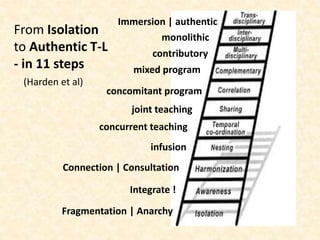
• Ronald Harden described a 11-step ladder
between the two extremes.
From Isolation
to Authentic T-L
- in 11 steps
(Harden et al)
Fragmentation | Anarchy
Connection | Consultation
infusion
concurrent teaching
Integrate !
joint teaching
concomitant program
mixed program
contributory
monolithic
Immersion | authentic
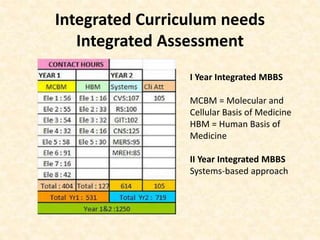
Integrated Curriculum needs
Integrated Assessment
I Year Integrated MBBS
MCBM = Molecular and
Cellular Basis of Medicine
HBM = Human Basis of
Medicine
II Year Integrated MBBS
Systems-based approach
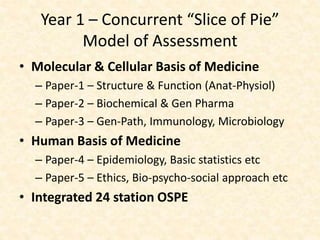
Year 1 – Concurrent “Slice of Pie”
Model of Assessment
• Molecular & Cellular Basis of Medicine
– Paper-1 – Structure & Function (Anat-Physiol)
– Paper-2 – Biochemical & Gen Pharma
– Paper-3 – Gen-Path, Immunology, Microbiology
• Human Basis of Medicine
– Paper-4 – Epidemiology, Basic statistics etc
– Paper-5 – Ethics, Bio-psycho-social approach etc
• Integrated 24 station OSPE
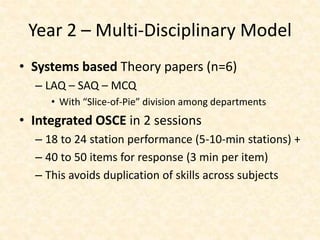
Year 2 – Multi-Disciplinary Model
• Systems based Theory papers (n=6)
– LAQ – SAQ – MCQ
• With “Slice-of-Pie” division among departments
• Integrated OSCE in 2 sessions
– 18 to 24 station performance (5-10-min stations) +
– 40 to 50 items for response (3 min per item)
– This avoids duplication of skills across subjects
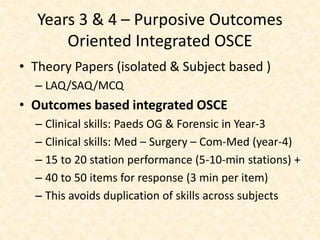
Years 3 & 4 – Purposive Outcomes
Oriented Integrated OSCE
• Theory Papers (isolated & Subject based )
– LAQ/SAQ/MCQ
• Outcomes based integrated OSCE
– Clinical skills: Paeds OG & Forensic in Year-3
– Clinical skills: Med – Surgery – Com-Med (year-4)
– 15 to 20 station performance (5-10-min stations) +
– 40 to 50 items for response (3 min per item)
– This avoids duplication of skills across subjects
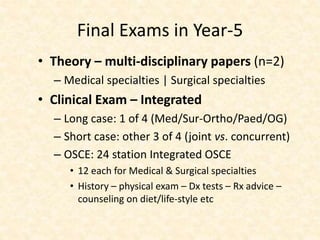
Final Exams in Year-5
• Theory – multi-disciplinary papers (n=2)
– Medical specialties | Surgical specialties
• Clinical Exam – Integrated
– Long case: 1 of 4 (Med/Sur-Ortho/Paed/OG)
– Short case: other 3 of 4 (joint vs. concurrent)
– OSCE: 24 station Integrated OSCE
• 12 each for Medical & Surgical specialties
• History – physical exam – Dx tests – Rx advice –
counseling on diet/life-style etc
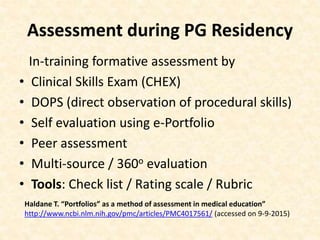
Assessment during PG Residency
In-training formative assessment by
• Clinical Skills Exam (CHEX)
• DOPS (direct observation of procedural skills)
• Self evaluation using e-Portfolio
• Peer assessment
• Multi-source / 360o evaluation
• Tools: Check list / Rating scale / Rubric
Haldane T. “Portfolios” as a method of assessment in medical education”
http://www.ncbi.nlm.nih.gov/pmc/articles/PMC4017561/ (accessed on 9-9-2015)
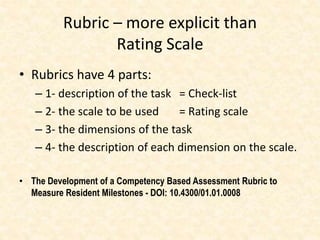
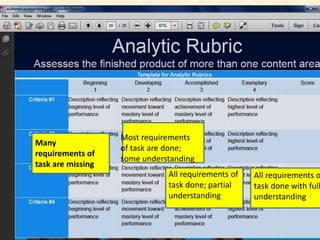
Rubric – more explicit than
Rating Scale
• Rubrics have 4 parts:
– 1- description of the task = Check-list
– 2- the scale to be used = Rating scale
– 3- the dimensions of the task
– 4- the description of each dimension on the scale.
• The Development of a Competency Based Assessment Rubric to
Measure Resident Milestones - DOI: 10.4300/01.01.0008
Many
requirements of
task are missing
All requirements of
task done; partial
understanding
All requirements o
task done with full
understanding
Most requirements
of task are done;
some understanding
Rubrics for Outcomes
1. Measure outcomes based on real-life criteria
2. Specify graded performance indicators
3. Permit assessment of outcome level achieved
in a specific competency
4. Ensure coherent and consistent assessment
5. Improve the quality of assessment
6. A collage of rubrics may permit integrated
assessment of professional behaviour
Be a Trail-blazer
• One more trail to blaze:
• Making rubrics for effective assessment of
specialty training to suit your training objectives
• Will you do it soon to enhance the quality of
assessment ?
• Strive for Success – Best wishes…

Integrated assessment in medical education

  • 1.
  • 2.
    Objectives for thisbrief session • Consider integration as a continuum – from Isolation to Trans-disciplinary holism • Share personal experience in Integrated assessment in a hybrid UG curriculum • Consider various tools for integrated assessment of competencies especially for postgraduate residencies
  • 3.
    Intro… – “Learning isby connecting things. If you can not connect, you can not learn.” – Lord Chesterton (paraphrased) • Integration as an educational strategy • Medical Teachers are polarized (For/Against) • Ronald Harden described a 11-step ladder between the two extremes.
  • 4.
    From Isolation to AuthenticT-L - in 11 steps (Harden et al) Fragmentation | Anarchy Connection | Consultation infusion concurrent teaching Integrate ! joint teaching concomitant program mixed program contributory monolithic Immersion | authentic
  • 5.
    Integrated Curriculum needs IntegratedAssessment I Year Integrated MBBS MCBM = Molecular and Cellular Basis of Medicine HBM = Human Basis of Medicine II Year Integrated MBBS Systems-based approach
  • 6.
    Year 1 –Concurrent “Slice of Pie” Model of Assessment • Molecular & Cellular Basis of Medicine – Paper-1 – Structure & Function (Anat-Physiol) – Paper-2 – Biochemical & Gen Pharma – Paper-3 – Gen-Path, Immunology, Microbiology • Human Basis of Medicine – Paper-4 – Epidemiology, Basic statistics etc – Paper-5 – Ethics, Bio-psycho-social approach etc • Integrated 24 station OSPE
  • 7.
    Year 2 –Multi-Disciplinary Model • Systems based Theory papers (n=6) – LAQ – SAQ – MCQ • With “Slice-of-Pie” division among departments • Integrated OSCE in 2 sessions – 18 to 24 station performance (5-10-min stations) + – 40 to 50 items for response (3 min per item) – This avoids duplication of skills across subjects
  • 8.
    Years 3 &4 – Purposive Outcomes Oriented Integrated OSCE • Theory Papers (isolated & Subject based ) – LAQ/SAQ/MCQ • Outcomes based integrated OSCE – Clinical skills: Paeds OG & Forensic in Year-3 – Clinical skills: Med – Surgery – Com-Med (year-4) – 15 to 20 station performance (5-10-min stations) + – 40 to 50 items for response (3 min per item) – This avoids duplication of skills across subjects
  • 9.
    Final Exams inYear-5 • Theory – multi-disciplinary papers (n=2) – Medical specialties | Surgical specialties • Clinical Exam – Integrated – Long case: 1 of 4 (Med/Sur-Ortho/Paed/OG) – Short case: other 3 of 4 (joint vs. concurrent) – OSCE: 24 station Integrated OSCE • 12 each for Medical & Surgical specialties • History – physical exam – Dx tests – Rx advice – counseling on diet/life-style etc
  • 10.
    Assessment during PGResidency In-training formative assessment by • Clinical Skills Exam (CHEX) • DOPS (direct observation of procedural skills) • Self evaluation using e-Portfolio • Peer assessment • Multi-source / 360o evaluation • Tools: Check list / Rating scale / Rubric Haldane T. “Portfolios” as a method of assessment in medical education” http://www.ncbi.nlm.nih.gov/pmc/articles/PMC4017561/ (accessed on 9-9-2015)
  • 11.
    Rubric – moreexplicit than Rating Scale • Rubrics have 4 parts: – 1- description of the task = Check-list – 2- the scale to be used = Rating scale – 3- the dimensions of the task – 4- the description of each dimension on the scale. • The Development of a Competency Based Assessment Rubric to Measure Resident Milestones - DOI: 10.4300/01.01.0008
  • 12.
    Many requirements of task aremissing All requirements of task done; partial understanding All requirements o task done with full understanding Most requirements of task are done; some understanding
  • 13.
    Rubrics for Outcomes 1.Measure outcomes based on real-life criteria 2. Specify graded performance indicators 3. Permit assessment of outcome level achieved in a specific competency 4. Ensure coherent and consistent assessment 5. Improve the quality of assessment 6. A collage of rubrics may permit integrated assessment of professional behaviour
  • 14.
    Be a Trail-blazer •One more trail to blaze: • Making rubrics for effective assessment of specialty training to suit your training objectives • Will you do it soon to enhance the quality of assessment ? • Strive for Success – Best wishes…