Ketosis- A
quick revision
Namrata Chhabra
Learning objectives
By the end of this presentation you will be
able to understand :
• Types of ketone bodies
• Significance of ketone bodies
• Steps of synthesis and utilization of
ketone bodies
• Conditions causes ketosis
2/20/2017 Namrata Chhabra, M.D. 2
What are ketone bodies ?
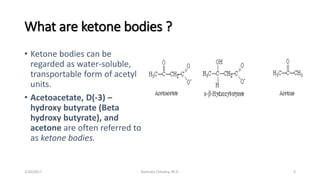
• Ketone bodies can be
regarded as water-soluble,
transportable form of acetyl
units.
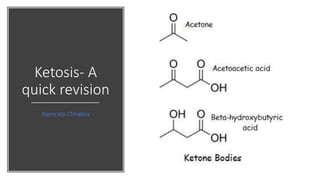
• Acetoacetate, D(-3) –
hydroxy butyrate (Beta
hydroxy butyrate), and
acetone are often referred to
as ketone bodies.
2/20/2017 Namrata Chhabra, M.D. 3
Ketone bodies
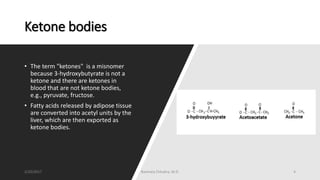
• The term "ketones" is a misnomer
because 3-hydroxybutyrate is not a
ketone and there are ketones in
blood that are not ketone bodies,
e.g., pyruvate, fructose.
• Fatty acids released by adipose tissue
are converted into acetyl units by the
liver, which are then exported as
ketone bodies.
2/20/2017 Namrata Chhabra, M.D. 4
Ketonemia, ketonuria and ketosis
• Ketonemia - increased concentration of ketone bodies in blood
• Ketonuria- Excess excretion of ketone bodies in urine
• Ketosis- Excess ketogenesis with impact on various organ functions
2/20/2017 Namrata Chhabra, M.D. 5
What is the significance of ketone bodies ?
Ketone bodies serve as a fuel for extra hepatic tissues.
• Liver can synthesize but cannot utilize the ketone bodies
• Brain can utilize but cannot synthesize the ketone bodies
• Brain utilizes ketone bodies only under conditions of glucose
deprivation
2/20/2017 Namrata Chhabra, M.D. 6
Ketogenesis
Ketogenesis takes place in liver using Acetyl co A as a substrate or a
precursor molecule.
 Enzymes responsible for ketone body formation are associated
mainly with the mitochondria
2/20/2017 Namrata Chhabra, M.D. 7
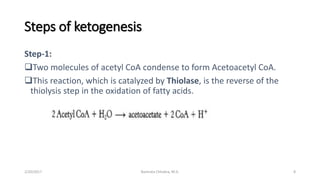
Steps of ketogenesis
Step-1:
Two molecules of acetyl CoA condense to form Acetoacetyl CoA.
This reaction, which is catalyzed by Thiolase, is the reverse of the
thiolysis step in the oxidation of fatty acids.
2/20/2017 Namrata Chhabra, M.D. 8
Ketogenesis
Step-2:
Acetoacetyl CoA then reacts with acetyl CoA and water to give 3-hydroxy-3-
methylglutaryl CoA (HMG-CoA) and CoASH.
 The reaction is catalyzed by HMG co A synthase.
 This enzyme is exclusively present in liver mitochondria.
 There are two iso-forms of this enzyme-cytosolic and mitochondrial.
 The mitochondrial enzyme is needed for ketogenesis while the cytosolic form
is associated with cholesterol biosynthesis.
2/20/2017 9Namrata Chhabra, M.D.
Ketogenesis
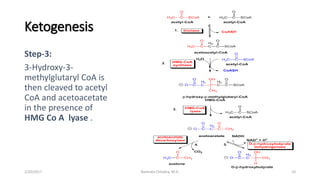
Step-3:
3-Hydroxy-3-
methylglutaryl CoA is
then cleaved to acetyl
CoA and acetoacetate
in the presence of
HMG Co A lyase .
102/20/2017 Namrata Chhabra, M.D.
Ketogenesis
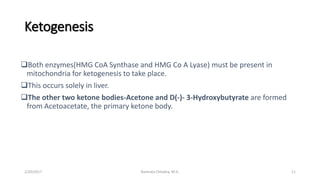
Both enzymes(HMG CoA Synthase and HMG Co A Lyase) must be present in
mitochondria for ketogenesis to take place.
This occurs solely in liver.
The other two ketone bodies-Acetone and D(-)- 3-Hydroxybutyrate are formed
from Acetoacetate, the primary ketone body.
112/20/2017 Namrata Chhabra, M.D.
Formation of Acetone
• Acetone is formed by decarboxylation in the
presence of decarboxylase enzyme and,
because it is a beta-keto acid, acetoacetate
also undergoes a slow, spontaneous
decarboxylation to acetone.
• The odor of acetone may be detected in the
breath of a person who has a high level of
acetoacetate in the blood.
• “Acetone-breath” has been used
as a crude method
of diagnosing individuals with untreated
Type I diabetes mellitus.
2/20/2017 12Namrata Chhabra, M.D.
Formation of β-Hydroxy Butyrate
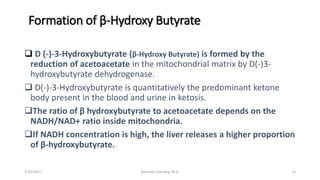
 D (-)-3-Hydroxybutyrate (β-Hydroxy Butyrate) is formed by the
reduction of acetoacetate in the mitochondrial matrix by D(-)3-
hydroxybutyrate dehydrogenase.
 D(-)-3-Hydroxybutyrate is quantitatively the predominant ketone
body present in the blood and urine in ketosis.
The ratio of β hydroxybutyrate to acetoacetate depends on the
NADH/NAD+ ratio inside mitochondria.
If NADH concentration is high, the liver releases a higher proportion
of β-hydroxybutyrate.
2/20/2017 13Namrata Chhabra, M.D.
Ketolysis
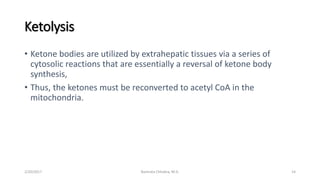
• Ketone bodies are utilized by extrahepatic tissues via a series of
cytosolic reactions that are essentially a reversal of ketone body
synthesis,
• Thus, the ketones must be reconverted to acetyl CoA in the
mitochondria.
2/20/2017 Namrata Chhabra, M.D. 14
Steps of ketolysis
Utilization of Beta-hydroxybutyrate
1) Beta-hydroxybutyrate, is first oxidized to acetoacetate with the
production of one NADH (1).
2) Under conditions where tissues are utilizing ketones for energy
production their NAD+/NADH ratios are going to be relatively high,
thus driving the β-hydroxybutyrate dehydrogenase catalyzed
reaction in the direction of acetoacetate synthesis.
2/20/2017 Namrata Chhabra, M.D. 15
Utilization of ketone bodies
2) Utilization of Acetoacetate-
Coenzyme A must be added to the acetoacetate.
 The thioester bond is a high energy bond, so ATP equivalents must
be used.
In this case the energy comes from a trans esterification of the
CoASH from Succinyl CoA to acetoacetate by Coenzyme A transferase,
also called Succinyl co A : Acetoacetate co A transferase, also known
as Thiophorase.
2/20/2017 16Namrata Chhabra, M.D.
Utilization of Acetoacetate
The Succinyl CoA comes from the TCA cycle.
This reaction bypasses the Succinyl CoA synthetase step of the TCA
cycle,
 hence there is no GTP formation at this steps although it does not
alter the amount of carbon in the cycle.
2/20/2017 Namrata Chhabra, M.D. 17
Utilization of ketone bodies
The liver has acetoacetate available to supply to other organs because it
lacks the particular CoA transferase and that is the reason that “Ketone
bodies are synthesized in the liver but utilized in the peripheral tissues”.
182/20/2017 Namrata Chhabra, M.D.
Liver v/s Peripheral tissues for ketones as fuel
molecules
• The enzyme, Succniyl co A Acetoacetate co A transferase, also
known as Thiophorase, is present at high levels in most tissues
except the liver.
• Importantly, very low level of enzyme expression in the liver allows
the liver to produce ketone bodies but not to utilize them.
• This ensures that extra hepatic tissues have access to ketone
bodies as a fuel source during prolonged fasting and starvation,
and
• Also, lack of this enzyme in the liver prevents the futile cycle of
synthesis and breakdown of acetoacetate.
2/20/2017 19Namrata Chhabra, M.D.
Regulation of Ketosis
Ketogenesis is regulated at three steps-
1) Lipolysis in Adipose tissue
 Ketosis does not occur unless there is an
increase in the level of circulating free
fatty acids that arise from lipolysis of
triacylglycerol in adipose tissue.
 When glucose levels fall, lipolysis
induced by glucagon secretion causes
increased hepatic ketogenesis due to
increased substrate (free fatty acids)
delivery from adipose tissue.
 Conversely, insulin, released in the well-
fed state, inhibits ketogenesis via the
triggering dephosphorylation and
inactivation of adipose tissue hormone
sensitive lipase (HSL).
20
2/20/2017 Namrata Chhabra, M.D.
Regulation of Ketosis
2) Fate of fatty acid-free fatty acids are either oxidized to CO2 or
ketone bodies or esterified to triacylglycerol and phospholipids.
 There is regulation of entry of fatty acids into the oxidative pathway
by carnitine Acyl transferase-I (CAT-I)
 Malonyl-CoA, the initial intermediate in fatty acid biosynthesis
formed by acetyl-CoA carboxylase in the fed state, is a potent
inhibitor of CAT-I .
 Under these conditions, free fatty acids enter the liver cell in low
concentrations and are nearly all esterified to acylglycerols and
transported out of the liver in very low density lipoproteins (VLDL).
2/20/2017 21Namrata Chhabra, M.D.
Regulation of Ketosis
3) Fate of Acetyl co A
 The acetyl-CoA formed in beta-oxidation is oxidized in the citric
acid cycle, or it enters the pathway of ketogenesis to form ketone
bodies.
 As the level of serum free fatty acids is raised, proportionately
more free fatty acids are converted to ketone bodies and less
are oxidized via the citric acid cycle to CO2.
 Entry of acetyl CoA into the citric acid cycle depends on the
availability of Oxaloacetate for the formation of citrate, but the
concentration of Oxaloacetate is lowered if carbohydrate is
unavailable or improperly utilized.
2/20/2017 22Namrata Chhabra, M.D.
Regulation of
ketosis
2/20/2017 Namrata Chhabra, M.D. 23
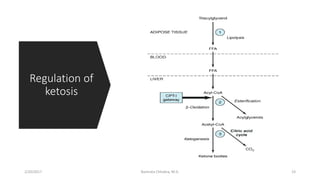
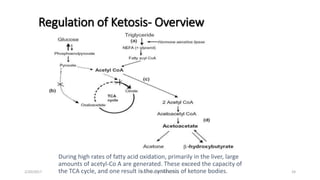
Regulation of Ketosis- Overview
During high rates of fatty acid oxidation, primarily in the liver, large
amounts of acetyl-Co A are generated. These exceed the capacity of
the TCA cycle, and one result is the synthesis of ketone bodies. 242/20/2017 Namrata Chhabra, M.D.
Biological significance of ketone bodies
Ketone bodies serve as a fuel for extra hepatic tissues
Brain
 It is metabolically active and metabolically privileged.
 The brain generally uses 60-70% of total body glucose requirements, and
always requires some glucose for normal functioning.
 Under most conditions, glucose is essentially the sole energy source of
the brain.
The brain cannot use fatty acids as they cannot cross the blood-
brain barrier.
As glucose availability decreases, the brain is forced to use either amino
acids or ketone bodies for fuel.
2/20/2017 25Namrata Chhabra, M.D.
Biological significance of ketone bodies
 Acetoacetate and β-hydroxybutyrate are normal fuels of respiration and
are quantitatively important as sources of energy.
 Heart muscle and the renal cortex use acetoacetate in preference to
glucose.
 In contrast, the brain adapts to the utilization of acetoacetate during
starvation and diabetes.
 In prolonged starvation,75% of the fuel needs of the brain are met by
ketone bodies.
 Individuals eating diets extremely high in fat and low in carbohydrate, or
starving, or suffering from a severe lack of insulin (Type I
diabetes mellitus) therefore increase the synthesis and utilization of
ketone bodies
2/20/2017 26Namrata Chhabra, M.D.
Ketonemia
• Ketonemia - increased concentration of ketone bodies in blood
• It is due to increased production of ketone bodies by the liver
rather than to a deficiency in their utilization by extra hepatic
tissues.
• The production of ketone bodies occurs at a relatively low rate
during normal feeding and under conditions of normal
physiological status.
• Normal physiological responses to carbohydrate shortages cause
the liver to increase the production of ketone bodies from the
acetyl-CoA generated from fatty acid oxidation.
2/20/2017 27Namrata Chhabra, M.D.
Causes of Ketosis
 Uncontrolled diabetes mellitus
 Starvation
 Chronic alcoholism
 Von- Gierke’s disease
 Heavy exercise
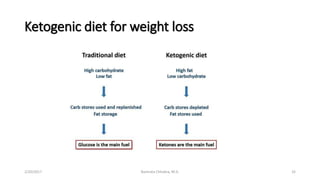
 Low carbohydrate diet- For weight loss
 Glycogen storage disease type 6(Due to phosphorylase kinase
deficiency)
 Pyruvate carboxylase deficiency
2/20/2017 28Namrata Chhabra, M.D.
Causes of Ketosis
 Prolonged ether anesthesia
 Toxemia of pregnancy
 Certain conditions of alkalosis
 Nonpathologic forms of ketosis are found under conditions of high-
fat feeding and
 After severe exercise in the post absorptive state.
2/20/2017 29Namrata Chhabra, M.D.
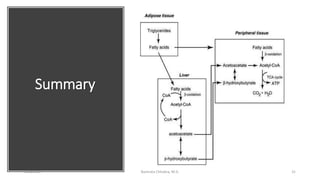
Summary
• The ketone bodies (acetoacetate, 3-hydroxybutyrate, and acetone)
are formed in hepatic mitochondria when there is a high rate of fatty
acid oxidation.
• The pathway of ketogenesis involves synthesis and breakdown of 3-
hydroxy-3-methylglutaryl-CoA (HMG-CoA) by two key enzymes, HMG-
CoA synthase and HMG-CoA lyase.
2/20/2017 30Namrata Chhabra, M.D.
Summary
2/20/2017 Namrata Chhabra, M.D. 31
Ketogenic diet for weight loss
2/20/2017 Namrata Chhabra, M.D. 32
Thank you
2/20/2017 Namrata Chhabra, M.D. 33

Ketosis a quick revision

  • 1.
  • 2.
    Learning objectives By theend of this presentation you will be able to understand : • Types of ketone bodies • Significance of ketone bodies • Steps of synthesis and utilization of ketone bodies • Conditions causes ketosis 2/20/2017 Namrata Chhabra, M.D. 2
  • 3.
    What are ketonebodies ? • Ketone bodies can be regarded as water-soluble, transportable form of acetyl units. • Acetoacetate, D(-3) – hydroxy butyrate (Beta hydroxy butyrate), and acetone are often referred to as ketone bodies. 2/20/2017 Namrata Chhabra, M.D. 3
  • 4.
    Ketone bodies • Theterm "ketones" is a misnomer because 3-hydroxybutyrate is not a ketone and there are ketones in blood that are not ketone bodies, e.g., pyruvate, fructose. • Fatty acids released by adipose tissue are converted into acetyl units by the liver, which are then exported as ketone bodies. 2/20/2017 Namrata Chhabra, M.D. 4
  • 5.
    Ketonemia, ketonuria andketosis • Ketonemia - increased concentration of ketone bodies in blood • Ketonuria- Excess excretion of ketone bodies in urine • Ketosis- Excess ketogenesis with impact on various organ functions 2/20/2017 Namrata Chhabra, M.D. 5
  • 6.
    What is thesignificance of ketone bodies ? Ketone bodies serve as a fuel for extra hepatic tissues. • Liver can synthesize but cannot utilize the ketone bodies • Brain can utilize but cannot synthesize the ketone bodies • Brain utilizes ketone bodies only under conditions of glucose deprivation 2/20/2017 Namrata Chhabra, M.D. 6
  • 7.
    Ketogenesis Ketogenesis takes placein liver using Acetyl co A as a substrate or a precursor molecule.  Enzymes responsible for ketone body formation are associated mainly with the mitochondria 2/20/2017 Namrata Chhabra, M.D. 7
  • 8.
    Steps of ketogenesis Step-1: Twomolecules of acetyl CoA condense to form Acetoacetyl CoA. This reaction, which is catalyzed by Thiolase, is the reverse of the thiolysis step in the oxidation of fatty acids. 2/20/2017 Namrata Chhabra, M.D. 8
  • 9.
    Ketogenesis Step-2: Acetoacetyl CoA thenreacts with acetyl CoA and water to give 3-hydroxy-3- methylglutaryl CoA (HMG-CoA) and CoASH.  The reaction is catalyzed by HMG co A synthase.  This enzyme is exclusively present in liver mitochondria.  There are two iso-forms of this enzyme-cytosolic and mitochondrial.  The mitochondrial enzyme is needed for ketogenesis while the cytosolic form is associated with cholesterol biosynthesis. 2/20/2017 9Namrata Chhabra, M.D.
  • 10.
    Ketogenesis Step-3: 3-Hydroxy-3- methylglutaryl CoA is thencleaved to acetyl CoA and acetoacetate in the presence of HMG Co A lyase . 102/20/2017 Namrata Chhabra, M.D.
  • 11.
    Ketogenesis Both enzymes(HMG CoASynthase and HMG Co A Lyase) must be present in mitochondria for ketogenesis to take place. This occurs solely in liver. The other two ketone bodies-Acetone and D(-)- 3-Hydroxybutyrate are formed from Acetoacetate, the primary ketone body. 112/20/2017 Namrata Chhabra, M.D.
  • 12.
    Formation of Acetone •Acetone is formed by decarboxylation in the presence of decarboxylase enzyme and, because it is a beta-keto acid, acetoacetate also undergoes a slow, spontaneous decarboxylation to acetone. • The odor of acetone may be detected in the breath of a person who has a high level of acetoacetate in the blood. • “Acetone-breath” has been used as a crude method of diagnosing individuals with untreated Type I diabetes mellitus. 2/20/2017 12Namrata Chhabra, M.D.
  • 13.
    Formation of β-HydroxyButyrate  D (-)-3-Hydroxybutyrate (β-Hydroxy Butyrate) is formed by the reduction of acetoacetate in the mitochondrial matrix by D(-)3- hydroxybutyrate dehydrogenase.  D(-)-3-Hydroxybutyrate is quantitatively the predominant ketone body present in the blood and urine in ketosis. The ratio of β hydroxybutyrate to acetoacetate depends on the NADH/NAD+ ratio inside mitochondria. If NADH concentration is high, the liver releases a higher proportion of β-hydroxybutyrate. 2/20/2017 13Namrata Chhabra, M.D.
  • 14.
    Ketolysis • Ketone bodiesare utilized by extrahepatic tissues via a series of cytosolic reactions that are essentially a reversal of ketone body synthesis, • Thus, the ketones must be reconverted to acetyl CoA in the mitochondria. 2/20/2017 Namrata Chhabra, M.D. 14
  • 15.
    Steps of ketolysis Utilizationof Beta-hydroxybutyrate 1) Beta-hydroxybutyrate, is first oxidized to acetoacetate with the production of one NADH (1). 2) Under conditions where tissues are utilizing ketones for energy production their NAD+/NADH ratios are going to be relatively high, thus driving the β-hydroxybutyrate dehydrogenase catalyzed reaction in the direction of acetoacetate synthesis. 2/20/2017 Namrata Chhabra, M.D. 15
  • 16.
    Utilization of ketonebodies 2) Utilization of Acetoacetate- Coenzyme A must be added to the acetoacetate.  The thioester bond is a high energy bond, so ATP equivalents must be used. In this case the energy comes from a trans esterification of the CoASH from Succinyl CoA to acetoacetate by Coenzyme A transferase, also called Succinyl co A : Acetoacetate co A transferase, also known as Thiophorase. 2/20/2017 16Namrata Chhabra, M.D.
  • 17.
    Utilization of Acetoacetate TheSuccinyl CoA comes from the TCA cycle. This reaction bypasses the Succinyl CoA synthetase step of the TCA cycle,  hence there is no GTP formation at this steps although it does not alter the amount of carbon in the cycle. 2/20/2017 Namrata Chhabra, M.D. 17
  • 18.
    Utilization of ketonebodies The liver has acetoacetate available to supply to other organs because it lacks the particular CoA transferase and that is the reason that “Ketone bodies are synthesized in the liver but utilized in the peripheral tissues”. 182/20/2017 Namrata Chhabra, M.D.
  • 19.
    Liver v/s Peripheraltissues for ketones as fuel molecules • The enzyme, Succniyl co A Acetoacetate co A transferase, also known as Thiophorase, is present at high levels in most tissues except the liver. • Importantly, very low level of enzyme expression in the liver allows the liver to produce ketone bodies but not to utilize them. • This ensures that extra hepatic tissues have access to ketone bodies as a fuel source during prolonged fasting and starvation, and • Also, lack of this enzyme in the liver prevents the futile cycle of synthesis and breakdown of acetoacetate. 2/20/2017 19Namrata Chhabra, M.D.
  • 20.
    Regulation of Ketosis Ketogenesisis regulated at three steps- 1) Lipolysis in Adipose tissue  Ketosis does not occur unless there is an increase in the level of circulating free fatty acids that arise from lipolysis of triacylglycerol in adipose tissue.  When glucose levels fall, lipolysis induced by glucagon secretion causes increased hepatic ketogenesis due to increased substrate (free fatty acids) delivery from adipose tissue.  Conversely, insulin, released in the well- fed state, inhibits ketogenesis via the triggering dephosphorylation and inactivation of adipose tissue hormone sensitive lipase (HSL). 20 2/20/2017 Namrata Chhabra, M.D.
  • 21.
    Regulation of Ketosis 2)Fate of fatty acid-free fatty acids are either oxidized to CO2 or ketone bodies or esterified to triacylglycerol and phospholipids.  There is regulation of entry of fatty acids into the oxidative pathway by carnitine Acyl transferase-I (CAT-I)  Malonyl-CoA, the initial intermediate in fatty acid biosynthesis formed by acetyl-CoA carboxylase in the fed state, is a potent inhibitor of CAT-I .  Under these conditions, free fatty acids enter the liver cell in low concentrations and are nearly all esterified to acylglycerols and transported out of the liver in very low density lipoproteins (VLDL). 2/20/2017 21Namrata Chhabra, M.D.
  • 22.
    Regulation of Ketosis 3)Fate of Acetyl co A  The acetyl-CoA formed in beta-oxidation is oxidized in the citric acid cycle, or it enters the pathway of ketogenesis to form ketone bodies.  As the level of serum free fatty acids is raised, proportionately more free fatty acids are converted to ketone bodies and less are oxidized via the citric acid cycle to CO2.  Entry of acetyl CoA into the citric acid cycle depends on the availability of Oxaloacetate for the formation of citrate, but the concentration of Oxaloacetate is lowered if carbohydrate is unavailable or improperly utilized. 2/20/2017 22Namrata Chhabra, M.D.
  • 23.
  • 24.
    Regulation of Ketosis-Overview During high rates of fatty acid oxidation, primarily in the liver, large amounts of acetyl-Co A are generated. These exceed the capacity of the TCA cycle, and one result is the synthesis of ketone bodies. 242/20/2017 Namrata Chhabra, M.D.
  • 25.
    Biological significance ofketone bodies Ketone bodies serve as a fuel for extra hepatic tissues Brain  It is metabolically active and metabolically privileged.  The brain generally uses 60-70% of total body glucose requirements, and always requires some glucose for normal functioning.  Under most conditions, glucose is essentially the sole energy source of the brain. The brain cannot use fatty acids as they cannot cross the blood- brain barrier. As glucose availability decreases, the brain is forced to use either amino acids or ketone bodies for fuel. 2/20/2017 25Namrata Chhabra, M.D.
  • 26.
    Biological significance ofketone bodies  Acetoacetate and β-hydroxybutyrate are normal fuels of respiration and are quantitatively important as sources of energy.  Heart muscle and the renal cortex use acetoacetate in preference to glucose.  In contrast, the brain adapts to the utilization of acetoacetate during starvation and diabetes.  In prolonged starvation,75% of the fuel needs of the brain are met by ketone bodies.  Individuals eating diets extremely high in fat and low in carbohydrate, or starving, or suffering from a severe lack of insulin (Type I diabetes mellitus) therefore increase the synthesis and utilization of ketone bodies 2/20/2017 26Namrata Chhabra, M.D.
  • 27.
    Ketonemia • Ketonemia -increased concentration of ketone bodies in blood • It is due to increased production of ketone bodies by the liver rather than to a deficiency in their utilization by extra hepatic tissues. • The production of ketone bodies occurs at a relatively low rate during normal feeding and under conditions of normal physiological status. • Normal physiological responses to carbohydrate shortages cause the liver to increase the production of ketone bodies from the acetyl-CoA generated from fatty acid oxidation. 2/20/2017 27Namrata Chhabra, M.D.
  • 28.
    Causes of Ketosis Uncontrolled diabetes mellitus  Starvation  Chronic alcoholism  Von- Gierke’s disease  Heavy exercise  Low carbohydrate diet- For weight loss  Glycogen storage disease type 6(Due to phosphorylase kinase deficiency)  Pyruvate carboxylase deficiency 2/20/2017 28Namrata Chhabra, M.D.
  • 29.
    Causes of Ketosis Prolonged ether anesthesia  Toxemia of pregnancy  Certain conditions of alkalosis  Nonpathologic forms of ketosis are found under conditions of high- fat feeding and  After severe exercise in the post absorptive state. 2/20/2017 29Namrata Chhabra, M.D.
  • 30.
    Summary • The ketonebodies (acetoacetate, 3-hydroxybutyrate, and acetone) are formed in hepatic mitochondria when there is a high rate of fatty acid oxidation. • The pathway of ketogenesis involves synthesis and breakdown of 3- hydroxy-3-methylglutaryl-CoA (HMG-CoA) by two key enzymes, HMG- CoA synthase and HMG-CoA lyase. 2/20/2017 30Namrata Chhabra, M.D.
  • 31.
  • 32.
    Ketogenic diet forweight loss 2/20/2017 Namrata Chhabra, M.D. 32
  • 33.