Welcome
to
the presentation
On the topic
“Biosynthesis of Lipids (Fatty acid synthesis)”
Name of
participants
HAFSA AFRIN ANIKA
ABU DARDA KHAN
FAHIMA SULTANA FAHI
AHSAN AHMED SHAZAL
SHAKLAEN SHAWKAT TUFAN
Respectivetopicsare:
Lipid Biosynthesis.
Fatty acid synthesis.
History of fatty acid synthesis observation.
Site of fatty acid synthesis.
Enzyme and cofactors involved in fatty acid synthesis.
Fatty acid synthase (FAS) complex.
Advantage of multi enzyme complex.
Transport of Acetyl CoA.
Steps of fatty acid synthesis.
Regulation of fatty acid synthesis.
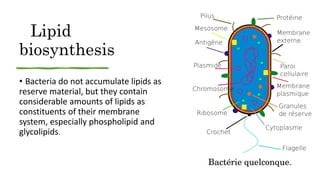
Lipid
biosynthesis
• Bacteria do not accumulate lipids as
reserve material, but they contain
considerable amounts of lipids as
constituents of their membrane
system, especially phospholipid and
glycolipids.
Fatty acid synthesis
• Fatty acid are synthesized mainly by a de
novo synthetic pathway operating in the
cytoplasm. So, it is referred to as
extramitochondrial or cytoplasmic fatty acid
synthase system. The major fatty acid
synthesized de novo is palmitic acid. The 16C
structured fatty acid. The process occurs in
liver, adipose tissue , kidney, brain and
mammary glands.
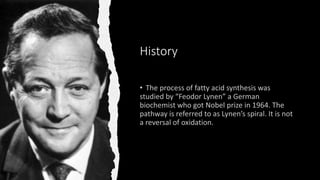
History
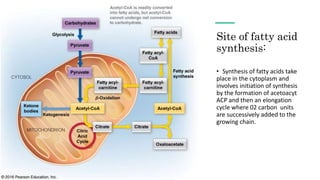
Site of fatty acid
synthesis:
• Synthesis of fatty acids take
place in the cytoplasm and
involves initiation of synthesis
by the formation of acetoacyt
ACP and then an elongation
cycle where 02 carbon units
are successively added to the
growing chain.
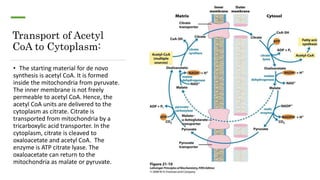
Transport of Acetyl
CoA to Cytoplasm:
• The starting material for de novo
synthesis is acetyl CoA. It is formed
inside the mitochondria from pyruvate.
The inner membrane is not freely
permeable to acetyl CoA. Hence, the
acetyl CoA units are delivered to the
cytoplasm as citrate. Citrate is
transported from mitochondria by a
tricarboxylic acid transporter. In the
cytoplasm, citrate is cleaved to
oxaloacetate and acetyl CoA. The
enzyme is ATP citrate lyase. The
oxaloacetate can return to the
mitochondria as malate or pyruvate.
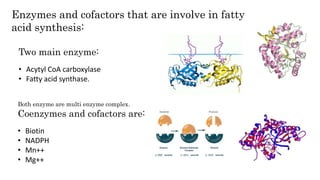
Enzymes and cofactors that are involve in fatty
acid synthesis:
Two main enzyme:
• Acytyl CoA carboxylase
• Fatty acid synthase.
Both enzyme are multi enzyme complex.
Coenzymes and cofactors are:
• Biotin
• NADPH
• Mn++
• Mg++
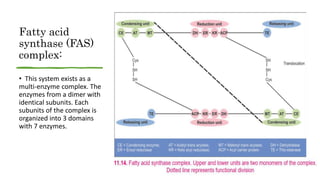
Fatty acid
synthase (FAS)
complex:
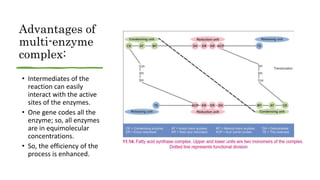
• This system exists as a
multi-enzyme complex. The
enzymes from a dimer with
identical subunits. Each
subunits of the complex is
organized into 3 domains
with 7 enzymes.
Advantages of
multi-enzyme
complex:
• Intermediates of the
reaction can easily
interact with the active
sites of the enzymes.
• One gene codes all the
enzyme; so, all enzymes
are in equimolecular
concentrations.
• So, the efficiency of the
process is enhanced.
1st-Domain or
condensing
units:
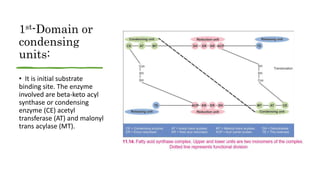
• It is initial substrate
binding site. The enzyme
involved are beta-keto acyl
synthase or condensing
enzyme (CE) acetyl
transferase (AT) and malonyl
trans acylase (MT).
2nd domain or
reduction
units:
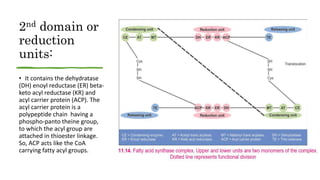
• It contains the dehydratase
(DH) enoyl reductase (ER) beta-
keto acyl reductase (KR) and
acyl carrier protein (ACP). The
acyl carrier protein is a
polypeptide chain having a
phospho-panto theine group,
to which the acyl group are
attached in thioester linkage.
So, ACP acts like the CoA
carrying fatty acyl groups.
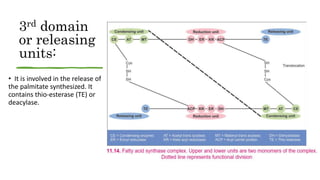
3rd domain
or releasing
units:
• It is involved in the release of
the palmitate synthesized. It
contains thio-esterase (TE) or
deacylase.
Steps of fatty acid synthesis:
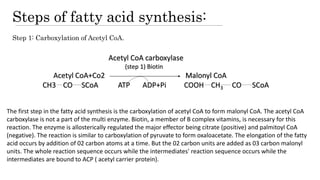
Step 1: Carboxylation of Acetyl CoA.
Acetyl CoA carboxylase
(step 1) Biotin
Acetyl CoA+Co2 Malonyl CoA
CH3 CO SCoA ATP ADP+Pi COOH CH3 CO SCoA
The first step in the fatty acid synthesis is the carboxylation of acetyl CoA to form malonyl CoA. The acetyl CoA
carboxylase is not a part of the multi enzyme. Biotin, a member of B complex vitamins, is necessary for this
reaction. The enzyme is allosterically regulated the major effector being citrate (positive) and palmitoyl CoA
(negative). The reaction is similar to carboxylation of pyruvate to form oxaloacetate. The elongation of the fatty
acid occurs by addition of 02 carbon atoms at a time. But the 02 carbon units are added as 03 carbon malonyl
units. The whole reaction sequence occurs while the intermediates' reaction sequence occurs while the
intermediates are bound to ACP ( acetyl carrier protein).
Steps of fatty acid synthesis:
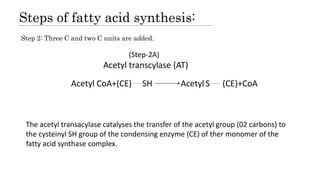
Step 2: Three C and two C units are added.
(Step-2A)
Acetyl transcylase (AT)
Acetyl CoA+(CE) SH AcetylS (CE)+CoA
The acetyl transacylase catalyses the transfer of the acetyl group (02 carbons) to
the cysteinyl SH group of the condensing enzyme (CE) of ther monomer of the
fatty acid synthase complex.
Steps of fatty acid synthesis:
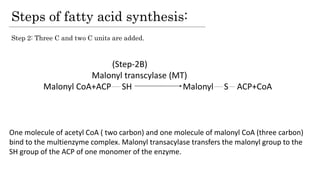
Step 2: Three C and two C units are added.
(Step-2B)
Malonyl transcylase (MT)
Malonyl CoA+ACP SH Malonyl S ACP+CoA
One molecule of acetyl CoA ( two carbon) and one molecule of malonyl CoA (three carbon)
bind to the multienzyme complex. Malonyl transacylase transfers the malonyl group to the
SH group of the ACP of one monomer of the enzyme.
Steps of fatty acid synthesis:
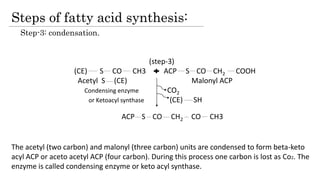
Step-3: condensation.
(step-3)
(CE) S CO CH3 ACP S CO CH2 COOH
Acetyl S (CE) Malonyl ACP
Condensing enzyme CO2
or Ketoacyl synthase (CE) SH
ACP S CO CH2 CO CH3
The acetyl (two carbon) and malonyl (three carbon) units are condensed to form beta-keto
acyl ACP or aceto acetyl ACP (four carbon). During this process one carbon is lost as Co2. The
enzyme is called condensing enzyme or keto acyl synthase.
Steps of fatty acid synthesis:
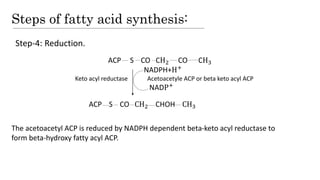
Step-4: Reduction.
The acetoacetyl ACP is reduced by NADPH dependent beta-keto acyl reductase to
form beta-hydroxy fatty acyl ACP.
ACP S CO CH2 CO CH3
NADPH+H+
Keto acyl reductase Acetoacetyle ACP or beta keto acyl ACP
NADP+
ACP S CO CH2 CHOH CH3
Steps of fatty acid synthesis:
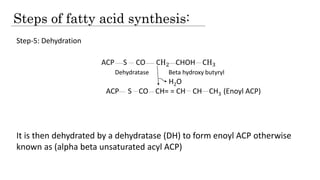
Step-5: Dehydration
It is then dehydrated by a dehydratase (DH) to form enoyl ACP otherwise
known as (alpha beta unsaturated acyl ACP)
ACP S CO CH2 CHOH CH3
Dehydratase Beta hydroxy butyryl
H2O
ACP S CO CH= = CH CH CH3 (Enoyl ACP)
Steps of fatty acid synthesis:
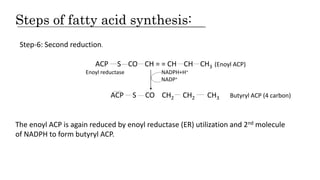
Step-6: Second reduction.
The enoyl ACP is again reduced by enoyl reductase (ER) utilization and 2nd molecule
of NADPH to form butyryl ACP.
ACP S CO CH = = CH CH CH3 (Enoyl ACP)
Enoyl reductase NADPH+H+
NADP+
ACP S CO CH2 CH2 CH3 Butyryl ACP (4 carbon)
Steps of fatty acid synthesis:
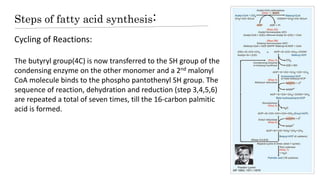
Cycling of Reactions:
The butyryl group(4C) is now transferred to the SH group of the
condensing enzyme on the other monomer and a 2nd malonyl
CoA molecule binds to the phospho pantothenyl SH group. The
sequence of reaction, dehydration and reduction (step 3,4,5,6)
are repeated a total of seven times, till the 16-carbon palmitic
acid is formed.
Steps of fatty acid synthesis:
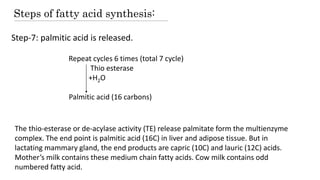
Step-7: palmitic acid is released.
The thio-esterase or de-acylase activity (TE) release palmitate form the multienzyme
complex. The end point is palmitic acid (16C) in liver and adipose tissue. But in
lactating mammary gland, the end products are capric (10C) and lauric (12C) acids.
Mother’s milk contains these medium chain fatty acids. Cow milk contains odd
numbered fatty acid.
Repeat cycles 6 times (total 7 cycle)
Thio esterase
+H2O
Palmitic acid (16 carbons)
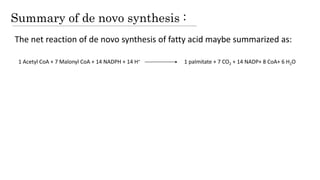
Summary of de novo synthesis :
The net reaction of de novo synthesis of fatty acid maybe summarized as:
1 Acetyl CoA + 7 Malonyl CoA + 14 NADPH + 14 H+ 1 palmitate + 7 CO2 + 14 NADP+ 8 CoA+ 6 H2O
• Regulation of fatty acid synthesis:
1. Availability of substrates:
Fatty acid synthesis occurs when carbohydrate is abundant, and the
level of fatty acid is low. The availability of citrate in the cytoplasm is
the most important regulatory factor producing a short-term effect.
• Regulation of fatty acid synthesis:
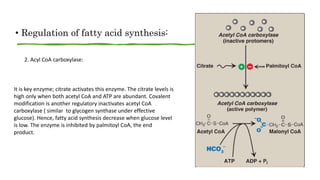
2. Acyl CoA carboxylase:
It is key enzyme; citrate activates this enzyme. The citrate levels is
high only when both acetyl CoA and ATP are abundant. Covalent
modification is another regulatory inactivates acetyl CoA
carboxylase ( similar to glycogen synthase under effective
glucose). Hence, fatty acid synthesis decrease when glucose level
is low. The enzyme is inhibited by palmitoyl CoA, the end
product.
Regulation of fatty acid
synthesis:
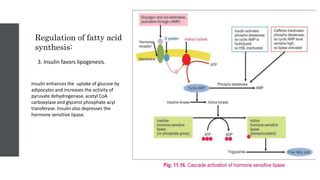
3. Insulin favors lipogenesis.
Insulin enhances the uptake of glucose by
adipocytes and increases the activity of
pyruvate dehydrogenase, acetyl CoA
carboxylase and glycerol phosphate acyl
transferase. Insulin also depresses the
hormone sensitive lipase.
Regulation of fatty acid synthesis:
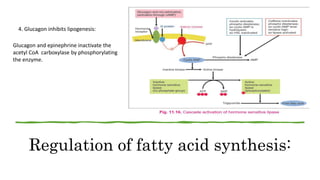
4. Glucagon inhibits lipogenesis:
Glucagon and epinephrine inactivate the
acetyl CoA carboxylase by phosphorylating
the enzyme.
Thank You!

Fatty Acid Synthesis

  • 1.
    Welcome to the presentation On thetopic “Biosynthesis of Lipids (Fatty acid synthesis)”
  • 2.
    Name of participants HAFSA AFRINANIKA ABU DARDA KHAN FAHIMA SULTANA FAHI AHSAN AHMED SHAZAL SHAKLAEN SHAWKAT TUFAN
  • 3.
    Respectivetopicsare: Lipid Biosynthesis. Fatty acidsynthesis. History of fatty acid synthesis observation. Site of fatty acid synthesis. Enzyme and cofactors involved in fatty acid synthesis. Fatty acid synthase (FAS) complex. Advantage of multi enzyme complex. Transport of Acetyl CoA. Steps of fatty acid synthesis. Regulation of fatty acid synthesis.
  • 4.
    Lipid biosynthesis • Bacteria donot accumulate lipids as reserve material, but they contain considerable amounts of lipids as constituents of their membrane system, especially phospholipid and glycolipids.
  • 5.
    Fatty acid synthesis •Fatty acid are synthesized mainly by a de novo synthetic pathway operating in the cytoplasm. So, it is referred to as extramitochondrial or cytoplasmic fatty acid synthase system. The major fatty acid synthesized de novo is palmitic acid. The 16C structured fatty acid. The process occurs in liver, adipose tissue , kidney, brain and mammary glands.
  • 6.
  • 7.
    Site of fattyacid synthesis: • Synthesis of fatty acids take place in the cytoplasm and involves initiation of synthesis by the formation of acetoacyt ACP and then an elongation cycle where 02 carbon units are successively added to the growing chain.
  • 8.
    Transport of Acetyl CoAto Cytoplasm: • The starting material for de novo synthesis is acetyl CoA. It is formed inside the mitochondria from pyruvate. The inner membrane is not freely permeable to acetyl CoA. Hence, the acetyl CoA units are delivered to the cytoplasm as citrate. Citrate is transported from mitochondria by a tricarboxylic acid transporter. In the cytoplasm, citrate is cleaved to oxaloacetate and acetyl CoA. The enzyme is ATP citrate lyase. The oxaloacetate can return to the mitochondria as malate or pyruvate.
  • 9.
    Enzymes and cofactorsthat are involve in fatty acid synthesis: Two main enzyme: • Acytyl CoA carboxylase • Fatty acid synthase. Both enzyme are multi enzyme complex. Coenzymes and cofactors are: • Biotin • NADPH • Mn++ • Mg++
  • 10.
    Fatty acid synthase (FAS) complex: •This system exists as a multi-enzyme complex. The enzymes from a dimer with identical subunits. Each subunits of the complex is organized into 3 domains with 7 enzymes.
  • 11.
    Advantages of multi-enzyme complex: • Intermediatesof the reaction can easily interact with the active sites of the enzymes. • One gene codes all the enzyme; so, all enzymes are in equimolecular concentrations. • So, the efficiency of the process is enhanced.
  • 12.
    1st-Domain or condensing units: • Itis initial substrate binding site. The enzyme involved are beta-keto acyl synthase or condensing enzyme (CE) acetyl transferase (AT) and malonyl trans acylase (MT).
  • 13.
    2nd domain or reduction units: •It contains the dehydratase (DH) enoyl reductase (ER) beta- keto acyl reductase (KR) and acyl carrier protein (ACP). The acyl carrier protein is a polypeptide chain having a phospho-panto theine group, to which the acyl group are attached in thioester linkage. So, ACP acts like the CoA carrying fatty acyl groups.
  • 14.
    3rd domain or releasing units: •It is involved in the release of the palmitate synthesized. It contains thio-esterase (TE) or deacylase.
  • 15.
    Steps of fattyacid synthesis: Step 1: Carboxylation of Acetyl CoA. Acetyl CoA carboxylase (step 1) Biotin Acetyl CoA+Co2 Malonyl CoA CH3 CO SCoA ATP ADP+Pi COOH CH3 CO SCoA The first step in the fatty acid synthesis is the carboxylation of acetyl CoA to form malonyl CoA. The acetyl CoA carboxylase is not a part of the multi enzyme. Biotin, a member of B complex vitamins, is necessary for this reaction. The enzyme is allosterically regulated the major effector being citrate (positive) and palmitoyl CoA (negative). The reaction is similar to carboxylation of pyruvate to form oxaloacetate. The elongation of the fatty acid occurs by addition of 02 carbon atoms at a time. But the 02 carbon units are added as 03 carbon malonyl units. The whole reaction sequence occurs while the intermediates' reaction sequence occurs while the intermediates are bound to ACP ( acetyl carrier protein).
  • 16.
    Steps of fattyacid synthesis: Step 2: Three C and two C units are added. (Step-2A) Acetyl transcylase (AT) Acetyl CoA+(CE) SH AcetylS (CE)+CoA The acetyl transacylase catalyses the transfer of the acetyl group (02 carbons) to the cysteinyl SH group of the condensing enzyme (CE) of ther monomer of the fatty acid synthase complex.
  • 17.
    Steps of fattyacid synthesis: Step 2: Three C and two C units are added. (Step-2B) Malonyl transcylase (MT) Malonyl CoA+ACP SH Malonyl S ACP+CoA One molecule of acetyl CoA ( two carbon) and one molecule of malonyl CoA (three carbon) bind to the multienzyme complex. Malonyl transacylase transfers the malonyl group to the SH group of the ACP of one monomer of the enzyme.
  • 18.
    Steps of fattyacid synthesis: Step-3: condensation. (step-3) (CE) S CO CH3 ACP S CO CH2 COOH Acetyl S (CE) Malonyl ACP Condensing enzyme CO2 or Ketoacyl synthase (CE) SH ACP S CO CH2 CO CH3 The acetyl (two carbon) and malonyl (three carbon) units are condensed to form beta-keto acyl ACP or aceto acetyl ACP (four carbon). During this process one carbon is lost as Co2. The enzyme is called condensing enzyme or keto acyl synthase.
  • 19.
    Steps of fattyacid synthesis: Step-4: Reduction. The acetoacetyl ACP is reduced by NADPH dependent beta-keto acyl reductase to form beta-hydroxy fatty acyl ACP. ACP S CO CH2 CO CH3 NADPH+H+ Keto acyl reductase Acetoacetyle ACP or beta keto acyl ACP NADP+ ACP S CO CH2 CHOH CH3
  • 20.
    Steps of fattyacid synthesis: Step-5: Dehydration It is then dehydrated by a dehydratase (DH) to form enoyl ACP otherwise known as (alpha beta unsaturated acyl ACP) ACP S CO CH2 CHOH CH3 Dehydratase Beta hydroxy butyryl H2O ACP S CO CH= = CH CH CH3 (Enoyl ACP)
  • 21.
    Steps of fattyacid synthesis: Step-6: Second reduction. The enoyl ACP is again reduced by enoyl reductase (ER) utilization and 2nd molecule of NADPH to form butyryl ACP. ACP S CO CH = = CH CH CH3 (Enoyl ACP) Enoyl reductase NADPH+H+ NADP+ ACP S CO CH2 CH2 CH3 Butyryl ACP (4 carbon)
  • 22.
    Steps of fattyacid synthesis: Cycling of Reactions: The butyryl group(4C) is now transferred to the SH group of the condensing enzyme on the other monomer and a 2nd malonyl CoA molecule binds to the phospho pantothenyl SH group. The sequence of reaction, dehydration and reduction (step 3,4,5,6) are repeated a total of seven times, till the 16-carbon palmitic acid is formed.
  • 23.
    Steps of fattyacid synthesis: Step-7: palmitic acid is released. The thio-esterase or de-acylase activity (TE) release palmitate form the multienzyme complex. The end point is palmitic acid (16C) in liver and adipose tissue. But in lactating mammary gland, the end products are capric (10C) and lauric (12C) acids. Mother’s milk contains these medium chain fatty acids. Cow milk contains odd numbered fatty acid. Repeat cycles 6 times (total 7 cycle) Thio esterase +H2O Palmitic acid (16 carbons)
  • 24.
    Summary of denovo synthesis : The net reaction of de novo synthesis of fatty acid maybe summarized as: 1 Acetyl CoA + 7 Malonyl CoA + 14 NADPH + 14 H+ 1 palmitate + 7 CO2 + 14 NADP+ 8 CoA+ 6 H2O
  • 25.
    • Regulation offatty acid synthesis: 1. Availability of substrates: Fatty acid synthesis occurs when carbohydrate is abundant, and the level of fatty acid is low. The availability of citrate in the cytoplasm is the most important regulatory factor producing a short-term effect.
  • 26.
    • Regulation offatty acid synthesis: 2. Acyl CoA carboxylase: It is key enzyme; citrate activates this enzyme. The citrate levels is high only when both acetyl CoA and ATP are abundant. Covalent modification is another regulatory inactivates acetyl CoA carboxylase ( similar to glycogen synthase under effective glucose). Hence, fatty acid synthesis decrease when glucose level is low. The enzyme is inhibited by palmitoyl CoA, the end product.
  • 27.
    Regulation of fattyacid synthesis: 3. Insulin favors lipogenesis. Insulin enhances the uptake of glucose by adipocytes and increases the activity of pyruvate dehydrogenase, acetyl CoA carboxylase and glycerol phosphate acyl transferase. Insulin also depresses the hormone sensitive lipase.
  • 28.
    Regulation of fattyacid synthesis: 4. Glucagon inhibits lipogenesis: Glucagon and epinephrine inactivate the acetyl CoA carboxylase by phosphorylating the enzyme.
  • 29.