1
Formal modeling (and verification) made easy
And fast!
Daniel Bristot de Oliveira
Principal Software Engineer
2
Linux is complex.
3
Linux is critical.
4
We need to be sure that Linux
_behaves_ as _expected_ .
5
What do we _expect_?
6
What do we _expect_?
- We have a lot of documentation explaining what is expected!
- In many different languages!
- We have a lot of “ifs” that asserts what is expected!
- We have lots of tests that check if part of the system behaves as
expected!
7
These things are good!
But we need something
more robust.
8
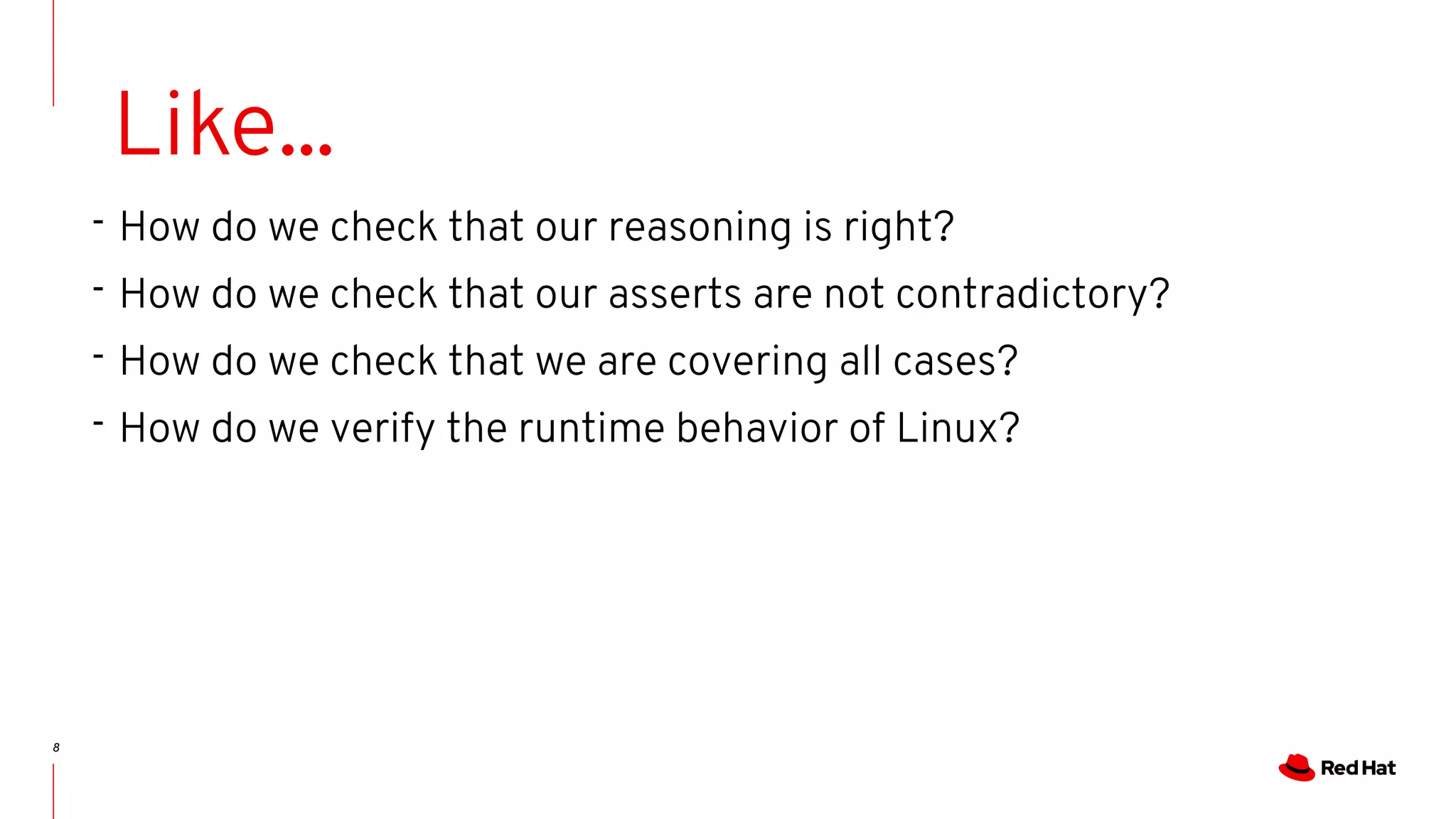
Like...
- How do we check that our reasoning is right?
- How do we check that our asserts are not contradictory?
- How do we check that we are covering all cases?
- How do we verify the runtime behavior of Linux?
9
How do we convince
other communities
about our properties?
10
What computer
scientists say about it?
11
Formal methods!
12
We already have some
examples!
13
But we need a more
“generic” and “intuitive
way” for modeling.
14
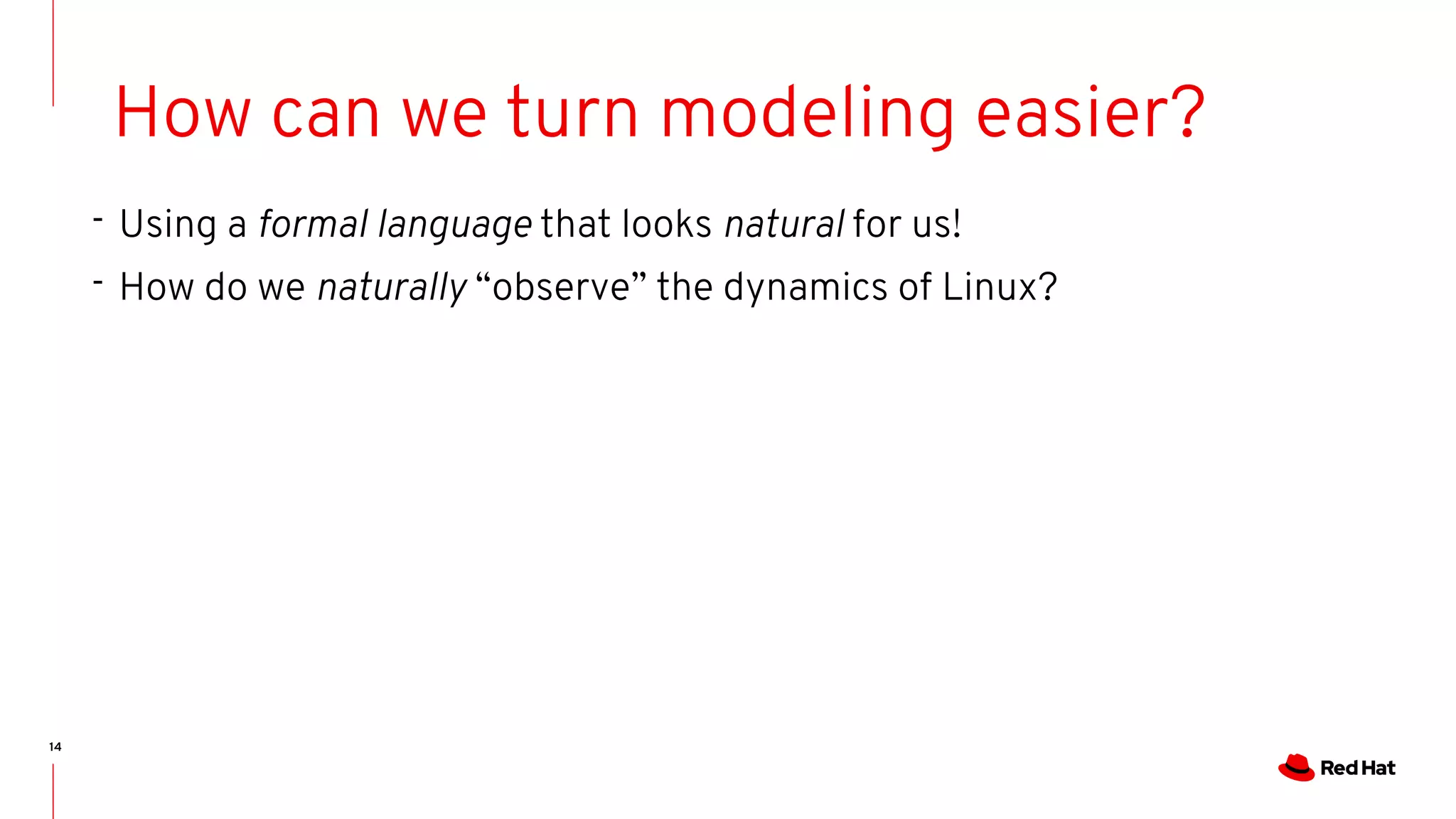
How can we turn modeling easier?
- Using a formal language that looks natural for us!
- How do we naturally “observe” the dynamics of Linux?
15
We trace events!
16
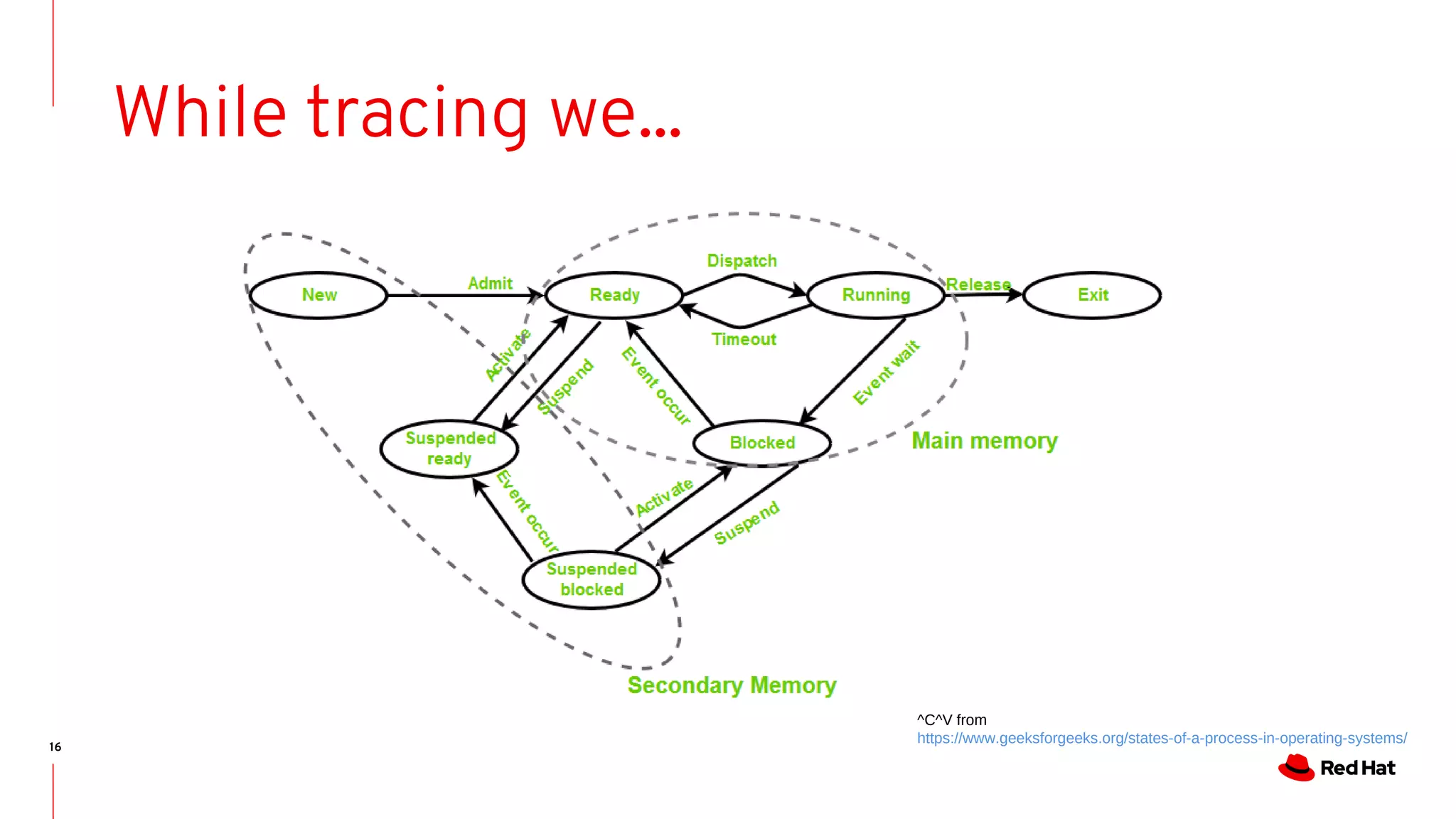
While tracing we...
^C^V from
https://www.geeksforgeeks.org/states-of-a-process-in-operating-systems/
17
State-machines + FM = Automata!
- State machines are Event-driven systems
- Event-driven systems describe the system evolution as trace of events
- As we do for run-time analysis.
tail-5572 [001] ....1.. 2888.401184: preempt_enable: caller=_raw_spin_unlock_irqrestore+0x2a/0x70 parent= (null)
tail-5572 [001] ....1.. 2888.401184: preempt_disable: caller=migrate_disable+0x8b/0x1e0 parent=migrate_disable+0x8b/0x1e0
tail-5572 [001] ....111 2888.401184: preempt_enable: caller=migrate_disable+0x12f/0x1e0 parent=migrate_disable+0x12f/0x1e0
tail-5572 [001] d..h212 2888.401189: local_timer_entry: vector=236
18
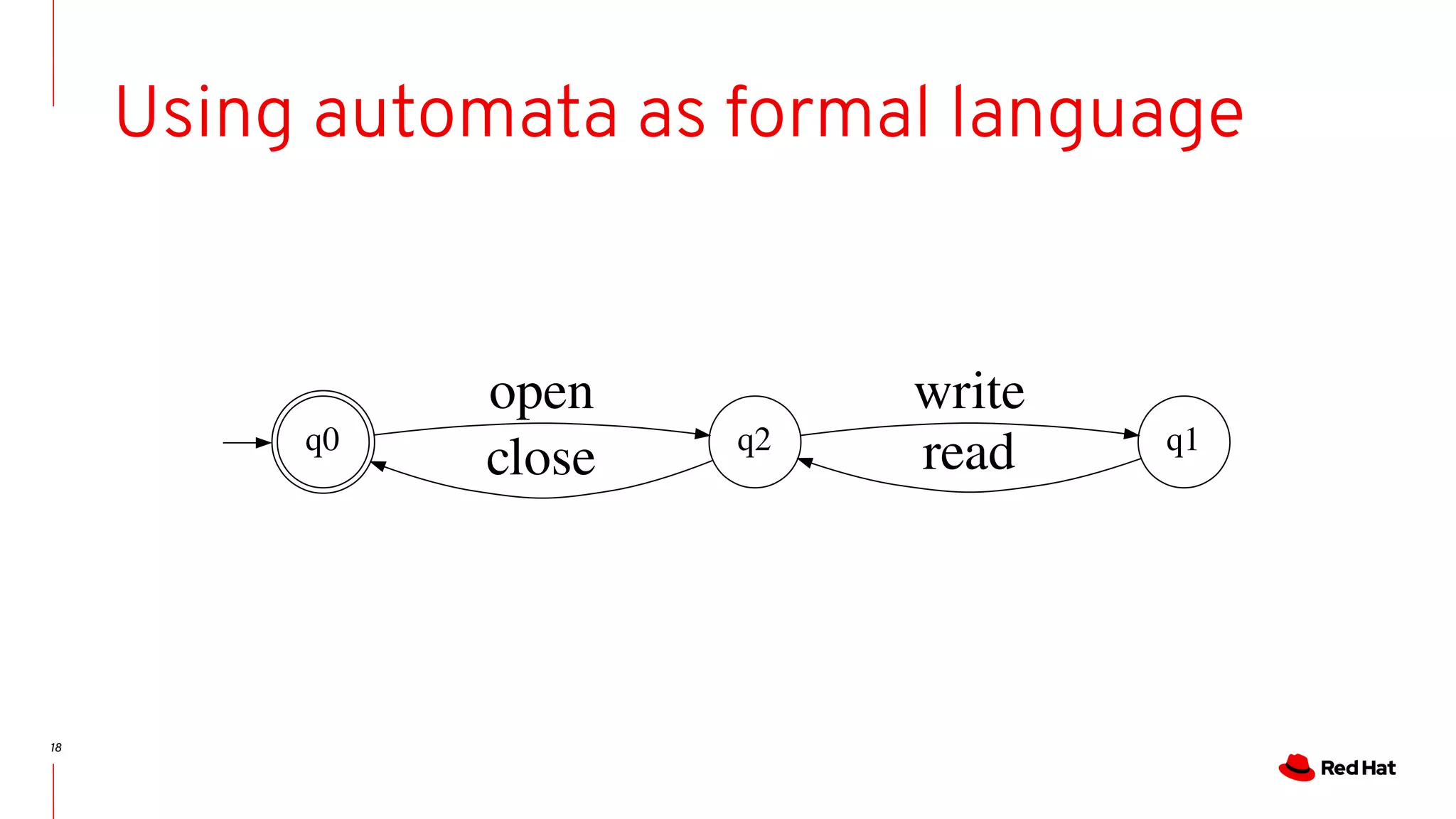
Using automata as formal language
q0 q2
open
q1
readclose
write
19
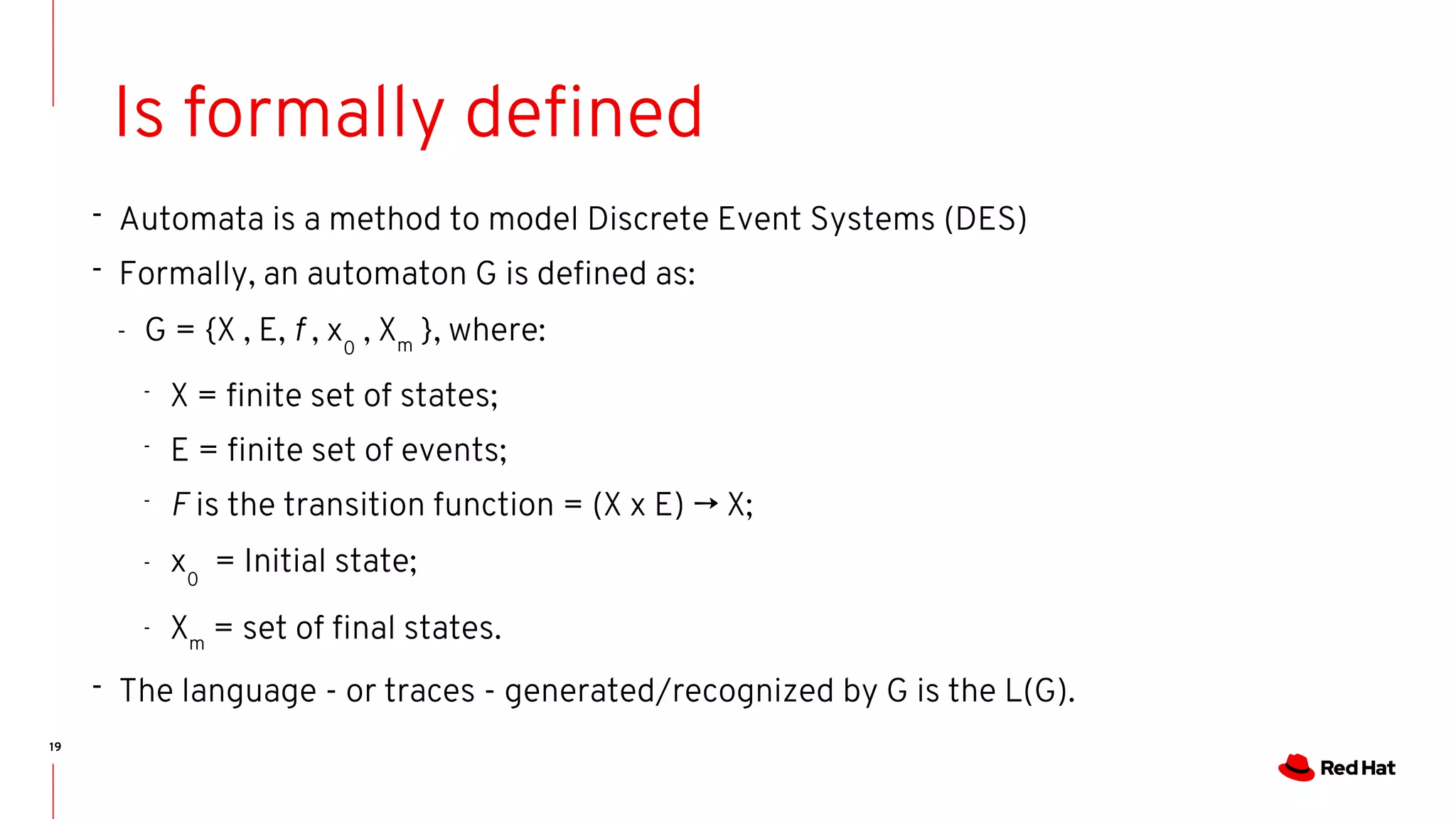
Is formally defined
- Automata is a method to model Discrete Event Systems (DES)
- Formally, an automaton G is defined as:
- G = {X , E, f , x0
, Xm
}, where:
-
X = finite set of states;
-
E = finite set of events;
-
F is the transition function = (X x E) → X;
- x0
= Initial state;
- Xm
= set of final states.
- The language - or traces - generated/recognized by G is the L(G).
20
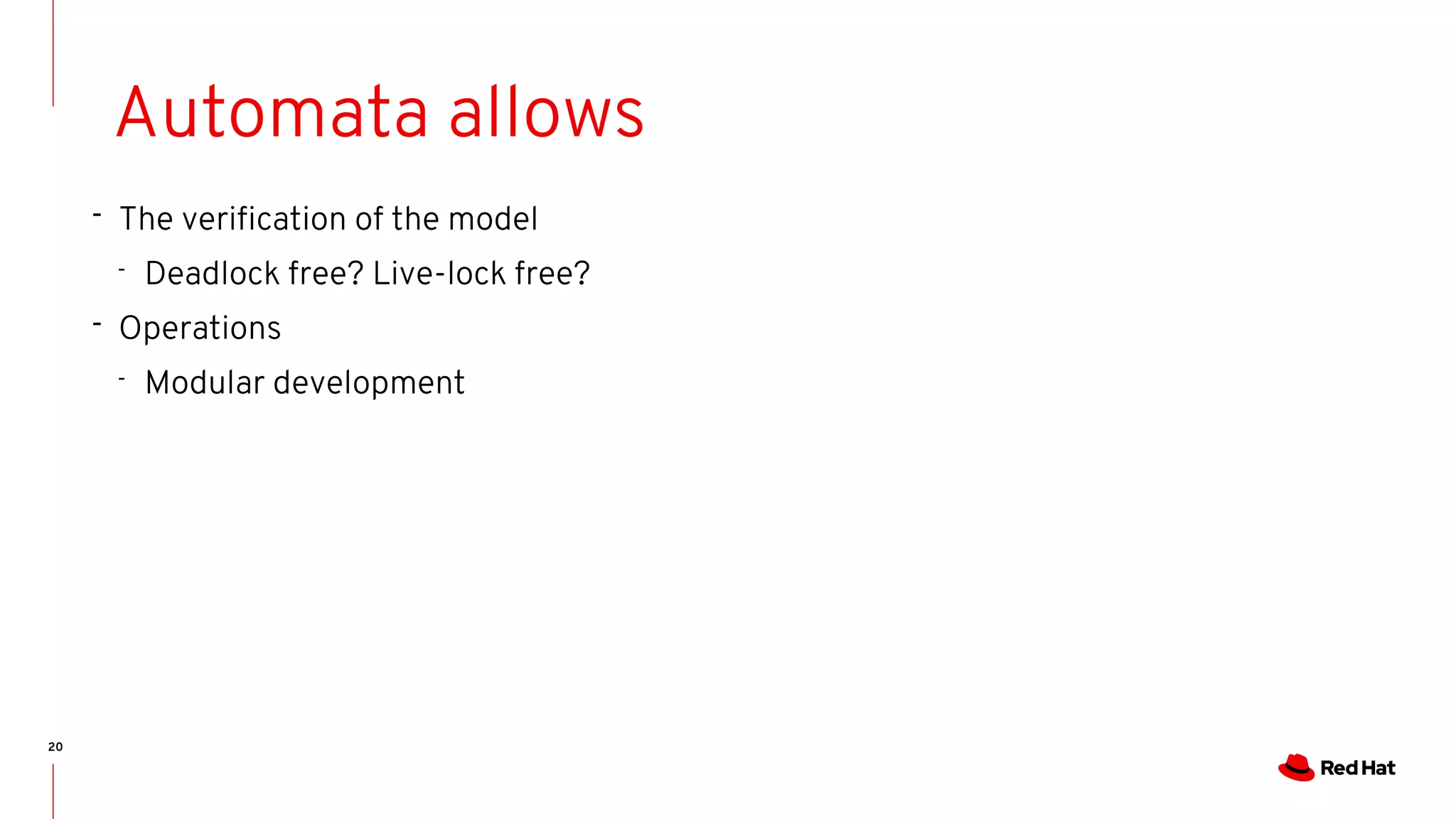
Automata allows
- The verification of the model
- Deadlock free? Live-lock free?
- Operations
- Modular development
21
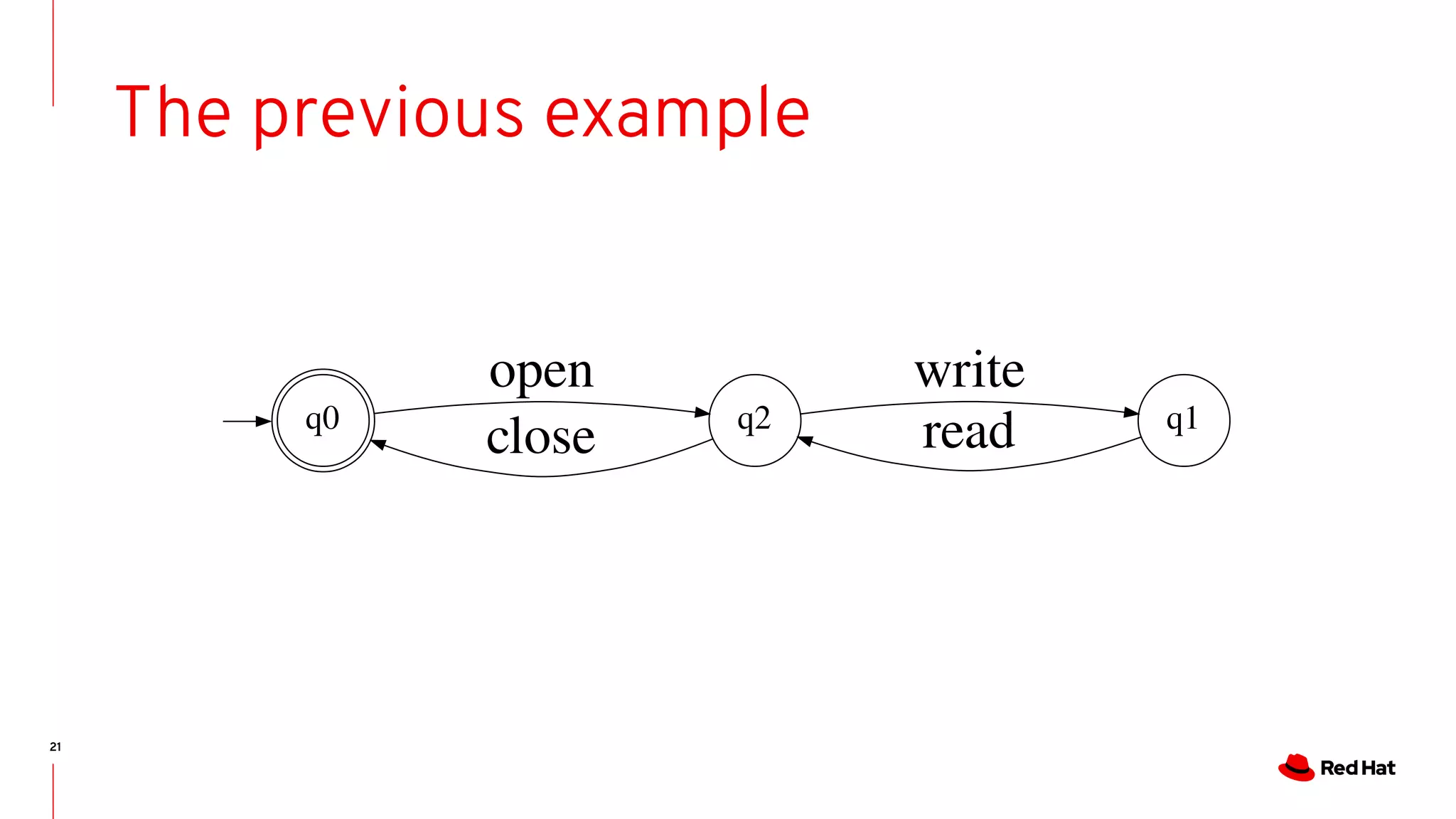
The previous example
q0 q2
open
q1
readclose
write
22
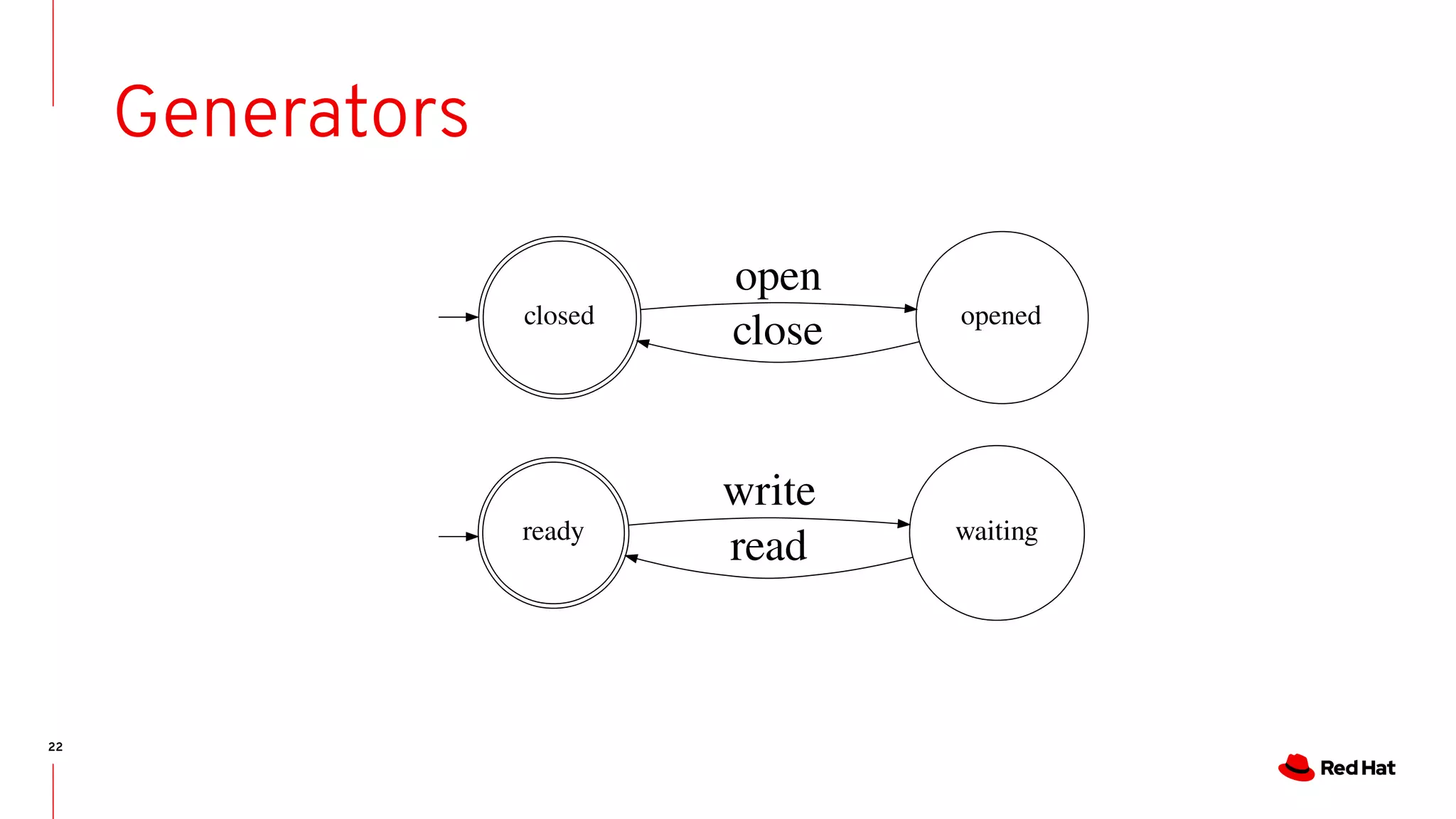
Generators
closed opened
open
close
ready waiting
write
read
23
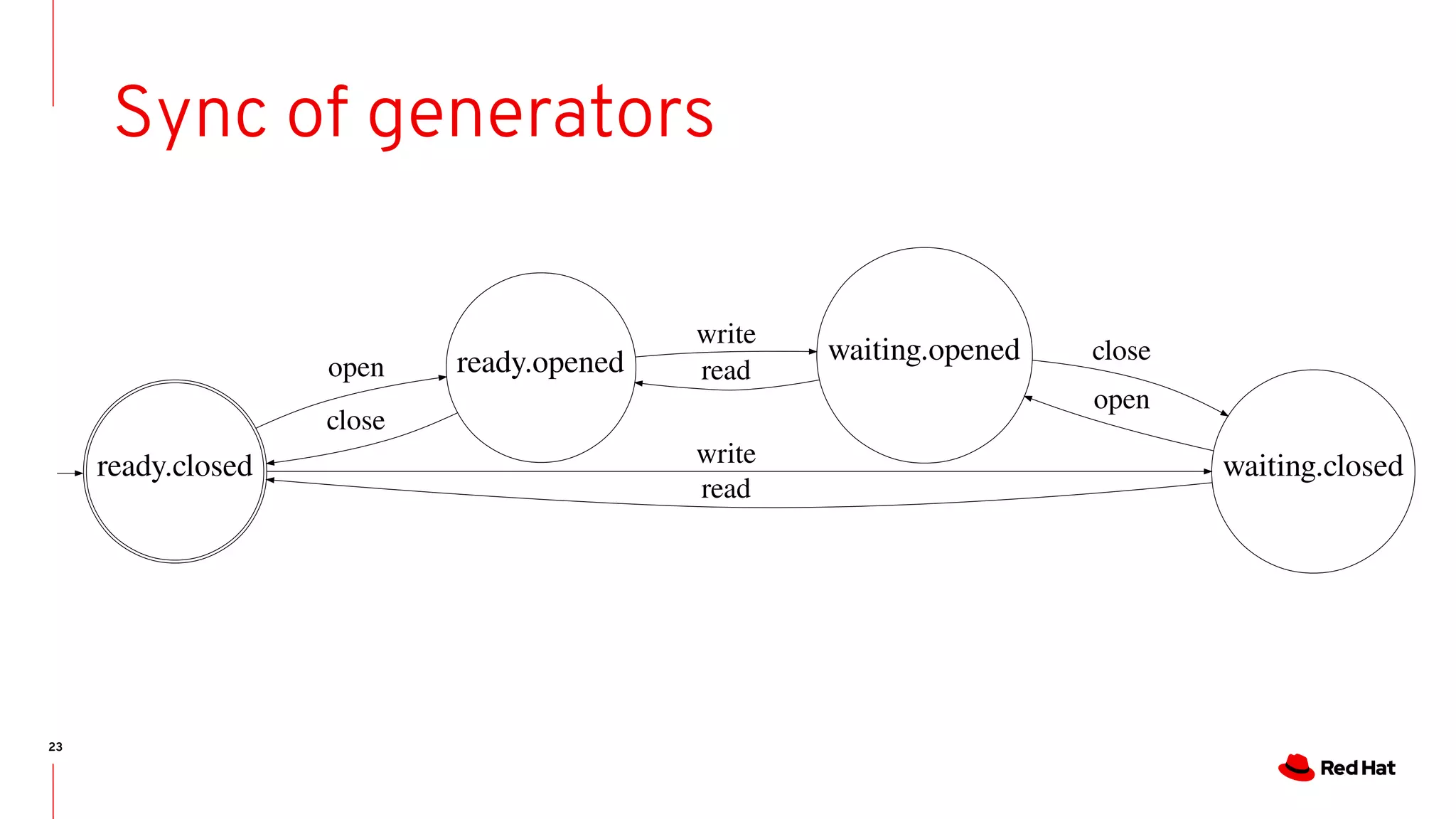
Sync of generators
ready.closed
ready.openedopen
waiting.closedwrite
close
waiting.opened
write
read
open
read
close
24
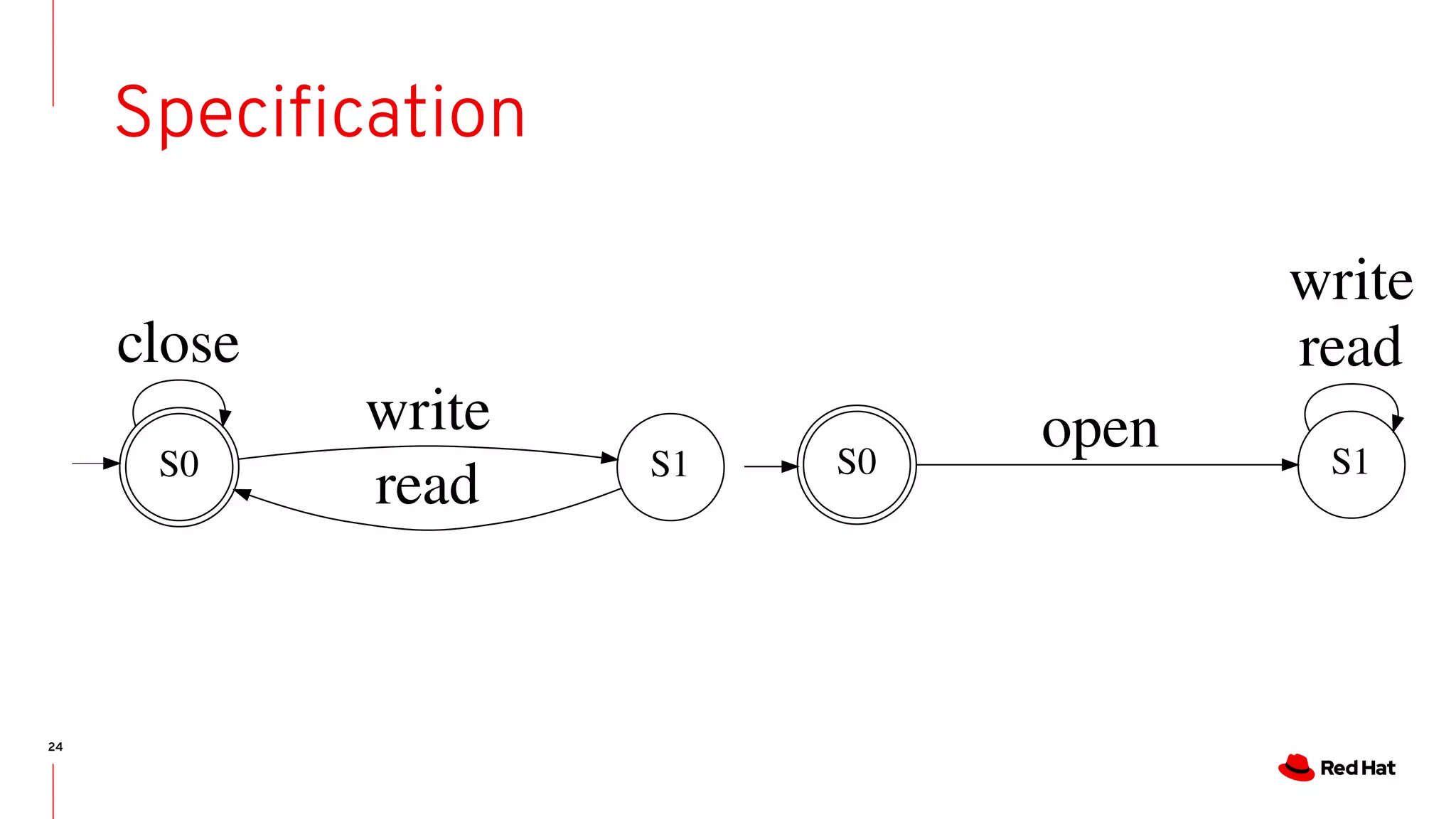
Specification
S0 S1
open
write
read
S0
close
S1
write
read
25
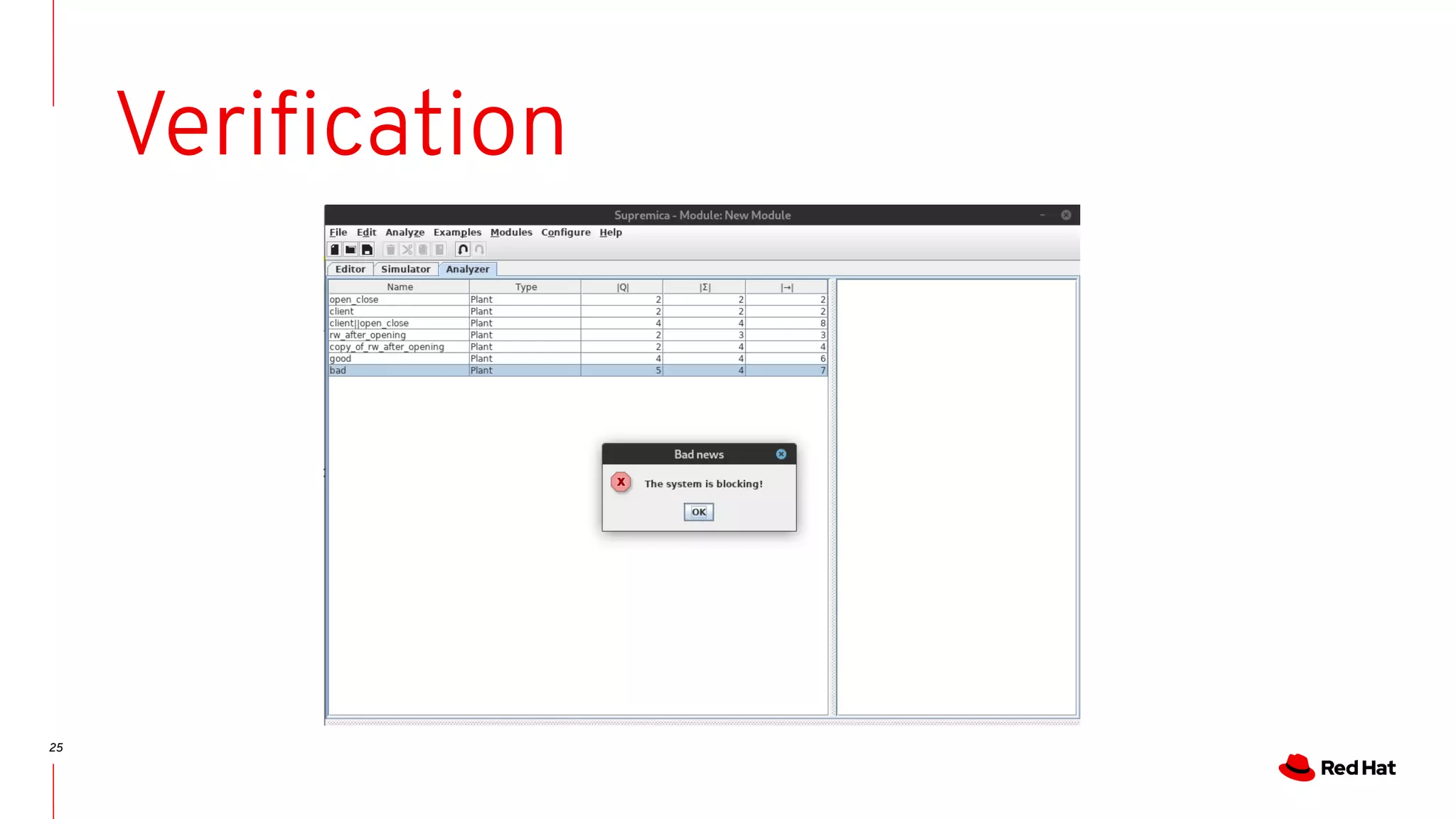
Verification
26
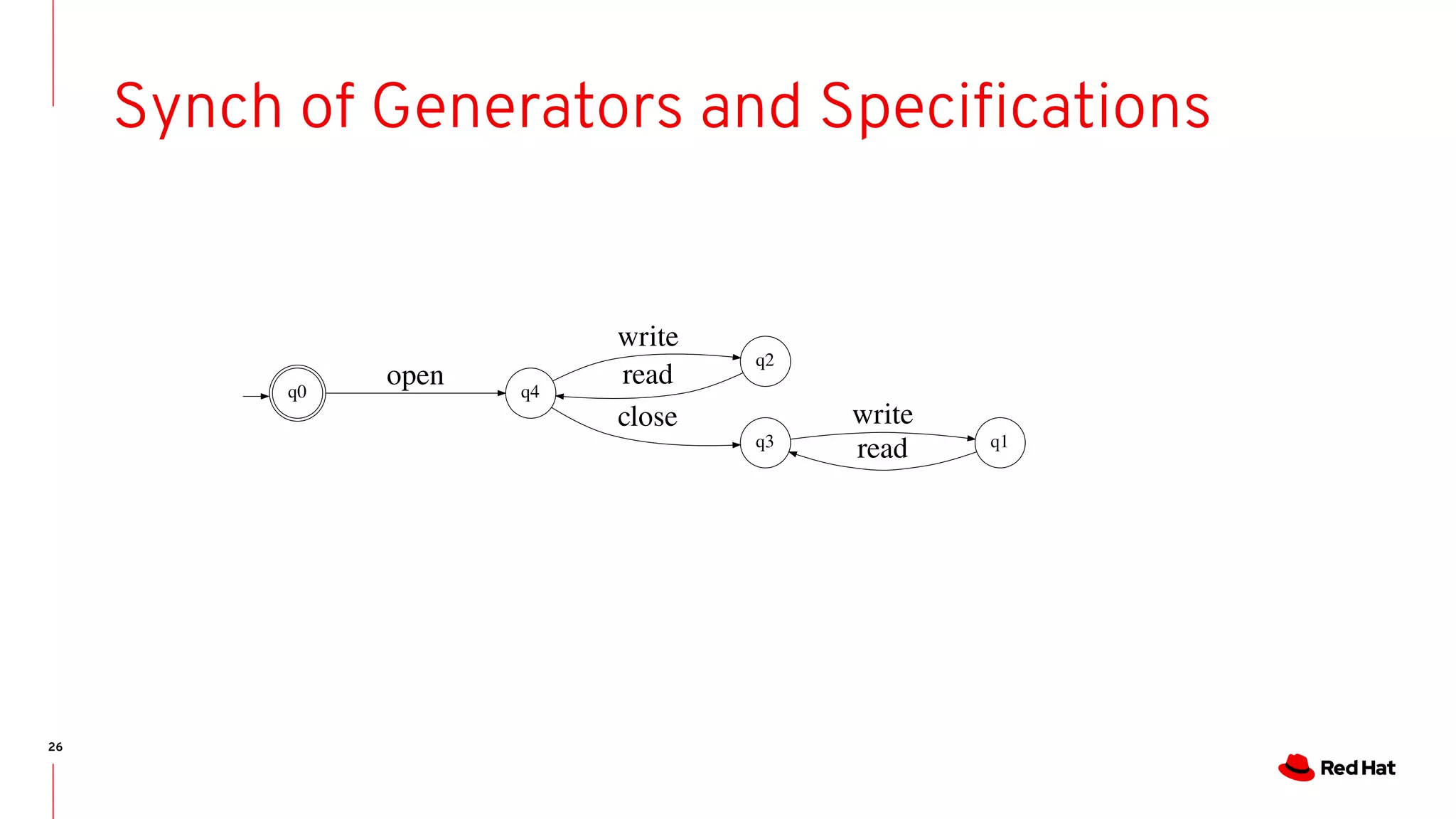
Synch of Generators and Specifications
q0 q4
open
q1q3
read
q2
read
write
write
close
27
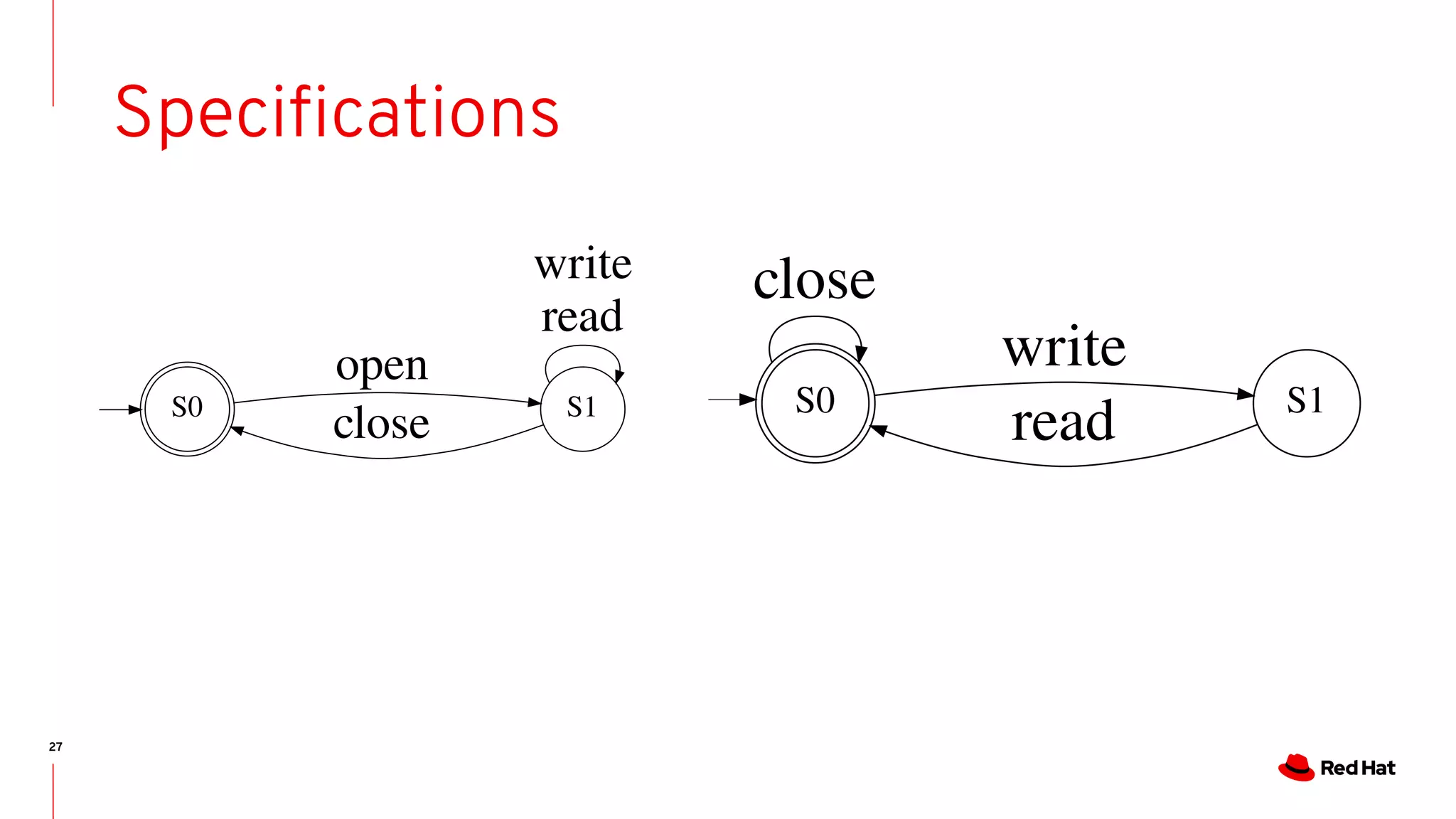
Specifications
S0 S1
open
close
write
read
S0
close
S1
write
read
28
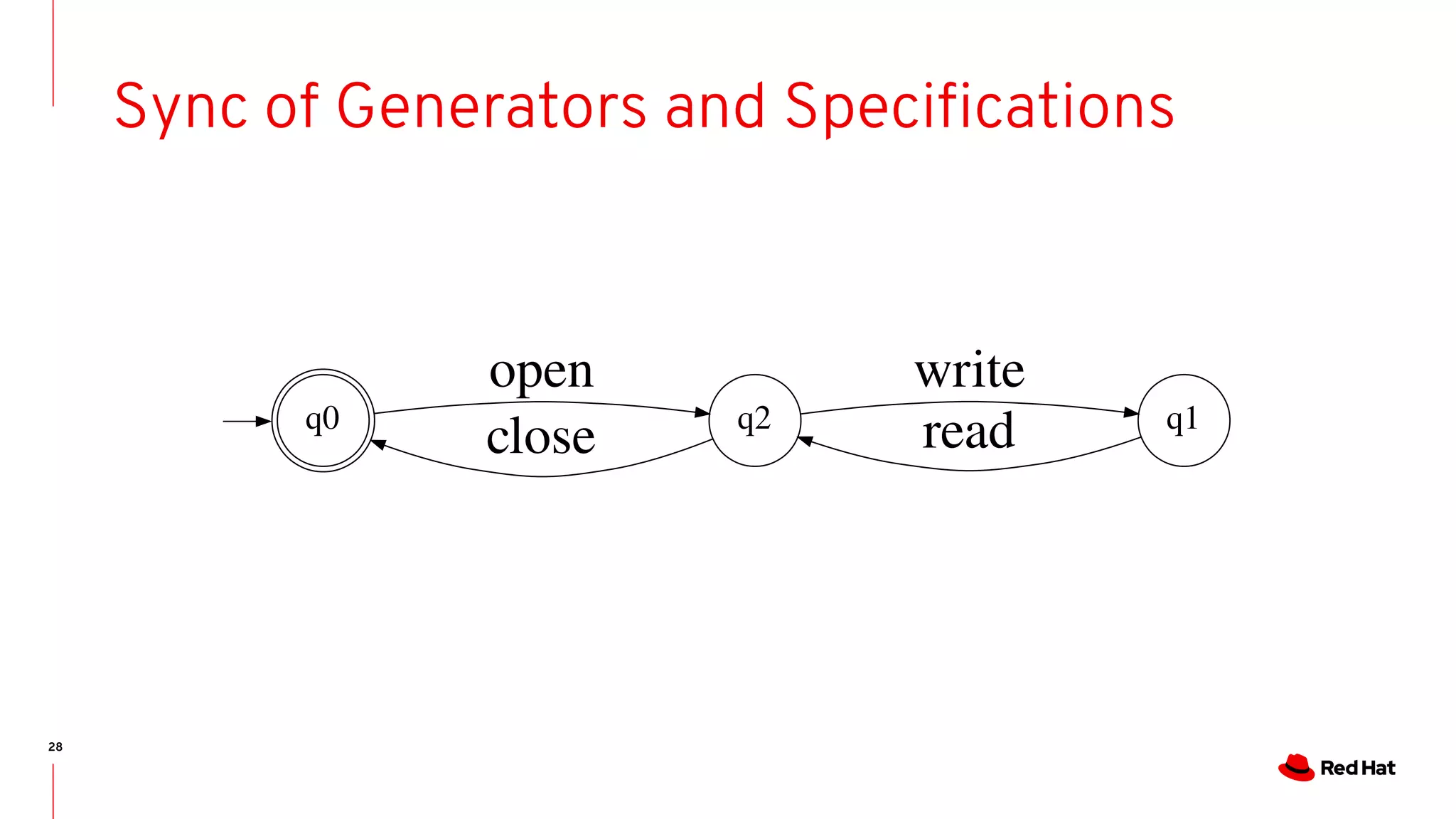
Sync of Generators and Specifications
q0 q2
open
q1
readclose
write
29
Why not just draw it?
30
Linux is Complex!
31
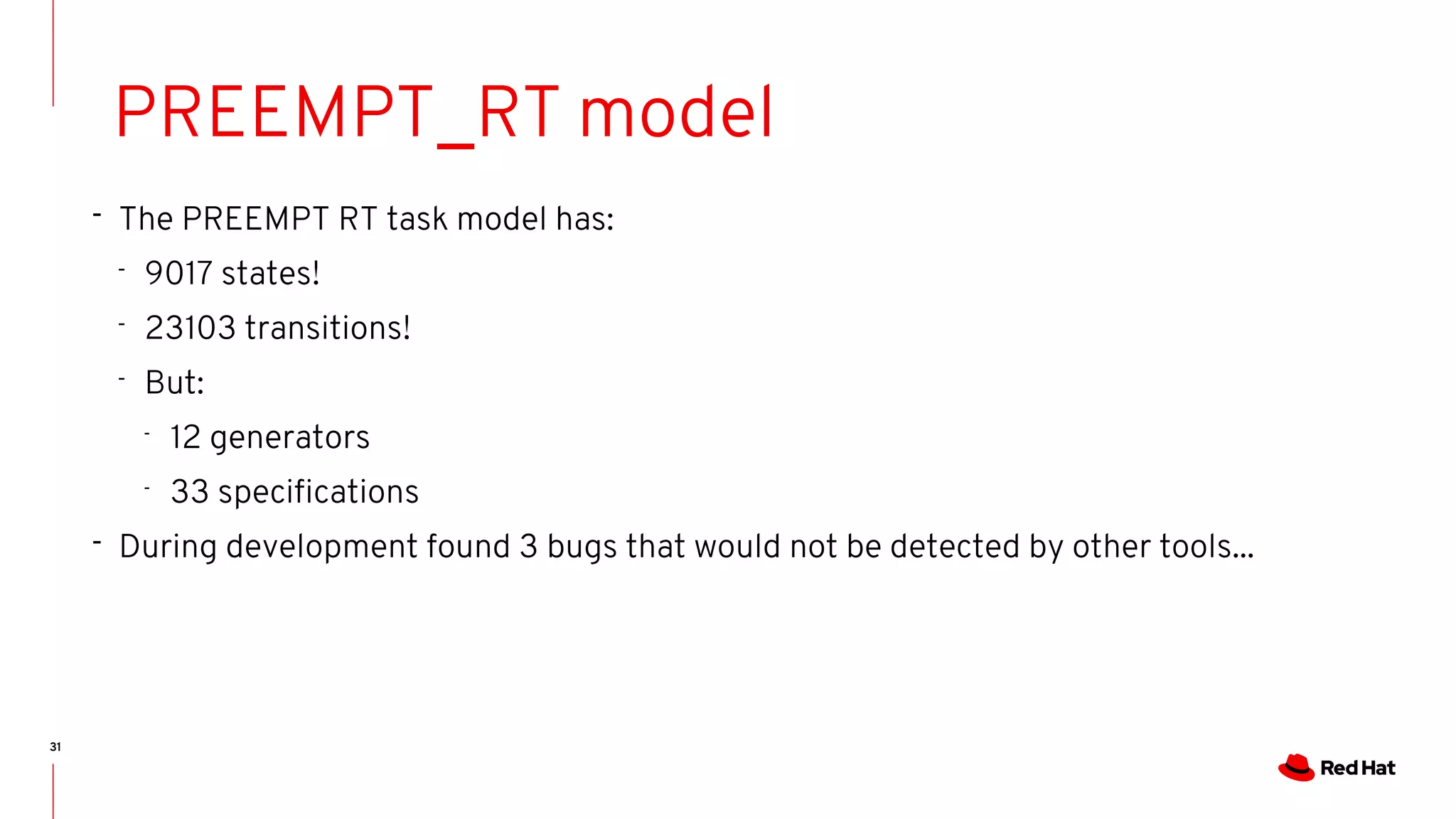
PREEMPT_RT model
- The PREEMPT RT task model has:
- 9017 states!
- 23103 transitions!
- But:
-
12 generators
-
33 specifications
- During development found 3 bugs that would not be detected by other tools...
32
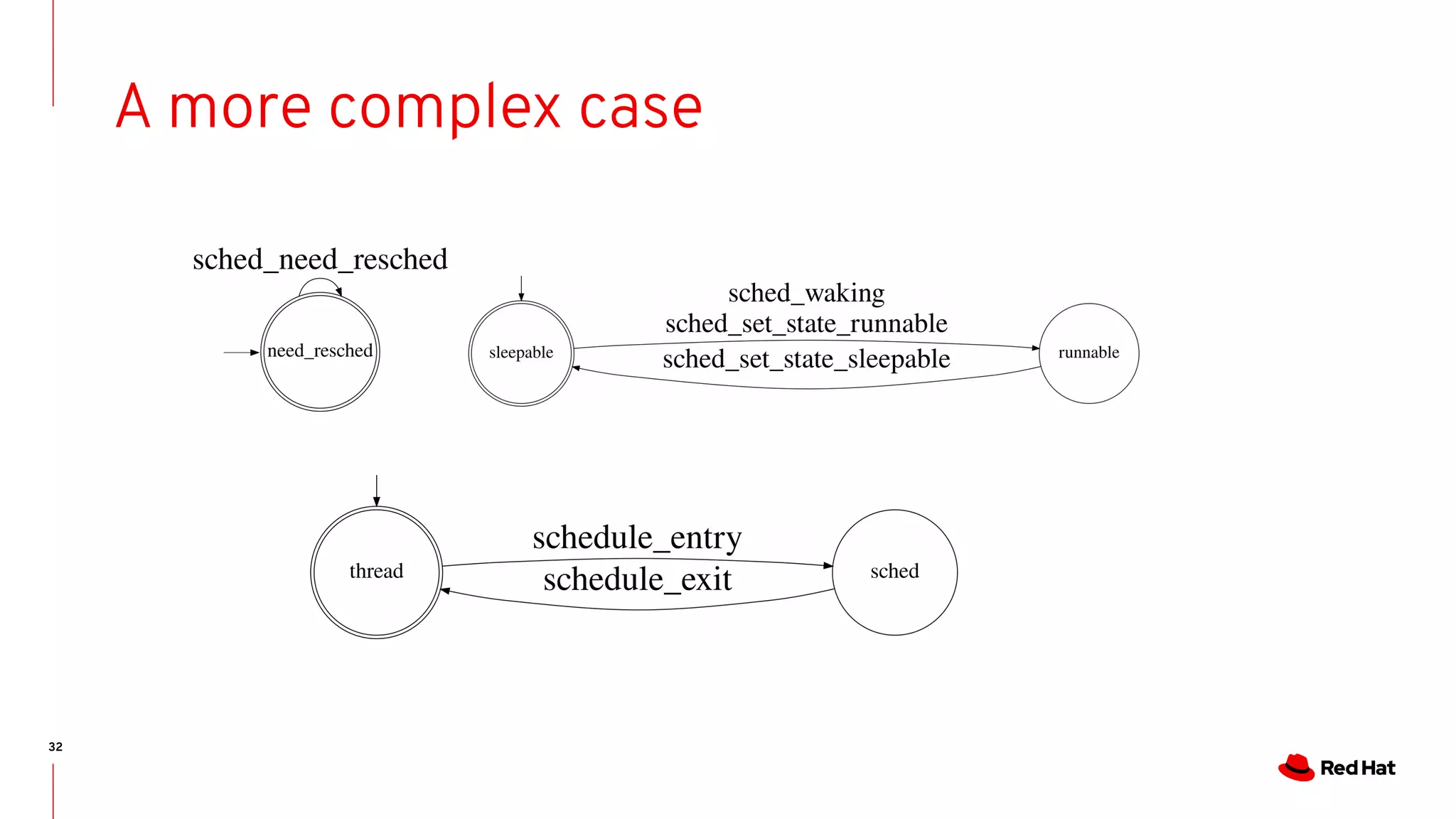
A more complex case
33
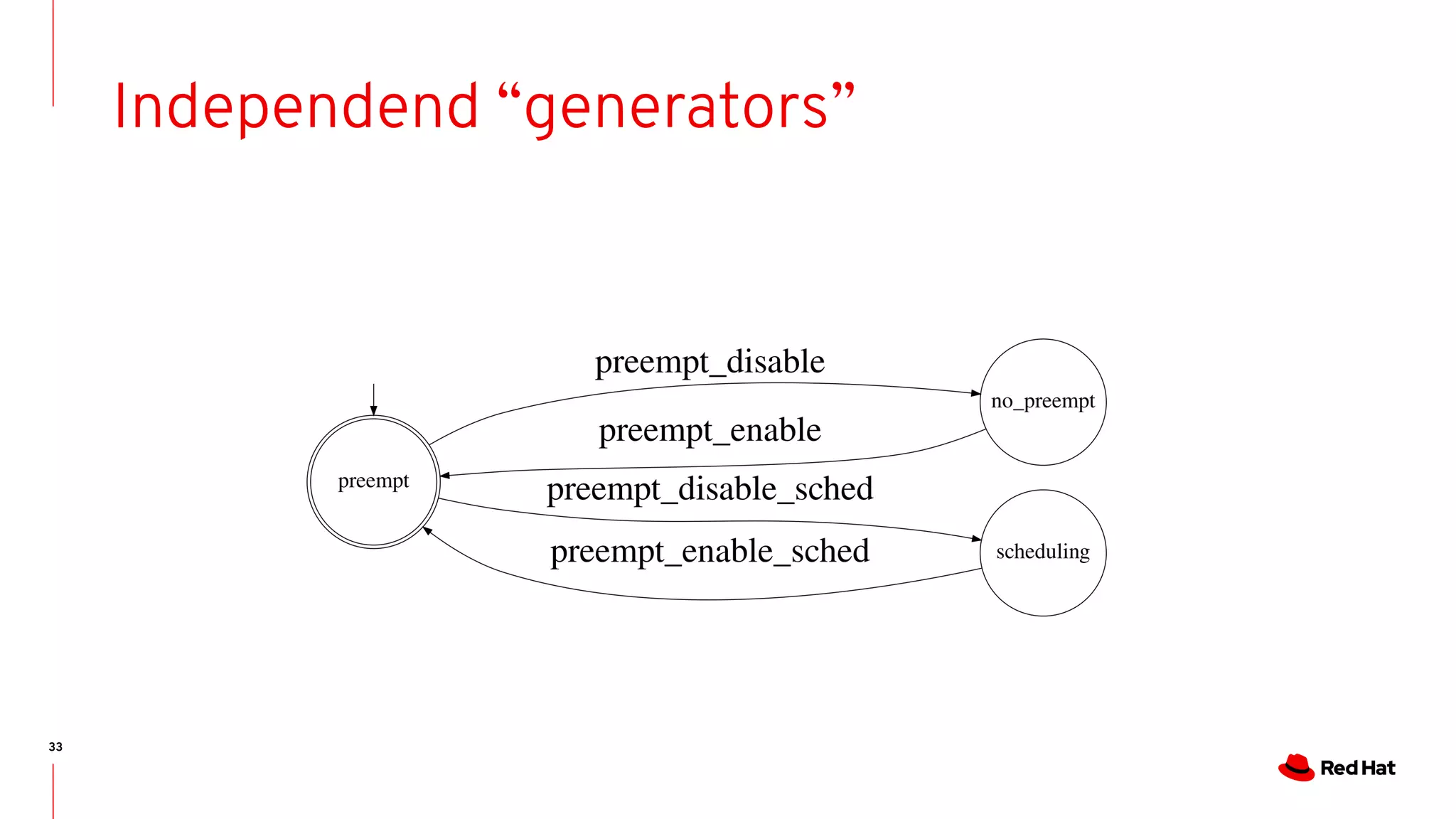
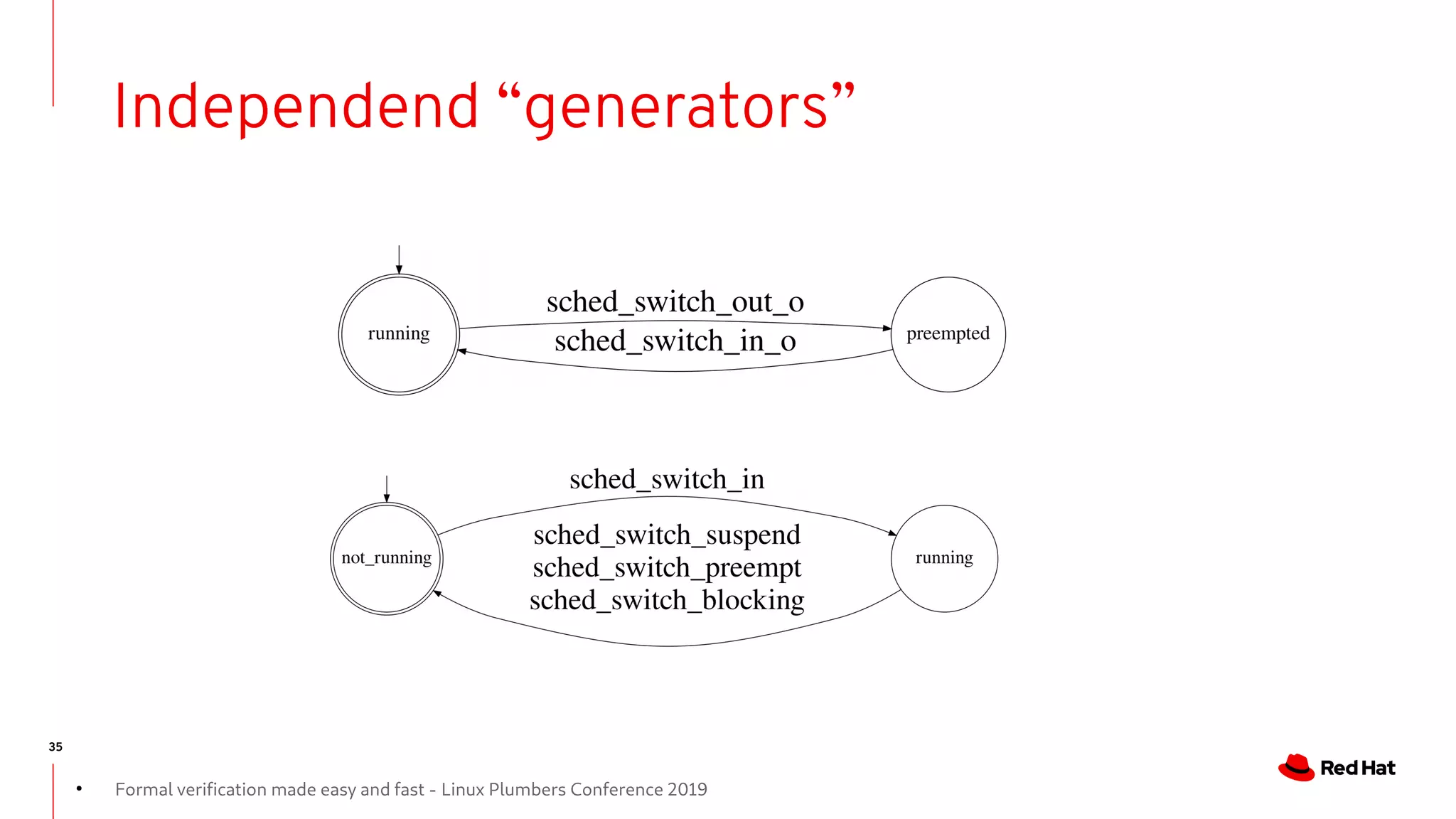
Independend “generators”
34
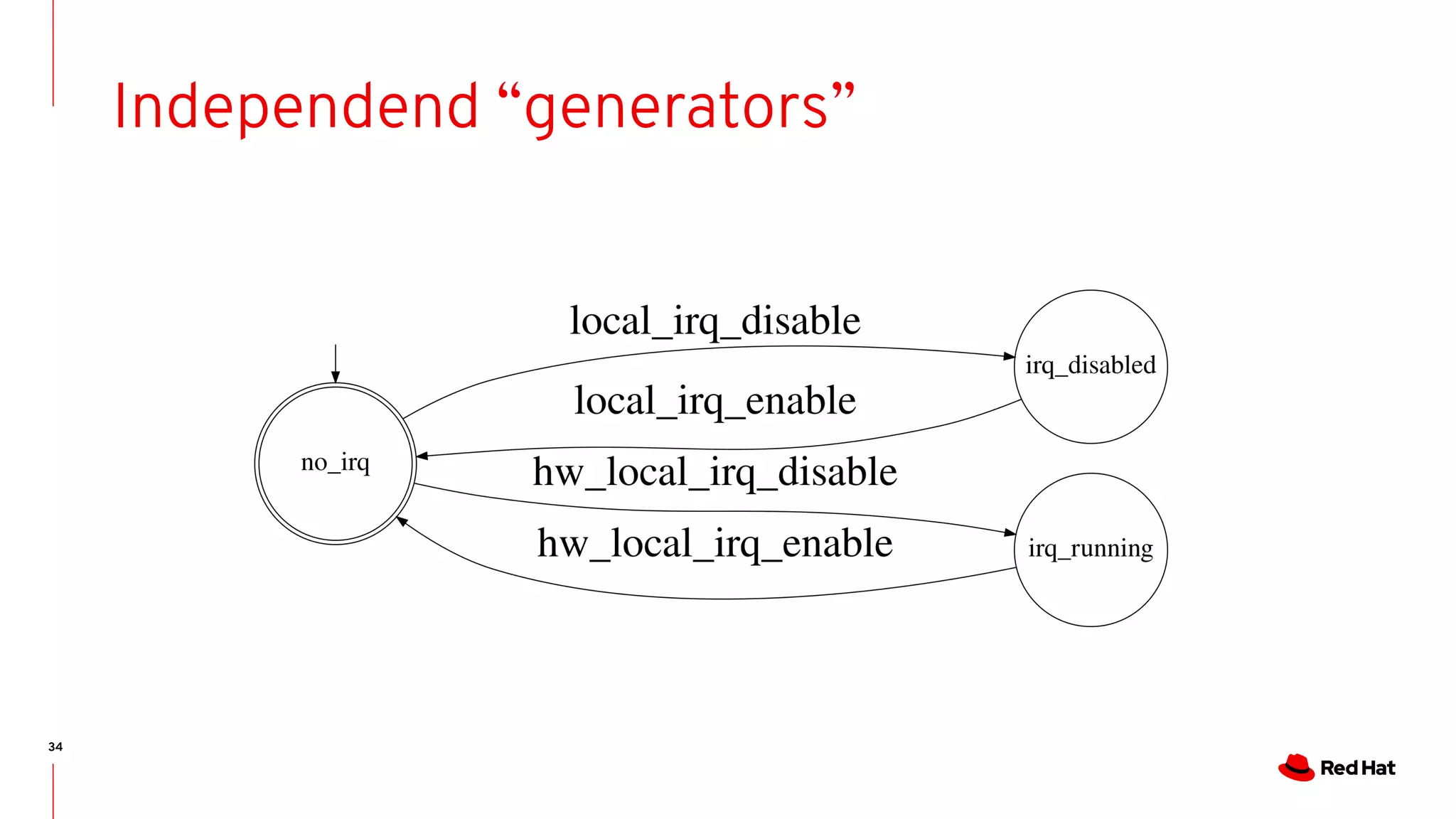
Independend “generators”
35
●
Formal verification made easy and fast - Linux Plumbers Conference 2019
Independend “generators”
36
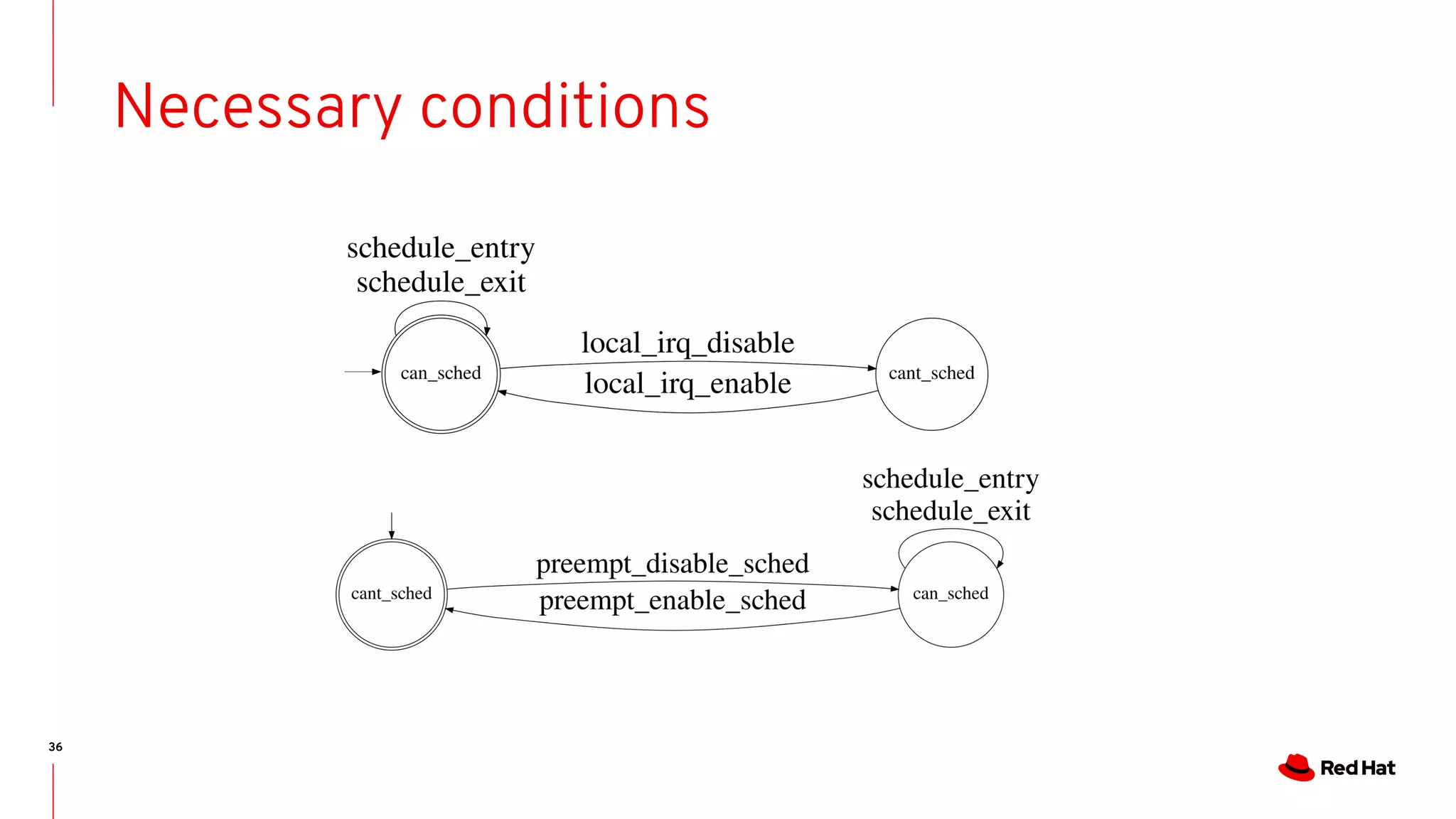
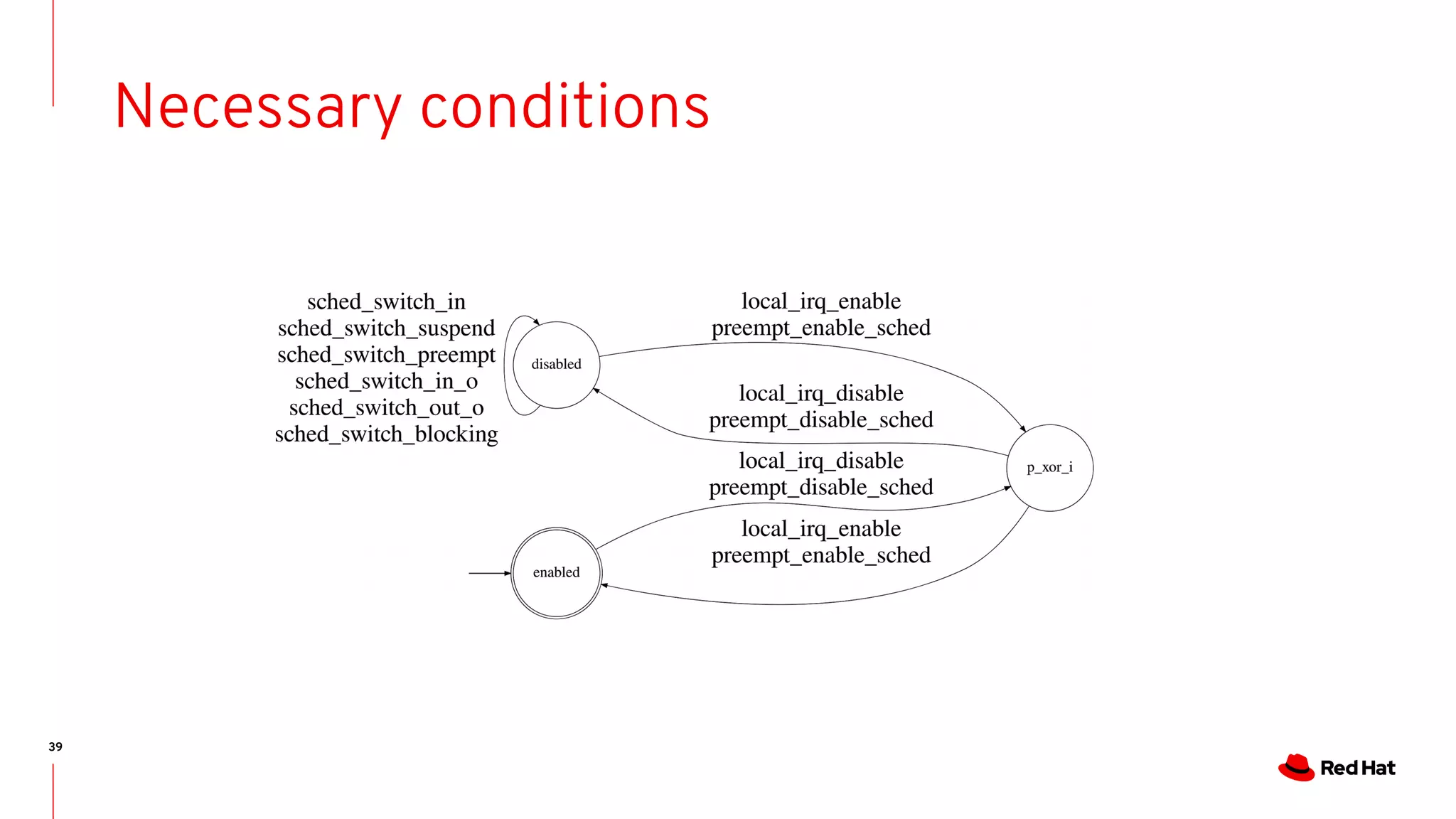
Necessary conditions
37
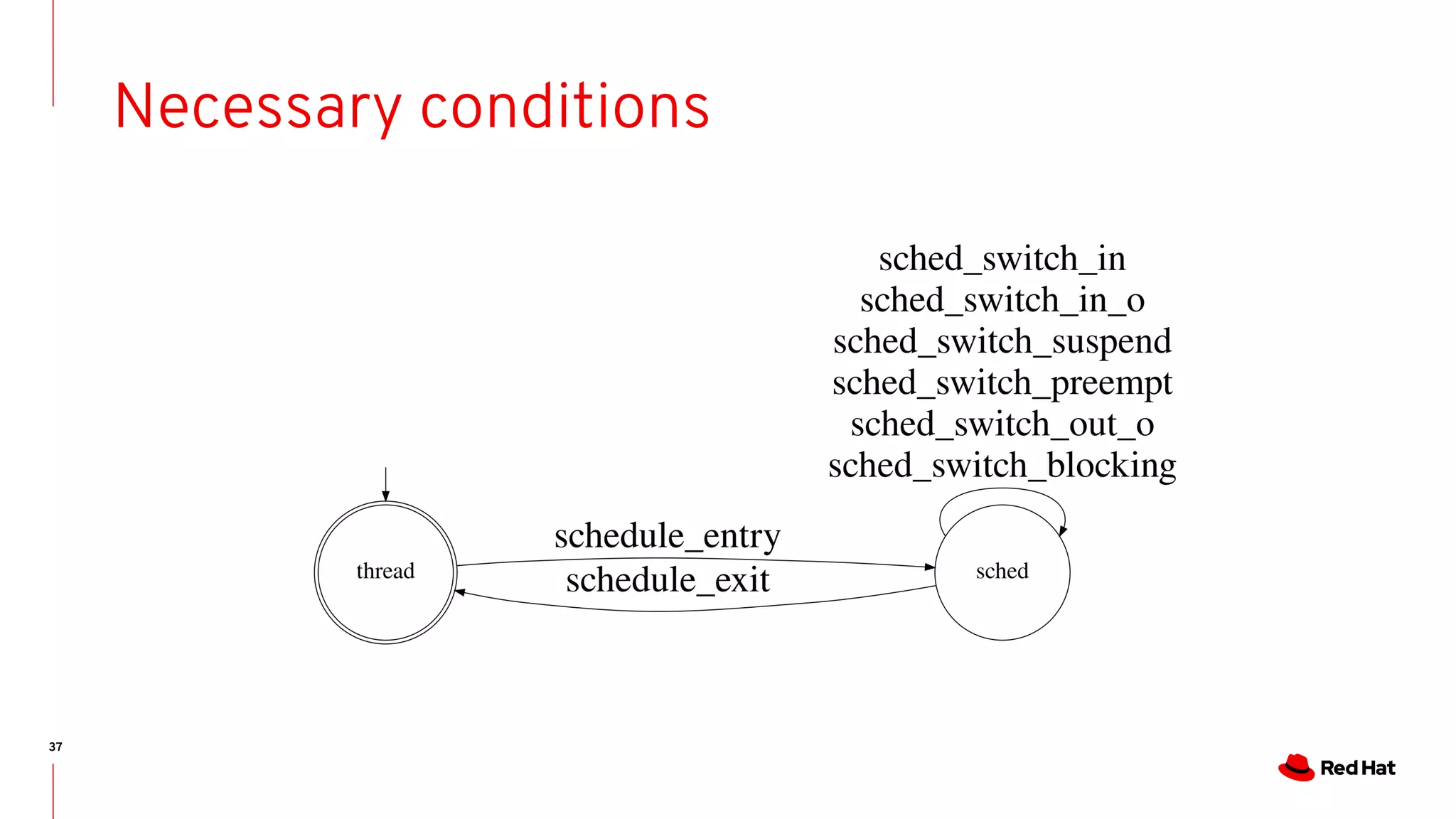
Necessary conditions
38
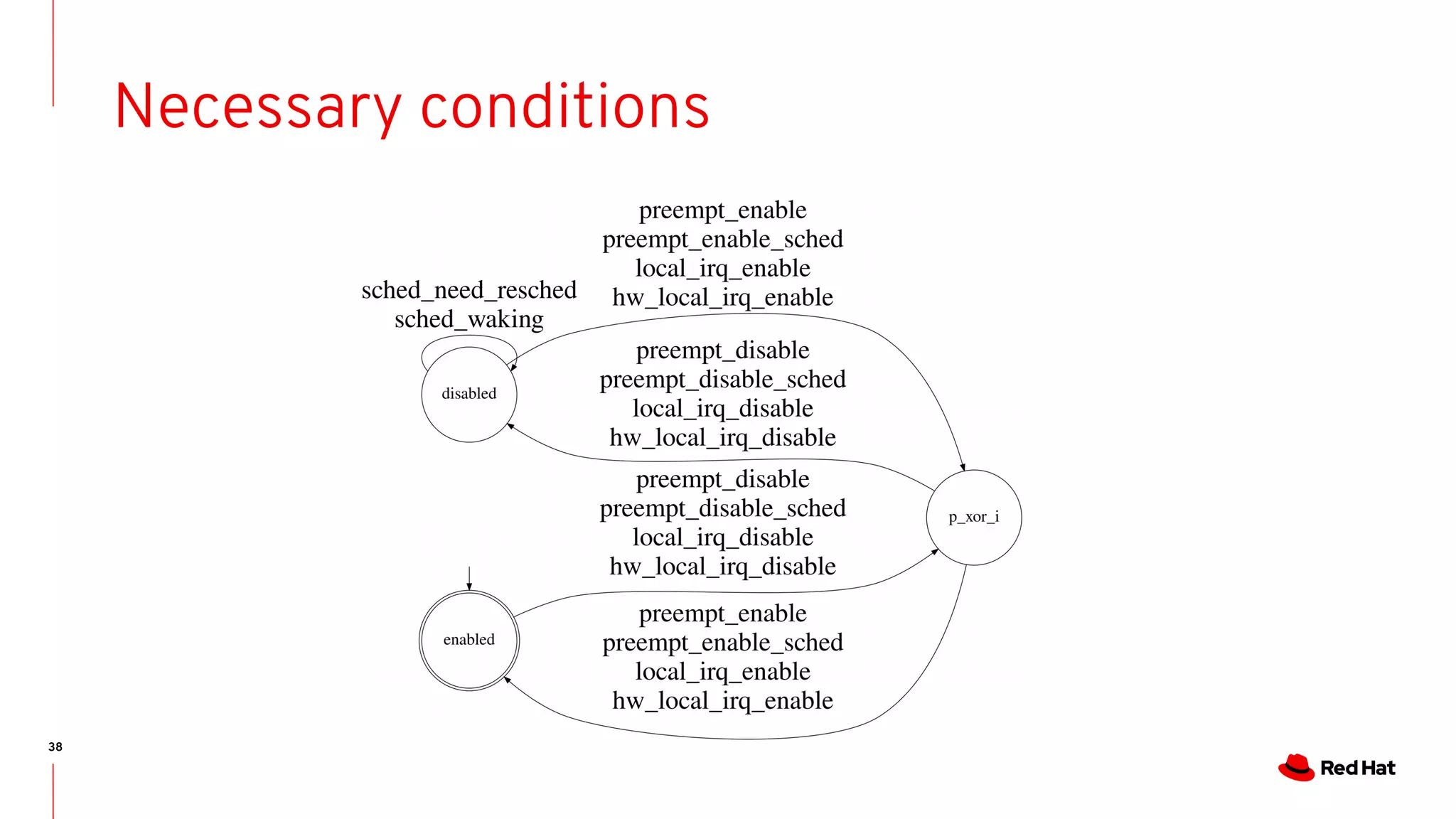
Necessary conditions
39
Necessary conditions
40
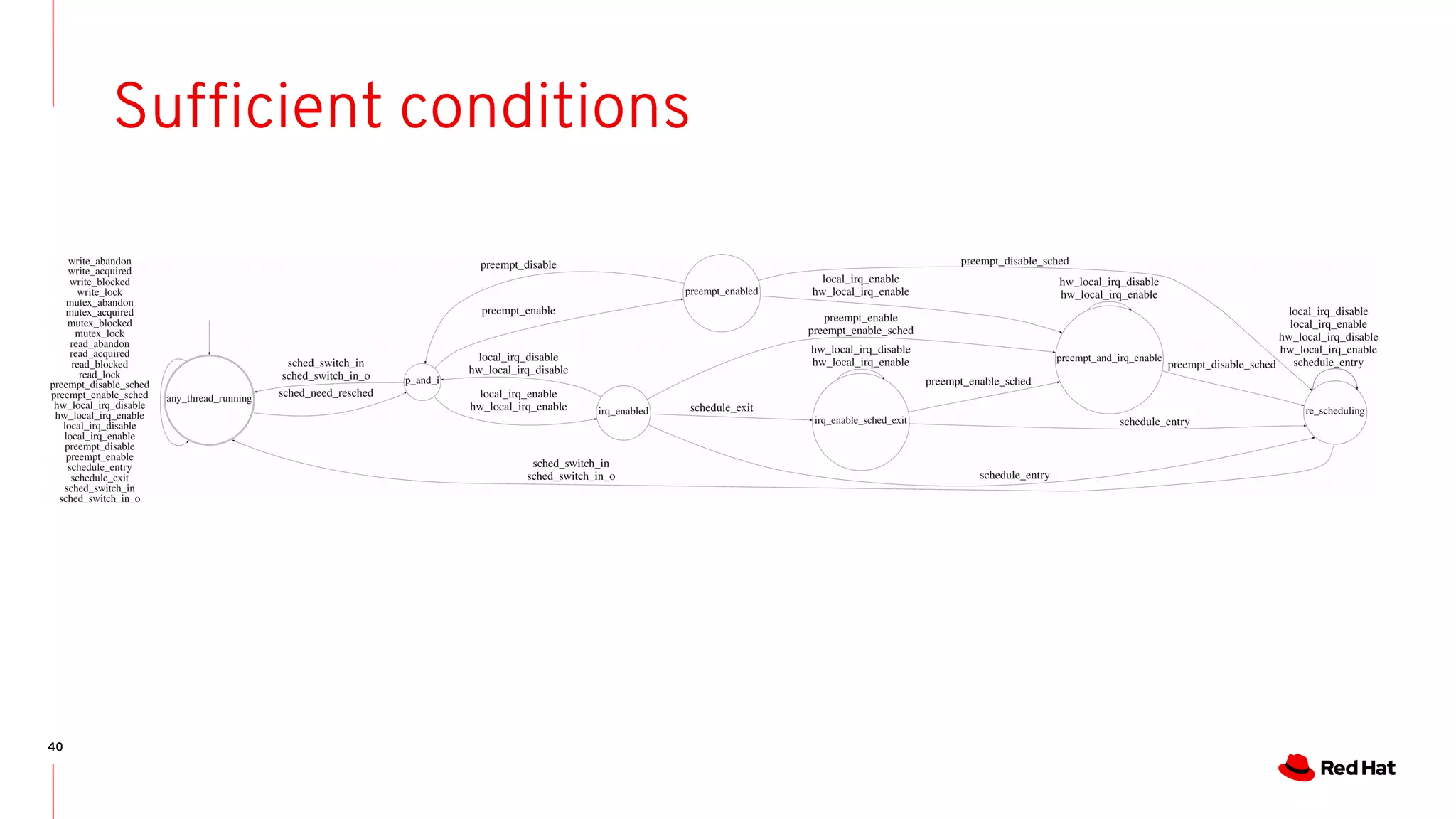
Sufficient conditions
41
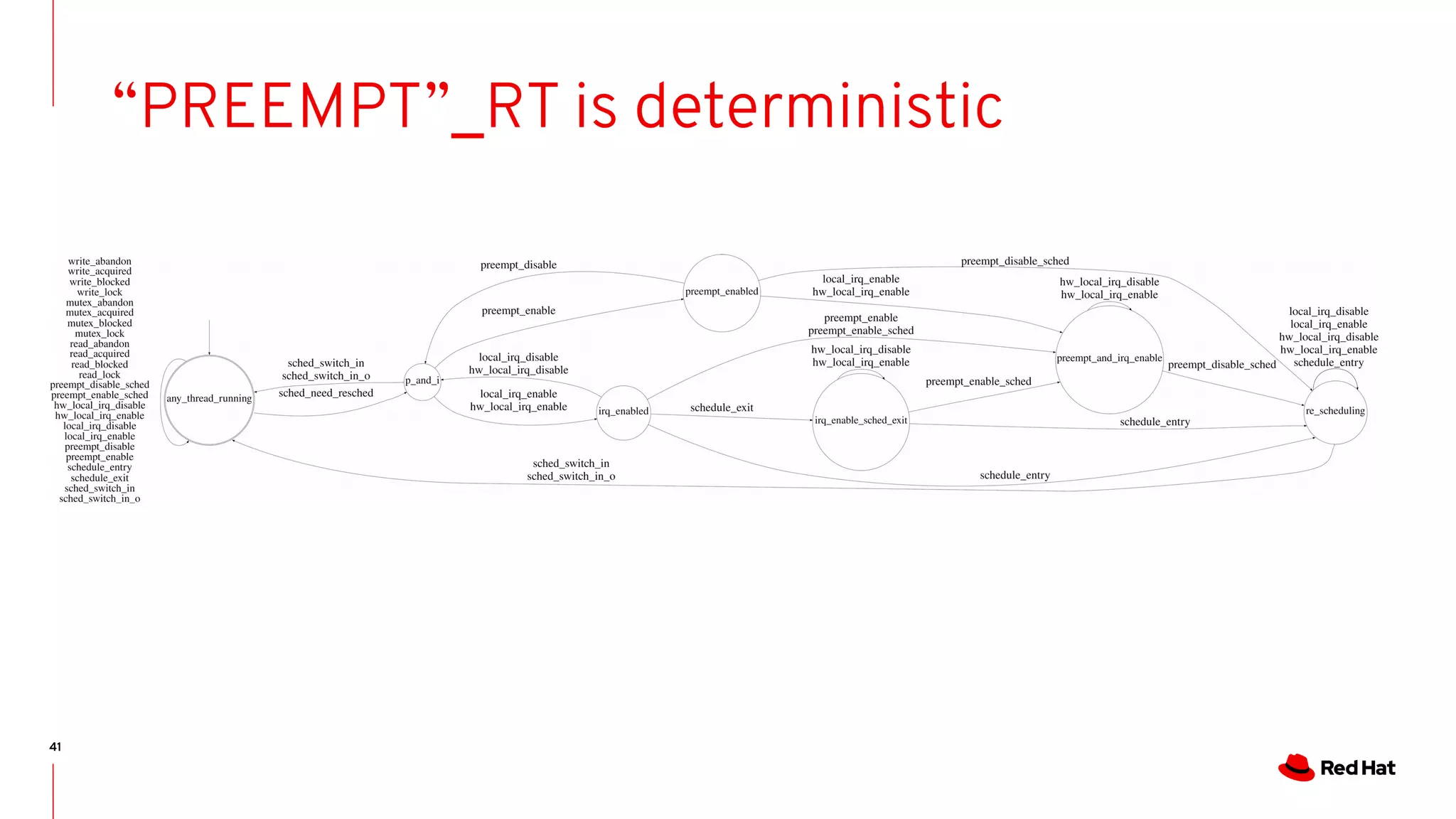
“PREEMPT”_RT is deterministic
42
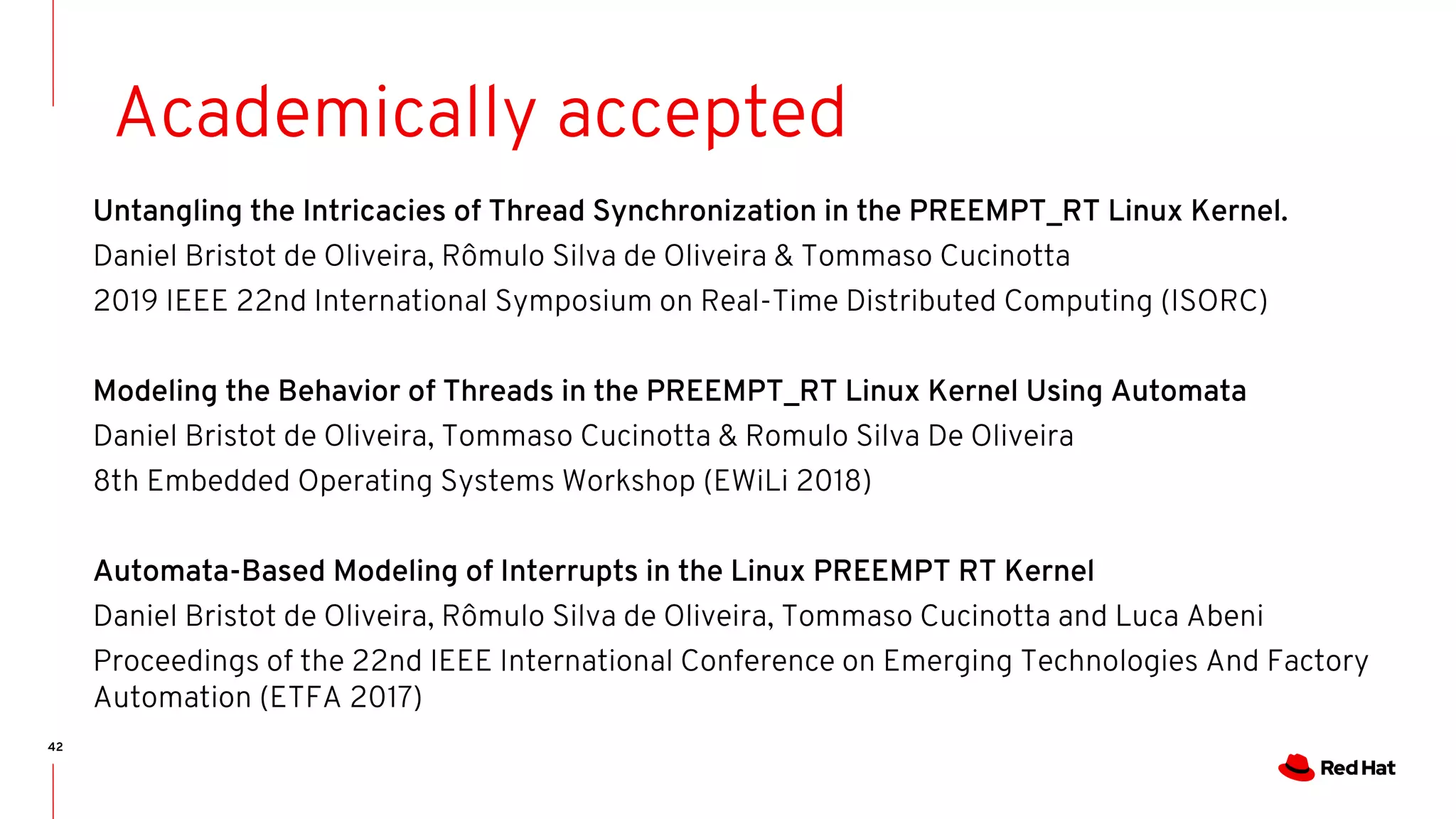
Academically accepted
Untangling the Intricacies of Thread Synchronization in the PREEMPT_RT Linux Kernel.
Daniel Bristot de Oliveira, Rômulo Silva de Oliveira & Tommaso Cucinotta
2019 IEEE 22nd International Symposium on Real-Time Distributed Computing (ISORC)
Modeling the Behavior of Threads in the PREEMPT_RT Linux Kernel Using Automata
Daniel Bristot de Oliveira, Tommaso Cucinotta & Romulo Silva De Oliveira
8th Embedded Operating Systems Workshop (EWiLi 2018)
Automata-Based Modeling of Interrupts in the Linux PREEMPT RT Kernel
Daniel Bristot de Oliveira, Rômulo Silva de Oliveira, Tommaso Cucinotta and Luca Abeni
Proceedings of the 22nd IEEE International Conference on Emerging Technologies And Factory
Automation (ETFA 2017)
43
How to verify that the
system _behaves_?
44
Comparing system
execution against the
model!
45
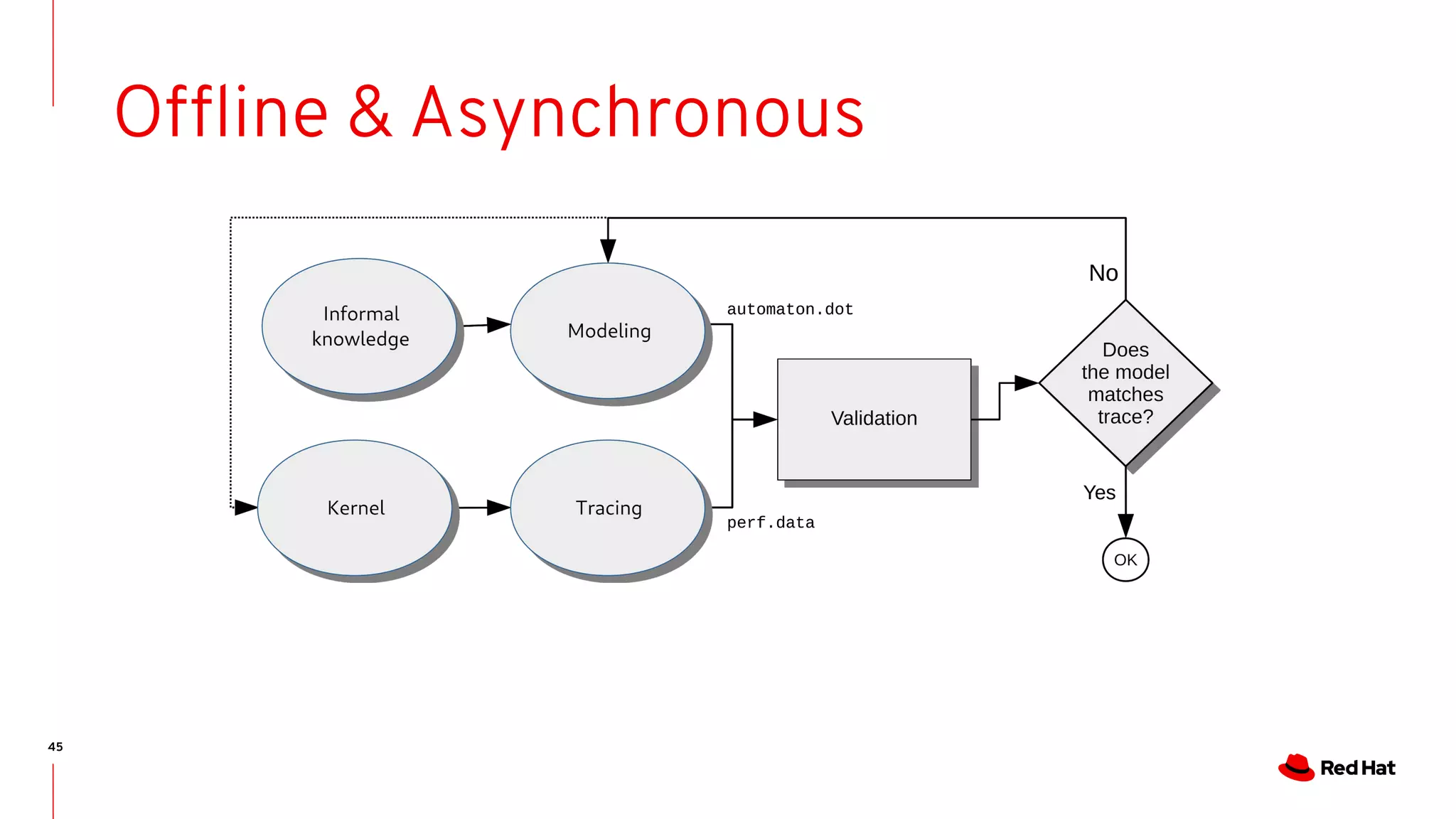
Offline & Asynchronous
46
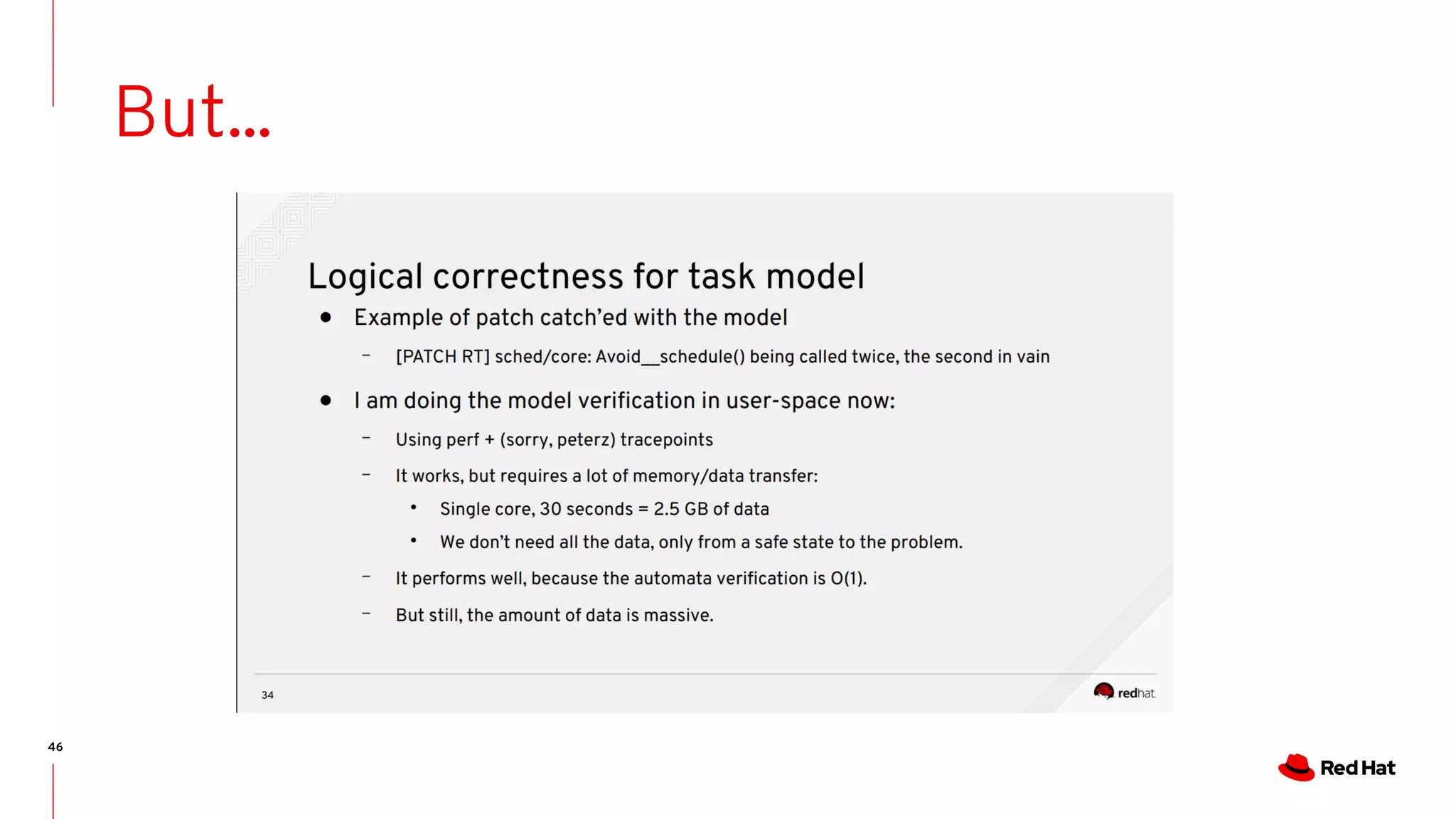
But...
47
What can we do?
48
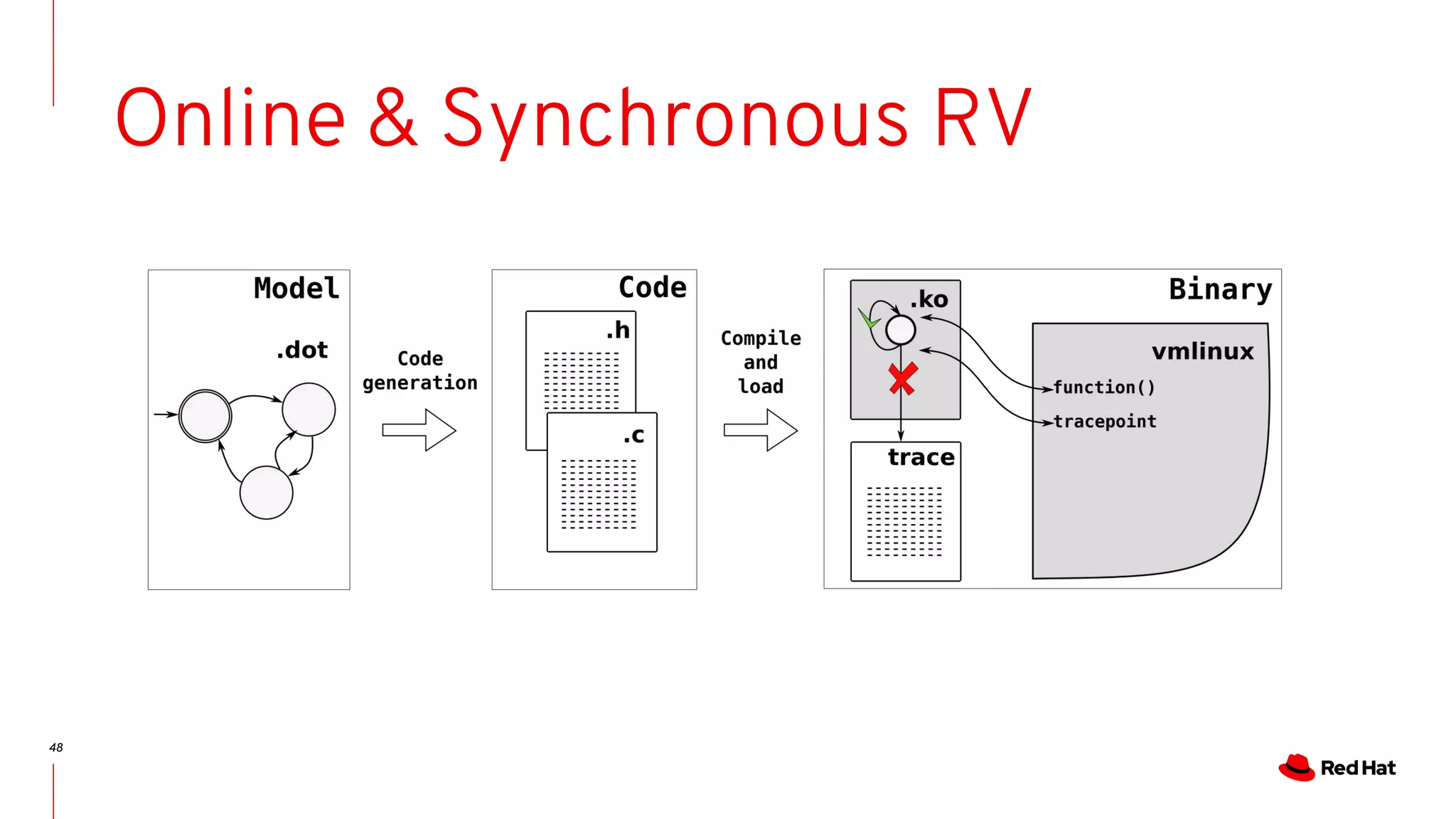
Online & Synchronous RV
49
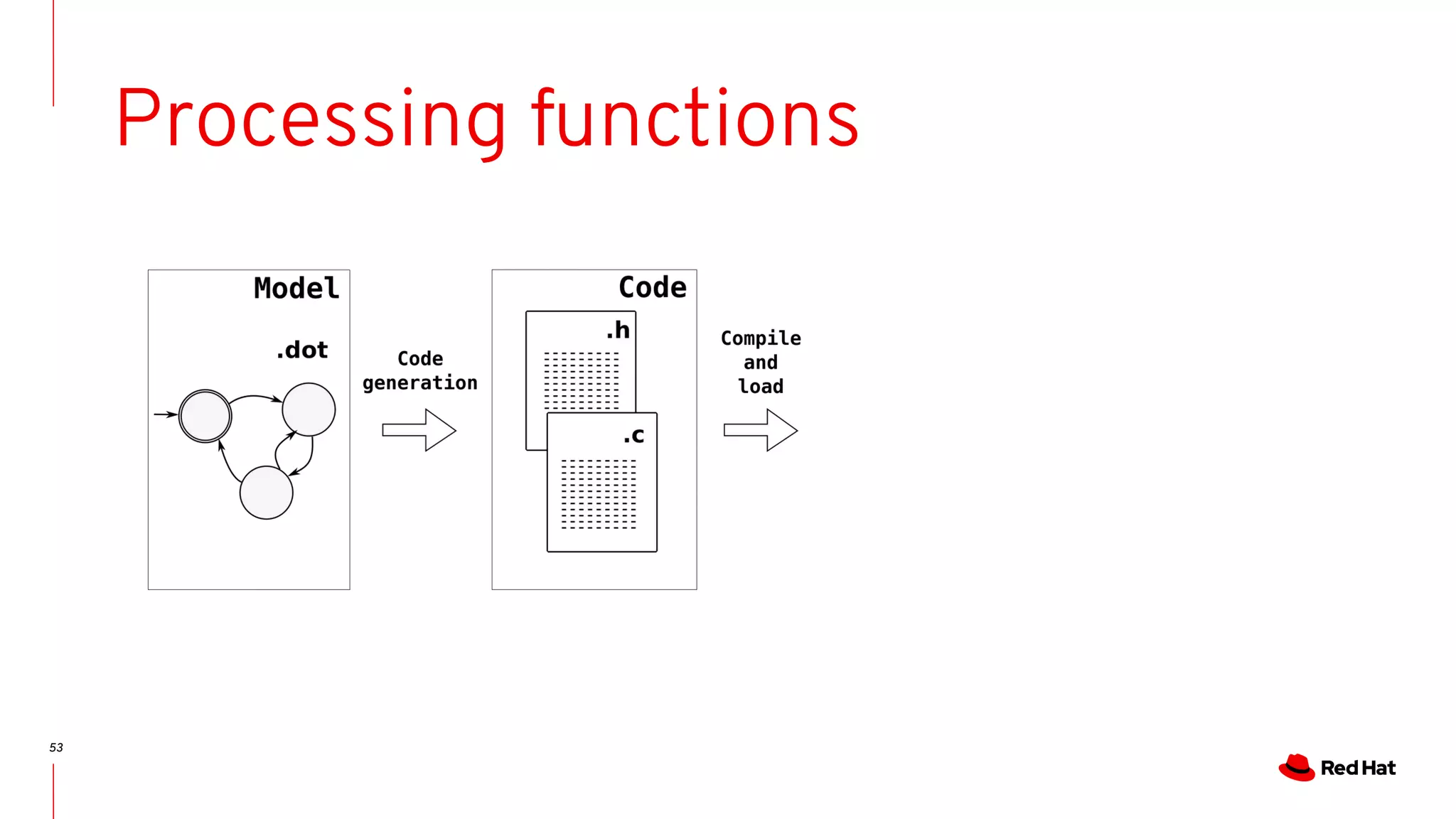
1) Code generation
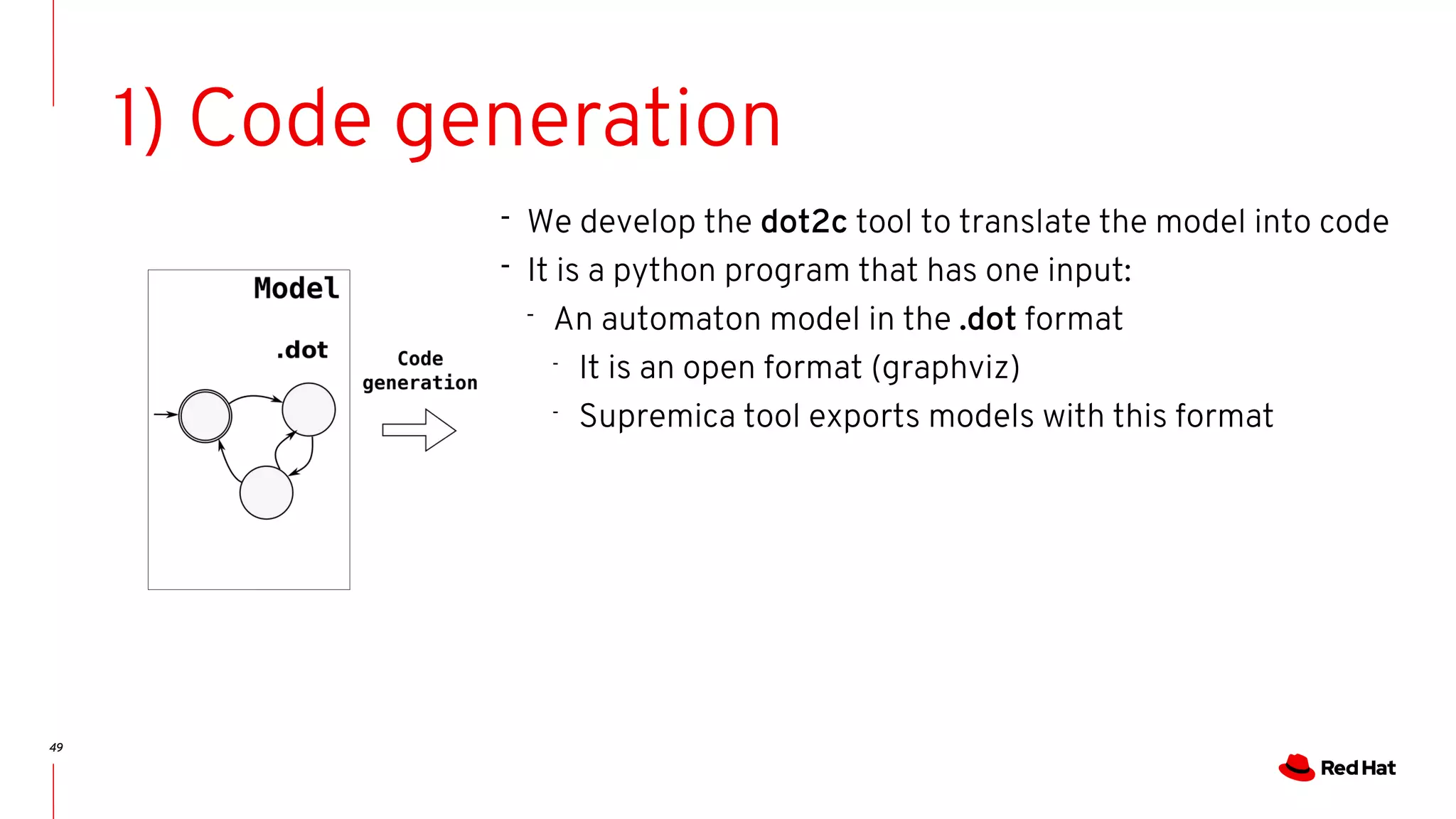
- We develop the dot2c tool to translate the model into code
- It is a python program that has one input:
- An automaton model in the .dot format
-
It is an open format (graphviz)
-
Supremica tool exports models with this format
50
Code generation
[bristot@t460s dot2c]$ ./dot2c wakeup_in_preemptive.dot
…..
Wakeup in preemptive model:
Code generation:
51
Automaton in C
enum states {
preemptive = 0,
non_preemptive,
state_max
};
enum events {
preempt_disable = 0,
preempt_enable,
sched_waking,
event_max
};
struct automaton {
char *state_names[state_max];
char *event_names[event_max];
char function[state_max][event_max];
char initial_state;
char final_states[state_max];
};
52
Automaton in C
enum states {
preemptive = 0,
non_preemptive,
state_max
};
enum events {
preempt_disable = 0,
preempt_enable,
sched_waking,
event_max
};
....
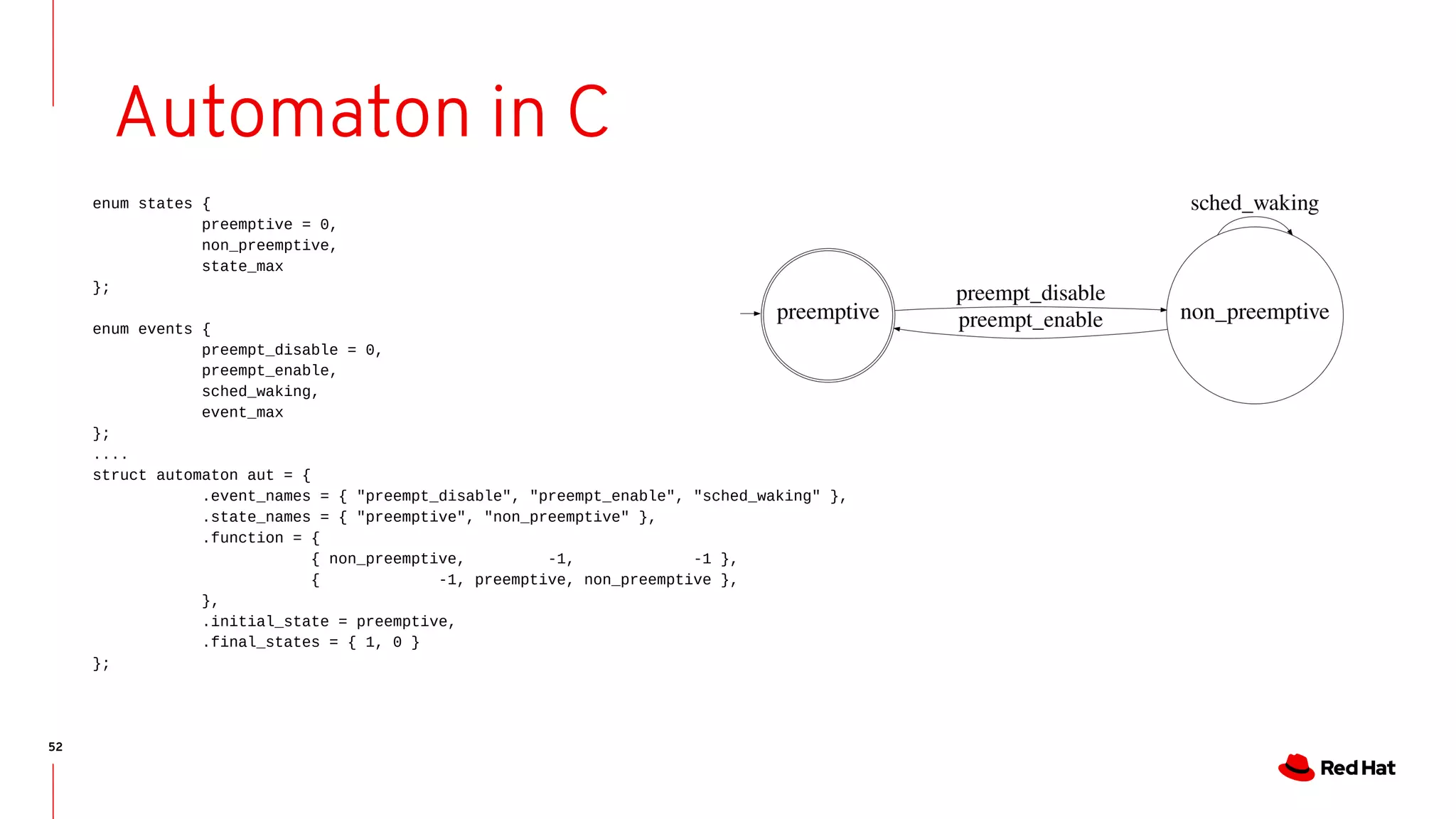
struct automaton aut = {
.event_names = { "preempt_disable", "preempt_enable", "sched_waking" },
.state_names = { "preemptive", "non_preemptive" },
.function = {
{ non_preemptive, -1, -1 },
{ -1, preemptive, non_preemptive },
},
.initial_state = preemptive,
.final_states = { 1, 0 }
};
53
Processing functions
54
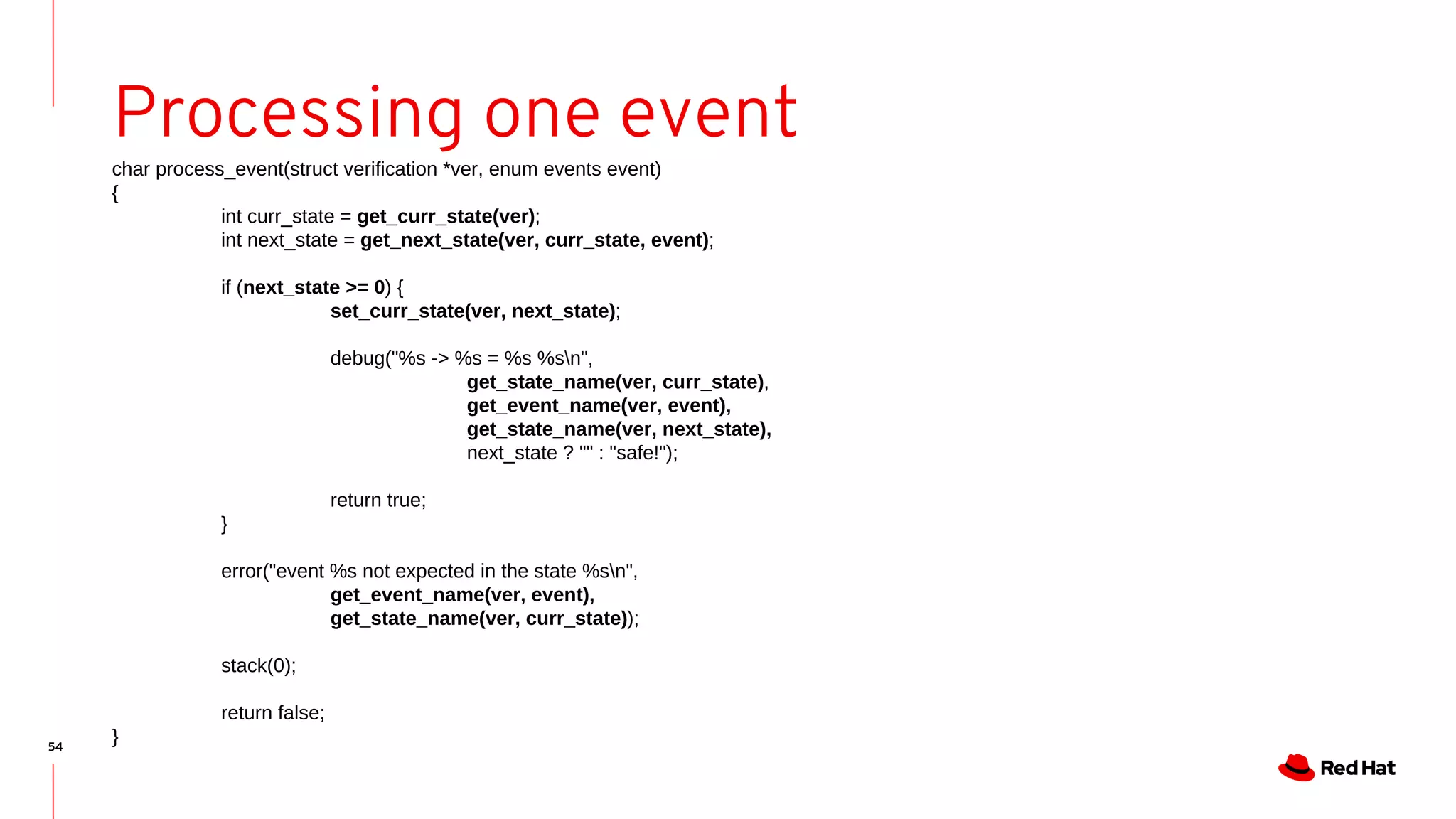
Processing one event
char process_event(struct verification *ver, enum events event)
{
int curr_state = get_curr_state(ver);
int next_state = get_next_state(ver, curr_state, event);
if (next_state >= 0) {
set_curr_state(ver, next_state);
debug("%s -> %s = %s %sn",
get_state_name(ver, curr_state),
get_event_name(ver, event),
get_state_name(ver, next_state),
next_state ? "" : "safe!");
return true;
}
error("event %s not expected in the state %sn",
get_event_name(ver, event),
get_state_name(ver, curr_state));
stack(0);
return false;
}
55
Processing one event
char *get_state_name(struct verification *ver, enum states state)
{
return ver->aut->state_names[state];
}
char *get_event_name(struct verification *ver, enum events event)
{
return ver->aut->event_names[event];
}
char get_next_state(struct verification *ver, enum states curr_state, enum events event)
{
return ver->aut->function[curr_state][event];
}
char get_curr_state(struct verification *ver)
{
return ver->curr_state;
}
void set_curr_state(struct verification *ver, enum states state)
{
ver->curr_state = state;
}
56
Processing one event
char *get_state_name(struct verification *ver, enum states state)
{
return ver->aut->state_names[state];
}
char *get_event_name(struct verification *ver, enum events event)
{
return ver->aut->event_names[event];
}
char get_next_state(struct verification *ver, enum states curr_state, enum events event)
{
return ver->aut->function[curr_state][event];
}
char get_curr_state(struct verification *ver)
{
return ver->curr_state;
}
void set_curr_state(struct verification *ver, enum states state)
{
ver->curr_state = state;
}
All operations are O(1)!
Only one variable to keep the state!
57
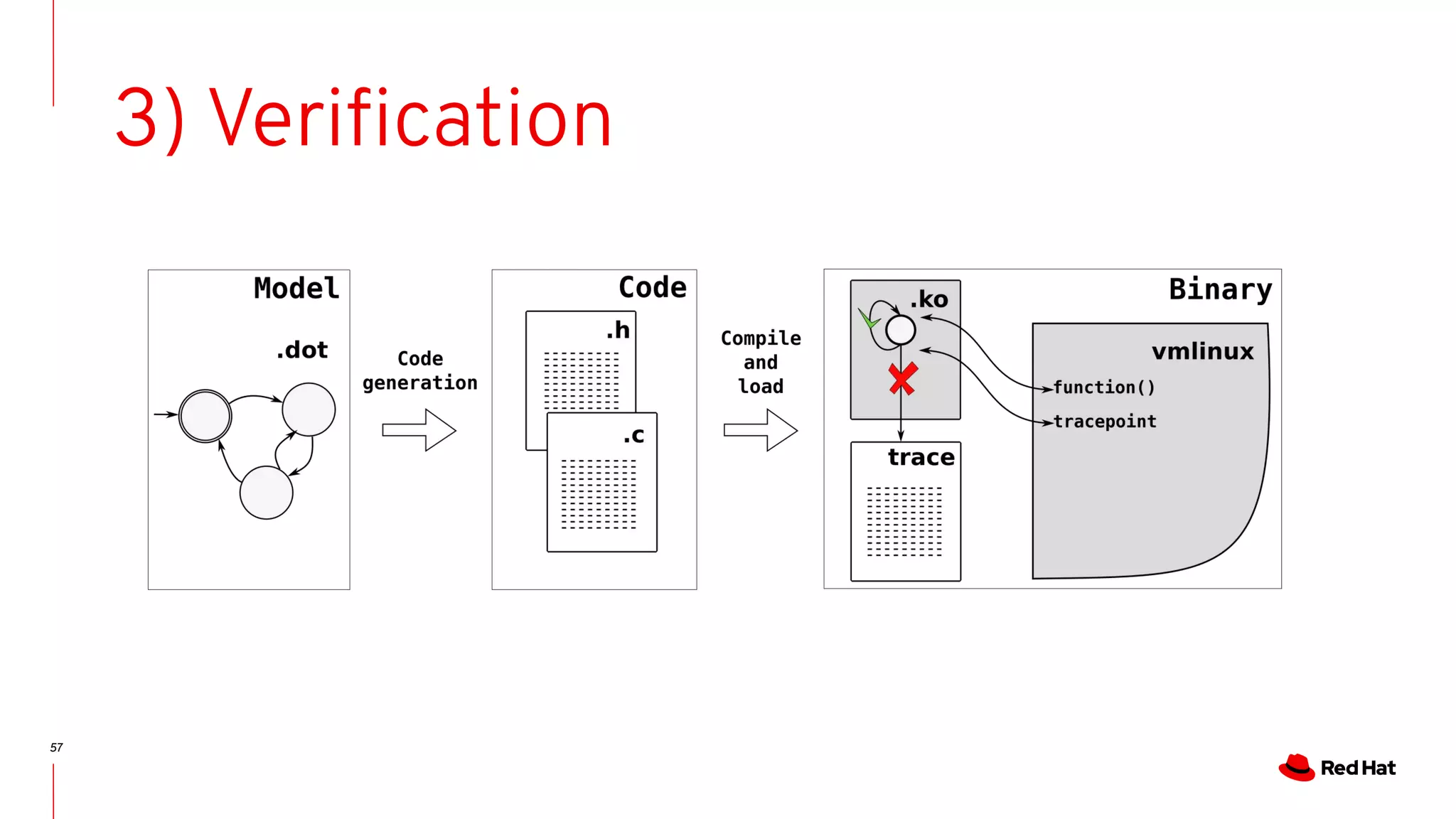
3) Verification
58
Verification
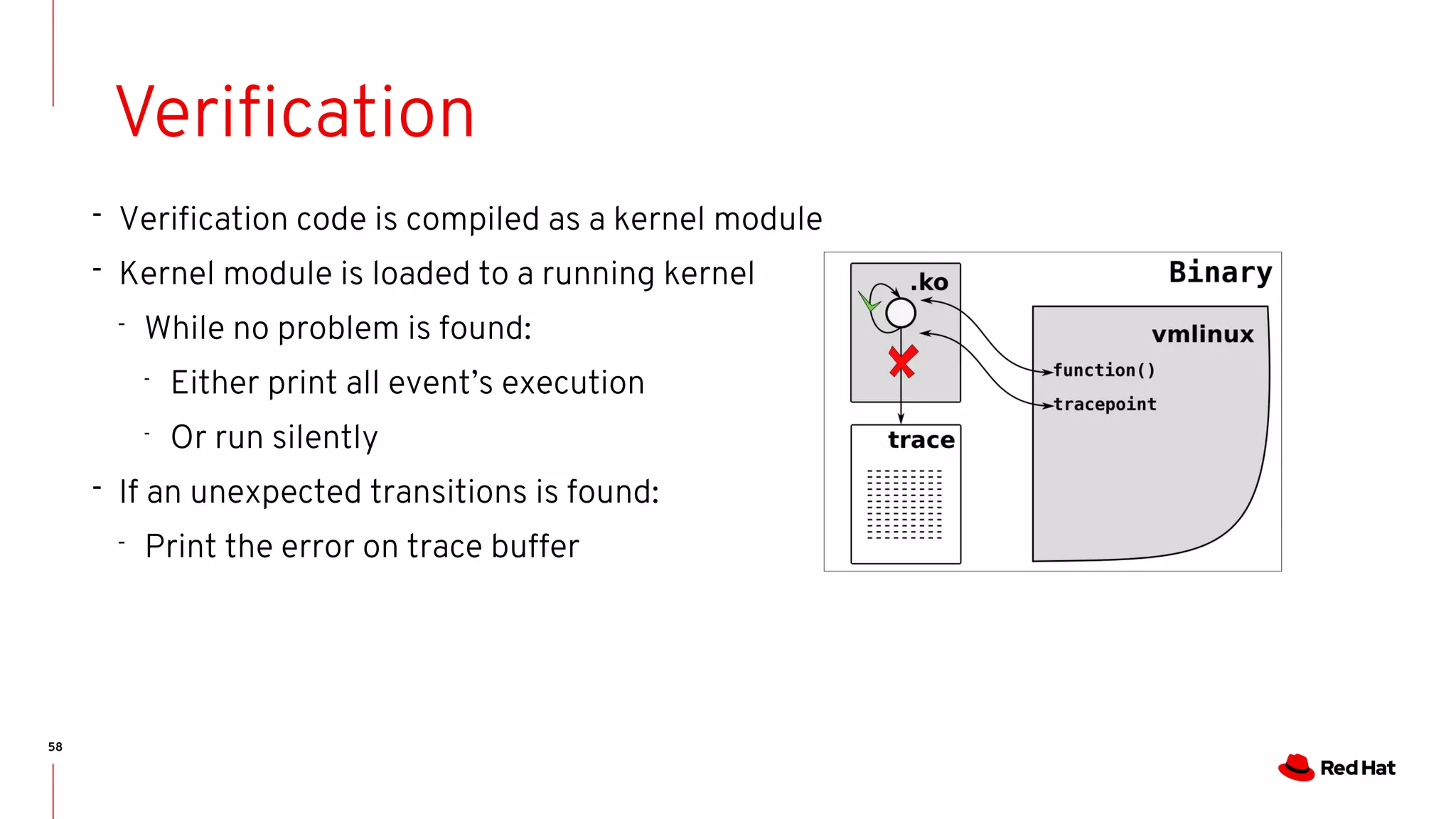
- Verification code is compiled as a kernel module
- Kernel module is loaded to a running kernel
- While no problem is found:
-
Either print all event’s execution
-
Or run silently
- If an unexpected transitions is found:
- Print the error on trace buffer
59
Error output
bash-1157 [003] ....2.. 191.199172: process_event: non_preemptive -> preempt_enable = preemptive safe!
bash-1157 [003] dN..5.. 191.199182: process_event: event sched_waking not expected in the state preemptive
bash-1157 [003] dN..5.. 191.199186: <stack trace>
=> process_event
=> __handle_event
=> ttwu_do_wakeup
=> try_to_wake_up
=> irq_exit
=> smp_apic_timer_interrupt
=> apic_timer_interrupt
=> rcu_irq_exit_irqson
=> trace_preempt_on
=> preempt_count_sub
=> _raw_spin_unlock_irqrestore
=> __down_write_common
=> anon_vma_clone
=> anon_vma_fork
=> copy_process.part.42
=> _do_fork
=> do_syscall_64
=> entry_SYSCALL_64_after_hwframe
60
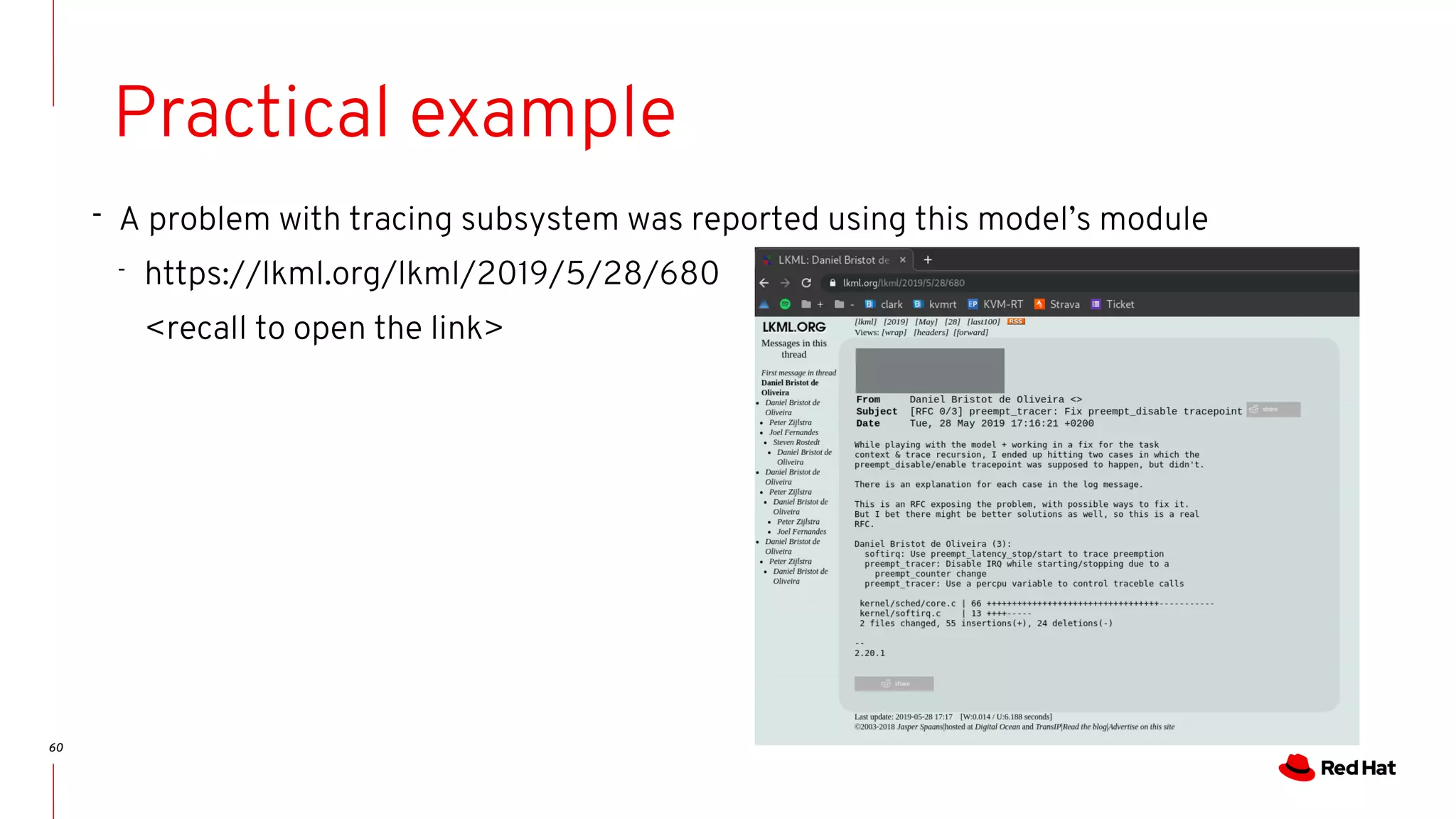
Practical example
- A problem with tracing subsystem was reported using this model’s module
- https://lkml.org/lkml/2019/5/28/680
<recall to open the link>
61
There is not free meal!
62
The price is in the data structure
- The vectors and matrix are not “compact” data structure
- BUT!
- The PREEEMPT_RT model, with:
- 9017 states!
- 23103 transitions!
- Compiles in a module with < 800KB
- Acceptable, no?
63
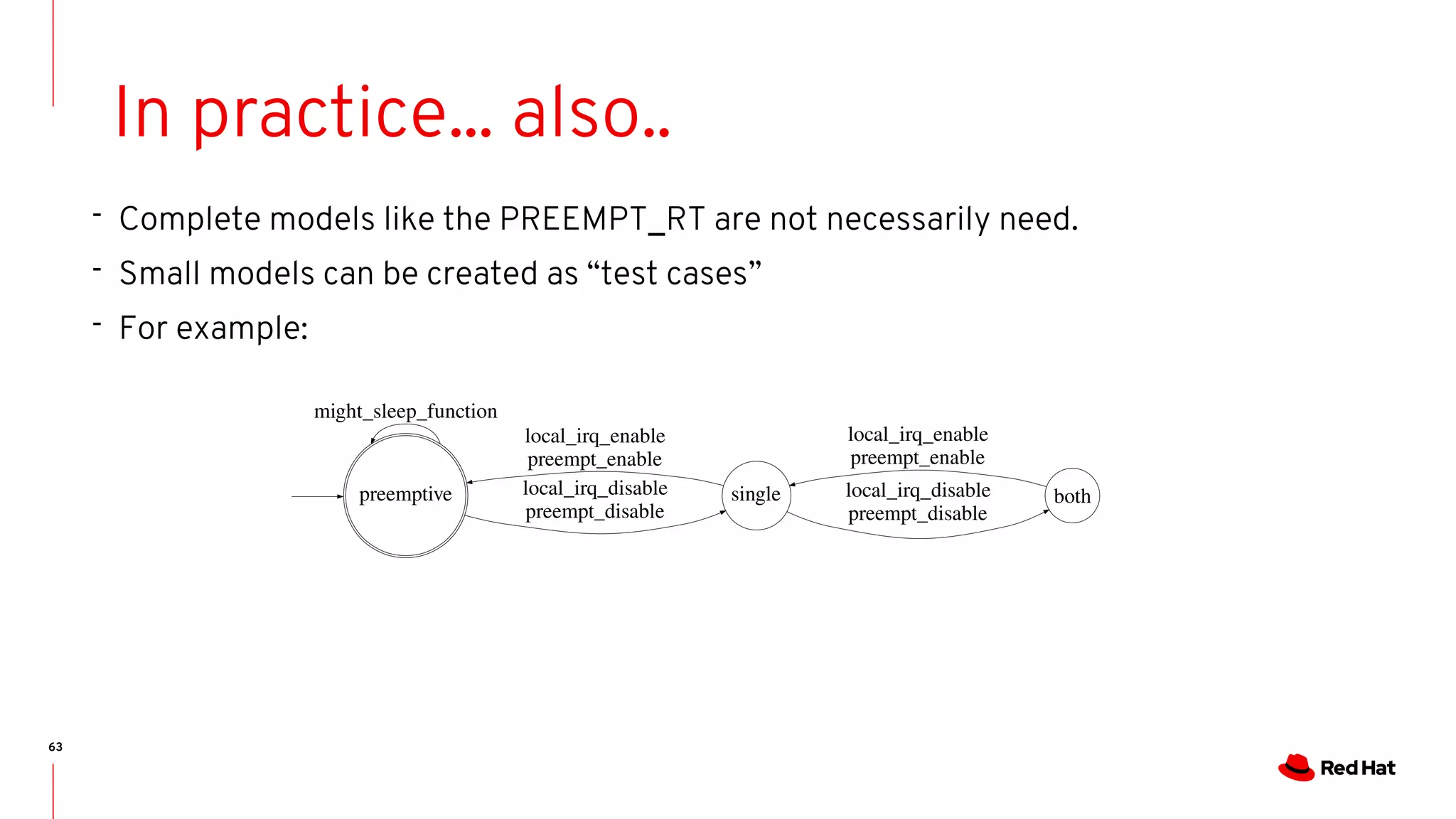
In practice... also..
- Complete models like the PREEMPT_RT are not necessarily need.
- Small models can be created as “test cases”
- For example:
bothsingle
local_irq_enable
preempt_enable
preemptive
might_sleep_function
local_irq_disable
preempt_disable
local_irq_disable
preempt_disable
local_irq_enable
preempt_enable
64
How _efficient_ is this
idea?
65
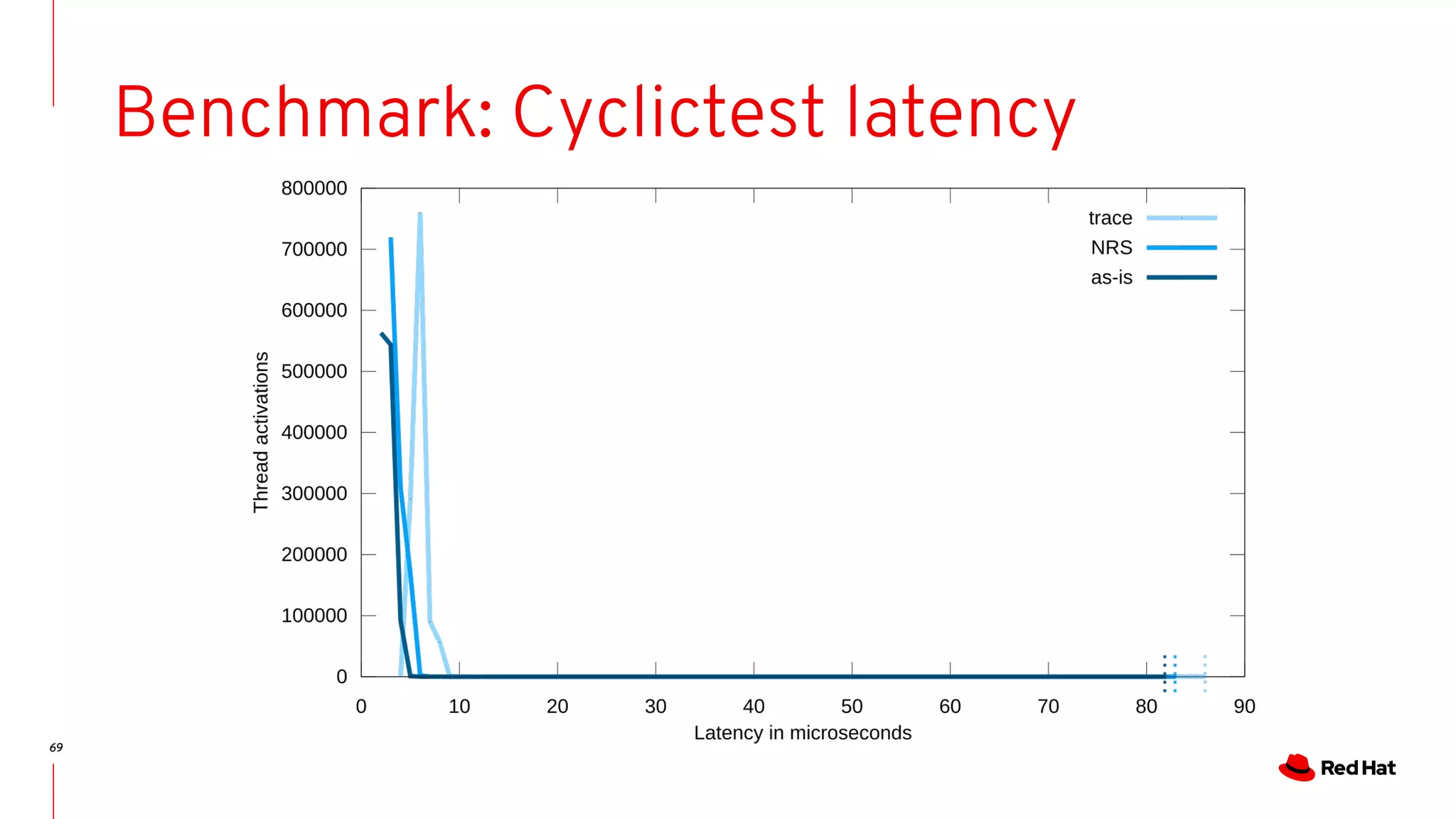
Efficiency in practice: a benchmark
- Two benchmarks
- Throughput: Using the Phoronix Test Suite
- Latency: Using cyclictest
- Base of comparison:
- as-is: The system without any verification or trace.
- trace: Tracing (ftrace) the same events used in the verification
-
Only trace! No collection or interpretation.
66
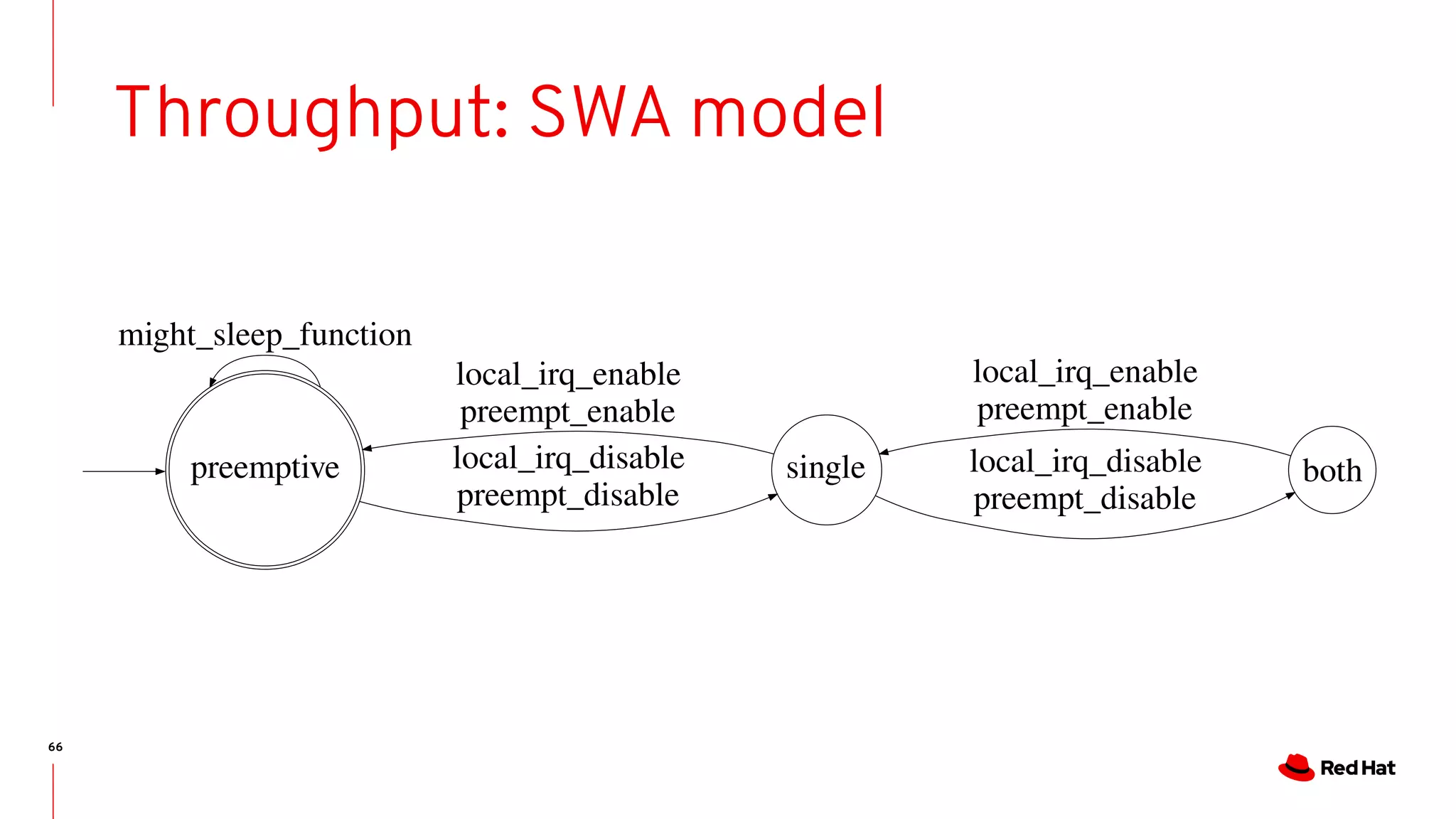
Throughput: SWA model
bothsingle
local_irq_enable
preempt_enable
preemptive
might_sleep_function
local_irq_disable
preempt_disable
local_irq_disable
preempt_disable
local_irq_enable
preempt_enable
67
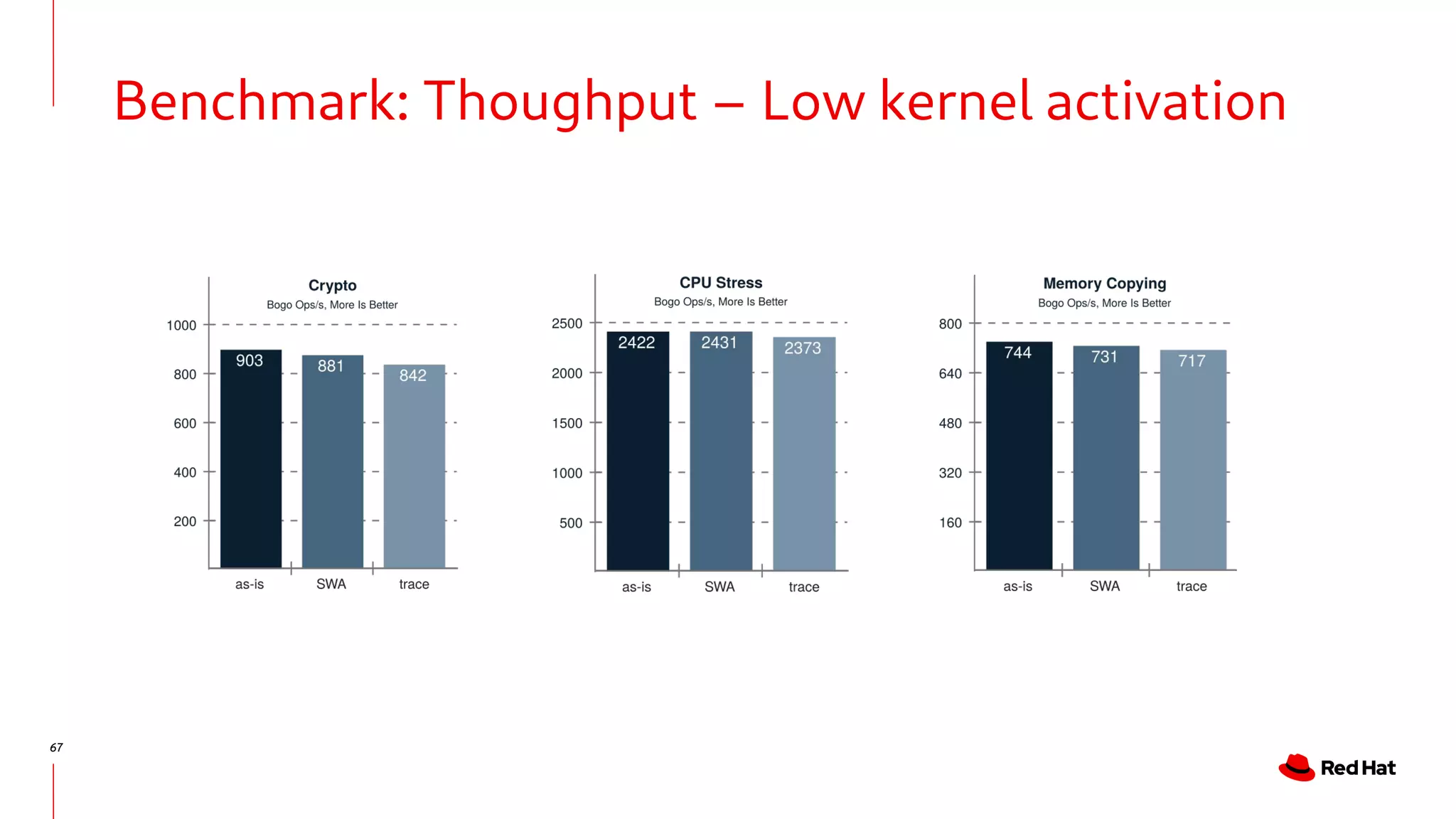
Benchmark: Thoughput – Low kernel activation
68
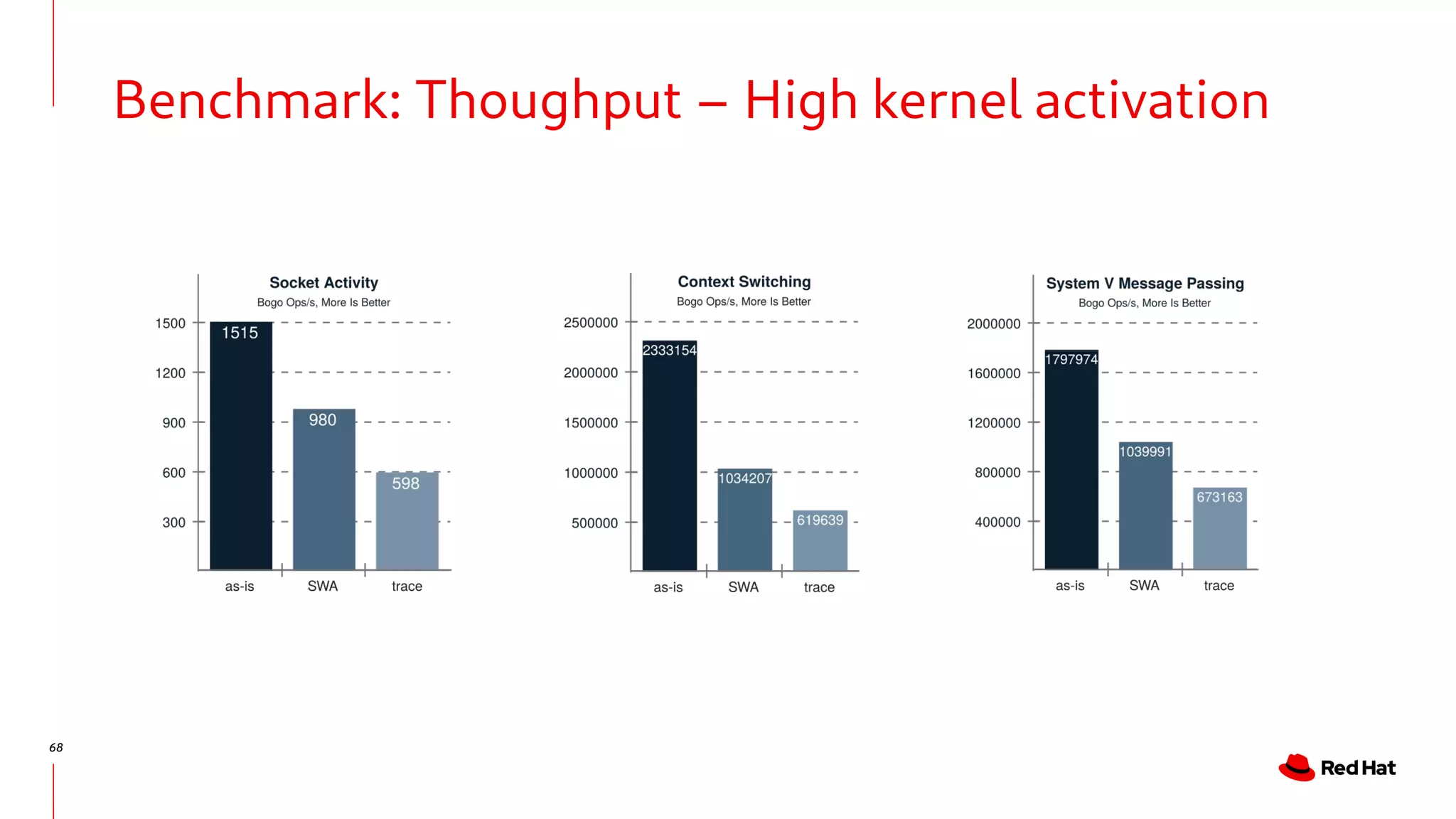
Benchmark: Thoughput – High kernel activation
69
Benchmark: Cyclictest latency
70
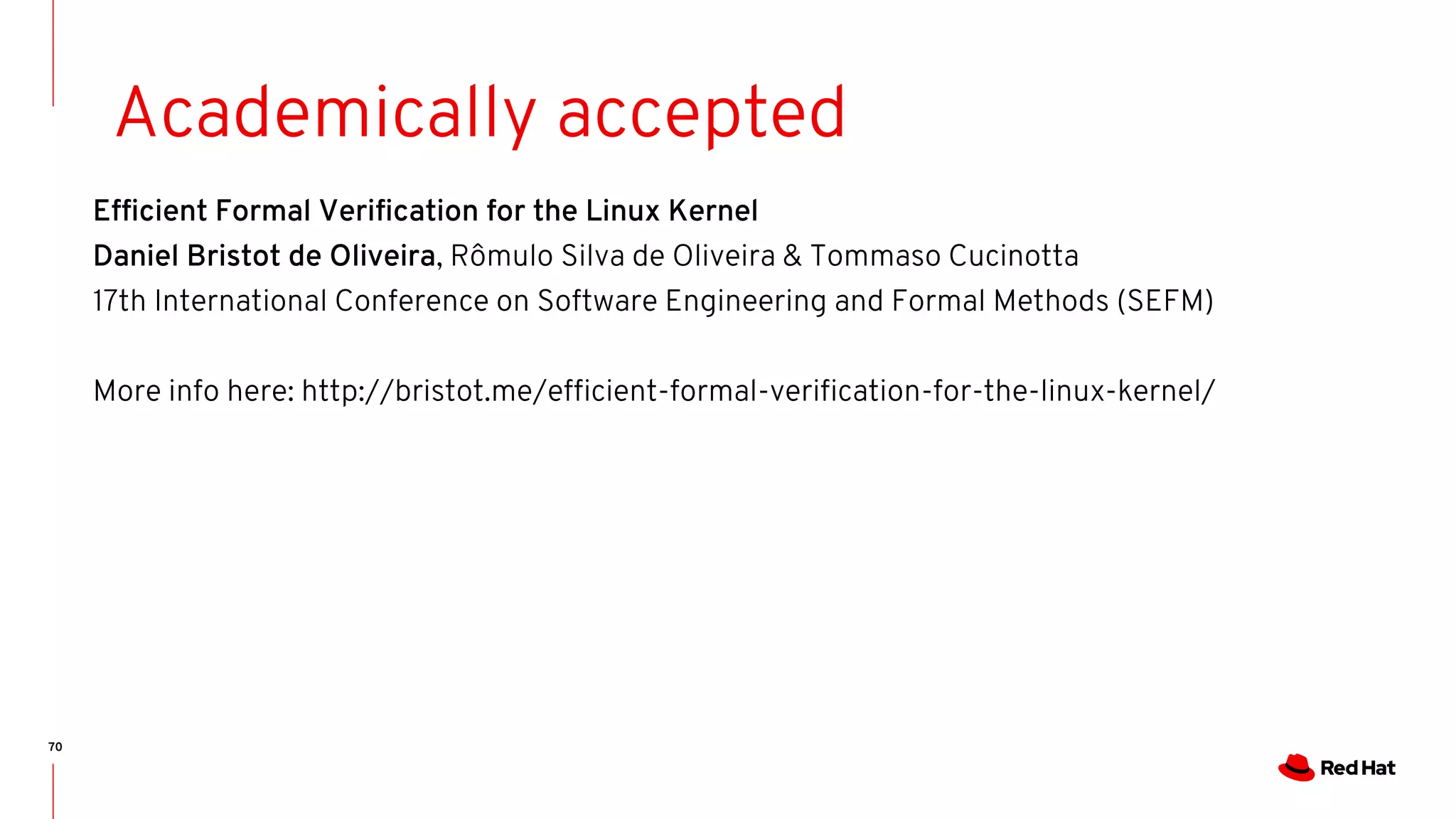
Academically accepted
Efficient Formal Verification for the Linux Kernel
Daniel Bristot de Oliveira, Rômulo Silva de Oliveira & Tommaso Cucinotta
17th International Conference on Software Engineering and Formal Methods (SEFM)
More info here: http://bristot.me/efficient-formal-verification-for-the-linux-kernel/
71
So...
72
So...
- It is possible to model complex behavior of Linux
- Using a formal language
- Creating big models from small ones
- It is possible to verify properties of models
- And so properties of the system
- Bonus: It is possible to use other more complex methods by using the automata
-
LTL and so on
- It is possible to verify the runtime behavior of Linux
73
What’s next?
- Better interface
- Working in a perf/ebpf version of the runtime verification part
- And also working with a “ftrace” like interface
- Then I will compare both
- Documenting the process in a “linux developer way”
- IOW: translating the papers into LWN articles
74
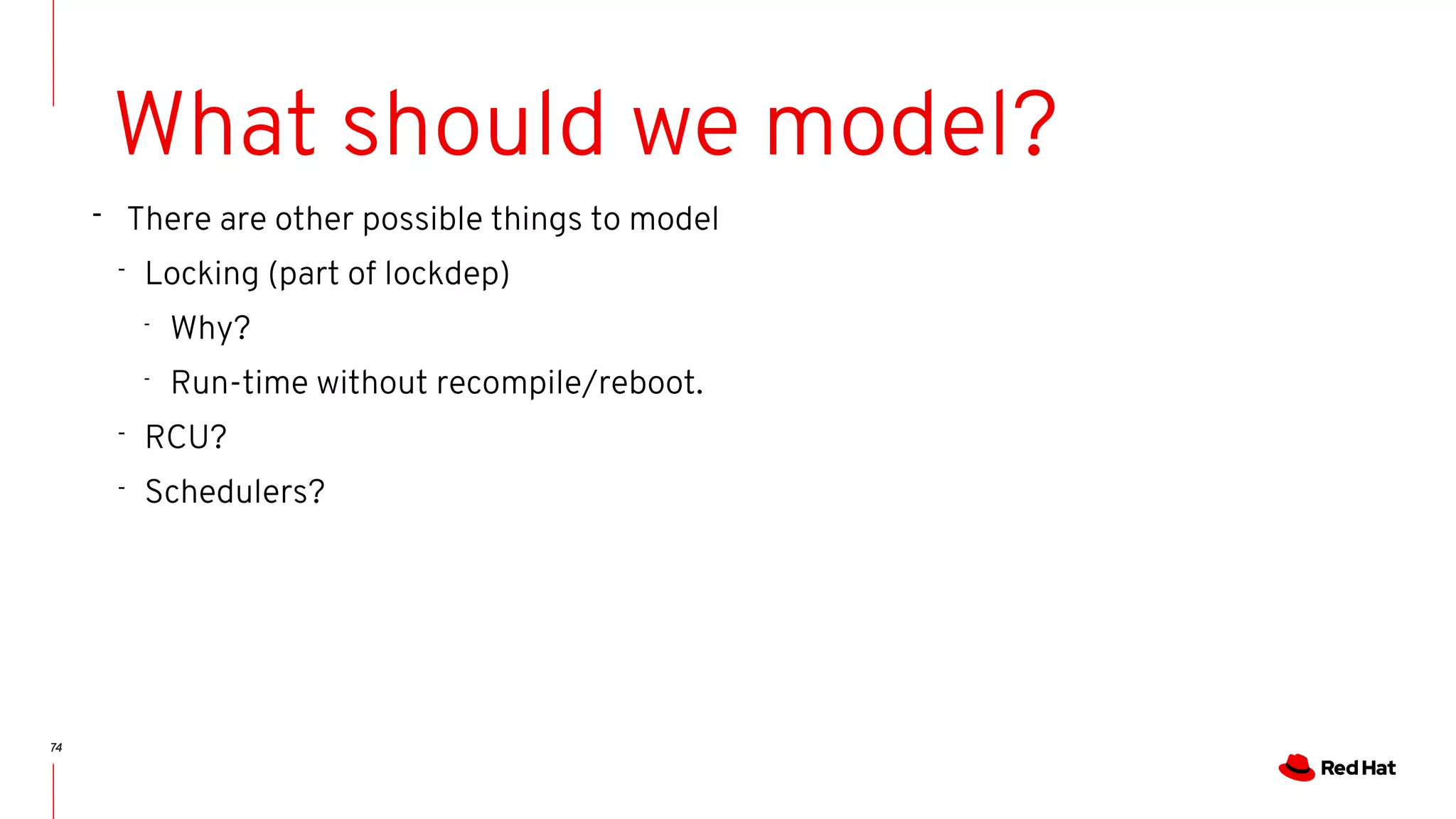
What should we model?
- There are other possible things to model
- Locking (part of lockdep)
-
Why?
-
Run-time without recompile/reboot.
- RCU?
- Schedulers?
75
Worth Mentioning
76
Something else?
77
Thank you!
This work is made in collaboration with:
the Retis Lab @ Scuola Superiore Sant’Anna (Pisa – Italy)
Universidade Federal de Santa Catarina (Florianópolis - Brazil)

Kernel Recipes 2019 - Formal modeling made easy

  • 1.
    1 Formal modeling (andverification) made easy And fast! Daniel Bristot de Oliveira Principal Software Engineer
  • 2.
  • 3.
  • 4.
    4 We need tobe sure that Linux _behaves_ as _expected_ .
  • 5.
    5 What do we_expect_?
  • 6.
    6 What do we_expect_? - We have a lot of documentation explaining what is expected! - In many different languages! - We have a lot of “ifs” that asserts what is expected! - We have lots of tests that check if part of the system behaves as expected!
  • 7.
    7 These things aregood! But we need something more robust.
  • 8.
    8 Like... - How dowe check that our reasoning is right? - How do we check that our asserts are not contradictory? - How do we check that we are covering all cases? - How do we verify the runtime behavior of Linux?
  • 9.
    9 How do weconvince other communities about our properties?
  • 10.
  • 11.
  • 12.
    12 We already havesome examples!
  • 13.
    13 But we needa more “generic” and “intuitive way” for modeling.
  • 14.
    14 How can weturn modeling easier? - Using a formal language that looks natural for us! - How do we naturally “observe” the dynamics of Linux?
  • 15.
  • 16.
    16 While tracing we... ^C^Vfrom https://www.geeksforgeeks.org/states-of-a-process-in-operating-systems/
  • 17.
    17 State-machines + FM= Automata! - State machines are Event-driven systems - Event-driven systems describe the system evolution as trace of events - As we do for run-time analysis. tail-5572 [001] ....1.. 2888.401184: preempt_enable: caller=_raw_spin_unlock_irqrestore+0x2a/0x70 parent= (null) tail-5572 [001] ....1.. 2888.401184: preempt_disable: caller=migrate_disable+0x8b/0x1e0 parent=migrate_disable+0x8b/0x1e0 tail-5572 [001] ....111 2888.401184: preempt_enable: caller=migrate_disable+0x12f/0x1e0 parent=migrate_disable+0x12f/0x1e0 tail-5572 [001] d..h212 2888.401189: local_timer_entry: vector=236
  • 18.
    18 Using automata asformal language q0 q2 open q1 readclose write
  • 19.
    19 Is formally defined -Automata is a method to model Discrete Event Systems (DES) - Formally, an automaton G is defined as: - G = {X , E, f , x0 , Xm }, where: - X = finite set of states; - E = finite set of events; - F is the transition function = (X x E) → X; - x0 = Initial state; - Xm = set of final states. - The language - or traces - generated/recognized by G is the L(G).
  • 20.
    20 Automata allows - Theverification of the model - Deadlock free? Live-lock free? - Operations - Modular development
  • 21.
    21 The previous example q0q2 open q1 readclose write
  • 22.
  • 23.
  • 24.
  • 25.
  • 26.
    26 Synch of Generatorsand Specifications q0 q4 open q1q3 read q2 read write write close
  • 27.
  • 28.
    28 Sync of Generatorsand Specifications q0 q2 open q1 readclose write
  • 29.
  • 30.
  • 31.
    31 PREEMPT_RT model - ThePREEMPT RT task model has: - 9017 states! - 23103 transitions! - But: - 12 generators - 33 specifications - During development found 3 bugs that would not be detected by other tools...
  • 32.
  • 33.
  • 34.
  • 35.
    35 ● Formal verification madeeasy and fast - Linux Plumbers Conference 2019 Independend “generators”
  • 36.
  • 37.
  • 38.
  • 39.
  • 40.
  • 41.
  • 42.
    42 Academically accepted Untangling theIntricacies of Thread Synchronization in the PREEMPT_RT Linux Kernel. Daniel Bristot de Oliveira, Rômulo Silva de Oliveira & Tommaso Cucinotta 2019 IEEE 22nd International Symposium on Real-Time Distributed Computing (ISORC) Modeling the Behavior of Threads in the PREEMPT_RT Linux Kernel Using Automata Daniel Bristot de Oliveira, Tommaso Cucinotta & Romulo Silva De Oliveira 8th Embedded Operating Systems Workshop (EWiLi 2018) Automata-Based Modeling of Interrupts in the Linux PREEMPT RT Kernel Daniel Bristot de Oliveira, Rômulo Silva de Oliveira, Tommaso Cucinotta and Luca Abeni Proceedings of the 22nd IEEE International Conference on Emerging Technologies And Factory Automation (ETFA 2017)
  • 43.
    43 How to verifythat the system _behaves_?
  • 44.
  • 45.
  • 46.
  • 47.
  • 48.
  • 49.
    49 1) Code generation -We develop the dot2c tool to translate the model into code - It is a python program that has one input: - An automaton model in the .dot format - It is an open format (graphviz) - Supremica tool exports models with this format
  • 50.
    50 Code generation [bristot@t460s dot2c]$./dot2c wakeup_in_preemptive.dot ….. Wakeup in preemptive model: Code generation:
  • 51.
    51 Automaton in C enumstates { preemptive = 0, non_preemptive, state_max }; enum events { preempt_disable = 0, preempt_enable, sched_waking, event_max }; struct automaton { char *state_names[state_max]; char *event_names[event_max]; char function[state_max][event_max]; char initial_state; char final_states[state_max]; };
  • 52.
    52 Automaton in C enumstates { preemptive = 0, non_preemptive, state_max }; enum events { preempt_disable = 0, preempt_enable, sched_waking, event_max }; .... struct automaton aut = { .event_names = { "preempt_disable", "preempt_enable", "sched_waking" }, .state_names = { "preemptive", "non_preemptive" }, .function = { { non_preemptive, -1, -1 }, { -1, preemptive, non_preemptive }, }, .initial_state = preemptive, .final_states = { 1, 0 } };
  • 53.
  • 54.
    54 Processing one event charprocess_event(struct verification *ver, enum events event) { int curr_state = get_curr_state(ver); int next_state = get_next_state(ver, curr_state, event); if (next_state >= 0) { set_curr_state(ver, next_state); debug("%s -> %s = %s %sn", get_state_name(ver, curr_state), get_event_name(ver, event), get_state_name(ver, next_state), next_state ? "" : "safe!"); return true; } error("event %s not expected in the state %sn", get_event_name(ver, event), get_state_name(ver, curr_state)); stack(0); return false; }
  • 55.
    55 Processing one event char*get_state_name(struct verification *ver, enum states state) { return ver->aut->state_names[state]; } char *get_event_name(struct verification *ver, enum events event) { return ver->aut->event_names[event]; } char get_next_state(struct verification *ver, enum states curr_state, enum events event) { return ver->aut->function[curr_state][event]; } char get_curr_state(struct verification *ver) { return ver->curr_state; } void set_curr_state(struct verification *ver, enum states state) { ver->curr_state = state; }
  • 56.
    56 Processing one event char*get_state_name(struct verification *ver, enum states state) { return ver->aut->state_names[state]; } char *get_event_name(struct verification *ver, enum events event) { return ver->aut->event_names[event]; } char get_next_state(struct verification *ver, enum states curr_state, enum events event) { return ver->aut->function[curr_state][event]; } char get_curr_state(struct verification *ver) { return ver->curr_state; } void set_curr_state(struct verification *ver, enum states state) { ver->curr_state = state; } All operations are O(1)! Only one variable to keep the state!
  • 57.
  • 58.
    58 Verification - Verification codeis compiled as a kernel module - Kernel module is loaded to a running kernel - While no problem is found: - Either print all event’s execution - Or run silently - If an unexpected transitions is found: - Print the error on trace buffer
  • 59.
    59 Error output bash-1157 [003]....2.. 191.199172: process_event: non_preemptive -> preempt_enable = preemptive safe! bash-1157 [003] dN..5.. 191.199182: process_event: event sched_waking not expected in the state preemptive bash-1157 [003] dN..5.. 191.199186: <stack trace> => process_event => __handle_event => ttwu_do_wakeup => try_to_wake_up => irq_exit => smp_apic_timer_interrupt => apic_timer_interrupt => rcu_irq_exit_irqson => trace_preempt_on => preempt_count_sub => _raw_spin_unlock_irqrestore => __down_write_common => anon_vma_clone => anon_vma_fork => copy_process.part.42 => _do_fork => do_syscall_64 => entry_SYSCALL_64_after_hwframe
  • 60.
    60 Practical example - Aproblem with tracing subsystem was reported using this model’s module - https://lkml.org/lkml/2019/5/28/680 <recall to open the link>
  • 61.
    61 There is notfree meal!
  • 62.
    62 The price isin the data structure - The vectors and matrix are not “compact” data structure - BUT! - The PREEEMPT_RT model, with: - 9017 states! - 23103 transitions! - Compiles in a module with < 800KB - Acceptable, no?
  • 63.
    63 In practice... also.. -Complete models like the PREEMPT_RT are not necessarily need. - Small models can be created as “test cases” - For example: bothsingle local_irq_enable preempt_enable preemptive might_sleep_function local_irq_disable preempt_disable local_irq_disable preempt_disable local_irq_enable preempt_enable
  • 64.
  • 65.
    65 Efficiency in practice:a benchmark - Two benchmarks - Throughput: Using the Phoronix Test Suite - Latency: Using cyclictest - Base of comparison: - as-is: The system without any verification or trace. - trace: Tracing (ftrace) the same events used in the verification - Only trace! No collection or interpretation.
  • 66.
  • 67.
    67 Benchmark: Thoughput –Low kernel activation
  • 68.
    68 Benchmark: Thoughput –High kernel activation
  • 69.
  • 70.
    70 Academically accepted Efficient FormalVerification for the Linux Kernel Daniel Bristot de Oliveira, Rômulo Silva de Oliveira & Tommaso Cucinotta 17th International Conference on Software Engineering and Formal Methods (SEFM) More info here: http://bristot.me/efficient-formal-verification-for-the-linux-kernel/
  • 71.
  • 72.
    72 So... - It ispossible to model complex behavior of Linux - Using a formal language - Creating big models from small ones - It is possible to verify properties of models - And so properties of the system - Bonus: It is possible to use other more complex methods by using the automata - LTL and so on - It is possible to verify the runtime behavior of Linux
  • 73.
    73 What’s next? - Betterinterface - Working in a perf/ebpf version of the runtime verification part - And also working with a “ftrace” like interface - Then I will compare both - Documenting the process in a “linux developer way” - IOW: translating the papers into LWN articles
  • 74.
    74 What should wemodel? - There are other possible things to model - Locking (part of lockdep) - Why? - Run-time without recompile/reboot. - RCU? - Schedulers?
  • 75.
  • 76.
  • 77.
    77 Thank you! This workis made in collaboration with: the Retis Lab @ Scuola Superiore Sant’Anna (Pisa – Italy) Universidade Federal de Santa Catarina (Florianópolis - Brazil)