
Missing points from last presentation
• Which modifications done
• Detailed configuration options
• Change realtime support run time or statically?
• Statically, you need to compile the realtime patched kernel with CONFIG_PREEMPT_RT_FULL=y to support realtime.
• Linux kernel API documents
• https://www.kernel.org/doc/htmldocs/kernel-api/
• Operating system design
• Scheduling
• Other approaches to Linux realtime
• Xenomai
• RTLinux
• RTAI
• extra: does other mobile operating systems provide realtime capability?
• android os
• firefox os
1
• will be covered later
Preempt_rt research
Emre Can Kucukoglu
eckucukoglu@gmail.com
28.08.14
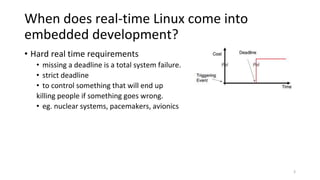
When does real-time Linux come into
embedded development?
• Hard real time requirements
• missing a deadline is a total system failure.
• strict deadline
• to control something that will end up
killing people if something goes wrong.
• eg. nuclear systems, pacemakers, avionics
3
When does real-time Linux come into
embedded development?
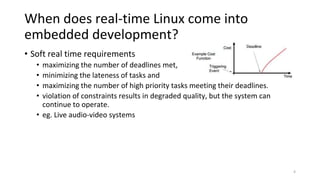
• Soft real time requirements
• maximizing the number of deadlines met,
• minimizing the lateness of tasks and
• maximizing the number of high priority tasks meeting their deadlines.
• violation of constraints results in degraded quality, but the system can
continue to operate.
• eg. Live audio-video systems
4
When does real-time Linux come into
embedded development?
• Firm real time requirements
• infrequent deadline misses are tolerable
• usefulness of a result is zero after its deadline
• eg. forecast systems
5
Preempt_rt: Hard real time
• "Hard" real-time software
• for robotics, stock exchanges (imkb)...
• has been used on computers that have gone into space.
6
Preempt_rt: Hard realtime
• faster response times
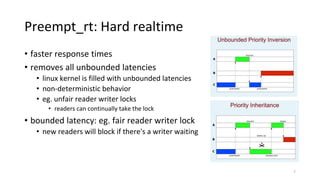
• removes all unbounded latencies
• linux kernel is filled with unbounded latencies
• non-deterministic behavior
• eg. unfair reader writer locks
• readers can continually take the lock
• bounded latency: eg. fair reader writer lock
• new readers will block if there's a writer waiting
7
Advantage over other rt linux
implementations
• preempt_rt makes linux itself real-time,
• others create a small ‘microkernel’ that runs like a hypervisor
• linux kernel runs as a task
• not really linux:
• rt tasks must be modified to communicate with ‘microkernel’
8
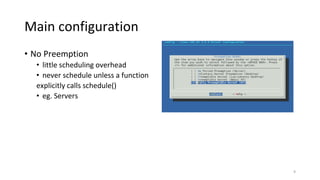
Main configuration
• No Preemption
• little scheduling overhead
• never schedule unless a function
explicitly calls schedule()
• eg. Servers
9
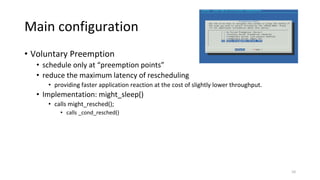
Main configuration
• Voluntary Preemption
• schedule only at “preemption points”
• reduce the maximum latency of rescheduling
• providing faster application reaction at the cost of slightly lower throughput.
• Implementation: might_sleep()
• calls might_resched();
• calls _cond_resched()
10
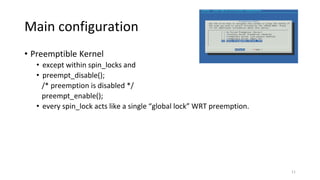
Main configuration
• Preemptible Kernel
• except within spin_locks and
• preempt_disable();
/* preemption is disabled */
preempt_enable();
• every spin_lock acts like a single “global lock” WRT preemption.
11
Main configuration
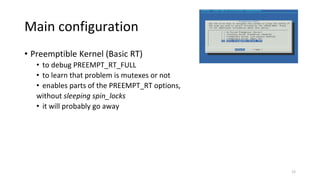
• Preemptible Kernel (Basic RT)
• to debug PREEMPT_RT_FULL
• to learn that problem is mutexes or not
• enables parts of the PREEMPT_RT options,
without sleeping spin_locks
• it will probably go away
12
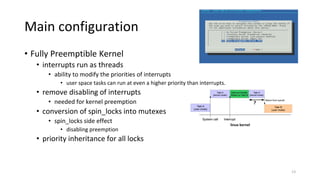
• Fully Preemptible Kernel
• interrupts run as threads
• ability to modify the priorities of interrupts
• user space tasks can run at even a higher priority than interrupts.
• remove disabling of interrupts
• needed for kernel preemption
• conversion of spin_locks into mutexes
• spin_locks side effect
• disabling preemption
• priority inheritance for all locks
linux kernel
Main configuration
13
Sleeping spin_lock
• if task is blocked go to sleep
• mutexes
• threaded interrupts needed
• otherwise miss interrupt
• if not-threaded (not-prioritized) interrupt’s spin_locks’ changed to mutexes
• must not be in atomic paths
• preempt_disable()
• local_irq_save(flags): disable interrupt on the current processor and prior to
which it saves current interrupt state into flags.
14
raw_spin_lock
• creation of non-preemptible sections
• same as current mainline spin_locks
• should only be used for scheduler, rtmutex implementation,
debugging/tracing infrastructure and for timer interrupts
15
Non-Thread IRQs
• timer interrupt
• IRQF_TIMER flag
• flag for timer interrupts
• IRQF_NO_THREAD flag
• Explicitly marking interrupt as not be a thread
16
Threaded Interrupts
• driver wants handler as thread
• request_threaded_irq(irq, handler, thread_fn, irqflags, devname, dev_id)
• same as request_irq() with the addition of the thread_fn
• handler
• called in hard interrupt context
• check whether the interrupt originates from the device. If yes it needs to disable the interrupt on the
device and return IRQ_WAKE_THREAD
• IRQ_WAKE_THREAD will wake up the handler thread and run thread_fn
• if null, must have thread_fn
• threadirqs
• commandline parameter
• forces all interrupts to run threaded
• except IRQF_NO_THREAD
• mostly a debug option to allow retrieving better debug data from crashing interrupt
handlers.
17
Critical sections & disabling interrupts
• local_irq_disable()
• disables local interrupt delivery
• should not be used since:
• what it's protecting?
• spin_lock_irqsave(lock, flags)
• disables interrupts before taking the spinlock; the previous interrupt state is
stored in flags. If you are absolutely sure nothing else might have already
disabled interrupts, you can use spin_lock_irq instead
• preempt_rt does not disable interrupts
• should be used since:
• spin_lock_irqsave labeling what it’s protecting
18
Critical sections & disabling interrupts
• Avoid using
• local_irq_save()
• preempt_disable()
• get_cpu_var() since it calls preempt_disable() for per_cpu variables
• per_cpu variables can be manipulated without explicit locking
• rwlocks
• Writes must wait for unknown amount of readers
• Use
• get_cpu_light()
• local_lock[_irq[save]](var)
• get_local_var(var)
19
preempt_rt primitives and methods
• http://lwn.net/Articles/146861/
• Locking Primitives
• Per-CPU Variables
• Interrupt Handlers
• Miscellaneous methods
20
Understanding files
• https://www.kernel.org/pub/linux/kernel/projects/rt/
• patch-x.xx.xx-rty.patch
• x: linux kernel, y: patch. x-y pairs are one-to-one.
• patches-x.xx.xx-rty
• ~ 300 patches
• eg. ata-Do-not-disable-interrupts-in-ide-code-for-preemp.patch
• ide-Do-not-disable-interrupts-for-PREEMPT-RT.patch
• core-Do-not-disable-interrupts-on-RT-in-kernel-users.patch
• comments in code: Use the local_irq_*_nort variants to reduce latencies in RT. The codeis
serialized by the locks. No need to disable interrupts.
• ...
21

Preempt_rt realtime patch

  • 1.
    Missing points fromlast presentation • Which modifications done • Detailed configuration options • Change realtime support run time or statically? • Statically, you need to compile the realtime patched kernel with CONFIG_PREEMPT_RT_FULL=y to support realtime. • Linux kernel API documents • https://www.kernel.org/doc/htmldocs/kernel-api/ • Operating system design • Scheduling • Other approaches to Linux realtime • Xenomai • RTLinux • RTAI • extra: does other mobile operating systems provide realtime capability? • android os • firefox os 1 • will be covered later
  • 2.
    Preempt_rt research Emre CanKucukoglu eckucukoglu@gmail.com 28.08.14
  • 3.
    When does real-timeLinux come into embedded development? • Hard real time requirements • missing a deadline is a total system failure. • strict deadline • to control something that will end up killing people if something goes wrong. • eg. nuclear systems, pacemakers, avionics 3
  • 4.
    When does real-timeLinux come into embedded development? • Soft real time requirements • maximizing the number of deadlines met, • minimizing the lateness of tasks and • maximizing the number of high priority tasks meeting their deadlines. • violation of constraints results in degraded quality, but the system can continue to operate. • eg. Live audio-video systems 4
  • 5.
    When does real-timeLinux come into embedded development? • Firm real time requirements • infrequent deadline misses are tolerable • usefulness of a result is zero after its deadline • eg. forecast systems 5
  • 6.
    Preempt_rt: Hard realtime • "Hard" real-time software • for robotics, stock exchanges (imkb)... • has been used on computers that have gone into space. 6
  • 7.
    Preempt_rt: Hard realtime •faster response times • removes all unbounded latencies • linux kernel is filled with unbounded latencies • non-deterministic behavior • eg. unfair reader writer locks • readers can continually take the lock • bounded latency: eg. fair reader writer lock • new readers will block if there's a writer waiting 7
  • 8.
    Advantage over otherrt linux implementations • preempt_rt makes linux itself real-time, • others create a small ‘microkernel’ that runs like a hypervisor • linux kernel runs as a task • not really linux: • rt tasks must be modified to communicate with ‘microkernel’ 8
  • 9.
    Main configuration • NoPreemption • little scheduling overhead • never schedule unless a function explicitly calls schedule() • eg. Servers 9
  • 10.
    Main configuration • VoluntaryPreemption • schedule only at “preemption points” • reduce the maximum latency of rescheduling • providing faster application reaction at the cost of slightly lower throughput. • Implementation: might_sleep() • calls might_resched(); • calls _cond_resched() 10
  • 11.
    Main configuration • PreemptibleKernel • except within spin_locks and • preempt_disable(); /* preemption is disabled */ preempt_enable(); • every spin_lock acts like a single “global lock” WRT preemption. 11
  • 12.
    Main configuration • PreemptibleKernel (Basic RT) • to debug PREEMPT_RT_FULL • to learn that problem is mutexes or not • enables parts of the PREEMPT_RT options, without sleeping spin_locks • it will probably go away 12
  • 13.
    • Fully PreemptibleKernel • interrupts run as threads • ability to modify the priorities of interrupts • user space tasks can run at even a higher priority than interrupts. • remove disabling of interrupts • needed for kernel preemption • conversion of spin_locks into mutexes • spin_locks side effect • disabling preemption • priority inheritance for all locks linux kernel Main configuration 13
  • 14.
    Sleeping spin_lock • iftask is blocked go to sleep • mutexes • threaded interrupts needed • otherwise miss interrupt • if not-threaded (not-prioritized) interrupt’s spin_locks’ changed to mutexes • must not be in atomic paths • preempt_disable() • local_irq_save(flags): disable interrupt on the current processor and prior to which it saves current interrupt state into flags. 14
  • 15.
    raw_spin_lock • creation ofnon-preemptible sections • same as current mainline spin_locks • should only be used for scheduler, rtmutex implementation, debugging/tracing infrastructure and for timer interrupts 15
  • 16.
    Non-Thread IRQs • timerinterrupt • IRQF_TIMER flag • flag for timer interrupts • IRQF_NO_THREAD flag • Explicitly marking interrupt as not be a thread 16
  • 17.
    Threaded Interrupts • driverwants handler as thread • request_threaded_irq(irq, handler, thread_fn, irqflags, devname, dev_id) • same as request_irq() with the addition of the thread_fn • handler • called in hard interrupt context • check whether the interrupt originates from the device. If yes it needs to disable the interrupt on the device and return IRQ_WAKE_THREAD • IRQ_WAKE_THREAD will wake up the handler thread and run thread_fn • if null, must have thread_fn • threadirqs • commandline parameter • forces all interrupts to run threaded • except IRQF_NO_THREAD • mostly a debug option to allow retrieving better debug data from crashing interrupt handlers. 17
  • 18.
    Critical sections &disabling interrupts • local_irq_disable() • disables local interrupt delivery • should not be used since: • what it's protecting? • spin_lock_irqsave(lock, flags) • disables interrupts before taking the spinlock; the previous interrupt state is stored in flags. If you are absolutely sure nothing else might have already disabled interrupts, you can use spin_lock_irq instead • preempt_rt does not disable interrupts • should be used since: • spin_lock_irqsave labeling what it’s protecting 18
  • 19.
    Critical sections &disabling interrupts • Avoid using • local_irq_save() • preempt_disable() • get_cpu_var() since it calls preempt_disable() for per_cpu variables • per_cpu variables can be manipulated without explicit locking • rwlocks • Writes must wait for unknown amount of readers • Use • get_cpu_light() • local_lock[_irq[save]](var) • get_local_var(var) 19
  • 20.
    preempt_rt primitives andmethods • http://lwn.net/Articles/146861/ • Locking Primitives • Per-CPU Variables • Interrupt Handlers • Miscellaneous methods 20
  • 21.
    Understanding files • https://www.kernel.org/pub/linux/kernel/projects/rt/ •patch-x.xx.xx-rty.patch • x: linux kernel, y: patch. x-y pairs are one-to-one. • patches-x.xx.xx-rty • ~ 300 patches • eg. ata-Do-not-disable-interrupts-in-ide-code-for-preemp.patch • ide-Do-not-disable-interrupts-for-PREEMPT-RT.patch • core-Do-not-disable-interrupts-on-RT-in-kernel-users.patch • comments in code: Use the local_irq_*_nort variants to reduce latencies in RT. The codeis serialized by the locks. No need to disable interrupts. • ... 21