THE EMBEDDED SYSTEMS 
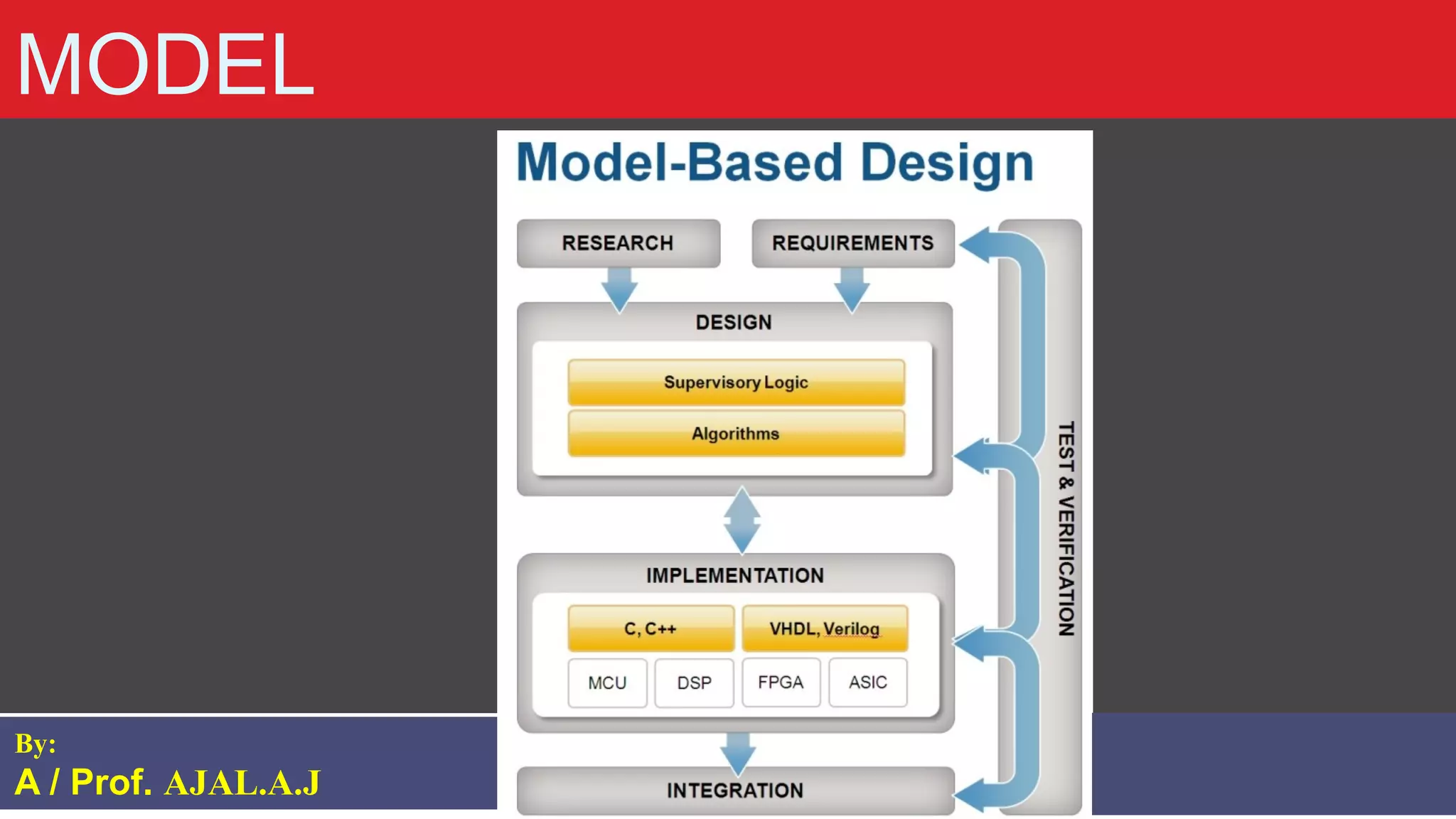
MODEL 
By: 
A / Prof. AJAL.A.J
Suggested reading 
Widescreen Test Pattern (16:9) 
Aspect Ratio 
Test 
(Should appear 
circular) 
16x9 
4x3
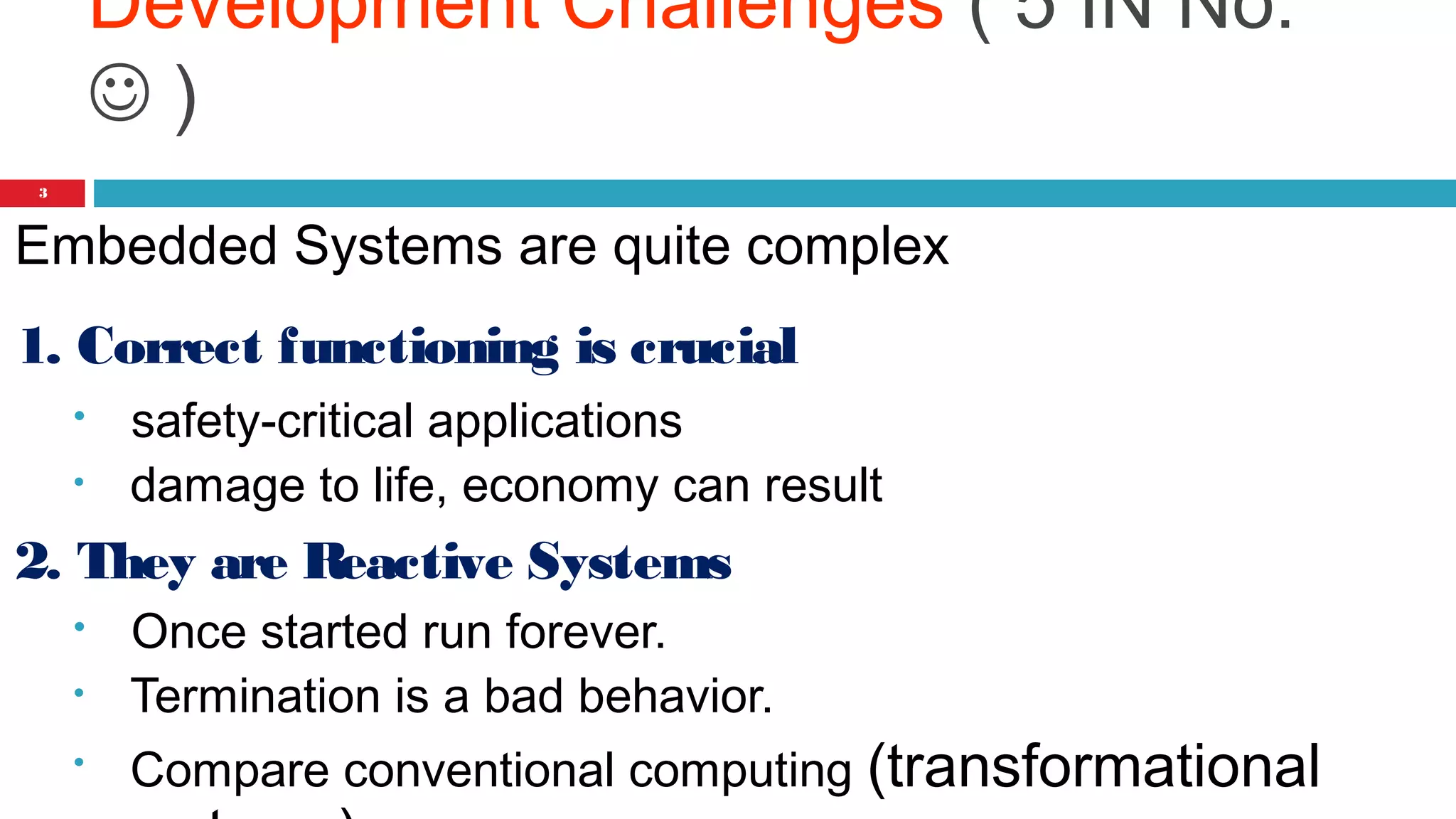
Development Challenges ( 5 IN No: 
 ) 
3 
Embedded Systems are quite complex 
1. Correct functioning is crucial 
• safety-critical applications 
• damage to life, economy can result 
2. They are Reactive Systems 
• Once started run forever. 
• Termination is a bad behavior. 
• Compare conventional computing (transformational 
systems)
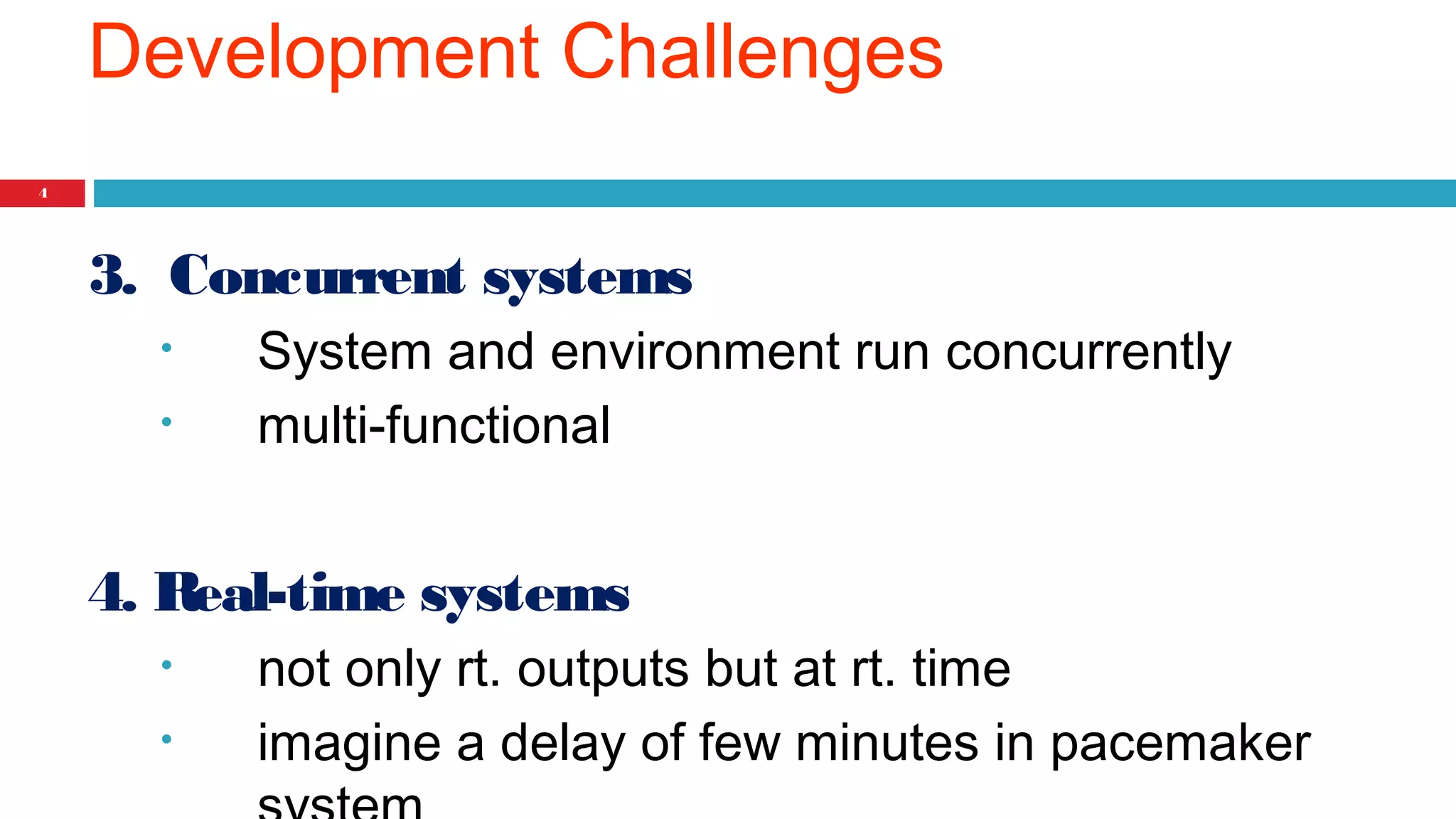
Development Challenges 
4 
3. Concurrent systems 
• System and environment run concurrently 
• multi-functional 
4. Real-time systems 
• not only rt. outputs but at rt. time 
• imagine a delay of few minutes in pacemaker 
system
Development Challenges 
5 
5. Stringent resource constraints 
• compact systems 
− simple processors 
− limited memory 
• quick response 
• good throughput 
• low power 
• Time-to-market
6 
Model-based Development 
 Models are abstract and high level descriptions 
of design objects 
 Focus on one aspect at a time 
 Less development and redesign time 
 Implementation constraints can be placed on 
models 
 Design exploration, evaluation and quick 
prototyping possible using models
7 
New Paradigm 
 Executable models essential 
 Simulation 
 Can be rigorously validated 
 Formal Verification 
 Models can be debugged and revised 
 Automatic generation of final code 
 Traceability 
 The paradigm: Model – Verify – Debug – Code 
Generate
8 
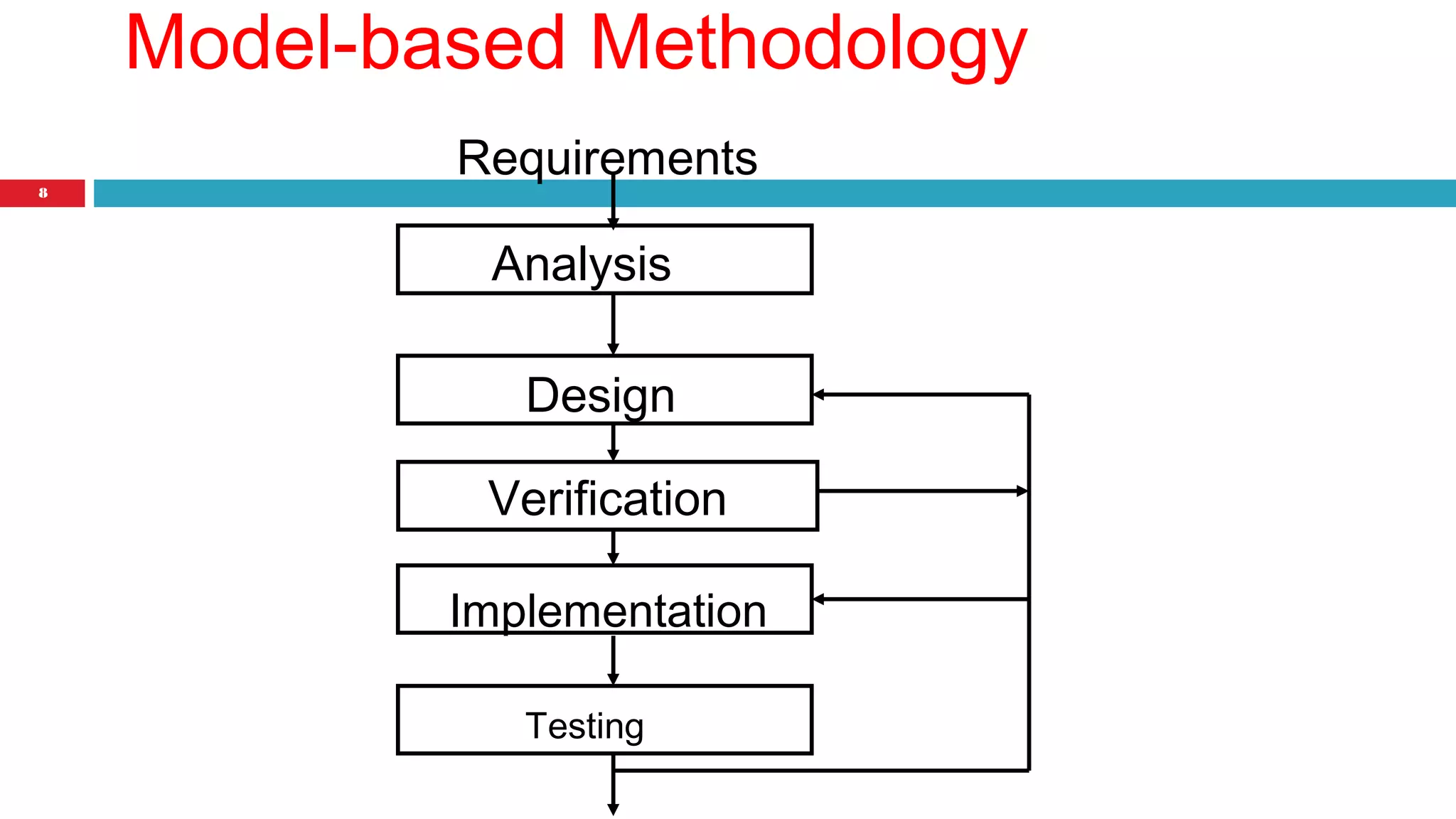
Model-based Methodology 
Requirements 
Analysis 
Design 
Verification 
Implementation 
Testing
9 
Modeling Languages 
 Models need to be formal 
 Languages for describing models 
 Various languages exist 
 High level programming languages (C, C++) 
 Finite State Machines, Statecharts, SpecCharts, 
Esterel, Stateflow 
 Data Flow Diagrams, Lustre, Signal, Simulink 
 Hardware description languages (VHDL, Verilog) 
 Unified Modeling Language(UML)
10 
Modeling Languages 
 Choice of languages depend upon the 
nature of computations modeled 
 Seq. programming models for standard data 
processing computations 
 Data flow diagrams for iterative data 
transformation 
 State Machines for controllers 
 HDLs for hardware components
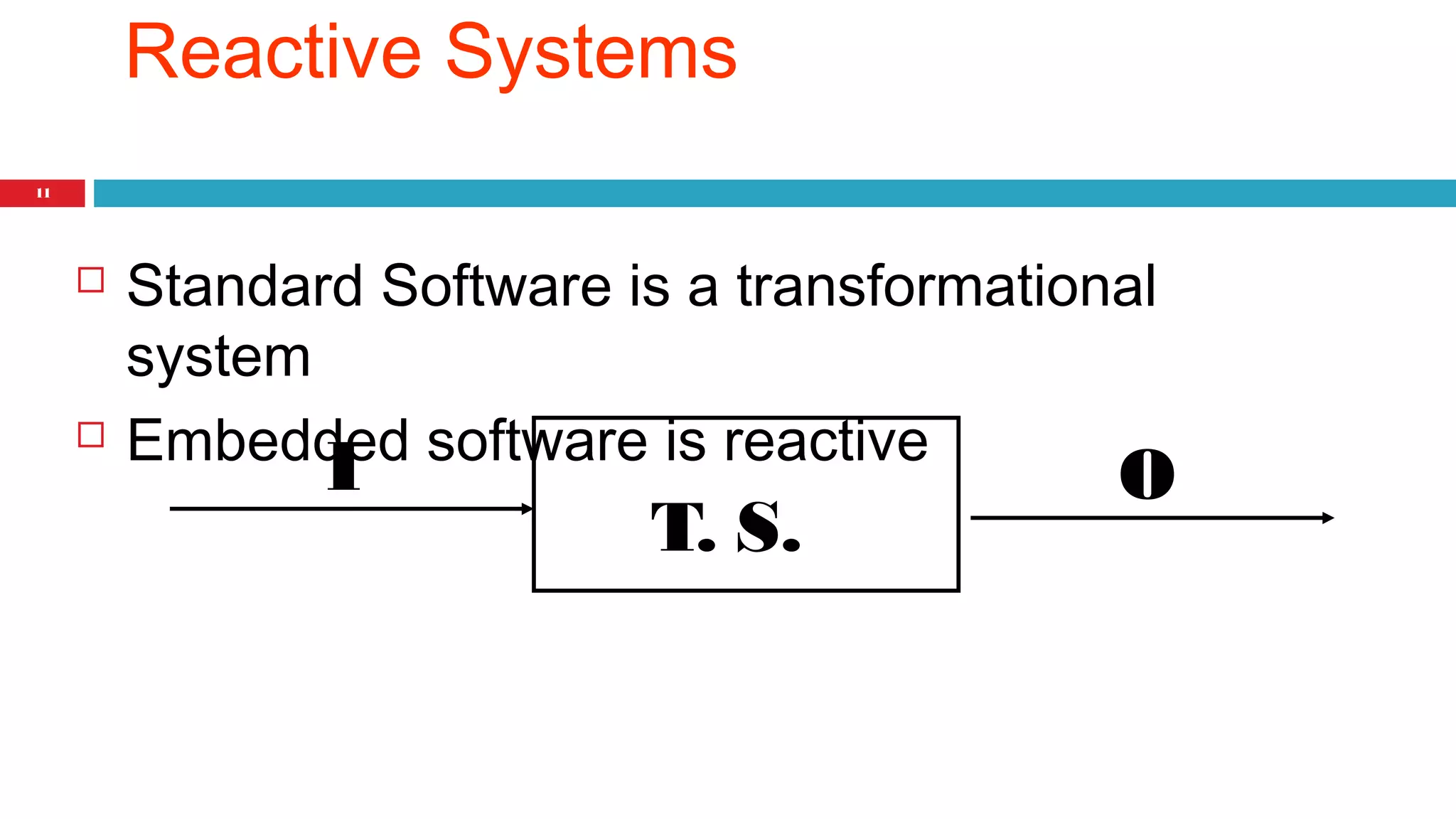
11 
Reactive Systems 
 Standard Software is a transformational 
system 
 Embedded software is reactive 
I O 
T. S.
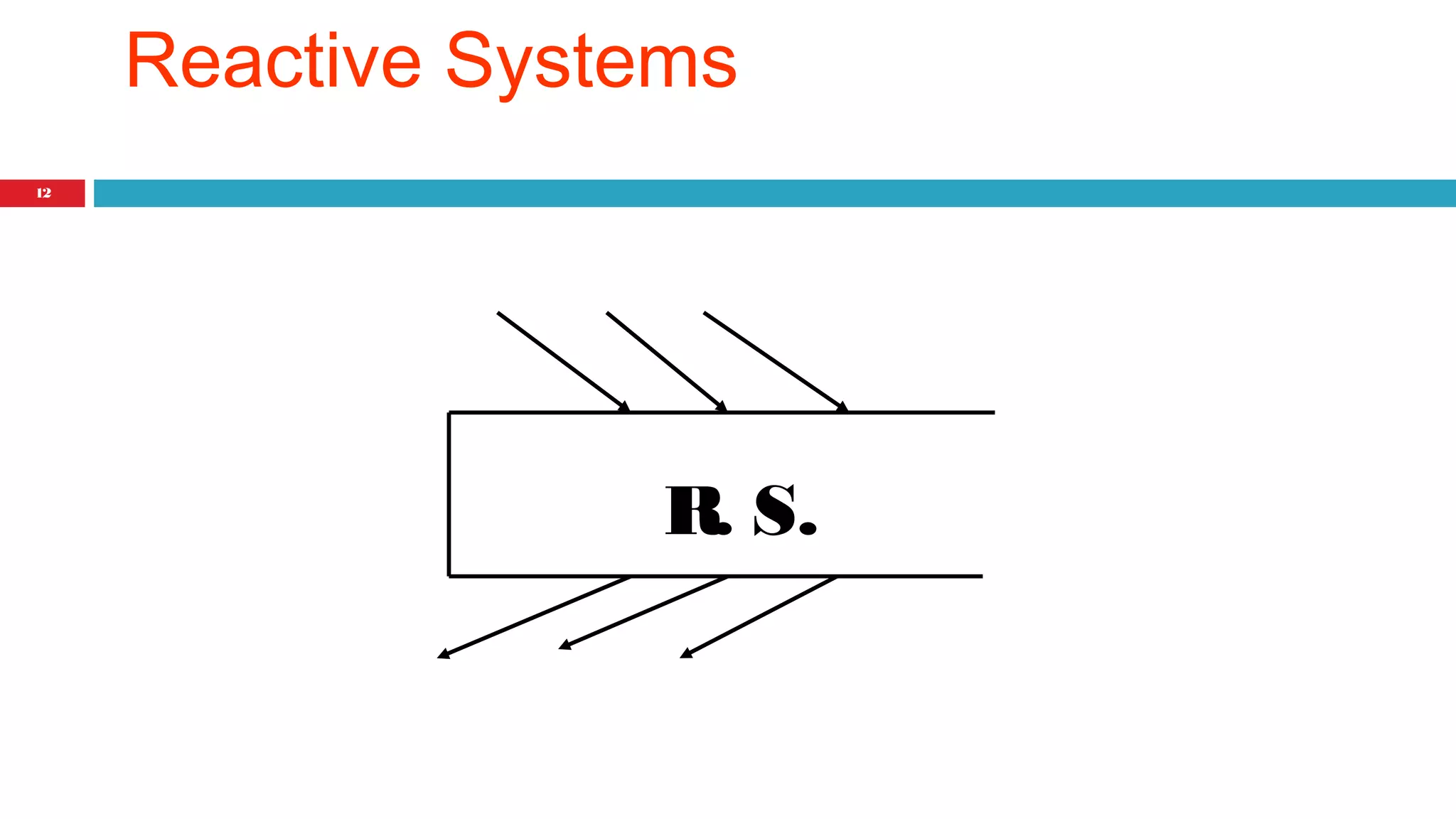
12 
Reactive Systems 
R. S.
13 
RS features 
 Non-termination 
 Ongoing continuous relationship with environment 
 Concurrency (at least system and environment) 
 Event driven 
 Events at unpredictable times 
 Environment is the master 
 Timely response (hard and soft real time) 
 Safety - Critical 
 Conventional models inadequate
14 
Finite State Machines 
 One of the well-known models 
 Intuitive and easy to understand 
 Pictorial appeal 
 Can be made rigorous 
 Standard models for Protocols, Controllers, 
HW
15 
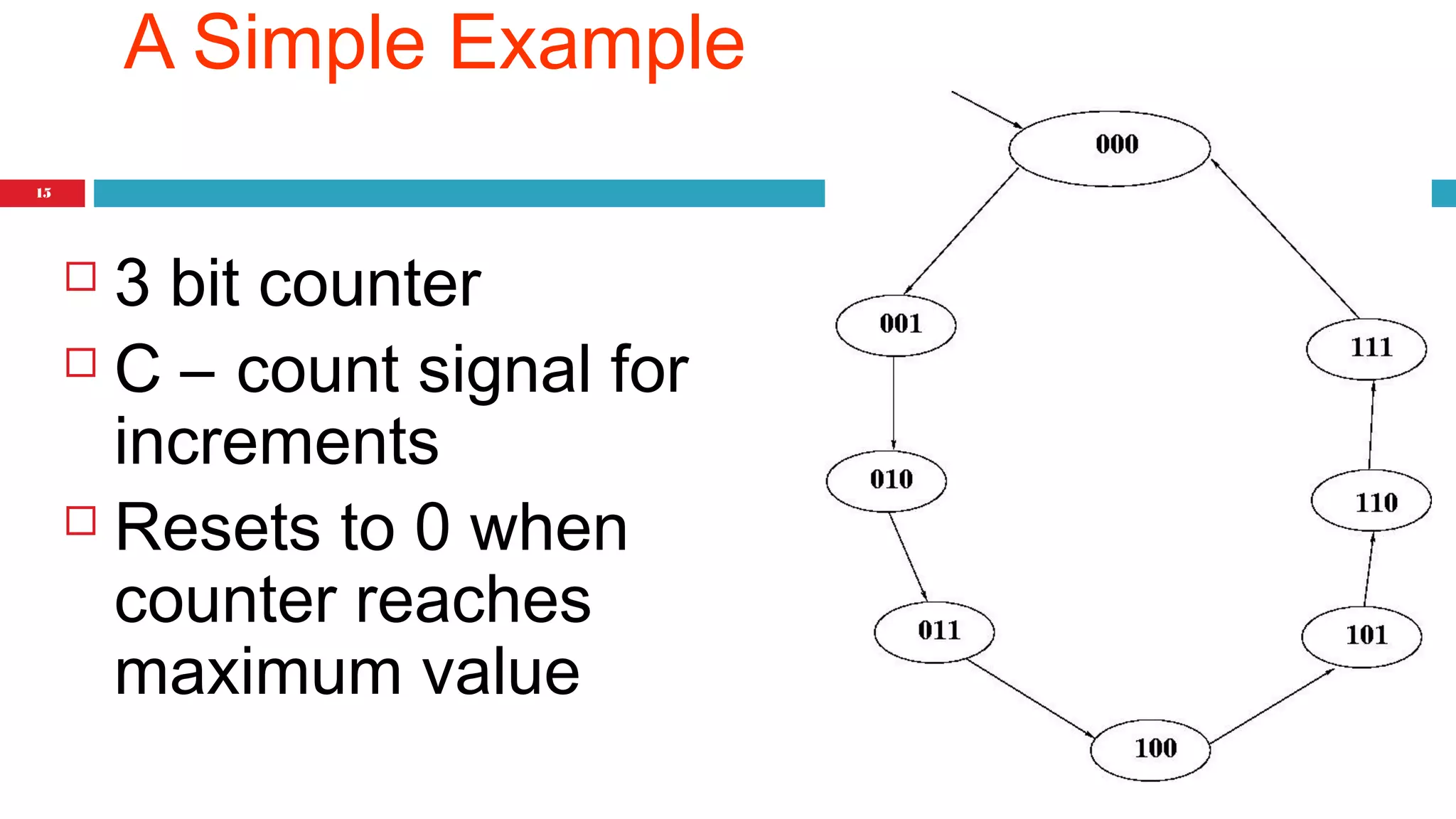
A Simple Example 
 3 bit counter 
 C – count signal for 
increments 
 Resets to 0 when 
counter reaches 
maximum value
16 
State Machine Model 
 Counter behaviour naturally described by a 
state machine 
 States determine the current value of the 
counter 
 Transitions model state changes to the 
event C. 
 Initial state determines the initial value of the 
counter 
 No final state (why?)
17 
Abstract Models 
 Finite State machine model is abstract 
 Abstracts out various details 
 How to read inputs? 
 How often to look for inputs? 
 How to represent states and transitions? 
 Focus on specific aspects 
 Easy for analysis, debugging 
 Redesign cost is reduced 
 Different possible implementations 
 Hardware or Software /Useful for co design of 
systems
18 
Intuitive Models 
 FSM models are intuitive 
 Visual 
 A picture is worth a thousand words 
 Fewer primitives – easy to learn, less scope 
for mistakes and confusion 
 Neutral and hence universal applicability 
 For Software, hardware and control engineers
19 
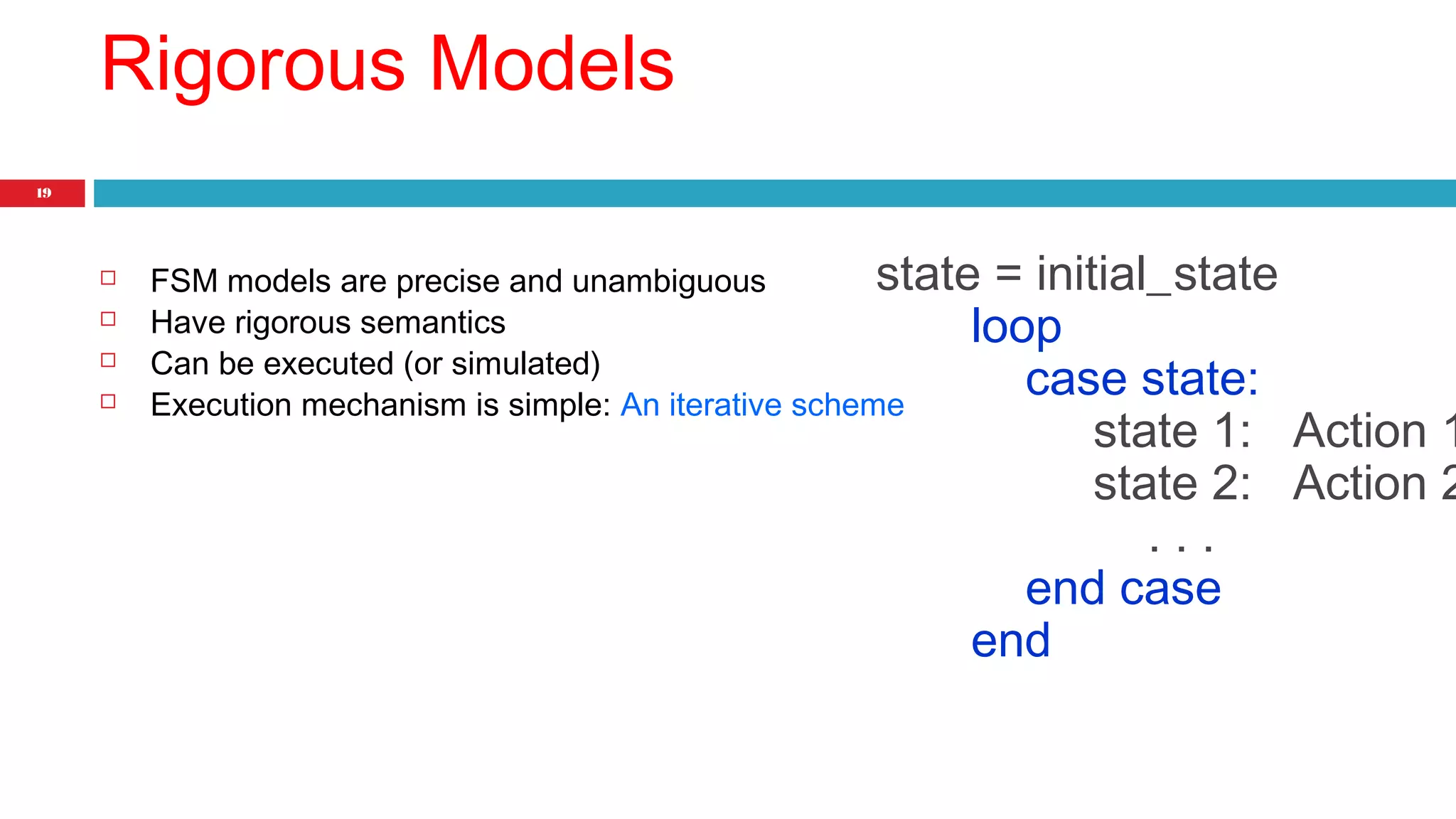
Rigorous Models 
state = initial_state 
 FSM models are precise and unambiguous 
 Have rigorous semantics 
 Can be executed (or simulated) 
 Execution mechanism is simple: An iterative scheme 
loop 
case state: 
state 1: Action 1 
state 2: Action 2 
. . . 
end case 
end
20 
Other Models 
 Synchronous Reactive Models 
 useful for expressing control dominated 
application 
 rich primitives for expressing complex controls 
 Esterel (Esterel Technologies) 
 More on this later
21 
Design Features 
 Two broad classifications 
 Control-dominated Designs 
 Data-dominated Designs
Design Features 
 Control-dominated designs 
 Input events arrive at irregular and unpredictable 
times 
 Time of arrival and response more crucial than 
values
23 
Design Features 
 Data-dominated designs 
 Inputs are streams of data coming at regular 
intervals (sampled data) 
 Values are more crucial 
 Outputs are complex mathematical functions of 
inputs 
 numerical computations and digital signal 
processing computations
24 
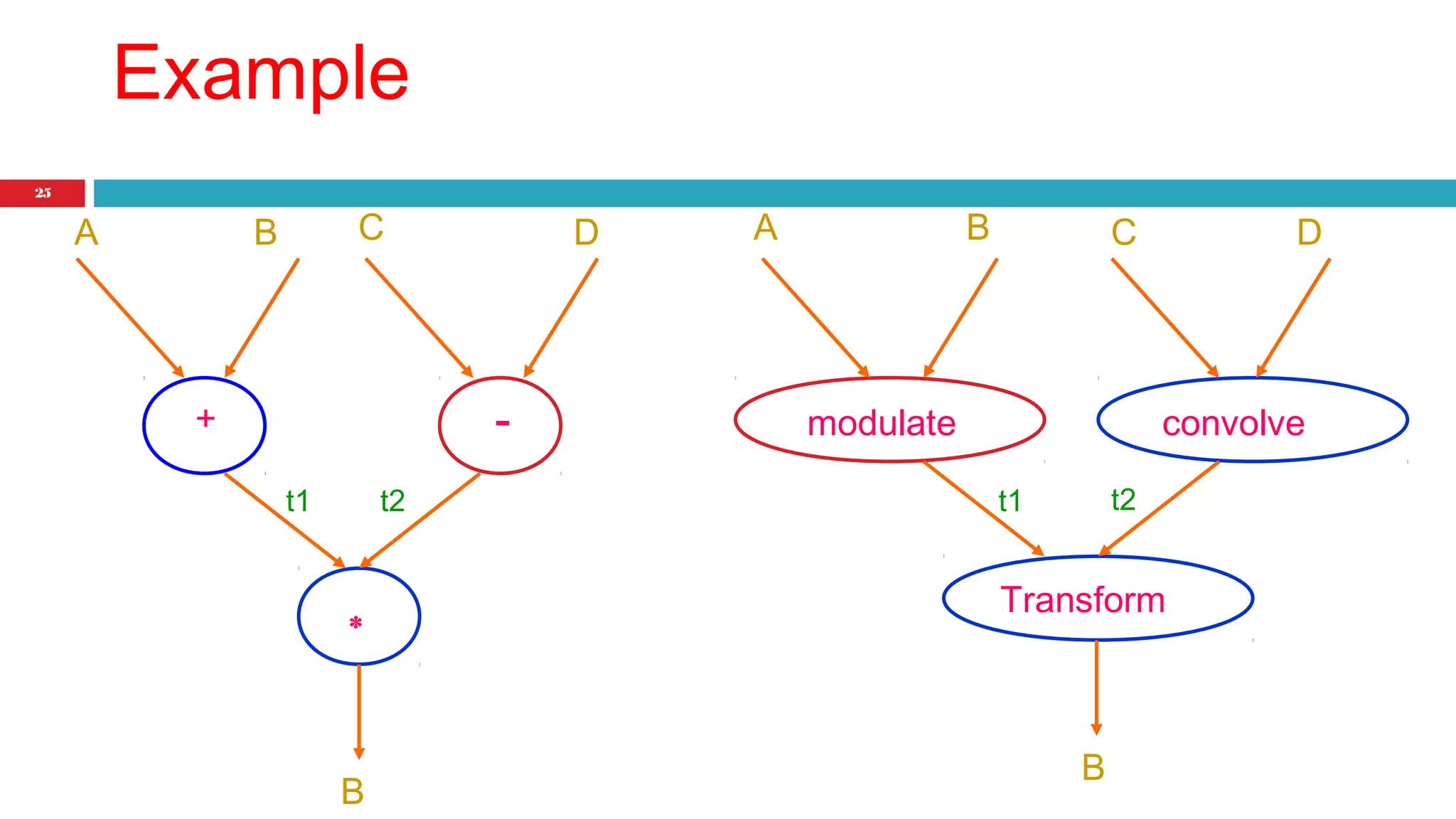
Data flow Models 
 State machines, Statecharts, Esterel are good for 
control-dominated designs 
 Date flow models are useful for data-dominated 
systems 
 Special case of concurrent process models 
 System behaviour described as an 
interconnection of nodes 
 Each node describes transformation of data 
 Connection between a pair of nodes describes 
the flow of data between from one node to the 
other
25 
Example 
A B C D A B C D 
+ - 
t1 t2 t1 t2 
* 
modulate convolve 
Transform 
B B
26 
Data Flow Models 
 Graphical Languages with support for 
 Simulation, debugging, analyisis 
 Code generation onto DSP and micro 
processors 
 Analysis support for hardware-software 
partitioning 
 Many commercial tools and languages 
 Lustre, Signal 
 SCADE
27 
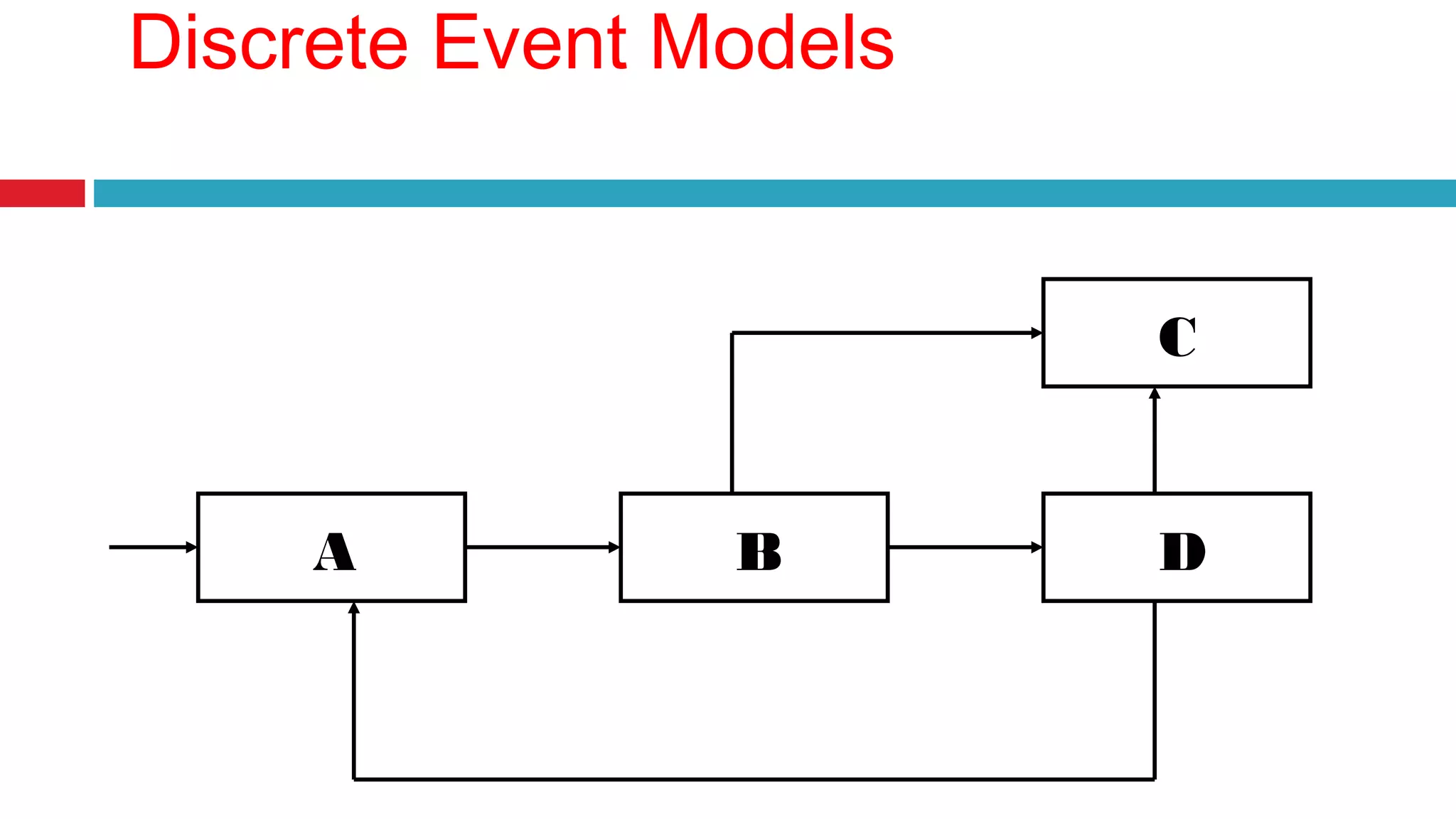
Discrete Event Models 
 Used for HW systems 
 VHDL, Verilog 
 Models are interconnection of nodes 
 Each node reacts to events at their inputs 
 Generates output events which trigger other 
nodes
28 
DE Models 
 External events initiates a reaction 
 Delays in nodes modeled as delays in 
event generation 
 Simulation 
 Problems with cycles 
 Delta cycles in VHDL
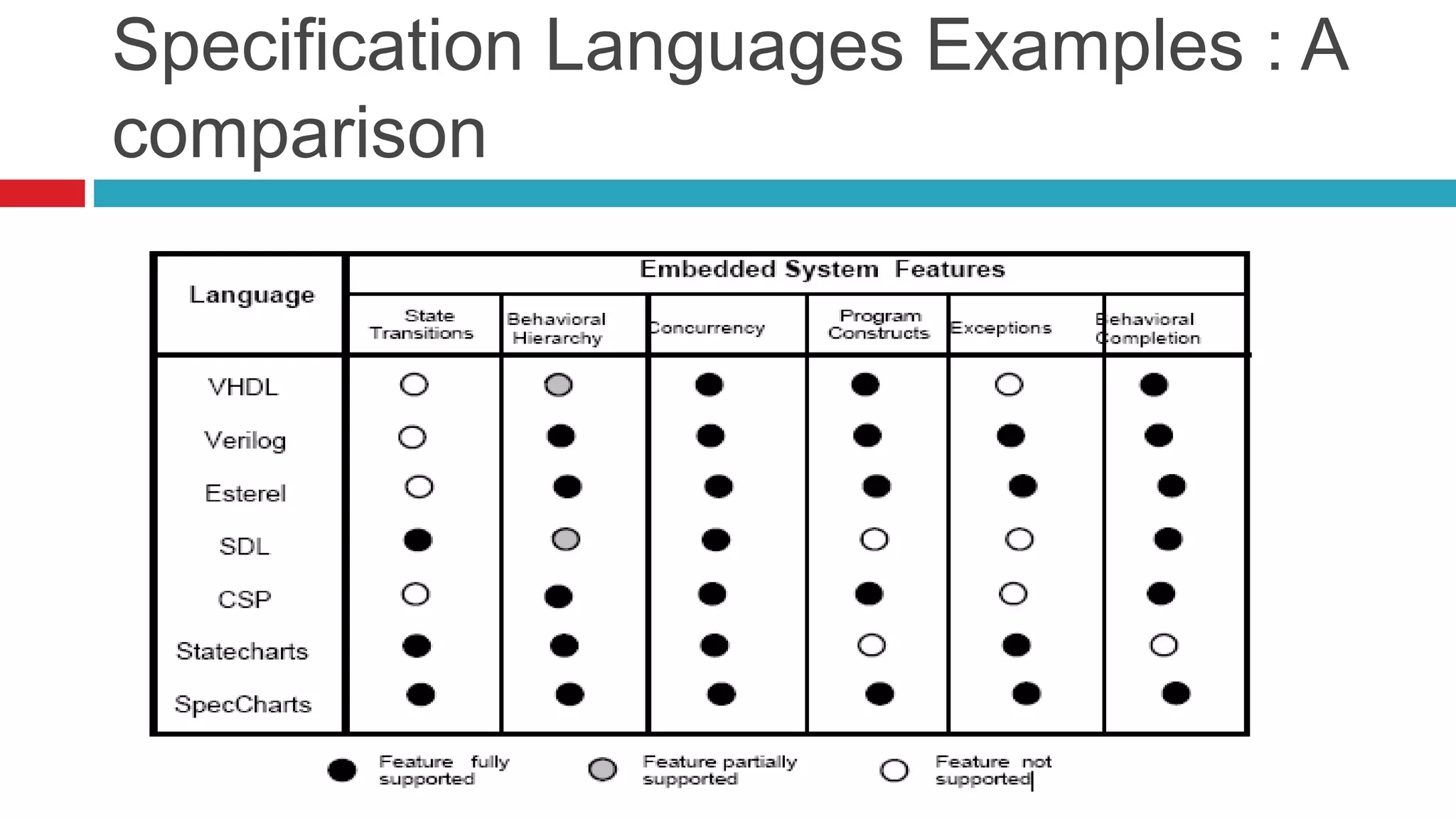
Specification Languages Examples : A 
comparison
30 
Discrete Event Models 
A B 
C 
D
31 
Summary 
 Various models reviewed 
 Sequential programming models 
 Hierarchical and Concurrent State Machines 
 Data Flow Models, Discrete Event Models 
 Each model suitable for particular applications 
 State Machines for event-oriented control 
systems
32 
Summary 
 Sequential program model, data flow model 
for function computation 
 Real systems often require mixture of 
models 
 Modeling tools and languages should have 
combination of all the features.
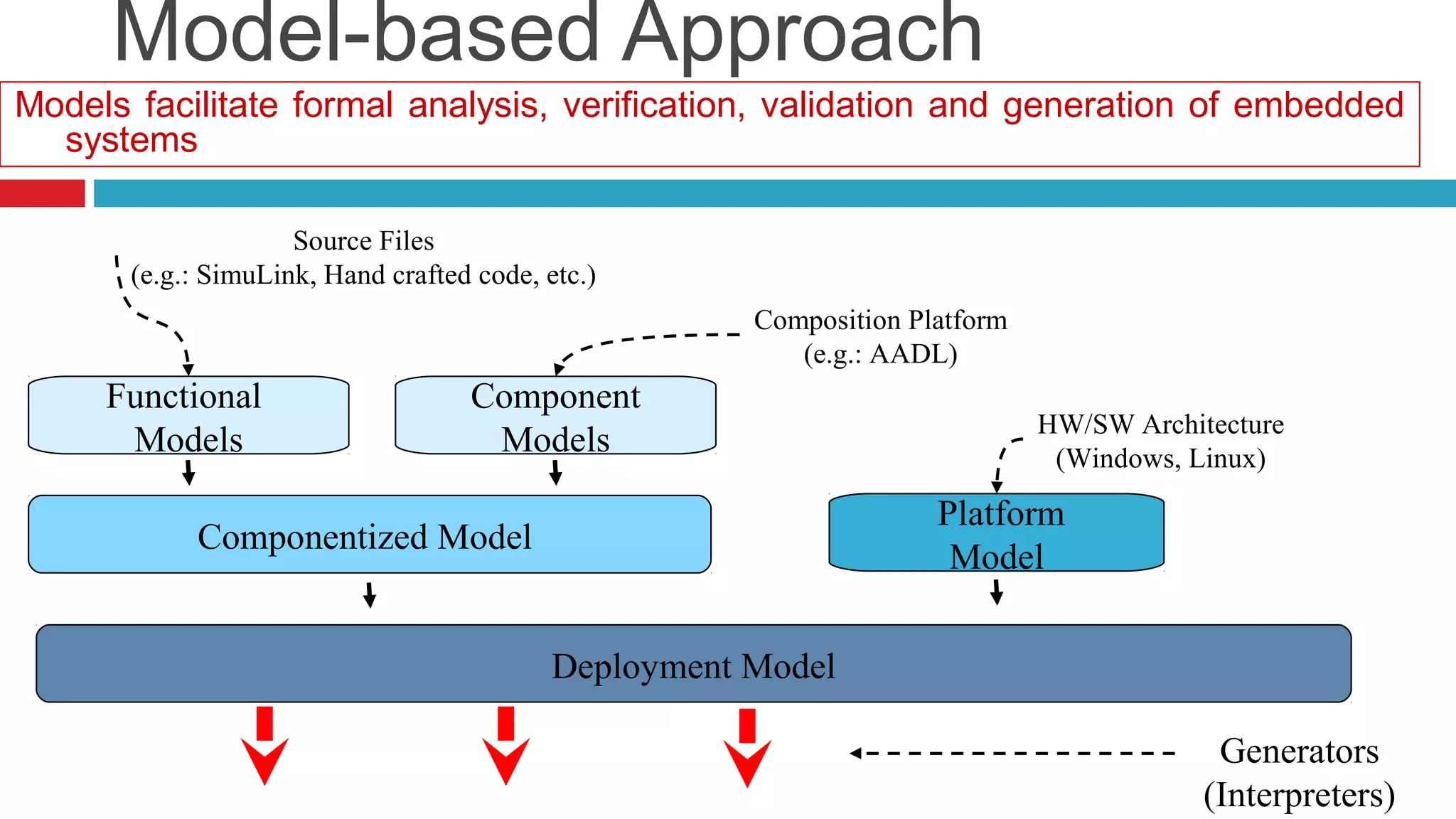
Model-based Approach 
Models facilitate formal analysis, verification, validation and generation of embedded 
systems 
Functional 
Models 
Component 
Models 
Componentized Model Platform 
Model 
Deployment Model 
Generators 
(Interpreters) 
Composition Platform 
(e.g.: AADL) 
HW/SW Architecture 
(Windows, Linux) 
Source Files 
(e.g.: SimuLink, Hand crafted code, etc.)
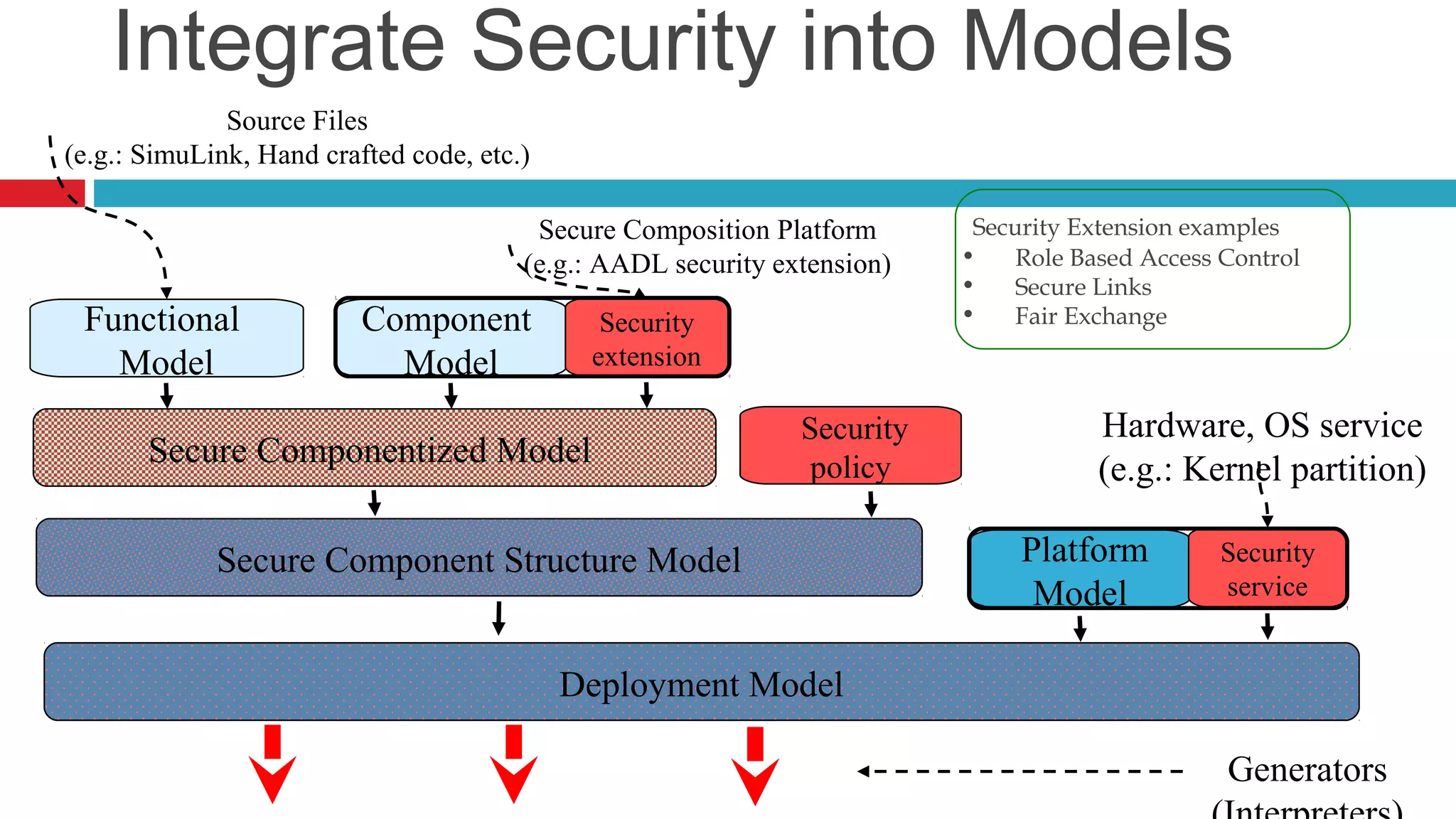
Integrate Security into Models 
Generators 
(Interpreters) 
Secure Composition Platform 
(e.g.: AADL security extension) 
Hardware, OS service 
(e.g.: Kernel partition) 
Source Files 
(e.g.: SimuLink, Hand crafted code, etc.) 
Security Extension examples 
• Role Based Access Control 
• Secure Links 
Functional Component 
• Fair Exchange 
Model 
Model 
Secure Componentized Model 
Platform 
Model 
Security 
extension 
Deployment Model 
Security 
service 
Secure Component Structure Model 
Security 
policy
Thank you very much! 
Questions ?

The embedded systems Model

  • 1.
    THE EMBEDDED SYSTEMS MODEL By: A / Prof. AJAL.A.J
  • 2.
    Suggested reading WidescreenTest Pattern (16:9) Aspect Ratio Test (Should appear circular) 16x9 4x3
  • 3.
    Development Challenges (5 IN No:  ) 3 Embedded Systems are quite complex 1. Correct functioning is crucial • safety-critical applications • damage to life, economy can result 2. They are Reactive Systems • Once started run forever. • Termination is a bad behavior. • Compare conventional computing (transformational systems)
  • 4.
    Development Challenges 4 3. Concurrent systems • System and environment run concurrently • multi-functional 4. Real-time systems • not only rt. outputs but at rt. time • imagine a delay of few minutes in pacemaker system
  • 5.
    Development Challenges 5 5. Stringent resource constraints • compact systems − simple processors − limited memory • quick response • good throughput • low power • Time-to-market
  • 6.
    6 Model-based Development  Models are abstract and high level descriptions of design objects  Focus on one aspect at a time  Less development and redesign time  Implementation constraints can be placed on models  Design exploration, evaluation and quick prototyping possible using models
  • 7.
    7 New Paradigm  Executable models essential  Simulation  Can be rigorously validated  Formal Verification  Models can be debugged and revised  Automatic generation of final code  Traceability  The paradigm: Model – Verify – Debug – Code Generate
  • 8.
    8 Model-based Methodology Requirements Analysis Design Verification Implementation Testing
  • 9.
    9 Modeling Languages  Models need to be formal  Languages for describing models  Various languages exist  High level programming languages (C, C++)  Finite State Machines, Statecharts, SpecCharts, Esterel, Stateflow  Data Flow Diagrams, Lustre, Signal, Simulink  Hardware description languages (VHDL, Verilog)  Unified Modeling Language(UML)
  • 10.
    10 Modeling Languages  Choice of languages depend upon the nature of computations modeled  Seq. programming models for standard data processing computations  Data flow diagrams for iterative data transformation  State Machines for controllers  HDLs for hardware components
  • 11.
    11 Reactive Systems  Standard Software is a transformational system  Embedded software is reactive I O T. S.
  • 12.
  • 13.
    13 RS features  Non-termination  Ongoing continuous relationship with environment  Concurrency (at least system and environment)  Event driven  Events at unpredictable times  Environment is the master  Timely response (hard and soft real time)  Safety - Critical  Conventional models inadequate
  • 14.
    14 Finite StateMachines  One of the well-known models  Intuitive and easy to understand  Pictorial appeal  Can be made rigorous  Standard models for Protocols, Controllers, HW
  • 15.
    15 A SimpleExample  3 bit counter  C – count signal for increments  Resets to 0 when counter reaches maximum value
  • 16.
    16 State MachineModel  Counter behaviour naturally described by a state machine  States determine the current value of the counter  Transitions model state changes to the event C.  Initial state determines the initial value of the counter  No final state (why?)
  • 17.
    17 Abstract Models  Finite State machine model is abstract  Abstracts out various details  How to read inputs?  How often to look for inputs?  How to represent states and transitions?  Focus on specific aspects  Easy for analysis, debugging  Redesign cost is reduced  Different possible implementations  Hardware or Software /Useful for co design of systems
  • 18.
    18 Intuitive Models  FSM models are intuitive  Visual  A picture is worth a thousand words  Fewer primitives – easy to learn, less scope for mistakes and confusion  Neutral and hence universal applicability  For Software, hardware and control engineers
  • 19.
    19 Rigorous Models state = initial_state  FSM models are precise and unambiguous  Have rigorous semantics  Can be executed (or simulated)  Execution mechanism is simple: An iterative scheme loop case state: state 1: Action 1 state 2: Action 2 . . . end case end
  • 20.
    20 Other Models  Synchronous Reactive Models  useful for expressing control dominated application  rich primitives for expressing complex controls  Esterel (Esterel Technologies)  More on this later
  • 21.
    21 Design Features  Two broad classifications  Control-dominated Designs  Data-dominated Designs
  • 22.
    Design Features Control-dominated designs  Input events arrive at irregular and unpredictable times  Time of arrival and response more crucial than values
  • 23.
    23 Design Features  Data-dominated designs  Inputs are streams of data coming at regular intervals (sampled data)  Values are more crucial  Outputs are complex mathematical functions of inputs  numerical computations and digital signal processing computations
  • 24.
    24 Data flowModels  State machines, Statecharts, Esterel are good for control-dominated designs  Date flow models are useful for data-dominated systems  Special case of concurrent process models  System behaviour described as an interconnection of nodes  Each node describes transformation of data  Connection between a pair of nodes describes the flow of data between from one node to the other
  • 25.
    25 Example AB C D A B C D + - t1 t2 t1 t2 * modulate convolve Transform B B
  • 26.
    26 Data FlowModels  Graphical Languages with support for  Simulation, debugging, analyisis  Code generation onto DSP and micro processors  Analysis support for hardware-software partitioning  Many commercial tools and languages  Lustre, Signal  SCADE
  • 27.
    27 Discrete EventModels  Used for HW systems  VHDL, Verilog  Models are interconnection of nodes  Each node reacts to events at their inputs  Generates output events which trigger other nodes
  • 28.
    28 DE Models  External events initiates a reaction  Delays in nodes modeled as delays in event generation  Simulation  Problems with cycles  Delta cycles in VHDL
  • 29.
  • 30.
    30 Discrete EventModels A B C D
  • 31.
    31 Summary Various models reviewed  Sequential programming models  Hierarchical and Concurrent State Machines  Data Flow Models, Discrete Event Models  Each model suitable for particular applications  State Machines for event-oriented control systems
  • 32.
    32 Summary Sequential program model, data flow model for function computation  Real systems often require mixture of models  Modeling tools and languages should have combination of all the features.
  • 33.
    Model-based Approach Modelsfacilitate formal analysis, verification, validation and generation of embedded systems Functional Models Component Models Componentized Model Platform Model Deployment Model Generators (Interpreters) Composition Platform (e.g.: AADL) HW/SW Architecture (Windows, Linux) Source Files (e.g.: SimuLink, Hand crafted code, etc.)
  • 34.
    Integrate Security intoModels Generators (Interpreters) Secure Composition Platform (e.g.: AADL security extension) Hardware, OS service (e.g.: Kernel partition) Source Files (e.g.: SimuLink, Hand crafted code, etc.) Security Extension examples • Role Based Access Control • Secure Links Functional Component • Fair Exchange Model Model Secure Componentized Model Platform Model Security extension Deployment Model Security service Secure Component Structure Model Security policy
  • 35.
    Thank you verymuch! Questions ?