PRESENTATION ON
PINA FIBER
Submitted by :-
132-065-0-155
132-073-0-155
132-072-0-155
132-070-0-155
132-078-0-155
Fiber
Pina fiber
History of pina fiber
Classification
Physical properties
Chemical properties
Chemical constituents
Difference between pina & other natural fiber
Cultivation method
Advantage of pina fiber
How to take care of pina fiber
Various uses
Why pina is so expensive
Past,present & future of pina fiber
What is fiber?
The material,
which consists fibrous
structure and length
is thousand times
higher than its width
is called FIBER.
FIBER
NATURAL
ANIMAL
VEGETAB
LE
SEED
LEAF PINA
BASTMINAREL
MAN
MADE
Man has always been innovative.
When talking of textile fibers, man
has made natural fibers many
plants. One of such inventions is
Piña, a textile fiber obtained from
pineapple leaves for making fabric.
What is pina fiber?
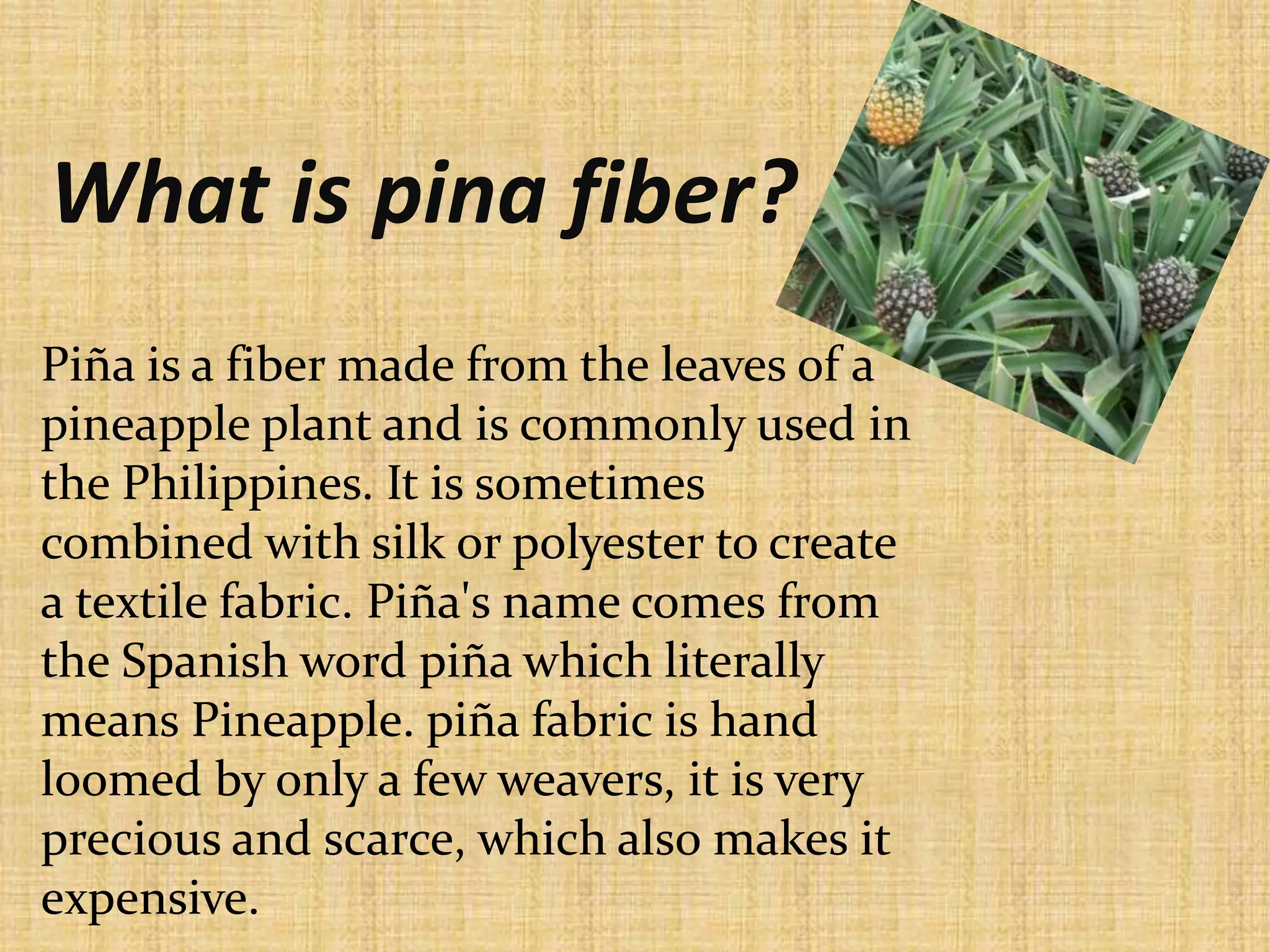
Piña is a fiber made from the leaves of a
pineapple plant and is commonly used in
the Philippines. It is sometimes
combined with silk or polyester to create
a textile fabric. Piña's name comes from
the Spanish word piña which literally
means Pineapple. piña fabric is hand
loomed by only a few weavers, it is very
precious and scarce, which also makes it
expensive.
Kalibo, Aklan is the main and the oldest manufacturer/weaver of piña
cloth in the Philippines which are being exported to various parts of the
world most particularly North America, and Europe. History records
suggest that Kalibo's piña cloth was traded during the Pre-Hispanic
times and reached as far as Greece and Egypt during its heyday, although
the pineapple plant was brought to the Philippines by the Spaniards from
the Americas. Kalibo is also known for other native products such as
handbags made of buri leaves which is a favorite for tourists visiting the
town. Pineapple silk is considered the queen of Philippine fabrics and is
considered the fabric of choice of the Philippine elite. During the 1996
meeting of APEC in the Philippines, world leaders donned a pineapple silk
Barong Tagalog from Kalibo during the traditional group photo.
Classification of pineapple
Kingdom Plante
(Unranked) Angiosperms
(Unranked) Monocots
(Unranked) Commelinids
Order Poales
Family Bromelioideae
Subfamily Bromelioideae
Genus Ananas
Species A.comosus
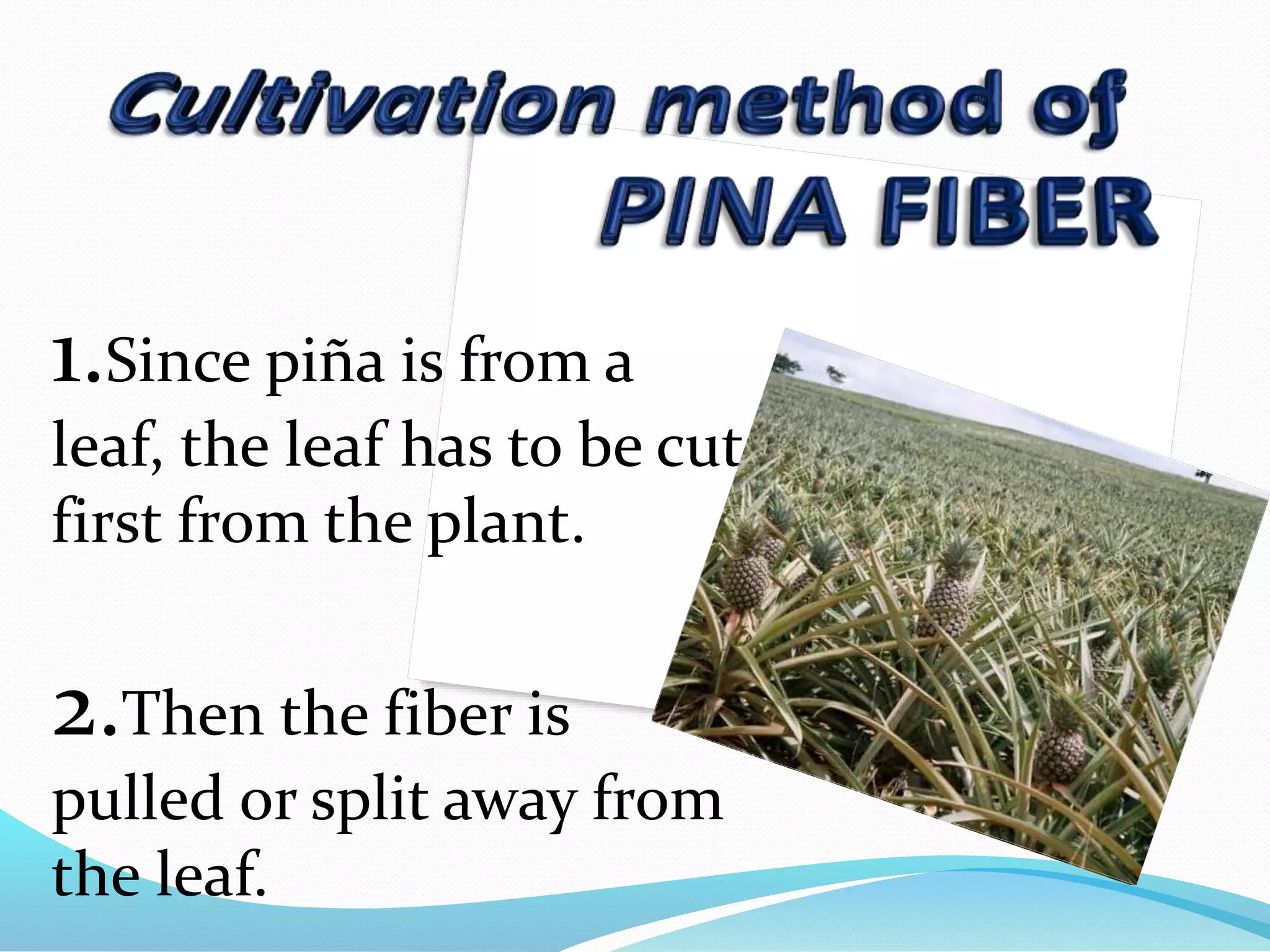
1.Since piña is from a
leaf, the leaf has to be cut
first from the plant.
2.Then the fiber is
pulled or split away from
the leaf.
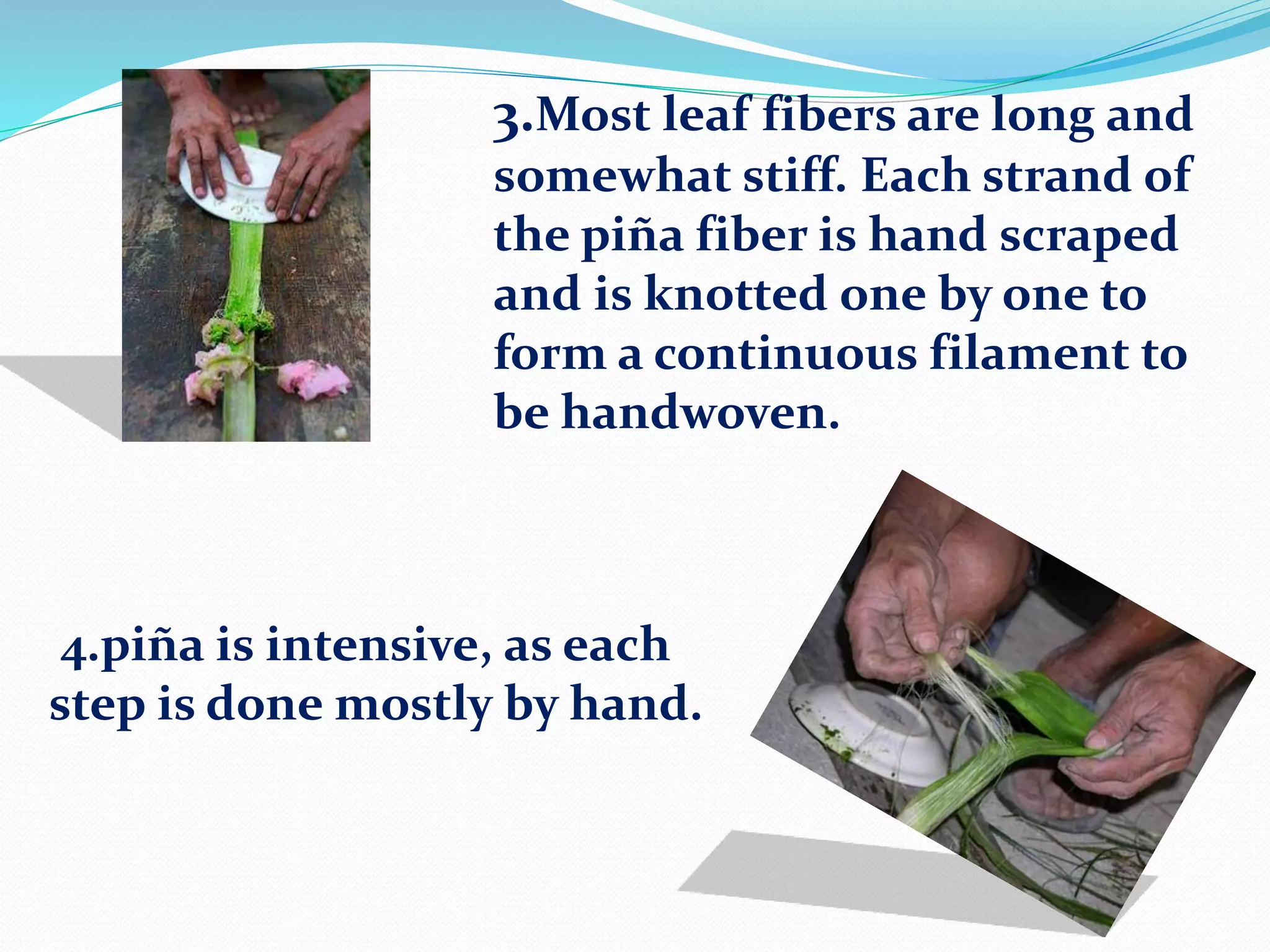
3.Most leaf fibers are long and
somewhat stiff. Each strand of
the piña fiber is hand scraped
and is knotted one by one to
form a continuous filament to
be handwoven.
4.piña is intensive, as each
step is done mostly by hand.
Physical Properties of pina fiber
Length(mm) 3-9
Breadth(10-3 mm) 4-8
L/B ratio 450
Gravimetric Fineness(tex) 1.54
Tenacity(gm/tex) 50
Extension at break(%) 2-6
Flextural rigidity(dyne cm-2) 3.8
Density (Gm/cc) 1.48
Moisture Regain at 65%
Pineapple leaf fiber is multi-
cellular with an average ultimate
cell length of 5 mm. The fiber
is lignocelluloses in nature.
Holocellulose 87.56%
Alpha-cellulose 78.11%
Hemicellulo 9.45%
Lignin 4.78%
It has been found that
PALF consists of following
chemical entities -
Chemical constituents
Various pineapple fibre
constituents viz. α-
cellulose, pentosans,
lignin, fat and wax,
ashcontent, nitrogenous
matter, pectin ,degree of
polymerization and
crystallinity of α-cellulose
determined with standard
methods.
Difference between pina & other
natural fiber(Physical and Chemical Properties)
Physical
Properties
Pineapple leaf
fiber
jute cotton
Length(mm) 3-9 0.8-6.0 15-60
Breadth(10-3 mm) 4-8 5-25 15-20
L/B ratio 450 110 1300
Gravimetric
Fineness(tex)
1.54 1.25-5.0 0.10-0.30
Tenacity(gm/tex) 50 35-50 20-45
Extension at
break(%)
2-6 1.0-2.5 6.5-7.5
Chemical
properties
Alpha-Cellulose 70 60.5 92.89
Lignin 4.5 13.3 0.54
The fabric has a natural gloss similar to silk, and
is better in quality. This gloss protects the fibers
and as a result, piña does not require any t0
treatment with toxic chemicals.
It is easy to wash and care for; no dry cleaning
required!
Piña cloth is wear-resistant
It is an ideal eco-textile for clothing
Pina fiber Long, fine, lustrous.
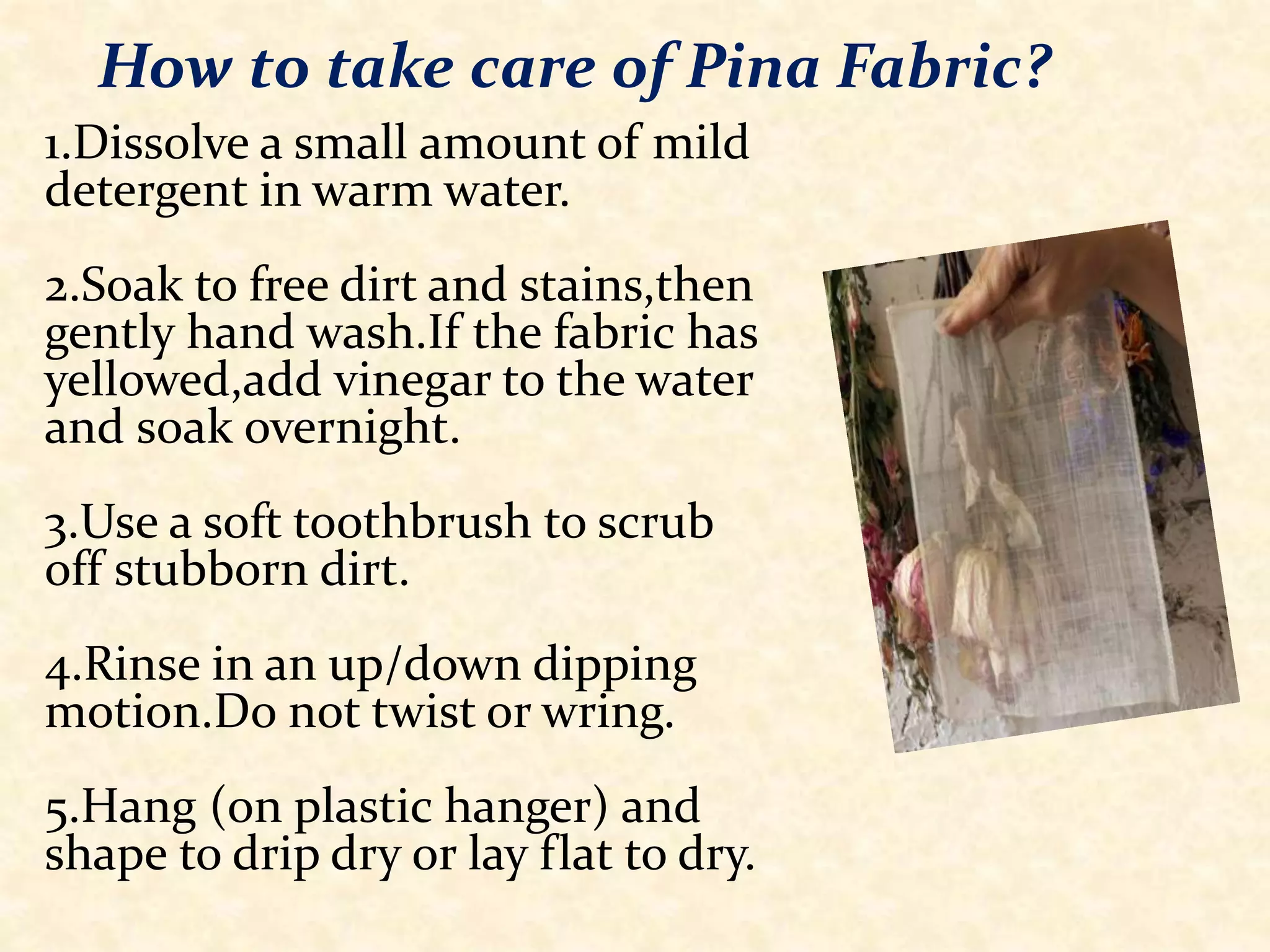
1.Dissolve a small amount of mild
detergent in warm water.
2.Soak to free dirt and stains,then
gently hand wash.If the fabric has
yellowed,add vinegar to the water
and soak overnight.
3.Use a soft toothbrush to scrub
off stubborn dirt.
4.Rinse in an up/down dipping
motion.Do not twist or wring.
5.Hang (on plastic hanger) and
shape to drip dry or lay flat to dry.
How to take care of Pina Fabric?
piña fabric is converted into valuable items such
as Barong Tagalog, kimona, panuelo, vestments,
table linen, pillow cases, gowns, shawls, fans and
other items.
Barong Tagalog kimona vestments Table linen
Past , Present & Future Prospective
of Pina Fiber……
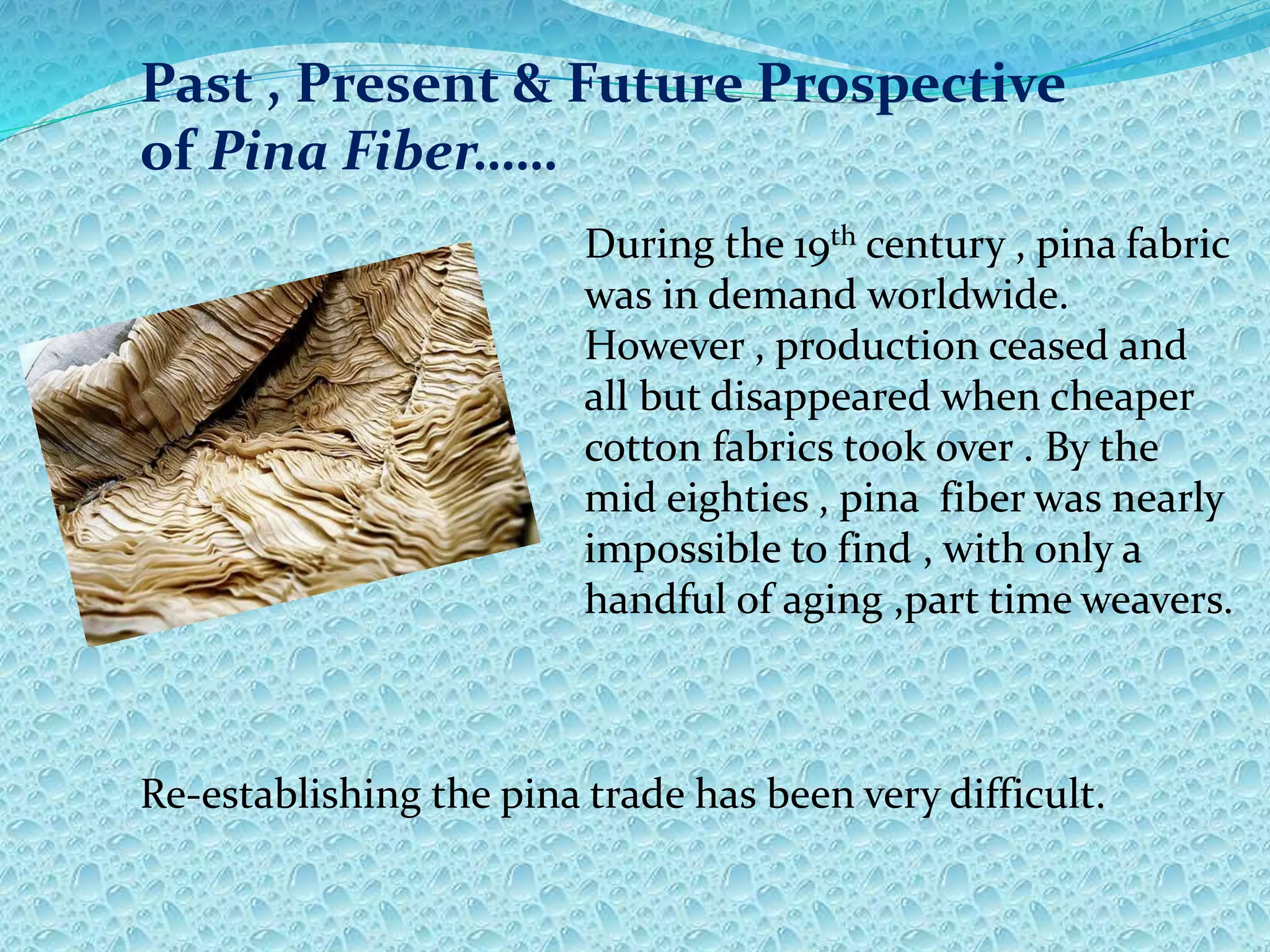
During the 19th century , pina fabric
was in demand worldwide.
However , production ceased and
all but disappeared when cheaper
cotton fabrics took over . By the
mid eighties , pina fiber was nearly
impossible to find , with only a
handful of aging ,part time weavers.
Re-establishing the pina trade has been very difficult.
Past,Present & Future Prospective of
Pina Fiber….
It began with marketing the pina barong
(embroidered traditional formal garment)
locally which eventually influenced the
elite.This campaign elevated pina fabric to
become a symbol of status.
Past,Present & Future
Prospective of Pina Fiber
Domestic support also marked the
beginning of a foundation dedicated to the
revival of Philippine arts , crafts and
culture.
Fortunately , traditional pina weaving has
survived being dangerously close to
disappearing and production has since
begun to flourish . Now , once again , pina
fiber has great prospects for the future.
Cloths made by pina fiber
Pina Fiber

Pina Fiber

  • 2.
  • 3.
  • 4.
    Fiber Pina fiber History ofpina fiber Classification Physical properties Chemical properties Chemical constituents Difference between pina & other natural fiber Cultivation method Advantage of pina fiber How to take care of pina fiber Various uses Why pina is so expensive Past,present & future of pina fiber
  • 5.
    What is fiber? Thematerial, which consists fibrous structure and length is thousand times higher than its width is called FIBER.
  • 6.
  • 7.
    Man has alwaysbeen innovative. When talking of textile fibers, man has made natural fibers many plants. One of such inventions is Piña, a textile fiber obtained from pineapple leaves for making fabric.
  • 8.
    What is pinafiber? Piña is a fiber made from the leaves of a pineapple plant and is commonly used in the Philippines. It is sometimes combined with silk or polyester to create a textile fabric. Piña's name comes from the Spanish word piña which literally means Pineapple. piña fabric is hand loomed by only a few weavers, it is very precious and scarce, which also makes it expensive.
  • 9.
    Kalibo, Aklan isthe main and the oldest manufacturer/weaver of piña cloth in the Philippines which are being exported to various parts of the world most particularly North America, and Europe. History records suggest that Kalibo's piña cloth was traded during the Pre-Hispanic times and reached as far as Greece and Egypt during its heyday, although the pineapple plant was brought to the Philippines by the Spaniards from the Americas. Kalibo is also known for other native products such as handbags made of buri leaves which is a favorite for tourists visiting the town. Pineapple silk is considered the queen of Philippine fabrics and is considered the fabric of choice of the Philippine elite. During the 1996 meeting of APEC in the Philippines, world leaders donned a pineapple silk Barong Tagalog from Kalibo during the traditional group photo.
  • 10.
    Classification of pineapple KingdomPlante (Unranked) Angiosperms (Unranked) Monocots (Unranked) Commelinids Order Poales Family Bromelioideae Subfamily Bromelioideae Genus Ananas Species A.comosus
  • 11.
    1.Since piña isfrom a leaf, the leaf has to be cut first from the plant. 2.Then the fiber is pulled or split away from the leaf.
  • 12.
    3.Most leaf fibersare long and somewhat stiff. Each strand of the piña fiber is hand scraped and is knotted one by one to form a continuous filament to be handwoven. 4.piña is intensive, as each step is done mostly by hand.
  • 13.
    Physical Properties ofpina fiber Length(mm) 3-9 Breadth(10-3 mm) 4-8 L/B ratio 450 Gravimetric Fineness(tex) 1.54 Tenacity(gm/tex) 50 Extension at break(%) 2-6 Flextural rigidity(dyne cm-2) 3.8 Density (Gm/cc) 1.48 Moisture Regain at 65% Pineapple leaf fiber is multi- cellular with an average ultimate cell length of 5 mm. The fiber is lignocelluloses in nature.
  • 14.
    Holocellulose 87.56% Alpha-cellulose 78.11% Hemicellulo9.45% Lignin 4.78% It has been found that PALF consists of following chemical entities -
  • 15.
    Chemical constituents Various pineapplefibre constituents viz. α- cellulose, pentosans, lignin, fat and wax, ashcontent, nitrogenous matter, pectin ,degree of polymerization and crystallinity of α-cellulose determined with standard methods.
  • 16.
    Difference between pina& other natural fiber(Physical and Chemical Properties) Physical Properties Pineapple leaf fiber jute cotton Length(mm) 3-9 0.8-6.0 15-60 Breadth(10-3 mm) 4-8 5-25 15-20 L/B ratio 450 110 1300 Gravimetric Fineness(tex) 1.54 1.25-5.0 0.10-0.30 Tenacity(gm/tex) 50 35-50 20-45 Extension at break(%) 2-6 1.0-2.5 6.5-7.5 Chemical properties Alpha-Cellulose 70 60.5 92.89 Lignin 4.5 13.3 0.54
  • 17.
    The fabric hasa natural gloss similar to silk, and is better in quality. This gloss protects the fibers and as a result, piña does not require any t0 treatment with toxic chemicals. It is easy to wash and care for; no dry cleaning required! Piña cloth is wear-resistant It is an ideal eco-textile for clothing Pina fiber Long, fine, lustrous.
  • 18.
    1.Dissolve a smallamount of mild detergent in warm water. 2.Soak to free dirt and stains,then gently hand wash.If the fabric has yellowed,add vinegar to the water and soak overnight. 3.Use a soft toothbrush to scrub off stubborn dirt. 4.Rinse in an up/down dipping motion.Do not twist or wring. 5.Hang (on plastic hanger) and shape to drip dry or lay flat to dry. How to take care of Pina Fabric?
  • 19.
    piña fabric isconverted into valuable items such as Barong Tagalog, kimona, panuelo, vestments, table linen, pillow cases, gowns, shawls, fans and other items. Barong Tagalog kimona vestments Table linen
  • 21.
    Past , Present& Future Prospective of Pina Fiber…… During the 19th century , pina fabric was in demand worldwide. However , production ceased and all but disappeared when cheaper cotton fabrics took over . By the mid eighties , pina fiber was nearly impossible to find , with only a handful of aging ,part time weavers. Re-establishing the pina trade has been very difficult.
  • 22.
    Past,Present & FutureProspective of Pina Fiber…. It began with marketing the pina barong (embroidered traditional formal garment) locally which eventually influenced the elite.This campaign elevated pina fabric to become a symbol of status.
  • 23.
    Past,Present & Future Prospectiveof Pina Fiber Domestic support also marked the beginning of a foundation dedicated to the revival of Philippine arts , crafts and culture. Fortunately , traditional pina weaving has survived being dangerously close to disappearing and production has since begun to flourish . Now , once again , pina fiber has great prospects for the future.
  • 24.
    Cloths made bypina fiber