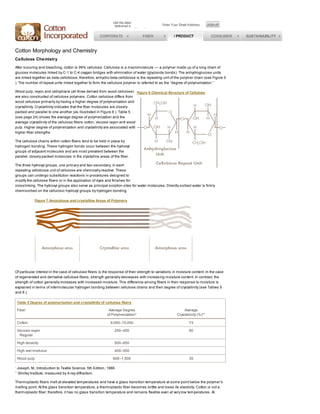
Figure 6 Chemical Structure of Cellulose
Cotton Morphology and Chemistry
Cellulose Chemistry
After scouring and bleaching, cotton is 99% cellulose. Cellulose is a macromolecule –– a polymer made up of a long chain of
glucose molecules linked by C-1 to C-4 oxygen bridges with elimination of water (glycoside bonds). The anhydroglucose units
are linked together as beta-cellobiose; therefore, anhydro-beta-cellobiose is the repeating unit of the polymer chain (see Figure 5
). The number of repeat units linked together to form the cellulose polymer is referred to as the “degree of polymerization.”
Wood pulp, rayon and cellophane (all three derived from wood cellulose)
are also constructed of cellulose polymers. Cotton cellulose differs from
wood cellulose primarily by having a higher degree of polymerization and
crystallinity. Crystallinity indicates that the fiber molecules are closely
packed and parallel to one another (as illustrated in Figure 6 ). Table 5
(see page 24) shows the average degree of polymerization and the
average crystallinity of the cellulose fibers cotton, viscose rayon and wood
pulp. Higher degree of polymerization and crystallinity are associated with
higher fiber strengths.
The cellulose chains within cotton fibers tend to be held in place by
hydrogen bonding. These hydrogen bonds occur between the hydroxyl
groups of adjacent molecules and are most prevalent between the
parallel, closely packed molecules in the crystalline areas of the fiber.
The three hydroxyl groups, one primary and two secondary, in each
repeating cellobiose unit of cellulose are chemically reactive. These
groups can undergo substitution reactions in procedures designed to
modify the cellulose fibers or in the application of dyes and finishes for
crosslinking. The hydroxyl groups also serve as principal sorption sites for water molecules. Directly sorbed water is firmly
chemisorbed on the cellulosic hydroxyl groups by hydrogen bonding.
Figure 7 Amorphous and crystalline Areas of Polymers
Of particular interest in the case of cellulose fibers is the response of their strength to variations in moisture content. In the case
of regenerated and derivative cellulose fibers, strength generally decreases with increasing moisture content. In contrast, the
strength of cotton generally increases with increased moisture. This difference among fibers in their response to moisture is
explained in terms of intermolecular hydrogen bonding between cellulose chains and their degree of crystallinity (see Tables 5
and 6 ).
Table 5 Degree of polymerization and crystallinity of cellulose fibers
Fiber Average Degree
of Polymerization*
Average
Crystallinity (%)**
Cotton 9,000–15,000 73
Viscose rayon
Regular
250–450 60
High tenacity 500–650
High wet modulus 400–550
Wood pulp 600–1,500 35
Joseph, M., Introduction to Textile Science, 5th Edition, 1986.
Shirley Institute; measured by X-ray diffraction.
Thermoplastic fibers melt at elevated temperatures and have a glass transition temperature at some point below the polymer’s
melting point. At the glass transition temperature, a thermoplastic fiber becomes brittle and loses its elasticity. Cotton is not a
thermoplastic fiber; therefore, it has no glass transition temperature and remains flexible even at very low temperatures. At
Get the latest Cotton Information
delivered straight to your inbox Enter Your Email Address
*
**
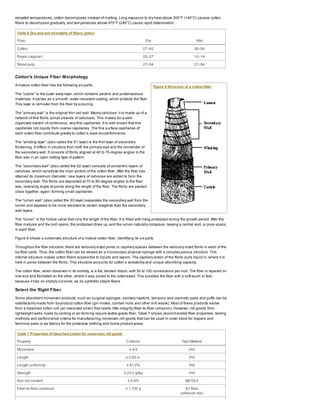
Figure 8 Structure of a cotton fiber
elevated temperatures, cotton decomposes instead of melting. Long exposure to dry heat above 300°F (149°C) causes cotton
fibers to decompose gradually, and temperatures above 475°F (246°C) cause rapid deterioration.
Table 6 Dry and wet strengths of fibers (g/tex)
Fiber Dry Wet
Cotton 27–45 30–54
Rayon (regular) 22–27 10–14
Wood pulp 27–54 27–54
Cotton's Unique Fiber Morphology
A mature cotton fiber has the following six parts.
The “cuticle” is the outer waxy layer, which contains pectins and proteinaceous
materials. It serves as a smooth, water-resistant coating, which protects the fiber.
This layer is removed from the fiber by scouring.
The “primary wall” is the original thin cell wall. Mainly cellulose, it is made up of a
network of fine fibrils (small strands of cellulose). This makes for a well-
organized system of continuous, very fine capillaries. It is well known that fine
capillaries rob liquids from coarse capillaries. The fine surface capillaries of
each cotton fiber contribute greatly to cotton’s wipe-dry performance.
The “winding layer” (also called the S1 layer) is the first layer of secondary
thickening. It differs in structure from both the primary wall and the remainder of
the secondary wall. It consists of fibrils aligned at 40 to 70-degree angles to the
fiber axis in an open netting type of pattern.
The “secondary wall” (also called the S2 layer) consists of concentric layers of
cellulose, which constitute the main portion of the cotton fiber. After the fiber has
attained its maximum diameter, new layers of cellulose are added to form the
secondary wall. The fibrils are deposited at 70 to 80-degree angles to the fiber
axis, reversing angle at points along the length of the fiber. The fibrils are packed
close together, again, forming small capillaries.
The “lumen wall” (also called the S3 layer) separates the secondary wall from the
lumen and appears to be more resistant to certain reagents than the secondary
wall layers.
The “lumen” is the hollow canal that runs the length of the fiber. It is filled with living protoplast during the growth period. After the
fiber matures and the boll opens, the protoplast dries up, and the lumen naturally collapses, leaving a central void, or pore space,
in each fiber.
Figure 8 shows a schematic structure of a mature cotton fiber, identifying its six parts.
Throughout the fiber structure, there are variously sized pores or capillary spaces between the variously sized fibrils in each of the
six fiber parts. Thus, the cotton fiber can be viewed as a microscopic physical sponge with a complex porous structure. This
internal structure makes cotton fibers accessible to liquids and vapors. The capillary action of the fibrils pulls liquid in, where it is
held in pores between the fibrils. This structure accounts for cotton’s wickability and unique absorbing capacity.
The cotton fiber, when observed in its entirety, is a flat, twisted ribbon, with 50 to 100 convolutions per inch. The fiber is tapered on
one end and fibrillated on the other, where it was joined to the cottonseed. This provides the fiber with a soft touch or feel,
because it has no sharply cut ends, as do synthetic staple fibers.
Select the Right Fiber
Some absorbent nonwoven products, such as surgical sponges, sanitary napkins, tampons and cosmetic pads and puffs can be
satisfactorily made from by-product cotton fiber (gin motes, comber noils and other mill waste). Most of these products evolve
from a bleached cotton coil (an oversized sliver) that needs little integrity (fiber-to-fiber cohesion). However, roll goods from
lightweight webs made by carding or air-forming require textile-grade fiber. Table 7 shows recommended fiber properties, testing
methods and performance criteria for manufacturing nonwoven roll goods that can be used in cover stock for diapers and
feminine pads or as fabrics for the protective clothing and home product areas.
Table 7 Properties of bleached cotton for nonwoven roll goods
Property Criterion Test Method
Micronaire ≥ 4.9 HVI
Length ≥ 0.95 in. HVI
Length uniformity ≥ 81.0% HVI
Strength ≥ 23.0 g/tex HVI
Non-lint content ≤ 0.8% MDTA-3
Fiber-to-fiber cohesion ≤ 1,700 g ICI fiber
cohesion test
▸ Cotton Preparation
Fiber openness ≥ 100 cc/g ITT test method
Fiber length and strength are important in the manufacture of lightweight roll goods, for obvious reasons. However, good fabric
appearance is more important than fabric strength in certain nonwoven products, and fiber micronaire is a major consideration
for these items. An undesirable characteristic for such items is high nep content. High-micronaire cotton tends to have lower nep
content after ginning and is less prone to form additional neps in subsequent processing.
To study the influence of micronaire on nep formation, three bales of cotton of both high and low micronaire were selected, based
on HVI data. Care was taken to keep other fiber variables constant to obtain a true measure of micronaire’s influence on nep
formation. The bales were bleached at a commercial operation using normal production procedures, and the nep content at
various stages of processing was determined with the Zellweger Uster AFIS nep tester.
Table 8 compares the properties and nep content of the two groups of cotton. The high-micronaire cotton showed some increase
in nep content due to bleaching, most likely attributable to the fiber opening stages before and after drying. In contrast, the low-
micronaire cotton showed substantial increases in nep content during bleaching and during nonwoven web formation. The
benefits of using a higher micronaire cotton are dramatic.
Table 8 Influence of micronaire on nep formation during processing
Property High Micronaire Low Micronaire
Micronaire 4.5 3.0
Length (inches) 1.0 1.0
Length uniformity (%) 79.4 78.8
Strength (g/tex) 25.0 25.0
Elongation (%) 7.0 7.4
Neps per gram:
Original bale 375 574
Mechanically cleaned 354 860
Bleached 520 1140
Card web 540 2406
HOME | PRESSROOM | CAREERS | COTTON SITEMAP | UPDATE EMAIL PROFILE
AMERICA'S COTTON PRODUCERS AND IMPORTERS. Serv ice Marks / Trademarks of Cotton Incorporated. © 2015 Cotton Incorporated. Terms and Conditions Privacy Policy

Cotton morphology

  • 1.
    Figure 6 ChemicalStructure of Cellulose Cotton Morphology and Chemistry Cellulose Chemistry After scouring and bleaching, cotton is 99% cellulose. Cellulose is a macromolecule –– a polymer made up of a long chain of glucose molecules linked by C-1 to C-4 oxygen bridges with elimination of water (glycoside bonds). The anhydroglucose units are linked together as beta-cellobiose; therefore, anhydro-beta-cellobiose is the repeating unit of the polymer chain (see Figure 5 ). The number of repeat units linked together to form the cellulose polymer is referred to as the “degree of polymerization.” Wood pulp, rayon and cellophane (all three derived from wood cellulose) are also constructed of cellulose polymers. Cotton cellulose differs from wood cellulose primarily by having a higher degree of polymerization and crystallinity. Crystallinity indicates that the fiber molecules are closely packed and parallel to one another (as illustrated in Figure 6 ). Table 5 (see page 24) shows the average degree of polymerization and the average crystallinity of the cellulose fibers cotton, viscose rayon and wood pulp. Higher degree of polymerization and crystallinity are associated with higher fiber strengths. The cellulose chains within cotton fibers tend to be held in place by hydrogen bonding. These hydrogen bonds occur between the hydroxyl groups of adjacent molecules and are most prevalent between the parallel, closely packed molecules in the crystalline areas of the fiber. The three hydroxyl groups, one primary and two secondary, in each repeating cellobiose unit of cellulose are chemically reactive. These groups can undergo substitution reactions in procedures designed to modify the cellulose fibers or in the application of dyes and finishes for crosslinking. The hydroxyl groups also serve as principal sorption sites for water molecules. Directly sorbed water is firmly chemisorbed on the cellulosic hydroxyl groups by hydrogen bonding. Figure 7 Amorphous and crystalline Areas of Polymers Of particular interest in the case of cellulose fibers is the response of their strength to variations in moisture content. In the case of regenerated and derivative cellulose fibers, strength generally decreases with increasing moisture content. In contrast, the strength of cotton generally increases with increased moisture. This difference among fibers in their response to moisture is explained in terms of intermolecular hydrogen bonding between cellulose chains and their degree of crystallinity (see Tables 5 and 6 ). Table 5 Degree of polymerization and crystallinity of cellulose fibers Fiber Average Degree of Polymerization* Average Crystallinity (%)** Cotton 9,000–15,000 73 Viscose rayon Regular 250–450 60 High tenacity 500–650 High wet modulus 400–550 Wood pulp 600–1,500 35 Joseph, M., Introduction to Textile Science, 5th Edition, 1986. Shirley Institute; measured by X-ray diffraction. Thermoplastic fibers melt at elevated temperatures and have a glass transition temperature at some point below the polymer’s melting point. At the glass transition temperature, a thermoplastic fiber becomes brittle and loses its elasticity. Cotton is not a thermoplastic fiber; therefore, it has no glass transition temperature and remains flexible even at very low temperatures. At Get the latest Cotton Information delivered straight to your inbox Enter Your Email Address * **
  • 2.
    Figure 8 Structureof a cotton fiber elevated temperatures, cotton decomposes instead of melting. Long exposure to dry heat above 300°F (149°C) causes cotton fibers to decompose gradually, and temperatures above 475°F (246°C) cause rapid deterioration. Table 6 Dry and wet strengths of fibers (g/tex) Fiber Dry Wet Cotton 27–45 30–54 Rayon (regular) 22–27 10–14 Wood pulp 27–54 27–54 Cotton's Unique Fiber Morphology A mature cotton fiber has the following six parts. The “cuticle” is the outer waxy layer, which contains pectins and proteinaceous materials. It serves as a smooth, water-resistant coating, which protects the fiber. This layer is removed from the fiber by scouring. The “primary wall” is the original thin cell wall. Mainly cellulose, it is made up of a network of fine fibrils (small strands of cellulose). This makes for a well- organized system of continuous, very fine capillaries. It is well known that fine capillaries rob liquids from coarse capillaries. The fine surface capillaries of each cotton fiber contribute greatly to cotton’s wipe-dry performance. The “winding layer” (also called the S1 layer) is the first layer of secondary thickening. It differs in structure from both the primary wall and the remainder of the secondary wall. It consists of fibrils aligned at 40 to 70-degree angles to the fiber axis in an open netting type of pattern. The “secondary wall” (also called the S2 layer) consists of concentric layers of cellulose, which constitute the main portion of the cotton fiber. After the fiber has attained its maximum diameter, new layers of cellulose are added to form the secondary wall. The fibrils are deposited at 70 to 80-degree angles to the fiber axis, reversing angle at points along the length of the fiber. The fibrils are packed close together, again, forming small capillaries. The “lumen wall” (also called the S3 layer) separates the secondary wall from the lumen and appears to be more resistant to certain reagents than the secondary wall layers. The “lumen” is the hollow canal that runs the length of the fiber. It is filled with living protoplast during the growth period. After the fiber matures and the boll opens, the protoplast dries up, and the lumen naturally collapses, leaving a central void, or pore space, in each fiber. Figure 8 shows a schematic structure of a mature cotton fiber, identifying its six parts. Throughout the fiber structure, there are variously sized pores or capillary spaces between the variously sized fibrils in each of the six fiber parts. Thus, the cotton fiber can be viewed as a microscopic physical sponge with a complex porous structure. This internal structure makes cotton fibers accessible to liquids and vapors. The capillary action of the fibrils pulls liquid in, where it is held in pores between the fibrils. This structure accounts for cotton’s wickability and unique absorbing capacity. The cotton fiber, when observed in its entirety, is a flat, twisted ribbon, with 50 to 100 convolutions per inch. The fiber is tapered on one end and fibrillated on the other, where it was joined to the cottonseed. This provides the fiber with a soft touch or feel, because it has no sharply cut ends, as do synthetic staple fibers. Select the Right Fiber Some absorbent nonwoven products, such as surgical sponges, sanitary napkins, tampons and cosmetic pads and puffs can be satisfactorily made from by-product cotton fiber (gin motes, comber noils and other mill waste). Most of these products evolve from a bleached cotton coil (an oversized sliver) that needs little integrity (fiber-to-fiber cohesion). However, roll goods from lightweight webs made by carding or air-forming require textile-grade fiber. Table 7 shows recommended fiber properties, testing methods and performance criteria for manufacturing nonwoven roll goods that can be used in cover stock for diapers and feminine pads or as fabrics for the protective clothing and home product areas. Table 7 Properties of bleached cotton for nonwoven roll goods Property Criterion Test Method Micronaire ≥ 4.9 HVI Length ≥ 0.95 in. HVI Length uniformity ≥ 81.0% HVI Strength ≥ 23.0 g/tex HVI Non-lint content ≤ 0.8% MDTA-3 Fiber-to-fiber cohesion ≤ 1,700 g ICI fiber cohesion test
  • 3.
    ▸ Cotton Preparation Fiberopenness ≥ 100 cc/g ITT test method Fiber length and strength are important in the manufacture of lightweight roll goods, for obvious reasons. However, good fabric appearance is more important than fabric strength in certain nonwoven products, and fiber micronaire is a major consideration for these items. An undesirable characteristic for such items is high nep content. High-micronaire cotton tends to have lower nep content after ginning and is less prone to form additional neps in subsequent processing. To study the influence of micronaire on nep formation, three bales of cotton of both high and low micronaire were selected, based on HVI data. Care was taken to keep other fiber variables constant to obtain a true measure of micronaire’s influence on nep formation. The bales were bleached at a commercial operation using normal production procedures, and the nep content at various stages of processing was determined with the Zellweger Uster AFIS nep tester. Table 8 compares the properties and nep content of the two groups of cotton. The high-micronaire cotton showed some increase in nep content due to bleaching, most likely attributable to the fiber opening stages before and after drying. In contrast, the low- micronaire cotton showed substantial increases in nep content during bleaching and during nonwoven web formation. The benefits of using a higher micronaire cotton are dramatic. Table 8 Influence of micronaire on nep formation during processing Property High Micronaire Low Micronaire Micronaire 4.5 3.0 Length (inches) 1.0 1.0 Length uniformity (%) 79.4 78.8 Strength (g/tex) 25.0 25.0 Elongation (%) 7.0 7.4 Neps per gram: Original bale 375 574 Mechanically cleaned 354 860 Bleached 520 1140 Card web 540 2406 HOME | PRESSROOM | CAREERS | COTTON SITEMAP | UPDATE EMAIL PROFILE AMERICA'S COTTON PRODUCERS AND IMPORTERS. Serv ice Marks / Trademarks of Cotton Incorporated. © 2015 Cotton Incorporated. Terms and Conditions Privacy Policy