Introduction
 important natural fibre crop.
 Raw material for packaging industries.
 Its silky lusture, high tensile strength, low exhaustibility, considerable
heat resistance and long staple length are qualities that, synthetic fibre
don’t have.
 Provides direct employment to 0.37 million workers & supports
livelihood of 4.0 million families.
 West Bengal has max. 70 jute mills.
RETTING
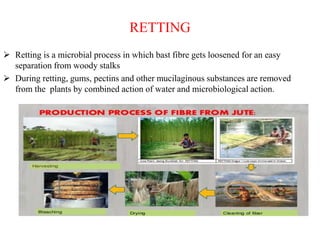
 Retting is a microbial process in which bast fibre gets loosened for an easy
separation from woody stalks
 During retting, gums, pectins and other mucilaginous substances are removed
from the plants by combined action of water and microbiological action.
Types of retting
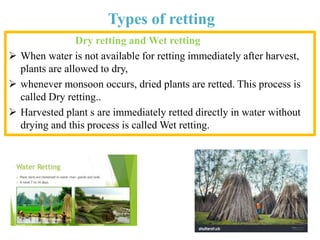
Dry retting and Wet retting
 When water is not available for retting immediately after harvest,
plants are allowed to dry,
 whenever monsoon occurs, dried plants are retted. This process is
called Dry retting..
 Harvested plant s are immediately retted directly in water without
drying and this process is called Wet retting.
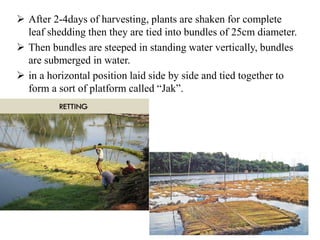
 After 2-4days of harvesting, plants are shaken for complete
leaf shedding then they are tied into bundles of 25cm diameter.
 Then bundles are steeped in standing water vertically, bundles
are submerged in water.
 in a horizontal position laid side by side and tied together to
form a sort of platform called “Jak”.
 Jaks are covered with plants like water hyacinth
 Float is then kept with weight to make the float completely
immersed in water.
 Wood logs and concrete slabs may be used for this purpose.
 Freshly cut mango logs or banana stems should not be used.
 tannins coming out from stems reacts with iron of retting water
and gives black color to fibre called “Shyamala”.
 This colour can be removed or reduced by adding 2% tamarind
solution.
 For ideal retting, JAKS should be kept submerged of at least
20cm deep .
 Most of the defects in fibre quality are due to improper or
incomplete or faulty retting.
 Incomplete submergence results in under retting produces a
fibre called “crappy fibre”
 where as over retting results into “dazed fibre”.
 gently flowing fairly deep clean and soft water are congenial
for ideal retting.
 Optimum temperature of water should be around 340C .
 Retting period is 8-30 days.
 Incase of stagnating water, addition of Ammonium sulphate
will hasten up retting process.
 finding out exact end point of retting, JAKS must be examined
every 10-12days.
 Fibre should be slip from the wood easily when the plants are
pressed between thumb and
 finger.
 Soon after the end point, JAKS or platforms should be taken
out of the water and fibre should be extracted.
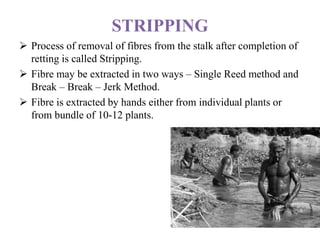
STRIPPING
 Process of removal of fibres from the stalk after completion of
retting is called Stripping.
 Fibre may be extracted in two ways – Single Reed method and
Break – Break – Jerk Method.
 Fibre is extracted by hands either from individual plants or
from bundle of 10-12 plants.
Difference between Bast Fibre Extractor and CRIJAFJuteExtractor
Advantages of different rettingprocesses
• the traditional process jute
• jute is retted in open natural water bodies. There is no need
to require any further artificial activities as it is retted
naturally.
• the labor is only required for cutting the jute stem in the
field and carrying out it from field to the ditches, ponds and
other water bodies to submerge under water.
• ribbon retting process
• requires more labor for disintegrate the fiber from the stem
and forming the process.
• In the traditional process the requirement of man-hr is
comparatively low and there is no required the skilled labor
to retting the jute stem.
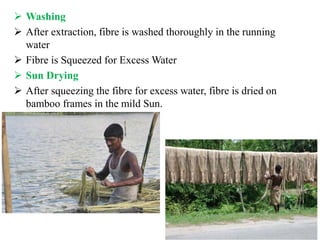
 Washing
 After extraction, fibre is washed thoroughly in the running
water
 Fibre is Squeezed for Excess Water
 Sun Drying
 After squeezing the fibre for excess water, fibre is dried on
bamboo frames in the mild Sun.
Factors hastening up Retting Process
 Warm water
 Retting in already used water
 Harvesting time
 Climate Conditions like high temperatures
 Deep water ( Too deep water will delay retting )
 Addition of Chemicals
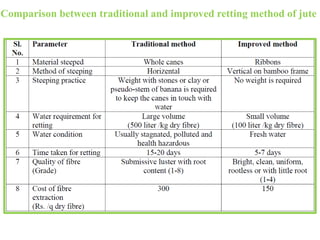
Comparison between traditional and improved retting method of jute
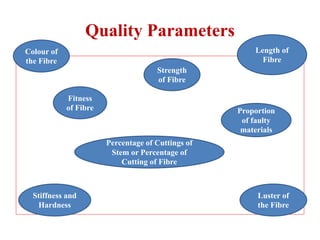
Quality Parameters
Length of
Fibre
Strength
of Fibre
Colour of
the Fibre
Luster of
the Fibre
Stiffness and
Hardness
Fitness
of Fibre
Percentage of Cuttings of
Stem or Percentage of
Cutting of Fibre
Proportion
of faulty
materials
Factors influencing Quality of Fibre
RettingWater
Materials used as
weights on JAKS
Seed rate
should be more
Stage of harvesting
Method
of Retting
Variety of
Jute
Method of
fibre
extraction
Period of
Retting
JUTE PRODUCTS
Effect of efficient pectinolytic bacterial isolates on retting and
fibre quality of jute Biswapriya Das et al.,(2010)
Industrial Crops and Products 36 (2012) 415–419
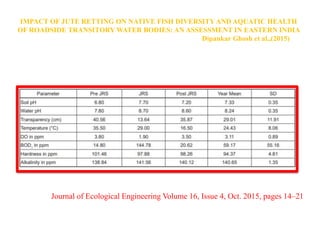
IMPACT OF JUTE RETTING ON NATIVE FISH DIVERSITYAND AQUATIC HEALTH
OF ROADSIDE TRANSITORY WATER BODIES: AN ASSESSMENT IN EASTERN INDIA
Dipankar Ghosh et al.,(2015)
Journal of Ecological Engineering Volume 16, Issue 4, Oct. 2015, pages 14–21
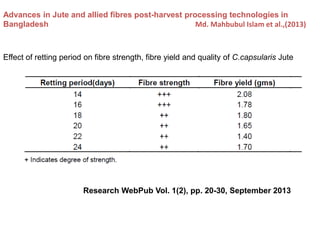
Effect of retting period on fibre strength, fibre yield and quality of C.capsularis Jute
Advances in Jute and allied fibres post-harvest processing technologies in
Bangladesh Md. Mahbubul Islam et al.,(2013)
Research WebPub Vol. 1(2), pp. 20-30, September 2013
RETTING PROCESS IN JUTE

RETTING PROCESS IN JUTE

  • 2.
    Introduction  important naturalfibre crop.  Raw material for packaging industries.  Its silky lusture, high tensile strength, low exhaustibility, considerable heat resistance and long staple length are qualities that, synthetic fibre don’t have.  Provides direct employment to 0.37 million workers & supports livelihood of 4.0 million families.  West Bengal has max. 70 jute mills.
  • 4.
    RETTING  Retting isa microbial process in which bast fibre gets loosened for an easy separation from woody stalks  During retting, gums, pectins and other mucilaginous substances are removed from the plants by combined action of water and microbiological action.
  • 5.
    Types of retting Dryretting and Wet retting  When water is not available for retting immediately after harvest, plants are allowed to dry,  whenever monsoon occurs, dried plants are retted. This process is called Dry retting..  Harvested plant s are immediately retted directly in water without drying and this process is called Wet retting.
  • 6.
     After 2-4daysof harvesting, plants are shaken for complete leaf shedding then they are tied into bundles of 25cm diameter.  Then bundles are steeped in standing water vertically, bundles are submerged in water.  in a horizontal position laid side by side and tied together to form a sort of platform called “Jak”.
  • 7.
     Jaks arecovered with plants like water hyacinth  Float is then kept with weight to make the float completely immersed in water.  Wood logs and concrete slabs may be used for this purpose.  Freshly cut mango logs or banana stems should not be used.  tannins coming out from stems reacts with iron of retting water and gives black color to fibre called “Shyamala”.  This colour can be removed or reduced by adding 2% tamarind solution.
  • 8.
     For idealretting, JAKS should be kept submerged of at least 20cm deep .  Most of the defects in fibre quality are due to improper or incomplete or faulty retting.  Incomplete submergence results in under retting produces a fibre called “crappy fibre”  where as over retting results into “dazed fibre”.
  • 9.
     gently flowingfairly deep clean and soft water are congenial for ideal retting.  Optimum temperature of water should be around 340C .  Retting period is 8-30 days.  Incase of stagnating water, addition of Ammonium sulphate will hasten up retting process.
  • 10.
     finding outexact end point of retting, JAKS must be examined every 10-12days.  Fibre should be slip from the wood easily when the plants are pressed between thumb and  finger.  Soon after the end point, JAKS or platforms should be taken out of the water and fibre should be extracted.
  • 11.
    STRIPPING  Process ofremoval of fibres from the stalk after completion of retting is called Stripping.  Fibre may be extracted in two ways – Single Reed method and Break – Break – Jerk Method.  Fibre is extracted by hands either from individual plants or from bundle of 10-12 plants.
  • 12.
    Difference between BastFibre Extractor and CRIJAFJuteExtractor
  • 13.
    Advantages of differentrettingprocesses • the traditional process jute • jute is retted in open natural water bodies. There is no need to require any further artificial activities as it is retted naturally. • the labor is only required for cutting the jute stem in the field and carrying out it from field to the ditches, ponds and other water bodies to submerge under water. • ribbon retting process • requires more labor for disintegrate the fiber from the stem and forming the process. • In the traditional process the requirement of man-hr is comparatively low and there is no required the skilled labor to retting the jute stem.
  • 14.
     Washing  Afterextraction, fibre is washed thoroughly in the running water  Fibre is Squeezed for Excess Water  Sun Drying  After squeezing the fibre for excess water, fibre is dried on bamboo frames in the mild Sun.
  • 15.
    Factors hastening upRetting Process  Warm water  Retting in already used water  Harvesting time  Climate Conditions like high temperatures  Deep water ( Too deep water will delay retting )  Addition of Chemicals
  • 16.
    Comparison between traditionaland improved retting method of jute
  • 17.
    Quality Parameters Length of Fibre Strength ofFibre Colour of the Fibre Luster of the Fibre Stiffness and Hardness Fitness of Fibre Percentage of Cuttings of Stem or Percentage of Cutting of Fibre Proportion of faulty materials
  • 18.
    Factors influencing Qualityof Fibre RettingWater Materials used as weights on JAKS Seed rate should be more Stage of harvesting Method of Retting Variety of Jute Method of fibre extraction Period of Retting
  • 20.
  • 21.
    Effect of efficientpectinolytic bacterial isolates on retting and fibre quality of jute Biswapriya Das et al.,(2010) Industrial Crops and Products 36 (2012) 415–419
  • 22.
    IMPACT OF JUTERETTING ON NATIVE FISH DIVERSITYAND AQUATIC HEALTH OF ROADSIDE TRANSITORY WATER BODIES: AN ASSESSMENT IN EASTERN INDIA Dipankar Ghosh et al.,(2015) Journal of Ecological Engineering Volume 16, Issue 4, Oct. 2015, pages 14–21
  • 23.
    Effect of rettingperiod on fibre strength, fibre yield and quality of C.capsularis Jute Advances in Jute and allied fibres post-harvest processing technologies in Bangladesh Md. Mahbubul Islam et al.,(2013) Research WebPub Vol. 1(2), pp. 20-30, September 2013