Study of some
Uncommon
Natural Cellulosic
Fibres
Presented by
Somyia
Dept. of Textile Engineering
1st year, 2nd semester
Id: TE 22040
Some Uncommon Natural Cellulosic
Fibre
2
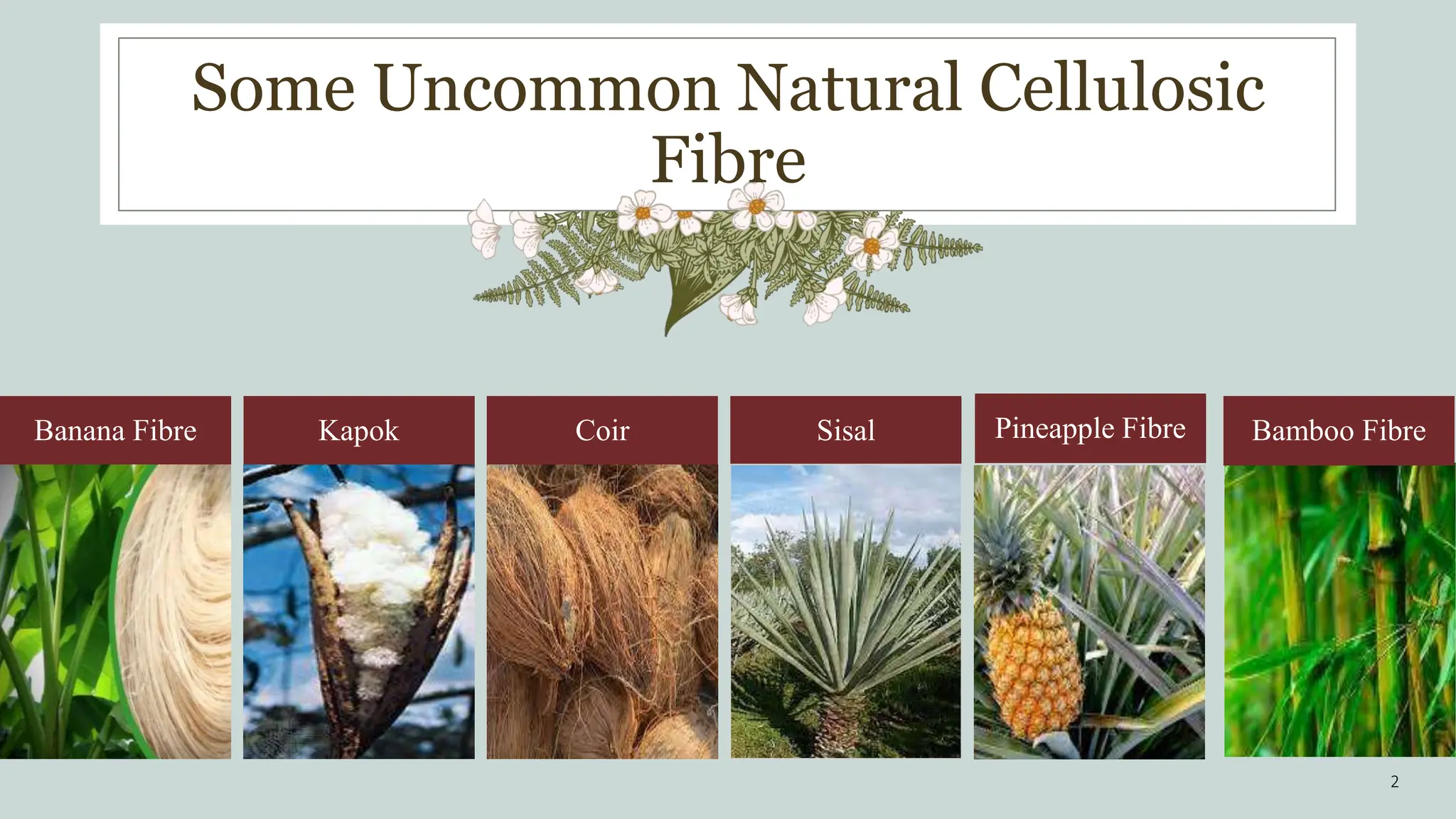
Banana Fibre Kapok Coir Sisal Pineapple Fibre Bamboo Fibre
Topics
about fibres
o Sources
o Geographical
distribution
o Fibre Extracting
Method
o Fibre Properties
o End Uses
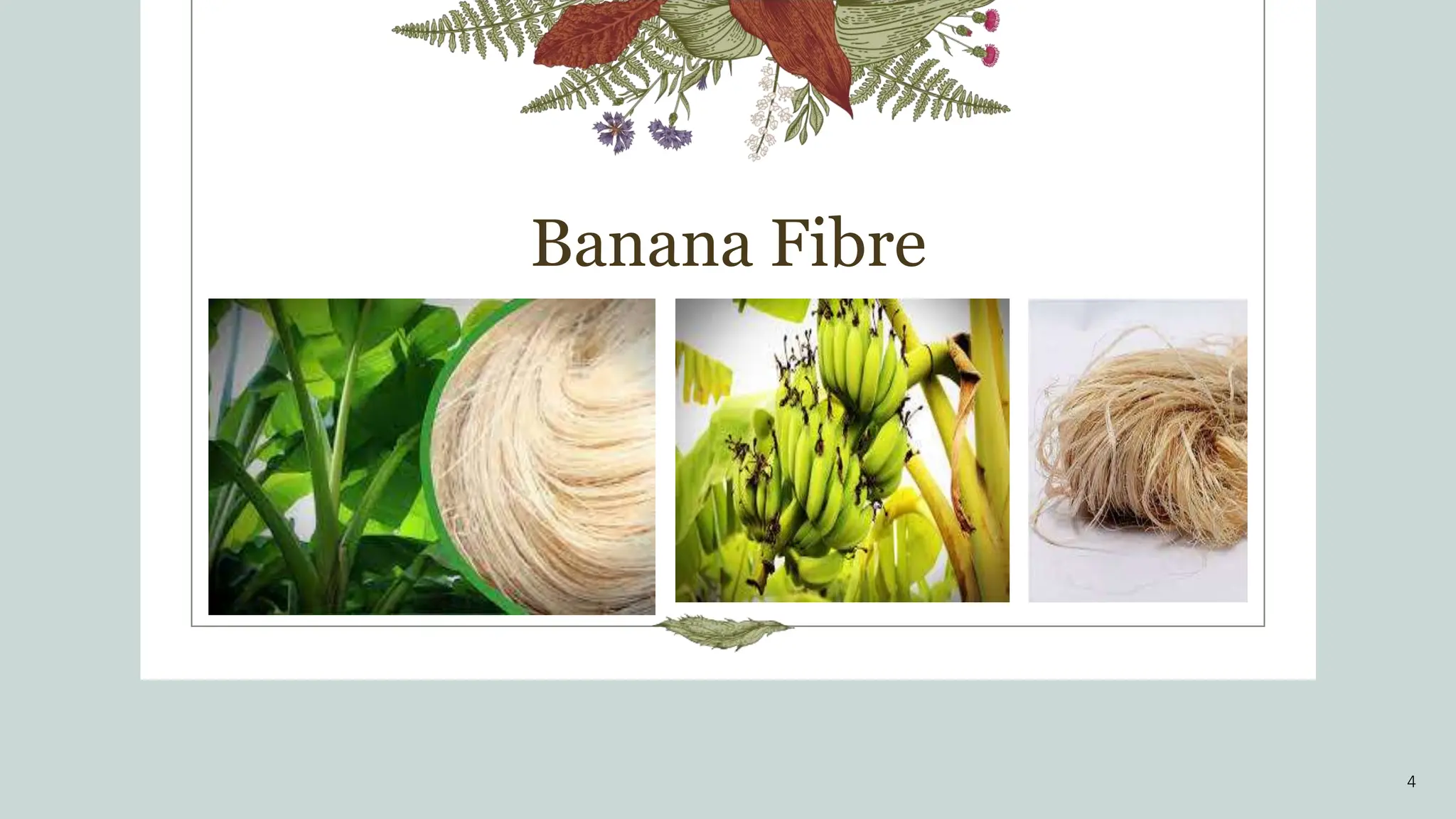
Banana Fibre
4
Source
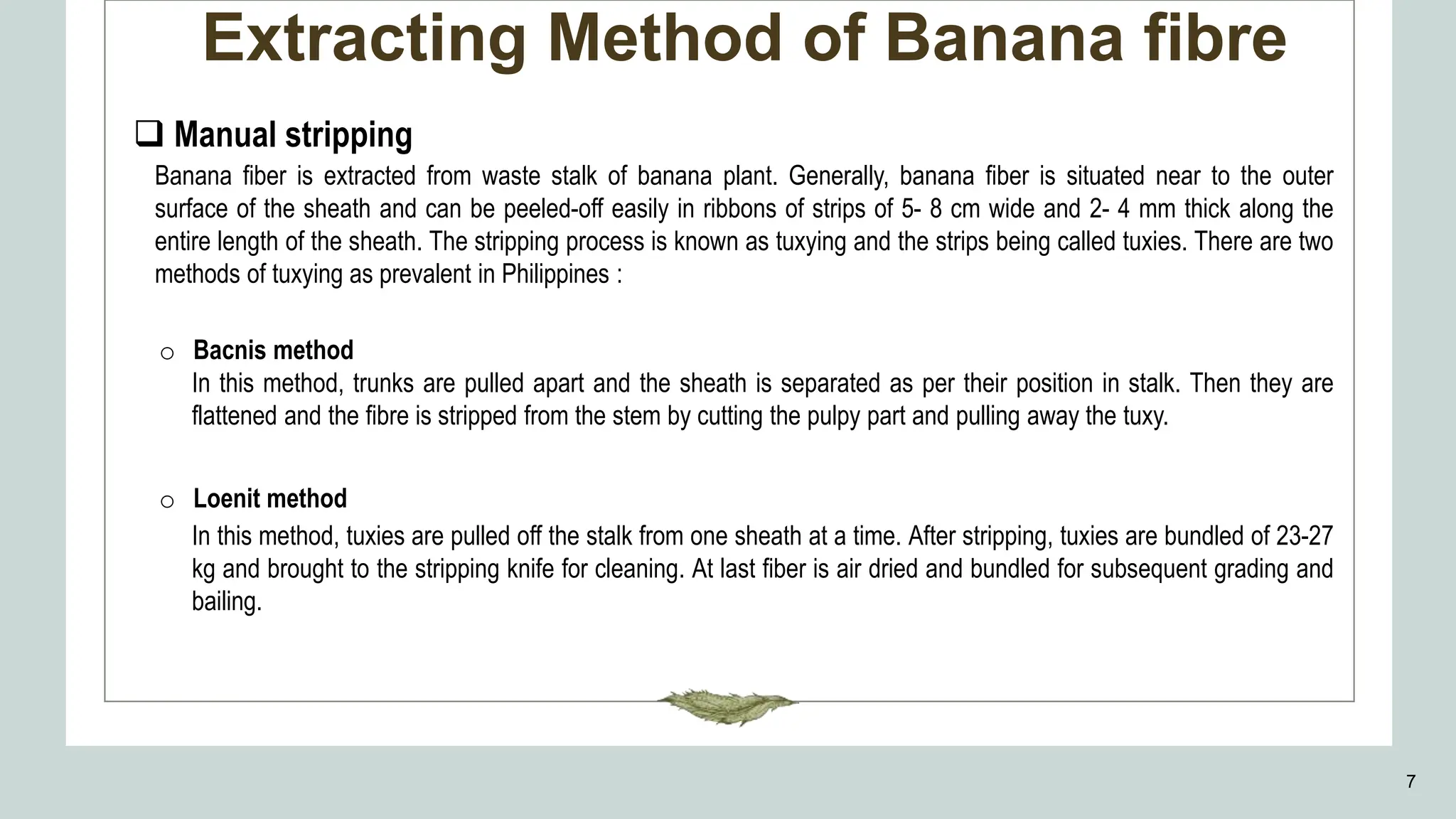
Banana fiber, a ligno-cellulosic fiber, obtained from the
pseudo-stem of banana plant (Musa sepientum), is a
bast fiber with relatively good mechanical properties,
The banana pseudo stem is a major source of banana
fiber. Banana is a tropical crop. Optimum temperature
range for banana cultivation is 15°C -35°C with relative
humidity of 75- 85%.
5
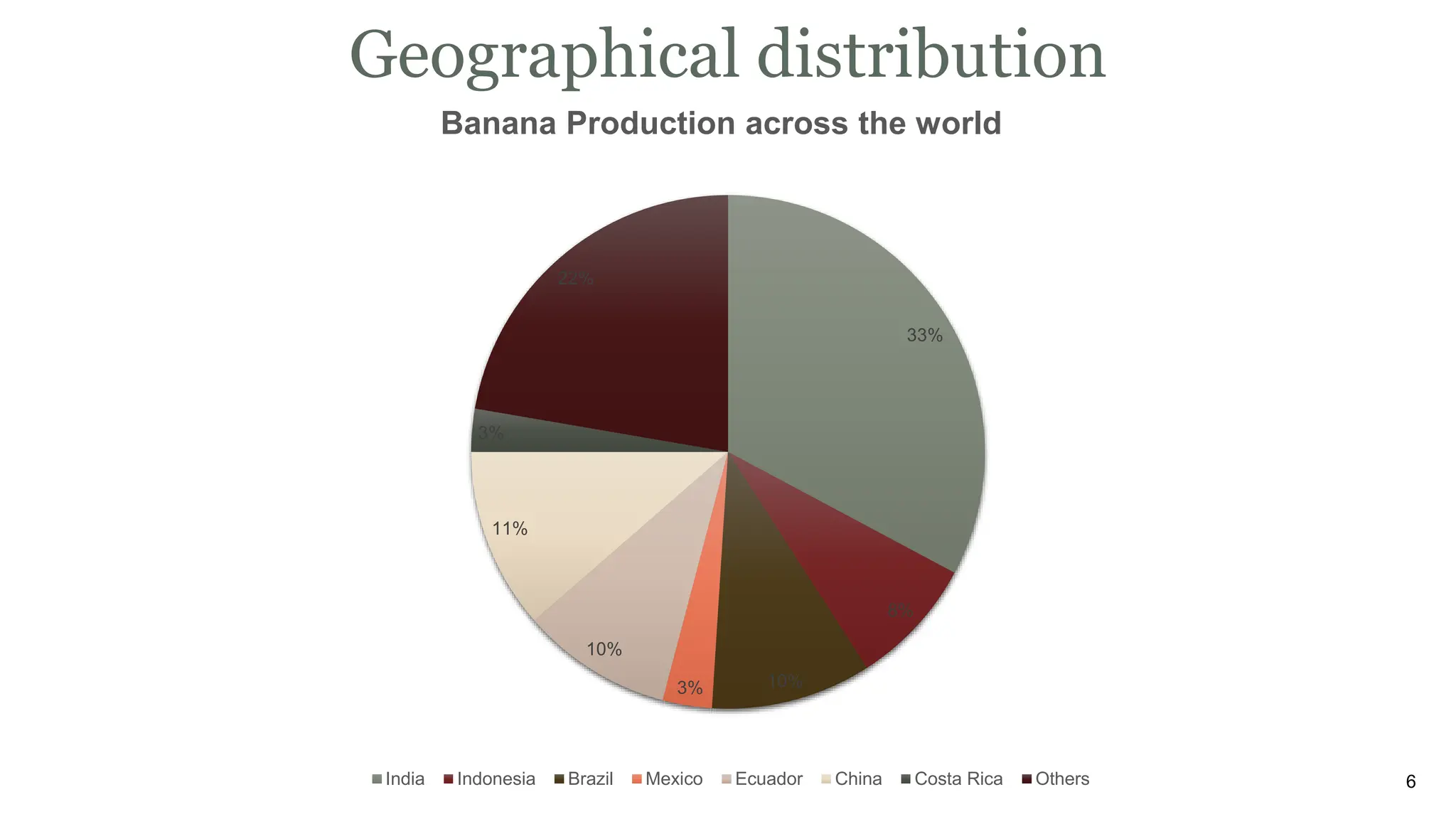
Geographical distribution
6
33%
8%
10%
3%
10%
11%
3%
22%
Banana Production across the world
India Indonesia Brazil Mexico Ecuador China Costa Rica Others
Extracting Method of Banana fibre
7
 Manual stripping
Banana fiber is extracted from waste stalk of banana plant. Generally, banana fiber is situated near to the outer
surface of the sheath and can be peeled-off easily in ribbons of strips of 5- 8 cm wide and 2- 4 mm thick along the
entire length of the sheath. The stripping process is known as tuxying and the strips being called tuxies. There are two
methods of tuxying as prevalent in Philippines :
o Bacnis method
In this method, trunks are pulled apart and the sheath is separated as per their position in stalk. Then they are
flattened and the fibre is stripped from the stem by cutting the pulpy part and pulling away the tuxy.
o Loenit method
In this method, tuxies are pulled off the stalk from one sheath at a time. After stripping, tuxies are bundled of 23-27
kg and brought to the stripping knife for cleaning. At last fiber is air dried and bundled for subsequent grading and
bailing.
Extracting Method of Banana fibre
8
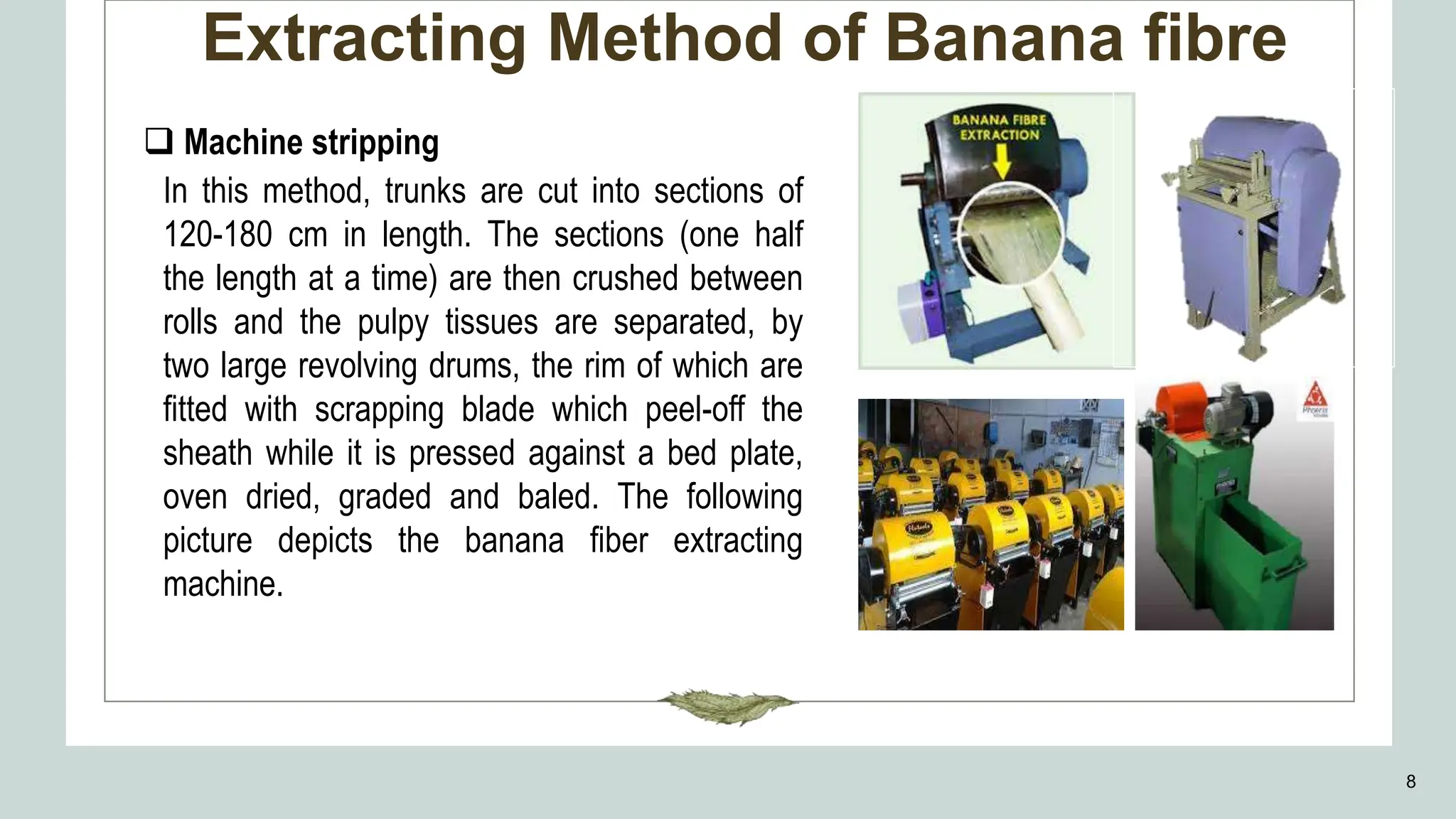
 Machine stripping
In this method, trunks are cut into sections of
120-180 cm in length. The sections (one half
the length at a time) are then crushed between
rolls and the pulpy tissues are separated, by
two large revolving drums, the rim of which are
fitted with scrapping blade which peel-off the
sheath while it is pressed against a bed plate,
oven dried, graded and baled. The following
picture depicts the banana fiber extracting
machine.
Fibre Properties
9
 Banana fiber has better fineness and spin ability. It has shiny appearance depending upon the extraction
process.
 It is very strong fiber with smaller elongation(3%)
 It can easily absorb moisture as well as release moisture.
 It can be spun by different methods like ring spinning, open- end spinning, bast fiber spinning, and semi-
worsted spinning.
 Plant fibers are schlerenchymatous cells with heavily lignified cell walls having a narrow lumen in cross
section. Fiber cells are dead at maturity and serve as a support tissue.
Some mechanical, physical and chemical properties of banana fibers are given
below:
10
End Uses of Banana Fibre
 Banana fibers can be used for various purposes such as in textile, paper or handicrafts industry. Banana paper is versatile as it is
waterproof and stronger than wood-pulp paper, meaning it can be used in packaging and even as a basis for building materials.
 Banana fiber is used for manufacturing doormats, carpets, yarn, rope, luggage carriers and interior decorative items.
 In recent past, banana fiber has also been recognized for manufacturing high quality apparel garments and home furnishings due to
increasing environmental awareness and growing importance of eco-friendly fabrics.
 Banana fiber is also used to make fine cushion covers, neckties, bags, tablecloths, curtains and other things. Rugs made from
banana silk yarn fibers are also very popular worldwide.
 Banana fiber can be easily blended with cotton or other synthetic fibers to produce blended fabric and textiles. Banana fiber has the
potential to partially replace the consumption of cotton and jute fiber.
 Banana fiber also use in high quality security currency paper, packing cloth for agriculture produce. ships towing ropes, wet drilling
cables and others.
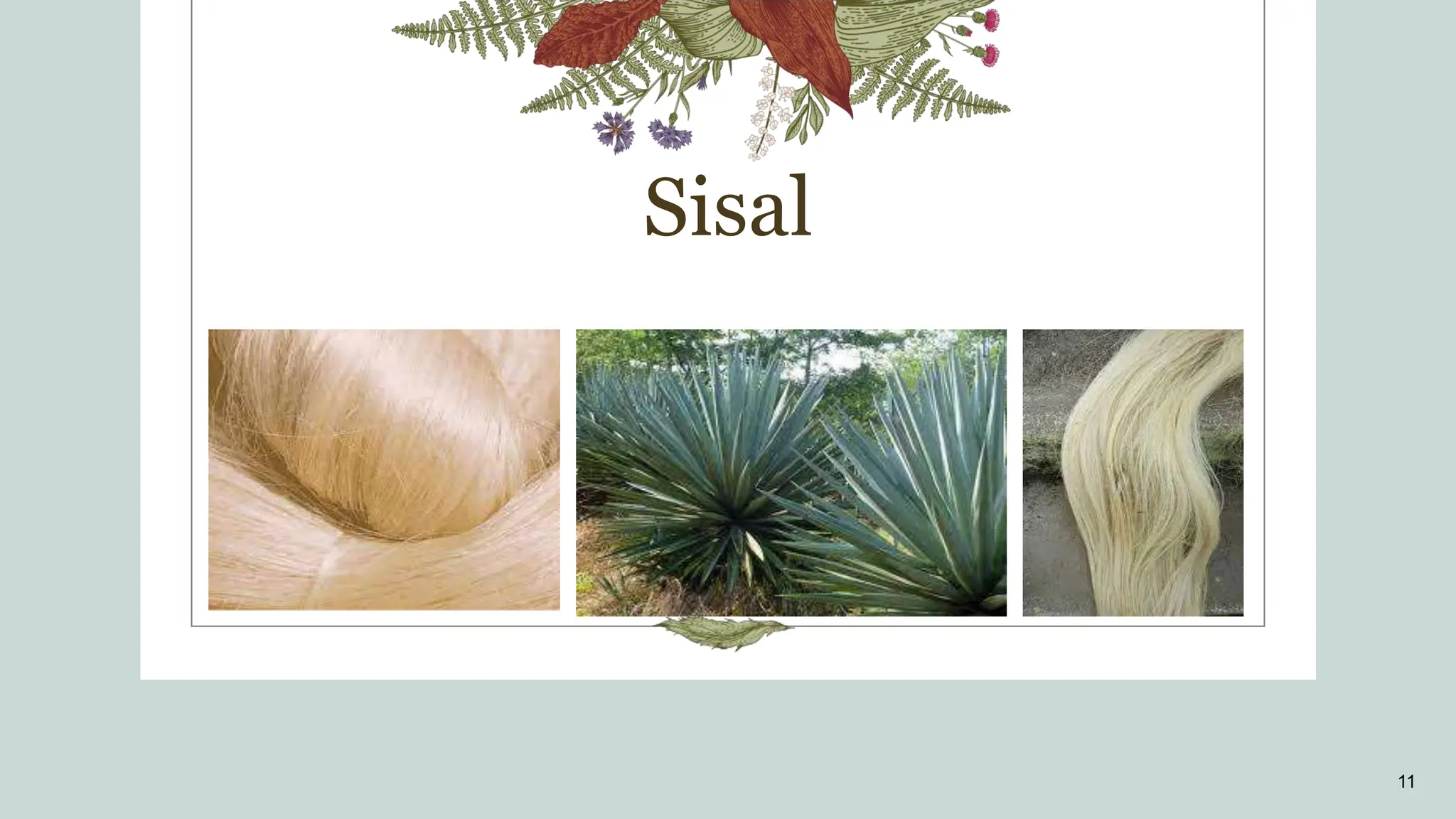
Sisal
11
Source
12
• Sisal Fiber is one of the most widely used natural
fiber and is very easily cultivated. It is obtained from sisal
plant. The plant, known formally as Agave sisalana.
These plants produce rosettes of sword-shaped leaves
which start out toothed, and gradually lose their teeth
with maturity
Geographical distribution
13
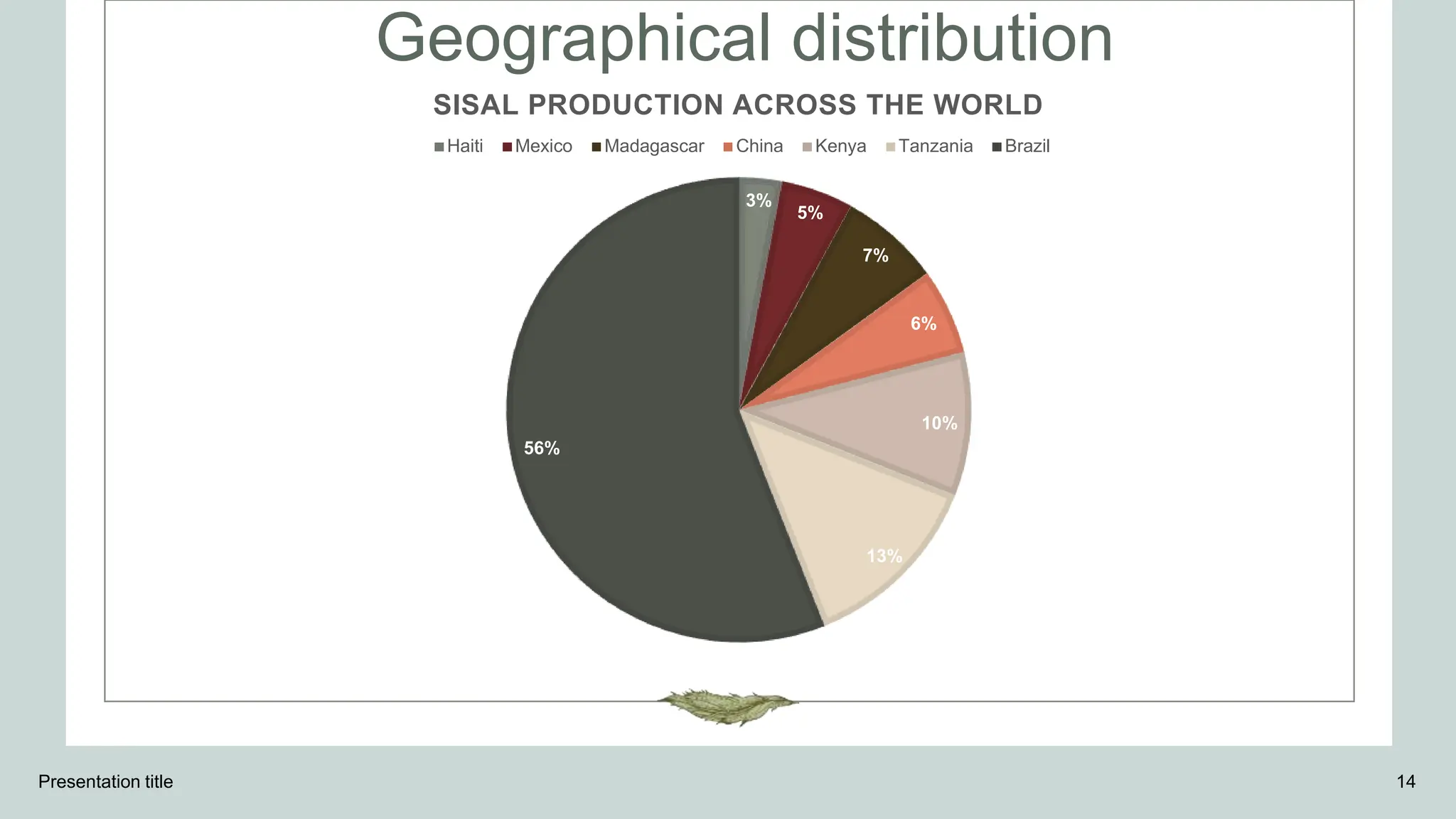
 Though native to tropical and sub tropical North and South America, sisal plant is now
widely grown in tropical countries of Africa and Asia.
 Tanzania and Brazil are the two main producing countries.
 Brazil, China, Tanzania and Kenya are the major producers and exporters of sisal in
the world.
 China dominates the market for imports of sisal fiber currently.
 In Kenya , Madagascar , Mexico, Haiti, Morocco, South Africa, Mozambique etc. sisal
are also produced.
 In Bangladesh small amount of sisal is produced.
Geographical distribution
Presentation title 14
3%
5%
7%
6%
10%
13%
56%
SISAL PRODUCTION ACROSS THE WORLD
Haiti Mexico Madagascar China Kenya Tanzania Brazil
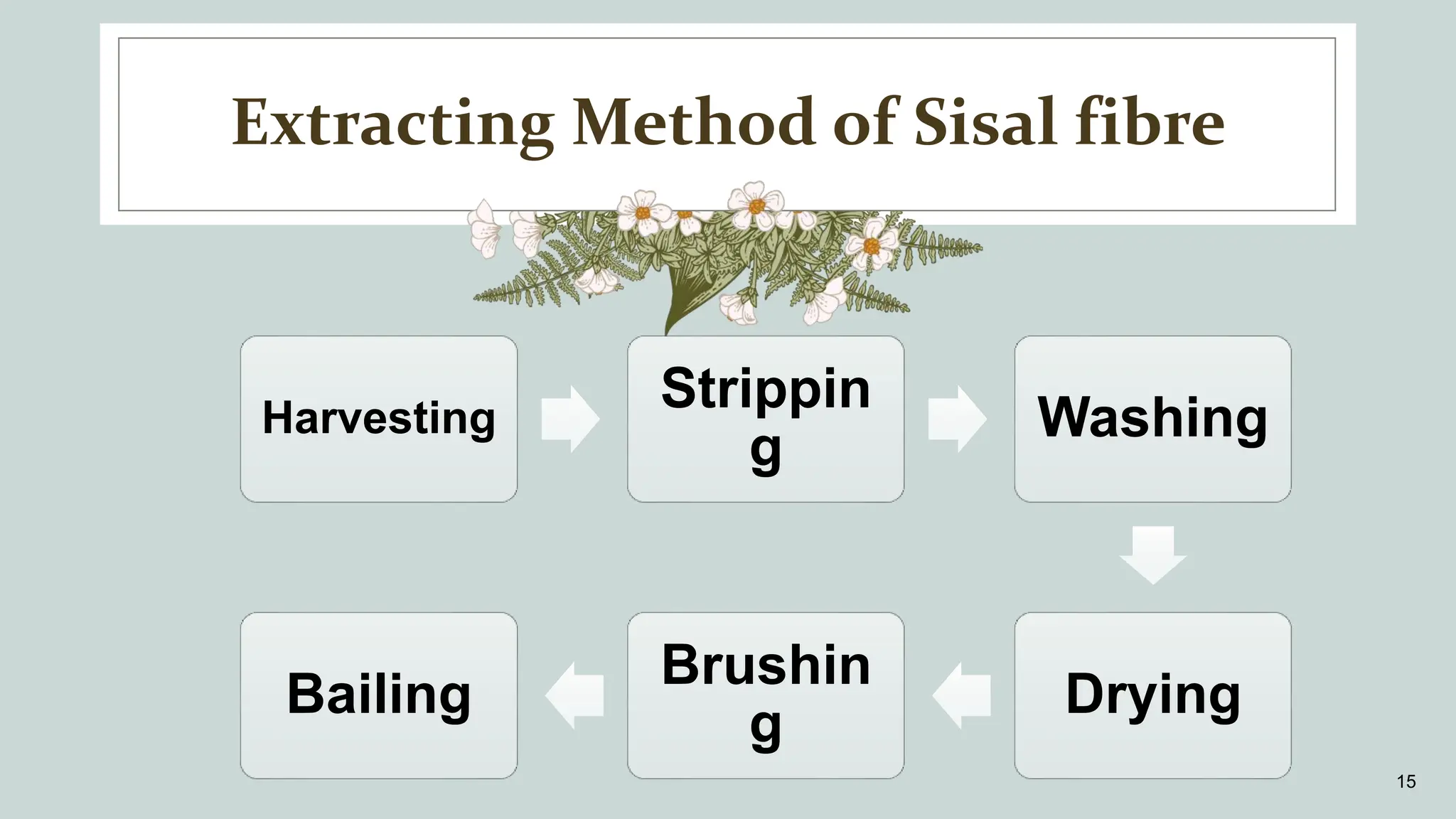
Extracting Method of Sisal fibre
15
Harvesting
Strippin
g
Washing
Drying
Brushin
g
Bailing
Extracting Method of Sisal fibre
16
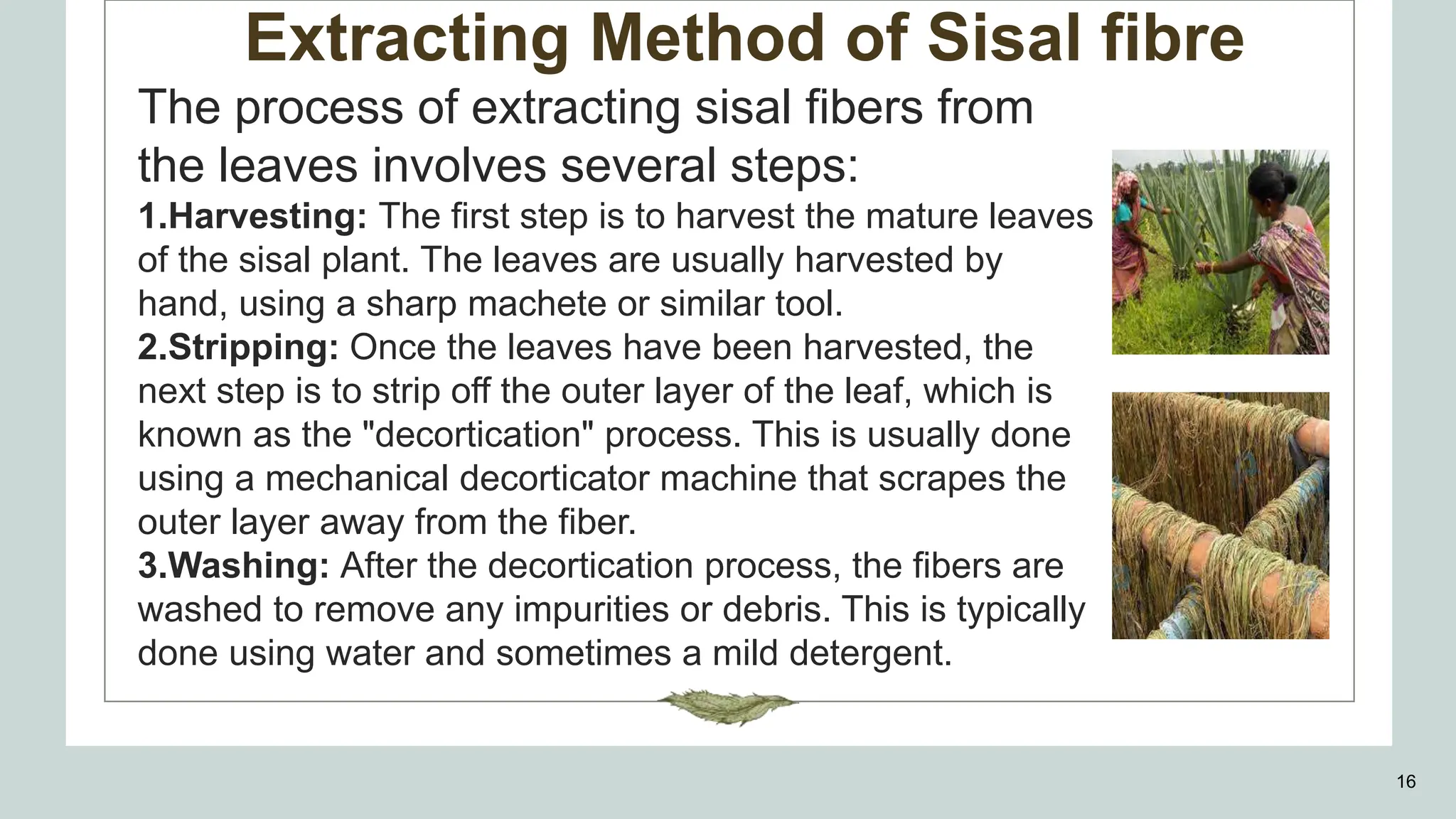
The process of extracting sisal fibers from
the leaves involves several steps:
1.Harvesting: The first step is to harvest the mature leaves
of the sisal plant. The leaves are usually harvested by
hand, using a sharp machete or similar tool.
2.Stripping: Once the leaves have been harvested, the
next step is to strip off the outer layer of the leaf, which is
known as the "decortication" process. This is usually done
using a mechanical decorticator machine that scrapes the
outer layer away from the fiber.

3.Washing: After the decortication process, the fibers are
washed to remove any impurities or debris. This is typically
done using water and sometimes a mild detergent.
Extracting Method of Sisal fibre
17
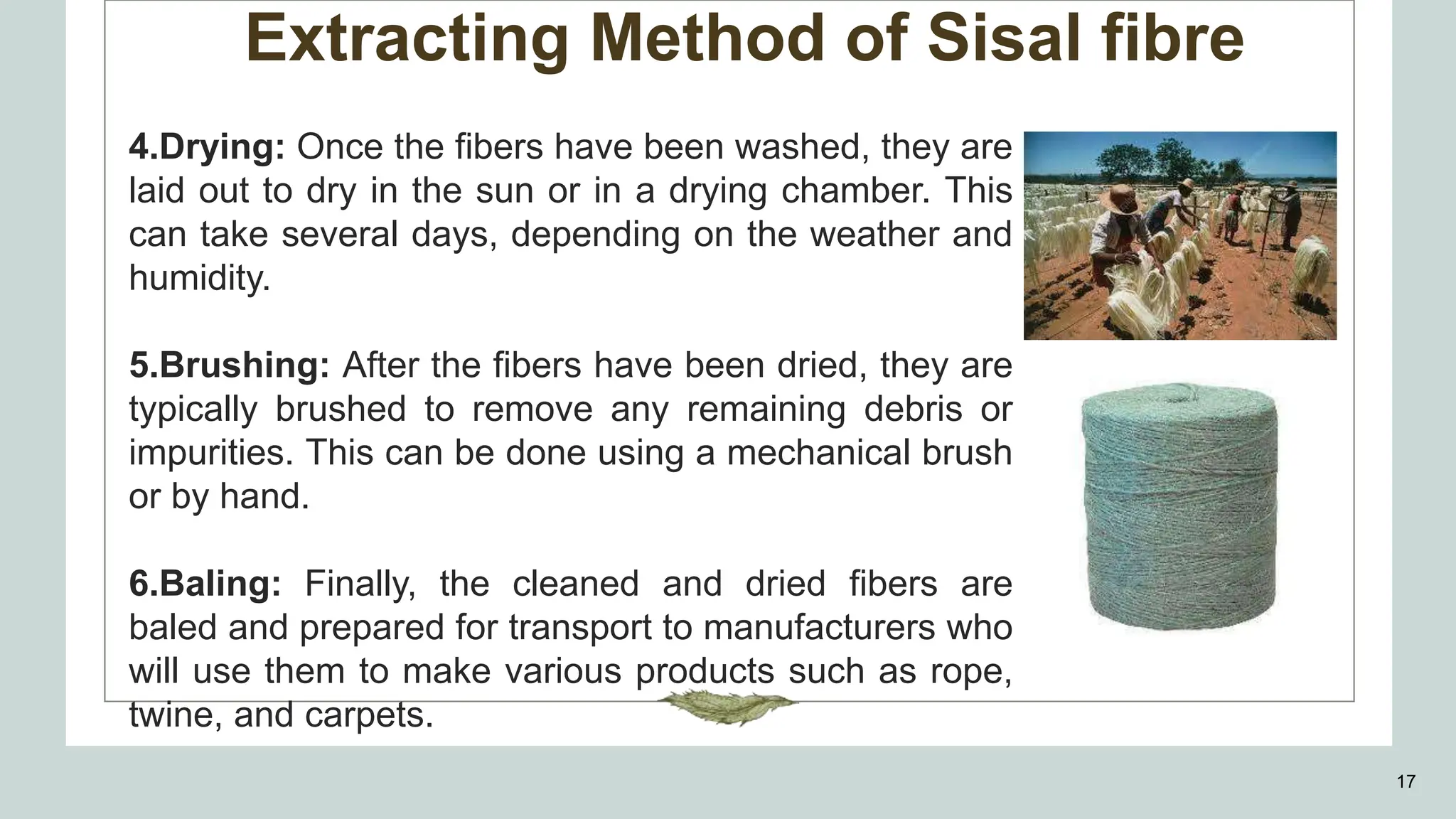
4.Drying: Once the fibers have been washed, they are
laid out to dry in the sun or in a drying chamber. This
can take several days, depending on the weather and
humidity.
5.Brushing: After the fibers have been dried, they are
typically brushed to remove any remaining debris or
impurities. This can be done using a mechanical brush
or by hand.
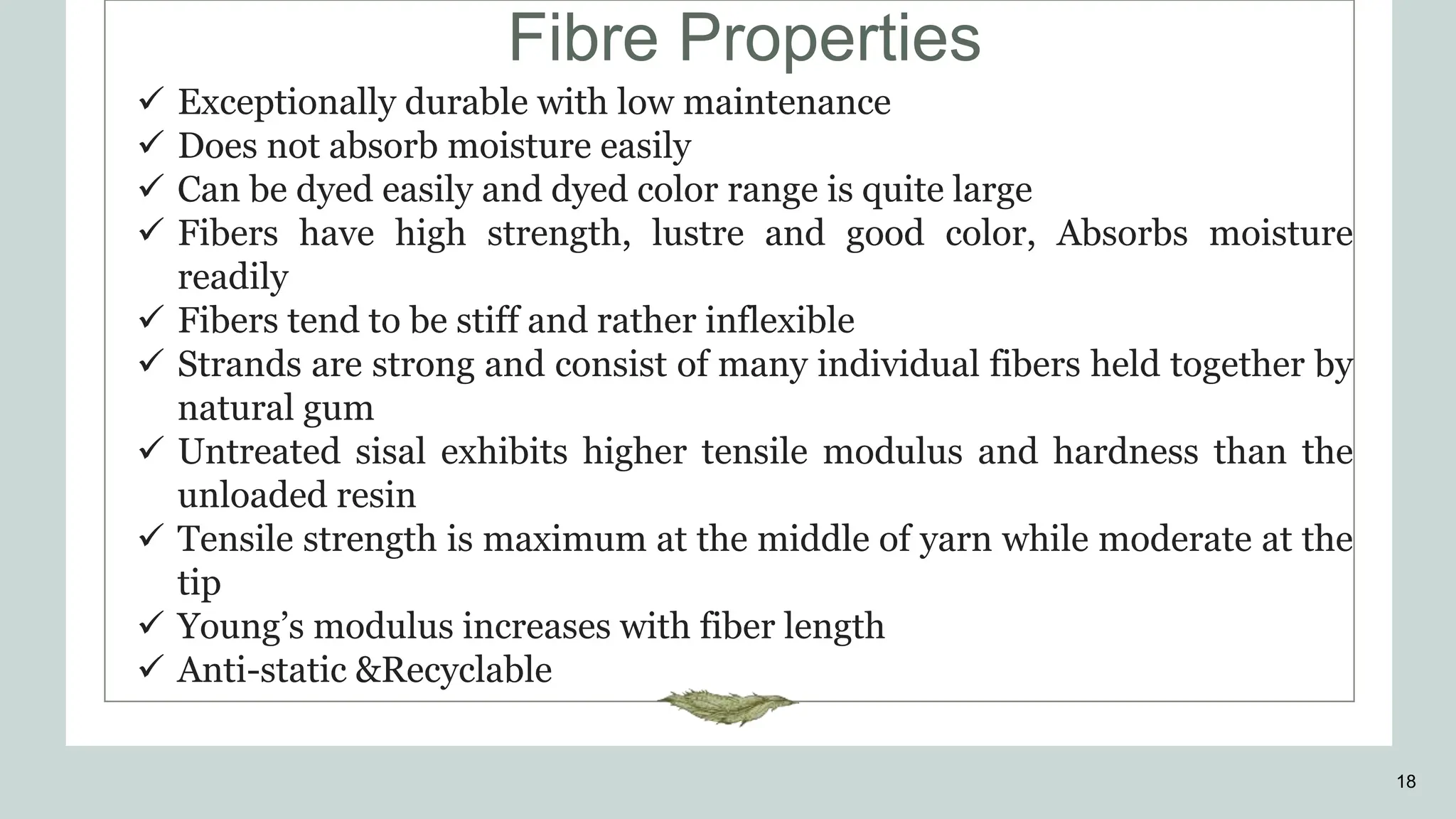
6.Baling: Finally, the cleaned and dried fibers are
baled and prepared for transport to manufacturers who
will use them to make various products such as rope,
twine, and carpets.
Fibre Properties
18
 Exceptionally durable with low maintenance
 Does not absorb moisture easily
 Can be dyed easily and dyed color range is quite large
 Fibers have high strength, lustre and good color, Absorbs moisture
readily
 Fibers tend to be stiff and rather inflexible
 Strands are strong and consist of many individual fibers held together by
natural gum
 Untreated sisal exhibits higher tensile modulus and hardness than the
unloaded resin
 Tensile strength is maximum at the middle of yarn while moderate at the
tip
 Young’s modulus increases with fiber length
 Anti-static &Recyclable
End Uses of Sisal
19
• Shipping industry: Sisal is used commonly in the shipping industry for
making products like mooring small craft, lashing, and handling cargo.
• Industrial purpose: Sisal fiber is also used as the fiber core of the steel
wire cables of elevators, because of its lubrication and flexibility purposes.
• Automobile industry: Sisal fiber is used in the automobile industry with
fiberglass in composite materials.
• Building materials: Sisal fiber can be used in making construction
materials such as cement composites. Due to lower costs, sisal fiber-
reinforced cement is used to make products such as tiles, bricks, water
tanks, and roofing sheets.
End Uses of Sisal
20
•Fashion Accessories: Sisal fiber is used to manufacture various fashion
accessories such as footwear, hats, bags, etc.
•Upholstery: Sisal is also used in manufacturing carpets or in blends with
wool and acrylic for a softer hand. The higher-grade sisal fibers are
converted into yarns which are used to manufacture carpets.
•Paper industry: Because of having a high content of cellulose and
hemicelluloses it is used by the paper industry to manufacture paper.
•Cordage Industry: The medium grade of sisal fiber is used for making
ropes, baler, and binder twine. These products are used in various other
industries such as marine, agricultural, and general industries.
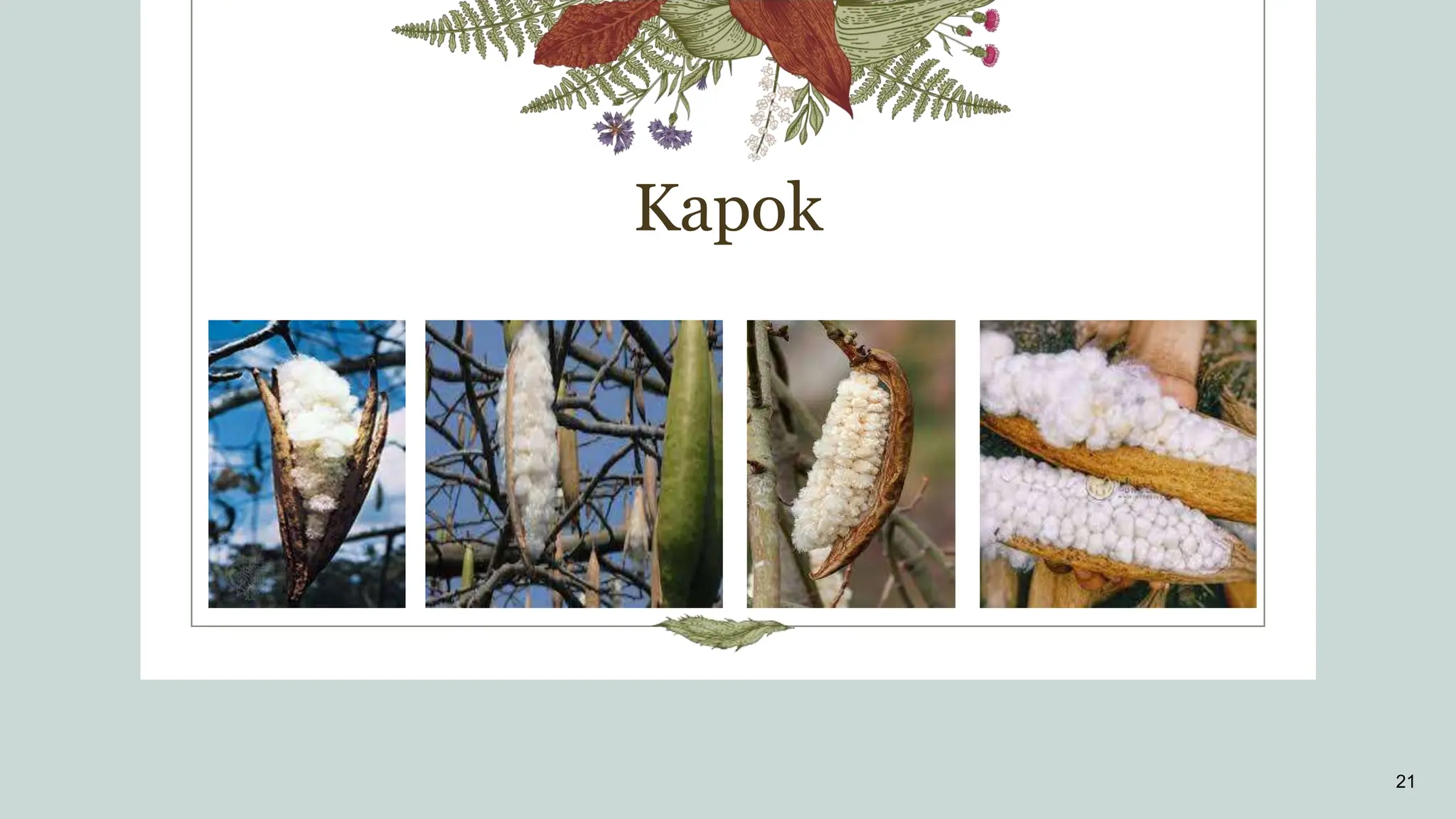
Kapok
21
Source
22
• Kapok fiber is one of the natural cellulosic fibers which grow on the kapok
plant. It has a hollow body and a sealed tail, which are desirable features
of candidates for functional textiles of this nature. However, the low
volume weight of kapok is (specific density 0.29g/cm3), and the short
length and smooth surface of the fibers, causing poor inter-fiber cohesion,
have prevented kapok from being processed by modern spinning
machines.
Geographical distribution
23
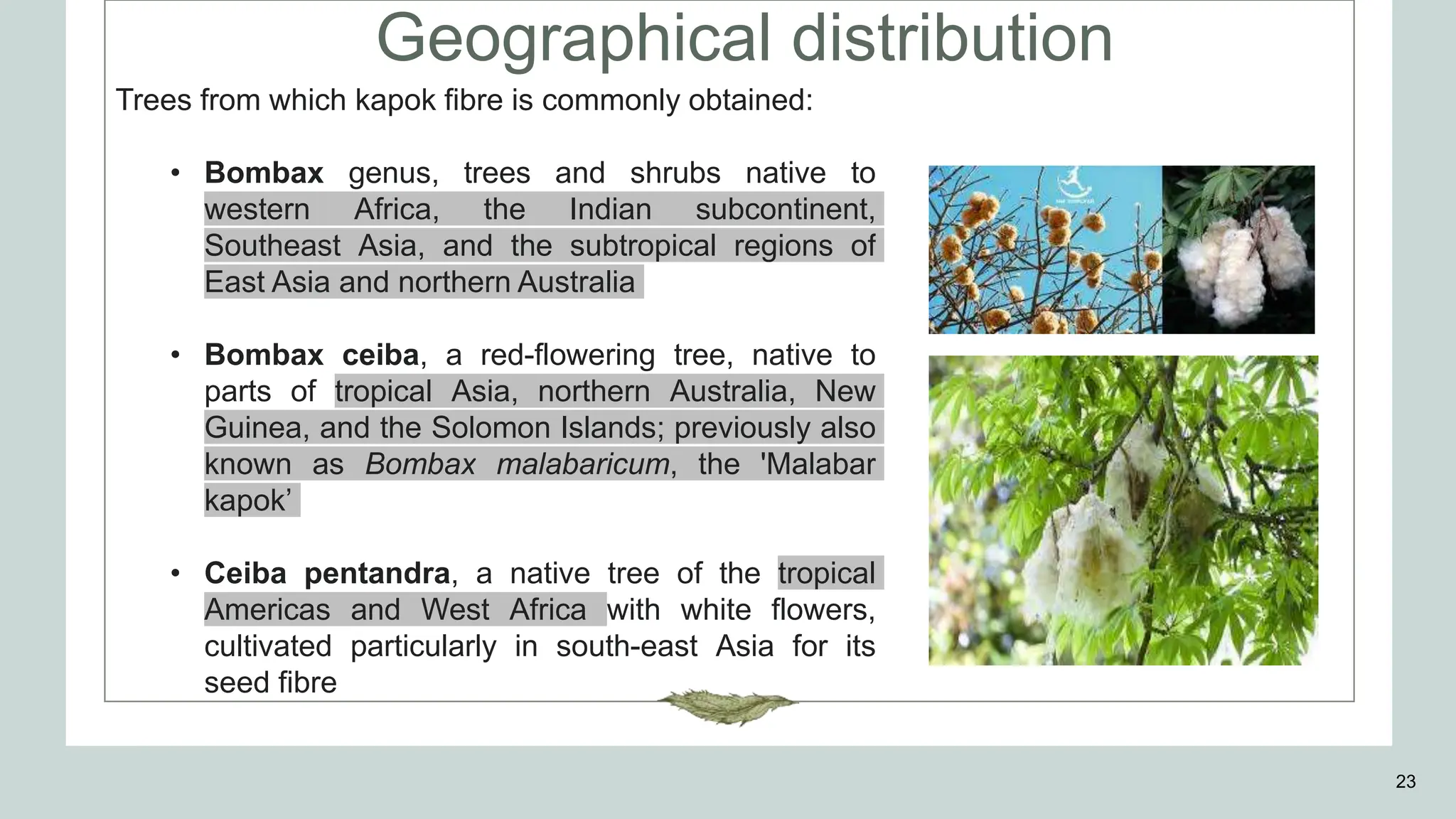
Trees from which kapok fibre is commonly obtained:
• Bombax genus, trees and shrubs native to
western Africa, the Indian subcontinent,
Southeast Asia, and the subtropical regions of
East Asia and northern Australia
• Bombax ceiba, a red-flowering tree, native to
parts of tropical Asia, northern Australia, New
Guinea, and the Solomon Islands; previously also
known as Bombax malabaricum, the 'Malabar
kapok’
• Ceiba pentandra, a native tree of the tropical
Americas and West Africa with white flowers,
cultivated particularly in south-east Asia for its
seed fibre
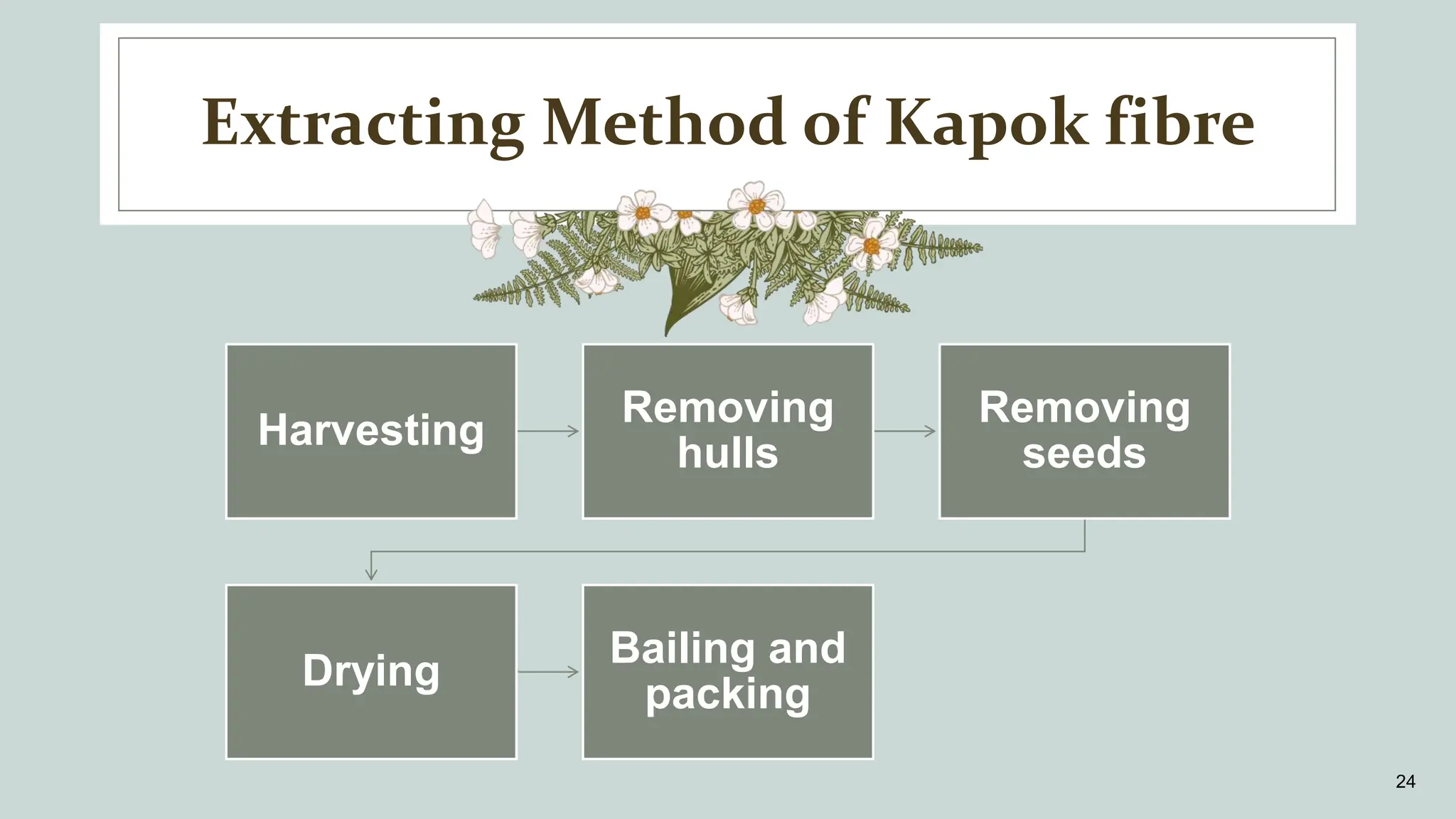
Extracting Method of Kapok fibre
24
Harvesting
Removing
hulls
Removing
seeds
Drying
Bailing and
packing
Extracting Method of Kapok fibre
25
All process are described briefly:
Harvesting:
The ripe unopened pods are normally harvested by knocking them off the
tree. But it can also be cut from the tree or harvested when fall to the
ground.
Removing hulls:
Kapok fiber is left in sunlight for drying of hulls. The fruits are hulled and seed and fibers
are removed from the pods by hand.
Removing seeds:
The seeds lie loose in the floss and, with the help of some beating they fall to the bottom
of the container where they are easily separated.
Extracting Method of Kapok fibre
26
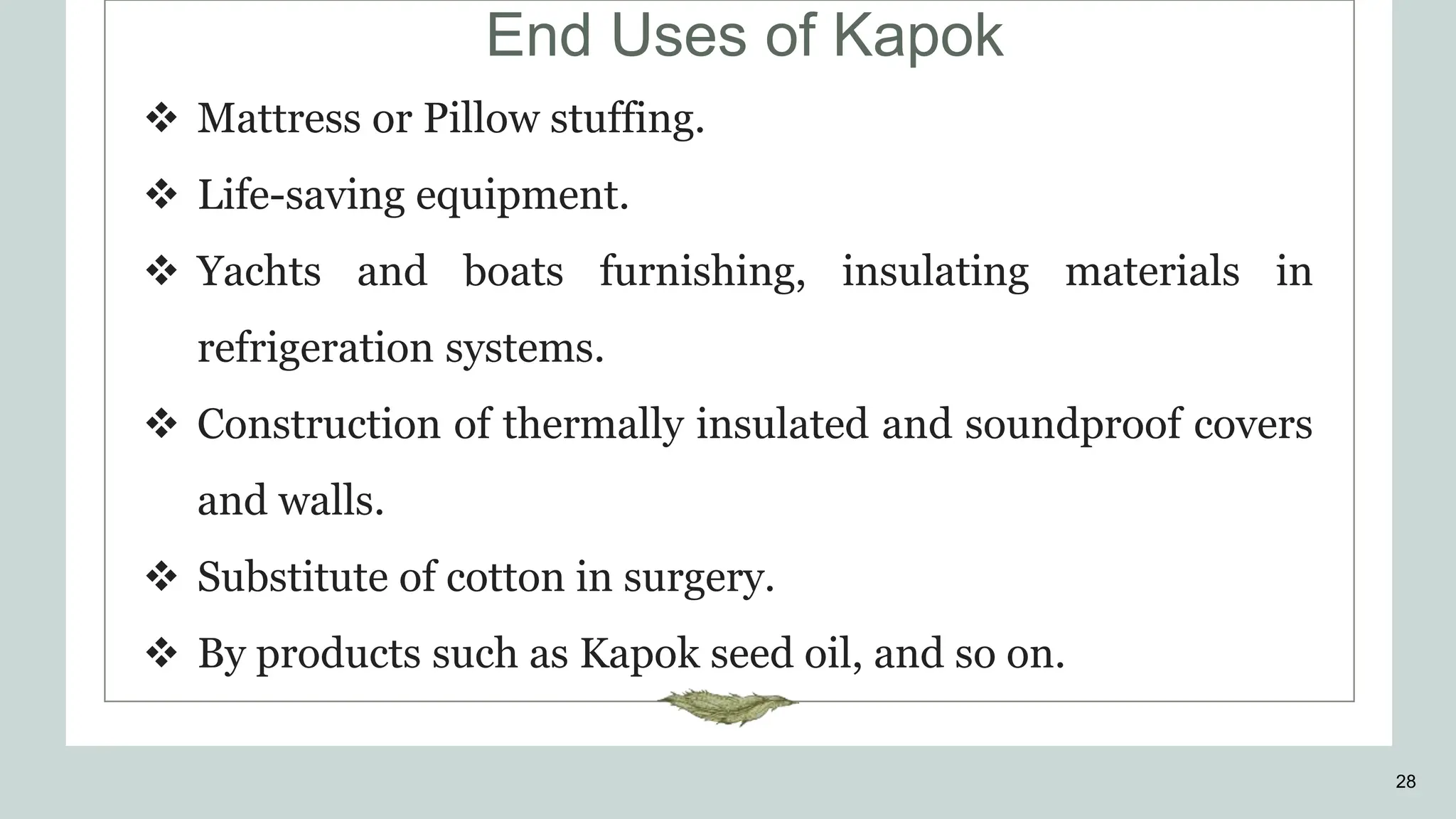
Drying:
Kapok fiber is dried under the sun for 3 -5 hours to
complete drying.
Bailing and packing:
Kapok fibers are then packed in the form of bales
and dispatched for further processing.
Fibre Properties
27
Kapok fiber is light, brittle, elastic, lustrous and white or pale yellow in
color.
 Individual fibers are cylindrical, each being a single cell with a bulbous
base.
The cells of the inner epidermis of the epicure form the fibers, which are
about 1-2 cm long.
 The air-filled lumen is broad and the wall rather thin. The fiber is,
therefore, fragile, which together with smoothness of the outer surface,
makes spinning impossible.
 It is a natural fiber that is completely biodegradable, anti-bacterial and
anti-microbial. Moths, mites and other microorganisms cannot infect it.
End Uses of Kapok
28
 Mattress or Pillow stuffing.
 Life-saving equipment.
 Yachts and boats furnishing, insulating materials in
refrigeration systems.
 Construction of thermally insulated and soundproof covers
and walls.
 Substitute of cotton in surgery.
 By products such as Kapok seed oil, and so on.
Thank you
“
”

Presentation about various cellulose those are uncommon in fabric industry

  • 1.
    Study of some Uncommon NaturalCellulosic Fibres Presented by Somyia Dept. of Textile Engineering 1st year, 2nd semester Id: TE 22040
  • 2.
    Some Uncommon NaturalCellulosic Fibre 2 Banana Fibre Kapok Coir Sisal Pineapple Fibre Bamboo Fibre
  • 3.
    Topics about fibres o Sources oGeographical distribution o Fibre Extracting Method o Fibre Properties o End Uses
  • 4.
  • 5.
    Source Banana fiber, aligno-cellulosic fiber, obtained from the pseudo-stem of banana plant (Musa sepientum), is a bast fiber with relatively good mechanical properties, The banana pseudo stem is a major source of banana fiber. Banana is a tropical crop. Optimum temperature range for banana cultivation is 15°C -35°C with relative humidity of 75- 85%. 5
  • 6.
    Geographical distribution 6 33% 8% 10% 3% 10% 11% 3% 22% Banana Productionacross the world India Indonesia Brazil Mexico Ecuador China Costa Rica Others
  • 7.
    Extracting Method ofBanana fibre 7  Manual stripping Banana fiber is extracted from waste stalk of banana plant. Generally, banana fiber is situated near to the outer surface of the sheath and can be peeled-off easily in ribbons of strips of 5- 8 cm wide and 2- 4 mm thick along the entire length of the sheath. The stripping process is known as tuxying and the strips being called tuxies. There are two methods of tuxying as prevalent in Philippines : o Bacnis method In this method, trunks are pulled apart and the sheath is separated as per their position in stalk. Then they are flattened and the fibre is stripped from the stem by cutting the pulpy part and pulling away the tuxy. o Loenit method In this method, tuxies are pulled off the stalk from one sheath at a time. After stripping, tuxies are bundled of 23-27 kg and brought to the stripping knife for cleaning. At last fiber is air dried and bundled for subsequent grading and bailing.
  • 8.
    Extracting Method ofBanana fibre 8  Machine stripping In this method, trunks are cut into sections of 120-180 cm in length. The sections (one half the length at a time) are then crushed between rolls and the pulpy tissues are separated, by two large revolving drums, the rim of which are fitted with scrapping blade which peel-off the sheath while it is pressed against a bed plate, oven dried, graded and baled. The following picture depicts the banana fiber extracting machine.
  • 9.
    Fibre Properties 9  Bananafiber has better fineness and spin ability. It has shiny appearance depending upon the extraction process.  It is very strong fiber with smaller elongation(3%)  It can easily absorb moisture as well as release moisture.  It can be spun by different methods like ring spinning, open- end spinning, bast fiber spinning, and semi- worsted spinning.  Plant fibers are schlerenchymatous cells with heavily lignified cell walls having a narrow lumen in cross section. Fiber cells are dead at maturity and serve as a support tissue. Some mechanical, physical and chemical properties of banana fibers are given below:
  • 10.
    10 End Uses ofBanana Fibre  Banana fibers can be used for various purposes such as in textile, paper or handicrafts industry. Banana paper is versatile as it is waterproof and stronger than wood-pulp paper, meaning it can be used in packaging and even as a basis for building materials.  Banana fiber is used for manufacturing doormats, carpets, yarn, rope, luggage carriers and interior decorative items.  In recent past, banana fiber has also been recognized for manufacturing high quality apparel garments and home furnishings due to increasing environmental awareness and growing importance of eco-friendly fabrics.  Banana fiber is also used to make fine cushion covers, neckties, bags, tablecloths, curtains and other things. Rugs made from banana silk yarn fibers are also very popular worldwide.  Banana fiber can be easily blended with cotton or other synthetic fibers to produce blended fabric and textiles. Banana fiber has the potential to partially replace the consumption of cotton and jute fiber.  Banana fiber also use in high quality security currency paper, packing cloth for agriculture produce. ships towing ropes, wet drilling cables and others.
  • 11.
  • 12.
    Source 12 • Sisal Fiberis one of the most widely used natural fiber and is very easily cultivated. It is obtained from sisal plant. The plant, known formally as Agave sisalana. These plants produce rosettes of sword-shaped leaves which start out toothed, and gradually lose their teeth with maturity
  • 13.
    Geographical distribution 13  Thoughnative to tropical and sub tropical North and South America, sisal plant is now widely grown in tropical countries of Africa and Asia.  Tanzania and Brazil are the two main producing countries.  Brazil, China, Tanzania and Kenya are the major producers and exporters of sisal in the world.  China dominates the market for imports of sisal fiber currently.  In Kenya , Madagascar , Mexico, Haiti, Morocco, South Africa, Mozambique etc. sisal are also produced.  In Bangladesh small amount of sisal is produced.
  • 14.
    Geographical distribution Presentation title14 3% 5% 7% 6% 10% 13% 56% SISAL PRODUCTION ACROSS THE WORLD Haiti Mexico Madagascar China Kenya Tanzania Brazil
  • 15.
    Extracting Method ofSisal fibre 15 Harvesting Strippin g Washing Drying Brushin g Bailing
  • 16.
    Extracting Method ofSisal fibre 16 The process of extracting sisal fibers from the leaves involves several steps: 1.Harvesting: The first step is to harvest the mature leaves of the sisal plant. The leaves are usually harvested by hand, using a sharp machete or similar tool. 2.Stripping: Once the leaves have been harvested, the next step is to strip off the outer layer of the leaf, which is known as the "decortication" process. This is usually done using a mechanical decorticator machine that scrapes the outer layer away from the fiber. 3.Washing: After the decortication process, the fibers are washed to remove any impurities or debris. This is typically done using water and sometimes a mild detergent.
  • 17.
    Extracting Method ofSisal fibre 17 4.Drying: Once the fibers have been washed, they are laid out to dry in the sun or in a drying chamber. This can take several days, depending on the weather and humidity. 5.Brushing: After the fibers have been dried, they are typically brushed to remove any remaining debris or impurities. This can be done using a mechanical brush or by hand. 6.Baling: Finally, the cleaned and dried fibers are baled and prepared for transport to manufacturers who will use them to make various products such as rope, twine, and carpets.
  • 18.
    Fibre Properties 18  Exceptionallydurable with low maintenance  Does not absorb moisture easily  Can be dyed easily and dyed color range is quite large  Fibers have high strength, lustre and good color, Absorbs moisture readily  Fibers tend to be stiff and rather inflexible  Strands are strong and consist of many individual fibers held together by natural gum  Untreated sisal exhibits higher tensile modulus and hardness than the unloaded resin  Tensile strength is maximum at the middle of yarn while moderate at the tip  Young’s modulus increases with fiber length  Anti-static &Recyclable
  • 19.
    End Uses ofSisal 19 • Shipping industry: Sisal is used commonly in the shipping industry for making products like mooring small craft, lashing, and handling cargo. • Industrial purpose: Sisal fiber is also used as the fiber core of the steel wire cables of elevators, because of its lubrication and flexibility purposes. • Automobile industry: Sisal fiber is used in the automobile industry with fiberglass in composite materials. • Building materials: Sisal fiber can be used in making construction materials such as cement composites. Due to lower costs, sisal fiber- reinforced cement is used to make products such as tiles, bricks, water tanks, and roofing sheets.
  • 20.
    End Uses ofSisal 20 •Fashion Accessories: Sisal fiber is used to manufacture various fashion accessories such as footwear, hats, bags, etc. •Upholstery: Sisal is also used in manufacturing carpets or in blends with wool and acrylic for a softer hand. The higher-grade sisal fibers are converted into yarns which are used to manufacture carpets. •Paper industry: Because of having a high content of cellulose and hemicelluloses it is used by the paper industry to manufacture paper. •Cordage Industry: The medium grade of sisal fiber is used for making ropes, baler, and binder twine. These products are used in various other industries such as marine, agricultural, and general industries.
  • 21.
  • 22.
    Source 22 • Kapok fiberis one of the natural cellulosic fibers which grow on the kapok plant. It has a hollow body and a sealed tail, which are desirable features of candidates for functional textiles of this nature. However, the low volume weight of kapok is (specific density 0.29g/cm3), and the short length and smooth surface of the fibers, causing poor inter-fiber cohesion, have prevented kapok from being processed by modern spinning machines.
  • 23.
    Geographical distribution 23 Trees fromwhich kapok fibre is commonly obtained: • Bombax genus, trees and shrubs native to western Africa, the Indian subcontinent, Southeast Asia, and the subtropical regions of East Asia and northern Australia • Bombax ceiba, a red-flowering tree, native to parts of tropical Asia, northern Australia, New Guinea, and the Solomon Islands; previously also known as Bombax malabaricum, the 'Malabar kapok’ • Ceiba pentandra, a native tree of the tropical Americas and West Africa with white flowers, cultivated particularly in south-east Asia for its seed fibre
  • 24.
    Extracting Method ofKapok fibre 24 Harvesting Removing hulls Removing seeds Drying Bailing and packing
  • 25.
    Extracting Method ofKapok fibre 25 All process are described briefly: Harvesting: The ripe unopened pods are normally harvested by knocking them off the tree. But it can also be cut from the tree or harvested when fall to the ground. Removing hulls: Kapok fiber is left in sunlight for drying of hulls. The fruits are hulled and seed and fibers are removed from the pods by hand. Removing seeds: The seeds lie loose in the floss and, with the help of some beating they fall to the bottom of the container where they are easily separated.
  • 26.
    Extracting Method ofKapok fibre 26 Drying: Kapok fiber is dried under the sun for 3 -5 hours to complete drying. Bailing and packing: Kapok fibers are then packed in the form of bales and dispatched for further processing.
  • 27.
    Fibre Properties 27 Kapok fiberis light, brittle, elastic, lustrous and white or pale yellow in color.  Individual fibers are cylindrical, each being a single cell with a bulbous base. The cells of the inner epidermis of the epicure form the fibers, which are about 1-2 cm long.  The air-filled lumen is broad and the wall rather thin. The fiber is, therefore, fragile, which together with smoothness of the outer surface, makes spinning impossible.  It is a natural fiber that is completely biodegradable, anti-bacterial and anti-microbial. Moths, mites and other microorganisms cannot infect it.
  • 28.
    End Uses ofKapok 28  Mattress or Pillow stuffing.  Life-saving equipment.  Yachts and boats furnishing, insulating materials in refrigeration systems.  Construction of thermally insulated and soundproof covers and walls.  Substitute of cotton in surgery.  By products such as Kapok seed oil, and so on.
  • 29.