© 2017 SAP SE or an SAP affiliate company. All rights reserved. I © Copyright 2017 Lenovo. All rights reserved. 1
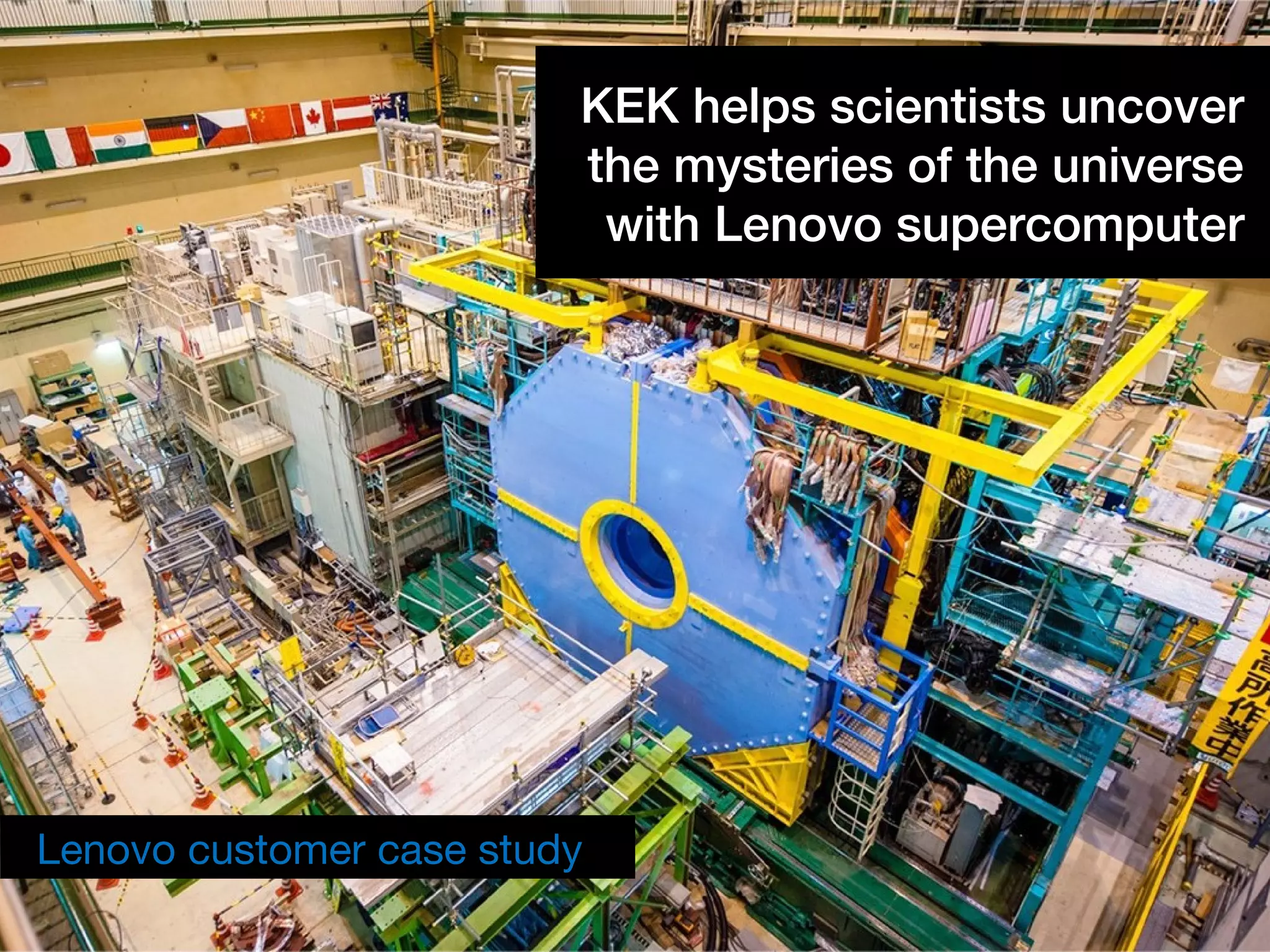
KEK helps scientists uncover
the mysteries of the universe
with Lenovo supercomputer
Lenovo customer case study
2
Academic Research
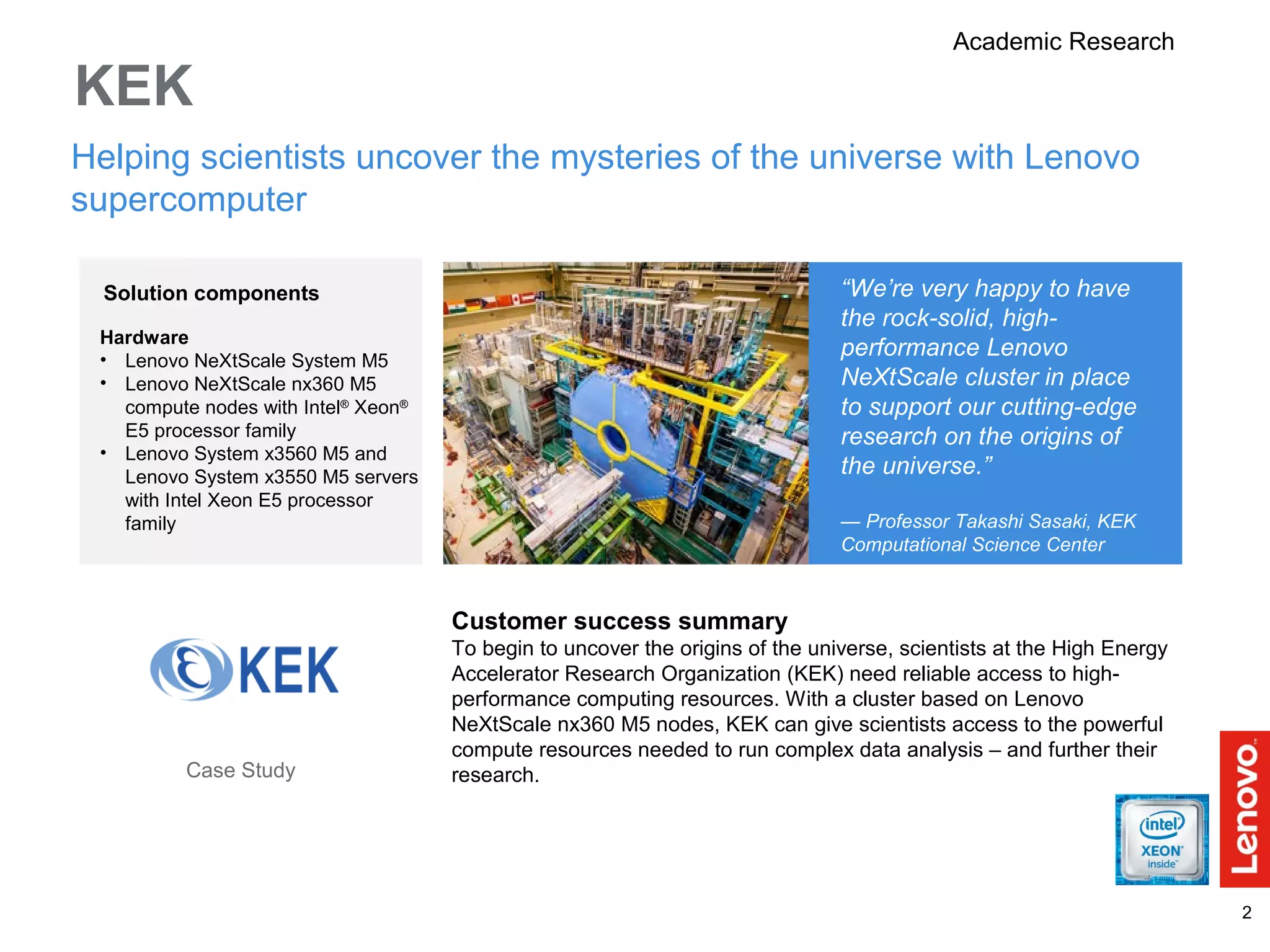
Solution components
Hardware
• Lenovo NeXtScale System M5
• Lenovo NeXtScale nx360 M5
compute nodes with Intel®
Xeon®
E5 processor family
• Lenovo System x3560 M5 and
Lenovo System x3550 M5 servers
with Intel Xeon E5 processor
family
KEK
Helping scientists uncover the mysteries of the universe with Lenovo
supercomputer
Customer success summary
To begin to uncover the origins of the universe, scientists at the High Energy
Accelerator Research Organization (KEK) need reliable access to high-
performance computing resources. With a cluster based on Lenovo
NeXtScale nx360 M5 nodes, KEK can give scientists access to the powerful
compute resources needed to run complex data analysis – and further their
research.
“We’re very happy to have
the rock-solid, high-
performance Lenovo
NeXtScale cluster in place
to support our cutting-edge
research on the origins of
the universe.”
— Professor Takashi Sasaki, KEK
Computational Science Center
Case Study
3
CASE STUDY
Supporting cutting-edge research
Over 600 researchers from 100 universities and institutes across 23 countries, known as the Belle II Collaboration,
use the organization’s facilities, including the SuperKEKB particle accelerator, to advance their understanding of
matter and antimatter, particles and antiparticles.
In the SuperKEKB particle accelerator, around 2,500 electromagnets are used to bend and converge electrons
and positrons in a 10-metre-long tunnel. This causes the particles to collide at nearly the speed of light. The Belle
II detectors capture the reaction.
The Belle II Collaboration has achieved great things since its formation, including experimentally demonstrating
2008 Nobel Prize winners Makoto Kobayashi and Toshihide Maskawa’s theory on the origin of the ‘broken
symmetry’ that contributed to a prevalence of matter over antimatter in the universe.
Crucially, the Belle II Collaboration is an ongoing partnership with much more left to discover. Researchers
stationed as KEK collect and analyze huge volumes of data from a range of scientific devices every day.
Professor Toshiaki Kaneko, Director of the KEK Computational Science Center, comments: “Having recently
introduced state-of-art nano-beams to SuperKEKB, we achieve 40 times as many particle reactions per unit of
time. This means that Belle II experiments produce 50 times more data than previous programs.”
Professor Takashi Sasaki, KEK Computational Science Center, remarks: “Our existing computing resources
simply weren’t powerful enough to cope with this enormous increase in data.”
KEK also operates the J-PARC accelerator in collaboration with the Japan Atomic Energy Agency. J-PARC is
used by researchers specializing in elementary particle and nuclear physics and materials engineering. About 2
PB of data from the J-PARC accelerator is also sent to KEK’s high-performance computing (HPC) environment
each year.
To store and analyze ever-increasing volumes of data generated by both the SuperKEKB and J-PARC particle
accelerators, the organization needed an extremely powerful IT infrastructure.
Professor Takashi Sasaki says: “As well as analyzing the data obtained from our observations, we also run
advanced data simulations – both very compute-intensive processes. So when the time to replace our central
computing system, we knew we needed a system with the highest number of cores and the most memory we
could get within our budget.”
KEK also wanted to ensure that its new central computing system delivered the high levels of availability and
reliability needed to support research. Professor Takashi Sasaki comments: “Because universities from all over
the world need access to our data, we must ensure that our systems are available 24 hours a day, 365 days a
year.”
However, KEK didn’t have free reign when it came to selecting its new HPC solution. Koichi Murakami, KEK
Computational Science Center, elaborates: “With limited floor space available in our server room, we had to
ensure that the new servers fit in the existing rack space and didn’t exceed our existing power or cooling limits.”
Background
The High Energy Accelerator
Research Organization, known
as KEK, operates the largest
particle physics laboratory in
Japan. Scientists at KEK use
accelerators to perform research
in high-energy physics to answer
the most basic questions about
the universe, and the matter and
life it contains.
Academic Research
4
CASE STUDY
© 2016 Lenovo. All rights reserved.
Availability: Offers, prices, specifications and availability may change without notice. Lenovo is not responsible for photographic or typographical errors.
Warranty: For a copy of applicable warranties, write to: Lenovo Warranty Information, 1009 Think Place, Morrisville, NC, 27560. Lenovo makes no
representation or warranty regarding third-party products or services. Trademarks: Lenovo, the Lenovo logo, and System x are trademarks or registered
trademarks of Lenovo. Microsoft and Windows are registered trademarks of Microsoft Corporation. Intel, the Intel logo, Xeon and Xeon Inside are
registered trademarks of Intel Corporation in the U.S. and other countries. Other company, product, and service names may be trademarks or service
names may be trademarks or service marks of others.
Finding the right fit
KEK chose Lenovo NeXtScale System M5 as the foundation for its new supercomputer. The organization
deployed a cluster based on 360 Lenovo NeXtScale nx360 M5 compute nodes. Powered by around 10,000 Intel®
Xeon® E5 processor cores, the cluster deliver high levels of performance. KEK uses IBM Spectrum Scale to serve
as an integrated, easily scalable storage system for the new supercomputing environment.
KEK also deployed 120 Lenovo System x3550 M5 server nodes and 30 Lenovo System x3650 M5 nodes to run
its web, mail and system management solutions.
Professor Toshiaki Kaneko recalls: “The migration to the new Lenovo solution went without a hitch. The
NeXtScale chassis fits nicely in our server room and everything is running very smoothly.”
Having used System x servers in the past, KEK was highly confident in the reliability, stability and easy
manageability its new Lenovo technology would provide.
Giving researchers the right tools for the job
Today, KEK is taking advantage of the powerful Lenovo NeXtScale nx360 M5 compute nodes to run large-scale
analysis and simulations of data obtained from the SuperKEKB and J-PARC particle accelerators, as well as Belle
II experiments.
Professor Takashi Sasaki concludes: “Research into particle physics is extremely compute-intensive and puts a
huge strain on IT infrastructure. We’re very happy to have the rock-solid, high-performance Lenovo NeXtScale
cluster in place to support our cutting-edge research on the origins of the universe.”
For more information
To learn more about Lenovo Data Center Systems solutions, contact your Lenovo Sales Representative or Lenovo
Business Partner, or visit: www.lenovo.com/systems
For more information about KEK, visit: www.kek.jp/en
“Research into particle
physics is extremely
compute-intensive and
puts a huge strain on IT
infrastructure. We’re
very happy to have the
rock-solid, high-
performance Lenovo
NeXtScale cluster in
place to support our
cutting-edge research
on the origins of the
universe.”
Professor Takashi Sasaki,
KEK Computational Science Center
Academic Research

KEK helps scientists uncover the mysteries of the universe with Lenovo supercomputer

  • 1.
    © 2017 SAPSE or an SAP affiliate company. All rights reserved. I © Copyright 2017 Lenovo. All rights reserved. 1 KEK helps scientists uncover the mysteries of the universe with Lenovo supercomputer Lenovo customer case study
  • 2.
    2 Academic Research Solution components Hardware •Lenovo NeXtScale System M5 • Lenovo NeXtScale nx360 M5 compute nodes with Intel® Xeon® E5 processor family • Lenovo System x3560 M5 and Lenovo System x3550 M5 servers with Intel Xeon E5 processor family KEK Helping scientists uncover the mysteries of the universe with Lenovo supercomputer Customer success summary To begin to uncover the origins of the universe, scientists at the High Energy Accelerator Research Organization (KEK) need reliable access to high- performance computing resources. With a cluster based on Lenovo NeXtScale nx360 M5 nodes, KEK can give scientists access to the powerful compute resources needed to run complex data analysis – and further their research. “We’re very happy to have the rock-solid, high- performance Lenovo NeXtScale cluster in place to support our cutting-edge research on the origins of the universe.” — Professor Takashi Sasaki, KEK Computational Science Center Case Study
  • 3.
    3 CASE STUDY Supporting cutting-edgeresearch Over 600 researchers from 100 universities and institutes across 23 countries, known as the Belle II Collaboration, use the organization’s facilities, including the SuperKEKB particle accelerator, to advance their understanding of matter and antimatter, particles and antiparticles. In the SuperKEKB particle accelerator, around 2,500 electromagnets are used to bend and converge electrons and positrons in a 10-metre-long tunnel. This causes the particles to collide at nearly the speed of light. The Belle II detectors capture the reaction. The Belle II Collaboration has achieved great things since its formation, including experimentally demonstrating 2008 Nobel Prize winners Makoto Kobayashi and Toshihide Maskawa’s theory on the origin of the ‘broken symmetry’ that contributed to a prevalence of matter over antimatter in the universe. Crucially, the Belle II Collaboration is an ongoing partnership with much more left to discover. Researchers stationed as KEK collect and analyze huge volumes of data from a range of scientific devices every day. Professor Toshiaki Kaneko, Director of the KEK Computational Science Center, comments: “Having recently introduced state-of-art nano-beams to SuperKEKB, we achieve 40 times as many particle reactions per unit of time. This means that Belle II experiments produce 50 times more data than previous programs.” Professor Takashi Sasaki, KEK Computational Science Center, remarks: “Our existing computing resources simply weren’t powerful enough to cope with this enormous increase in data.” KEK also operates the J-PARC accelerator in collaboration with the Japan Atomic Energy Agency. J-PARC is used by researchers specializing in elementary particle and nuclear physics and materials engineering. About 2 PB of data from the J-PARC accelerator is also sent to KEK’s high-performance computing (HPC) environment each year. To store and analyze ever-increasing volumes of data generated by both the SuperKEKB and J-PARC particle accelerators, the organization needed an extremely powerful IT infrastructure. Professor Takashi Sasaki says: “As well as analyzing the data obtained from our observations, we also run advanced data simulations – both very compute-intensive processes. So when the time to replace our central computing system, we knew we needed a system with the highest number of cores and the most memory we could get within our budget.” KEK also wanted to ensure that its new central computing system delivered the high levels of availability and reliability needed to support research. Professor Takashi Sasaki comments: “Because universities from all over the world need access to our data, we must ensure that our systems are available 24 hours a day, 365 days a year.” However, KEK didn’t have free reign when it came to selecting its new HPC solution. Koichi Murakami, KEK Computational Science Center, elaborates: “With limited floor space available in our server room, we had to ensure that the new servers fit in the existing rack space and didn’t exceed our existing power or cooling limits.” Background The High Energy Accelerator Research Organization, known as KEK, operates the largest particle physics laboratory in Japan. Scientists at KEK use accelerators to perform research in high-energy physics to answer the most basic questions about the universe, and the matter and life it contains. Academic Research
  • 4.
    4 CASE STUDY © 2016Lenovo. All rights reserved. Availability: Offers, prices, specifications and availability may change without notice. Lenovo is not responsible for photographic or typographical errors. Warranty: For a copy of applicable warranties, write to: Lenovo Warranty Information, 1009 Think Place, Morrisville, NC, 27560. Lenovo makes no representation or warranty regarding third-party products or services. Trademarks: Lenovo, the Lenovo logo, and System x are trademarks or registered trademarks of Lenovo. Microsoft and Windows are registered trademarks of Microsoft Corporation. Intel, the Intel logo, Xeon and Xeon Inside are registered trademarks of Intel Corporation in the U.S. and other countries. Other company, product, and service names may be trademarks or service names may be trademarks or service marks of others. Finding the right fit KEK chose Lenovo NeXtScale System M5 as the foundation for its new supercomputer. The organization deployed a cluster based on 360 Lenovo NeXtScale nx360 M5 compute nodes. Powered by around 10,000 Intel® Xeon® E5 processor cores, the cluster deliver high levels of performance. KEK uses IBM Spectrum Scale to serve as an integrated, easily scalable storage system for the new supercomputing environment. KEK also deployed 120 Lenovo System x3550 M5 server nodes and 30 Lenovo System x3650 M5 nodes to run its web, mail and system management solutions. Professor Toshiaki Kaneko recalls: “The migration to the new Lenovo solution went without a hitch. The NeXtScale chassis fits nicely in our server room and everything is running very smoothly.” Having used System x servers in the past, KEK was highly confident in the reliability, stability and easy manageability its new Lenovo technology would provide. Giving researchers the right tools for the job Today, KEK is taking advantage of the powerful Lenovo NeXtScale nx360 M5 compute nodes to run large-scale analysis and simulations of data obtained from the SuperKEKB and J-PARC particle accelerators, as well as Belle II experiments. Professor Takashi Sasaki concludes: “Research into particle physics is extremely compute-intensive and puts a huge strain on IT infrastructure. We’re very happy to have the rock-solid, high-performance Lenovo NeXtScale cluster in place to support our cutting-edge research on the origins of the universe.” For more information To learn more about Lenovo Data Center Systems solutions, contact your Lenovo Sales Representative or Lenovo Business Partner, or visit: www.lenovo.com/systems For more information about KEK, visit: www.kek.jp/en “Research into particle physics is extremely compute-intensive and puts a huge strain on IT infrastructure. We’re very happy to have the rock-solid, high- performance Lenovo NeXtScale cluster in place to support our cutting-edge research on the origins of the universe.” Professor Takashi Sasaki, KEK Computational Science Center Academic Research