To support vital scientific research in fields as diverse as
astrophysics, biomedicine and climate science, SciNet beefed
up its high-performance computing resources with a Lenovo
supercomputer 10 times more powerful than its predecessor.
SciNet
Pushing scientific boundaries
The largest supercomputing center in Canada, SciNet provides
researchers all over the country with the computational
resources and expertise they need to advance their
understanding of the world around us. A consortium of the
University of Toronto and its affiliated teaching hospitals,
SciNet also provides high-performance computing (HPC)
resources to Compute Canada, the country’s national
infrastructure for supercomputing-powered research.
Dr. Daniel Gruner, CTO at SciNet, begins: “We are a
not-for-profit organization focused exclusively on the
advancement of science. We’re proud to welcome some of the
greatest minds in Canada through our doors and provide them
with the HPC resources they need to run advanced data
processing, modeling and analytics jobs.”
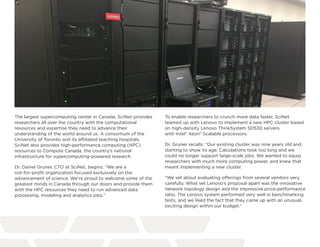
To enable researchers to crunch more data faster, SciNet
teamed up with Lenovo to implement a new HPC cluster based
on high-density Lenovo ThinkSystem SD530 servers
with Intel® Xeon® Scalable processors.
Dr. Gruner recalls: “Our existing cluster was nine years old and
starting to show its age. Calculations took too long and we
could no longer support large-scale jobs. We wanted to equip
researchers with much more computing power, and knew that
meant implementing a new cluster.
“We set about evaluating offerings from several vendors very
carefully. What set Lenovo’s proposal apart was the innovative
network topology design and the impressive price-performance
ratio. The Lenovo system performed very well in benchmarking
tests, and we liked the fact that they came up with an unusual,
exciting design within our budget.”
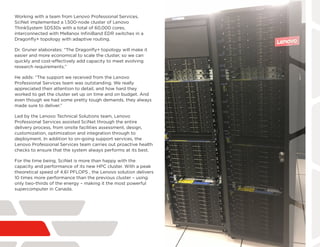
Working with a team from Lenovo Professional Services,
SciNet implemented a 1,500-node cluster of Lenovo
ThinkSystem SD530s with a total of 60,000 cores,
interconnected with Mellanox InfiniBand EDR switches in a
Dragonfly+ topology with adaptive routing.
Dr. Gruner elaborates: “The Dragonfly+ topology will make it
easier and more economical to scale the cluster, so we can
quickly and cost-effectively add capacity to meet evolving
research requirements.”
He adds: “The support we received from the Lenovo
Professional Services team was outstanding. We really
appreciated their attention to detail, and how hard they
worked to get the cluster set up on time and on budget. And
even though we had some pretty tough demands, they always
made sure to deliver.”
Led by the Lenovo Technical Solutions team, Lenovo
Professional Services assisted SciNet through the entire
delivery process, from onsite facilities assessment, design,
customization, optimization and integration through to
deployment. In addition to on-going support services, the
Lenovo Professional Services team carries out proactive health
checks to ensure that the system always performs at its best.
For the time being, SciNet is more than happy with the
capacity and performance of its new HPC cluster. With a peak
theoretical speed of 4.61 PFLOPS , the Lenovo solution delivers
10 times more performance than the previous cluster – using
only two-thirds of the energy – making it the most powerful
supercomputer in Canada.
“We’re delighted with the performance of the Lenovo cluster,”
says Dr. Gruner. “The increase in processing power means that
researchers can run bigger, more complex jobs than they
would previously have been able to. Today, we can even run
enormous 30,000-core jobs that would have been out of the
question before.”
With the Lenovo system in place, SciNet is empowering
researchers to ask bigger questions, delve deeper into their
data and break new ground.
One group of climate scientists is using the cluster to run
oceanic modeling calculations that will help them to better
understand the dynamics of heat transfer, salinity and
pollutants. Oceanic simulations have never been done at such
a high resolution before, giving the scientists unprecedented
insight into these phenomena. Research that may one day
inform government policy on climate change, or fishing
industry practices, for example.
Other researchers are using SciNet resources to investigate the
aerodynamics of commercial planes so that they can design
more fuel-efficient aircraft. Important work on gravitational
waves is also being conducted at SciNet – including some of
the simulations for the Laser Interferometer Gravitational-Wave
Observatory (LIGO) project, which makes direct observation
of gravitational waves (ripples in the fabric of space and
time predicted by Einstein) and recently won the Nobel Prize
for Physics.
Dr. Gruner states: “The list of research projects that we
support goes on and on. The Lenovo cluster is already in full
production and open to the wider academic research
community. Feedback from researchers already running jobs
on the cluster has been fantastic, and we know that others
can’t wait to get started.
© 2018 Lenovo. All rights reserved.
Availability: Offers, prices, specifications and availability may change without notice. Lenovo is not
responsible for photographic or typographical errors. Warranty: For a copy of applicable warranties,
write to: Lenovo Warranty Information, 1009 Think Place, Morrisville, NC, 27560. Lenovo makes no
representation or warranty regarding third-party products or services. Trademarks: Lenovo, the
Lenovo logo, AnyBay, ThinkSystem, and XClarity are trademarks or registered trademarks of Lenovo.
Microsoft and Windows are registered trademarks of Microsoft Corporation. Intel, the Intel logo,
Xeon and Xeon Inside are registered trademarks of Intel Corporation in the U.S. and other countries.
Other company, product, and service names may be trademarks or service marks of others.
CS00054-00
He concludes: “The size and speed of the Lenovo cluster means
that we can now handle even the largest and most complex
jobs, and that researchers will get results back fast. We’re really
excited that users will be able to conduct research on the
Lenovo system that hasn’t been possible in Canada before,
advancing scientific knowledge.”
“We’re really excited that users will
be able to conduct research on the
Lenovo system that hasn’t been
possible in Canada before,
advancing scientific knowledge.”
– Dr. Daniel Gruner, CTO, SciNet
Facebook “f” Logo CMYK / .eps Facebook “f” Logo CMYK / .eps
Canadian research consortium SciNet implemented a powerful HPC
cluster based on Lenovo ThinkSystem SD530 servers with Intel®
Xeon® Scalable processors and a unique Dragonfly+ network
topology that delivers 10 times the performance using only two-thirds
of the energy.
SciNet
Pushing scientific boundaries
ACADEMIC RESEARCH
Solution components
Hardware
Lenovo ThinkSystem SD530 with
Intel® Xeon® Scalable processor
family
Lenovo Distributed Storage
Solution for IBM Spectrum
Scale (DSS-G)
Lenovo RackSwitch G8052 &
G8272 Ethernet Networking
Mellanox Switch IB-2 SB7800
series InfiniBand EDR switches
Software
Red Hat Enterprise Linux /
CentOS
Excelero
IBM Spectrum Scale
Services
Lenovo Professional Services
“We’re really excited that users will be able to conduct research on
the Lenovo system that hasn’t been possible in Canada before,
advancing scientific knowledge.”
—Dr. Daniel Gruner, CTO, SciNet

SciNet -- Pushing scientific boundaries

  • 1.
    To support vitalscientific research in fields as diverse as astrophysics, biomedicine and climate science, SciNet beefed up its high-performance computing resources with a Lenovo supercomputer 10 times more powerful than its predecessor. SciNet Pushing scientific boundaries
  • 2.
    The largest supercomputingcenter in Canada, SciNet provides researchers all over the country with the computational resources and expertise they need to advance their understanding of the world around us. A consortium of the University of Toronto and its affiliated teaching hospitals, SciNet also provides high-performance computing (HPC) resources to Compute Canada, the country’s national infrastructure for supercomputing-powered research. Dr. Daniel Gruner, CTO at SciNet, begins: “We are a not-for-profit organization focused exclusively on the advancement of science. We’re proud to welcome some of the greatest minds in Canada through our doors and provide them with the HPC resources they need to run advanced data processing, modeling and analytics jobs.” To enable researchers to crunch more data faster, SciNet teamed up with Lenovo to implement a new HPC cluster based on high-density Lenovo ThinkSystem SD530 servers with Intel® Xeon® Scalable processors. Dr. Gruner recalls: “Our existing cluster was nine years old and starting to show its age. Calculations took too long and we could no longer support large-scale jobs. We wanted to equip researchers with much more computing power, and knew that meant implementing a new cluster. “We set about evaluating offerings from several vendors very carefully. What set Lenovo’s proposal apart was the innovative network topology design and the impressive price-performance ratio. The Lenovo system performed very well in benchmarking tests, and we liked the fact that they came up with an unusual, exciting design within our budget.”
  • 3.
    Working with ateam from Lenovo Professional Services, SciNet implemented a 1,500-node cluster of Lenovo ThinkSystem SD530s with a total of 60,000 cores, interconnected with Mellanox InfiniBand EDR switches in a Dragonfly+ topology with adaptive routing. Dr. Gruner elaborates: “The Dragonfly+ topology will make it easier and more economical to scale the cluster, so we can quickly and cost-effectively add capacity to meet evolving research requirements.” He adds: “The support we received from the Lenovo Professional Services team was outstanding. We really appreciated their attention to detail, and how hard they worked to get the cluster set up on time and on budget. And even though we had some pretty tough demands, they always made sure to deliver.” Led by the Lenovo Technical Solutions team, Lenovo Professional Services assisted SciNet through the entire delivery process, from onsite facilities assessment, design, customization, optimization and integration through to deployment. In addition to on-going support services, the Lenovo Professional Services team carries out proactive health checks to ensure that the system always performs at its best. For the time being, SciNet is more than happy with the capacity and performance of its new HPC cluster. With a peak theoretical speed of 4.61 PFLOPS , the Lenovo solution delivers 10 times more performance than the previous cluster – using only two-thirds of the energy – making it the most powerful supercomputer in Canada.
  • 4.
    “We’re delighted withthe performance of the Lenovo cluster,” says Dr. Gruner. “The increase in processing power means that researchers can run bigger, more complex jobs than they would previously have been able to. Today, we can even run enormous 30,000-core jobs that would have been out of the question before.” With the Lenovo system in place, SciNet is empowering researchers to ask bigger questions, delve deeper into their data and break new ground. One group of climate scientists is using the cluster to run oceanic modeling calculations that will help them to better understand the dynamics of heat transfer, salinity and pollutants. Oceanic simulations have never been done at such a high resolution before, giving the scientists unprecedented insight into these phenomena. Research that may one day inform government policy on climate change, or fishing industry practices, for example. Other researchers are using SciNet resources to investigate the aerodynamics of commercial planes so that they can design more fuel-efficient aircraft. Important work on gravitational waves is also being conducted at SciNet – including some of the simulations for the Laser Interferometer Gravitational-Wave Observatory (LIGO) project, which makes direct observation of gravitational waves (ripples in the fabric of space and time predicted by Einstein) and recently won the Nobel Prize for Physics. Dr. Gruner states: “The list of research projects that we support goes on and on. The Lenovo cluster is already in full production and open to the wider academic research community. Feedback from researchers already running jobs on the cluster has been fantastic, and we know that others can’t wait to get started. © 2018 Lenovo. All rights reserved. Availability: Offers, prices, specifications and availability may change without notice. Lenovo is not responsible for photographic or typographical errors. Warranty: For a copy of applicable warranties, write to: Lenovo Warranty Information, 1009 Think Place, Morrisville, NC, 27560. Lenovo makes no representation or warranty regarding third-party products or services. Trademarks: Lenovo, the Lenovo logo, AnyBay, ThinkSystem, and XClarity are trademarks or registered trademarks of Lenovo. Microsoft and Windows are registered trademarks of Microsoft Corporation. Intel, the Intel logo, Xeon and Xeon Inside are registered trademarks of Intel Corporation in the U.S. and other countries. Other company, product, and service names may be trademarks or service marks of others. CS00054-00 He concludes: “The size and speed of the Lenovo cluster means that we can now handle even the largest and most complex jobs, and that researchers will get results back fast. We’re really excited that users will be able to conduct research on the Lenovo system that hasn’t been possible in Canada before, advancing scientific knowledge.” “We’re really excited that users will be able to conduct research on the Lenovo system that hasn’t been possible in Canada before, advancing scientific knowledge.” – Dr. Daniel Gruner, CTO, SciNet Facebook “f” Logo CMYK / .eps Facebook “f” Logo CMYK / .eps
  • 5.
    Canadian research consortiumSciNet implemented a powerful HPC cluster based on Lenovo ThinkSystem SD530 servers with Intel® Xeon® Scalable processors and a unique Dragonfly+ network topology that delivers 10 times the performance using only two-thirds of the energy. SciNet Pushing scientific boundaries ACADEMIC RESEARCH Solution components Hardware Lenovo ThinkSystem SD530 with Intel® Xeon® Scalable processor family Lenovo Distributed Storage Solution for IBM Spectrum Scale (DSS-G) Lenovo RackSwitch G8052 & G8272 Ethernet Networking Mellanox Switch IB-2 SB7800 series InfiniBand EDR switches Software Red Hat Enterprise Linux / CentOS Excelero IBM Spectrum Scale Services Lenovo Professional Services “We’re really excited that users will be able to conduct research on the Lenovo system that hasn’t been possible in Canada before, advancing scientific knowledge.” —Dr. Daniel Gruner, CTO, SciNet