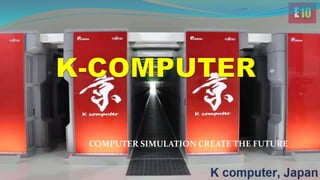
COMPUTER SIMULATION CREATE THE FUTURE
CONTENTS
Introduction
Architectural View
Network
File System
Power Consumption
Performance and Development
Uses of k computer
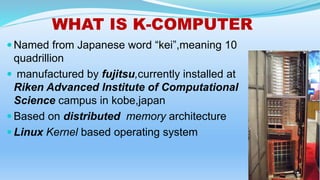
WHAT IS K-COMPUTER
Named from Japanese word “kei”,meaning 10
quadrillion
 manufactured by fujitsu,currently installed at
Riken Advanced Institute of Computational
Science campus in kobe,japan
Based on distributed memory architecture
Linux Kernel based operating system
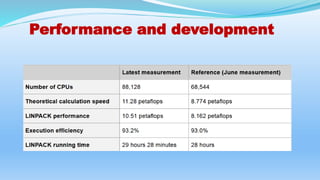
In June 2011, TOP500 ranked K the world's fastest
supercomputer, with a computation speed of over 8
petaflops
As of November 2016, K is the world's seventh-
fastest computer, with the Chinese Sunway
TaihuLight and Tianhe-2 being the fastest
supercomputers.
Network
The nodes are interconnected by Fujitsu's proprietary
Torus fusion (Tofu) interconnect.
Tofu has a six-dimensional mesh/torus topology, a
scalability of over 100,000 nodes, and full-duplex links
that have a peak bandwidth of 10 GB/s (5 GB/s per
direction).
Each node is connected to its own InterConnect
Controller (ICC) chip, which contains four Tofu interfaces
(one for the node and three for connecting to other ICC
chips) and a router.
Tofu's six-dimensional mesh/torus topology is abstracted
by software to appear as a three-dimensional torus
It is supported by a Tofu-optimized version of the open-
source Open MPI Message Passing Interfacelibrary.
 Users can create application programs adapted to
either a one-, two-, or three-dimensional torus network.
Architecture VIEW..
The K computer comprises 88,128 2.0 GHz eight-core
SPARC64VIIIfxprocessors contained in 864 cabinets, for
a total of 705,024 cores, manufactured by Fujitsu with
45 nm CMOS technology.
 Each cabinet contains 96 computing nodes, in addition
to 6 I/O nodes. Each computing node contains a single
processor and 16 GB of memory. The computer's water
cooling system is designed to minimize failure rate and
power consumption.
File system
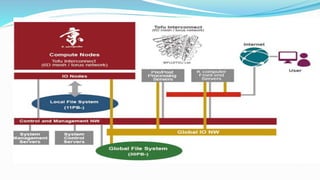
The system adopts a two-level local/global file system
with parallel/distributed functions, and provides users
with an automatic staging function for moving files
between global and local file systems.
 Fujitsu developed an optimized parallel file system
based on Lustre , called the Fujitsu Exabyte File System
(FEFS), which is scalable to several hundred petabytes.
Power consumption
 K computer reported the highest total power consumption of
any 2011 TOP500 supercomputer (9.89 MW), it is relatively
efficient, achieving 824.6 GFlop/kWatt.
 According to TOP500 compiler Jack Dongarra, professor of
electrical engineering and computer science at the
University of Tennessee, the K computer's performance
equals "one million linked desktop computers".
 The computer's annual running costs are estimated at
US$10 million.
Performance and development
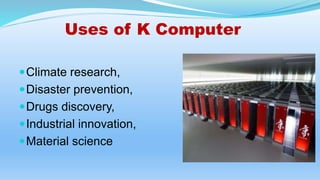
Uses of K Computer
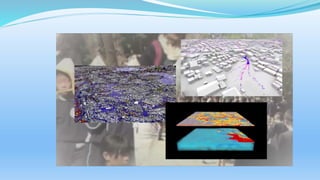
Climate research,
Disaster prevention,
Drugs discovery,
Industrial innovation,
Material science
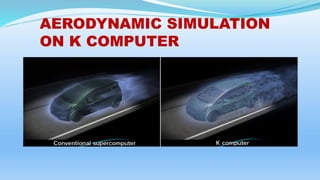
AERODYNAMIC SIMULATION
ON K COMPUTER
MEMBERS:
RAUSHAN KUMAR 1551137
RAVI KUMAR 1551138
ABHISHEK GOYAL 1551159
AMAR ANAND 1551157
ANKIT SINGH RAJPUT 1551139
THANK YOU!!

K computer

  • 1.
  • 2.
    CONTENTS Introduction Architectural View Network File System PowerConsumption Performance and Development Uses of k computer
  • 3.
    WHAT IS K-COMPUTER Namedfrom Japanese word “kei”,meaning 10 quadrillion  manufactured by fujitsu,currently installed at Riken Advanced Institute of Computational Science campus in kobe,japan Based on distributed memory architecture Linux Kernel based operating system
  • 4.
    In June 2011,TOP500 ranked K the world's fastest supercomputer, with a computation speed of over 8 petaflops As of November 2016, K is the world's seventh- fastest computer, with the Chinese Sunway TaihuLight and Tianhe-2 being the fastest supercomputers.
  • 5.
    Network The nodes areinterconnected by Fujitsu's proprietary Torus fusion (Tofu) interconnect. Tofu has a six-dimensional mesh/torus topology, a scalability of over 100,000 nodes, and full-duplex links that have a peak bandwidth of 10 GB/s (5 GB/s per direction). Each node is connected to its own InterConnect Controller (ICC) chip, which contains four Tofu interfaces (one for the node and three for connecting to other ICC chips) and a router.
  • 6.
    Tofu's six-dimensional mesh/torustopology is abstracted by software to appear as a three-dimensional torus It is supported by a Tofu-optimized version of the open- source Open MPI Message Passing Interfacelibrary.  Users can create application programs adapted to either a one-, two-, or three-dimensional torus network.
  • 8.
    Architecture VIEW.. The Kcomputer comprises 88,128 2.0 GHz eight-core SPARC64VIIIfxprocessors contained in 864 cabinets, for a total of 705,024 cores, manufactured by Fujitsu with 45 nm CMOS technology.  Each cabinet contains 96 computing nodes, in addition to 6 I/O nodes. Each computing node contains a single processor and 16 GB of memory. The computer's water cooling system is designed to minimize failure rate and power consumption.
  • 9.
    File system The systemadopts a two-level local/global file system with parallel/distributed functions, and provides users with an automatic staging function for moving files between global and local file systems.  Fujitsu developed an optimized parallel file system based on Lustre , called the Fujitsu Exabyte File System (FEFS), which is scalable to several hundred petabytes.
  • 10.
    Power consumption  Kcomputer reported the highest total power consumption of any 2011 TOP500 supercomputer (9.89 MW), it is relatively efficient, achieving 824.6 GFlop/kWatt.  According to TOP500 compiler Jack Dongarra, professor of electrical engineering and computer science at the University of Tennessee, the K computer's performance equals "one million linked desktop computers".  The computer's annual running costs are estimated at US$10 million.
  • 11.
  • 12.
    Uses of KComputer Climate research, Disaster prevention, Drugs discovery, Industrial innovation, Material science
  • 13.
  • 15.
    MEMBERS: RAUSHAN KUMAR 1551137 RAVIKUMAR 1551138 ABHISHEK GOYAL 1551159 AMAR ANAND 1551157 ANKIT SINGH RAJPUT 1551139 THANK YOU!!