HPC, Grid and Cloud Computing
   - The Past, Present and Future


             Jason Shih
    Academia Sinica Grid computing
      FBI 極簡主義, Nov 3rd, 2010
Outline


 Trend in HPC
 Grid: eScience Research @ PetaScale
 Cloud Hype and Observation
 Future Exploration Path of Computing
 Summary
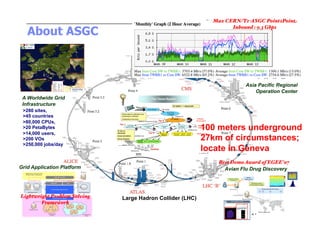
Max CERN/T1-ASGC Point2Point

   About ASGC
                                                                    Inbound : 9.3 Gbps!


                                                              1. Most Reliable T1: 98.83%!
                                                              2. Very Highly Performing and
                                                               most Stable Site in CCRC08!

                                                                            Asia Pacific Regional
                                                                                Operation Center
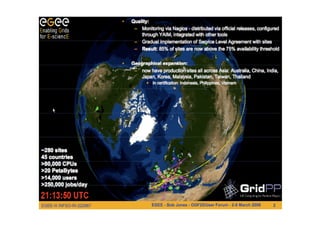
 A Worldwide Grid
 Infrastructure
 >280 sites,
 >45 countries
 >80,000 CPUs,
 >20 PetaBytes                                              100 meters underground
 >14,000 users,
 >200 VOs                                                   27km of circumstances;
 >250,000 jobs/day
                                                            locate in Geneva
                                                                 Best Demo Award of EGEE’07!
Grid Application Platform                                          Avian Flu Drug Discovery


Lightweight Problem Solving   Large Hadron Collider (LHC)
        Framework!

                                                                              21
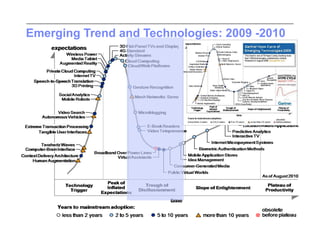
Emerging Trend and Technologies: 2009 -2010
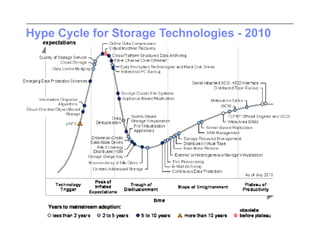
Hype Cycle for Storage Technologies - 2010
Trend in High Performance Computing
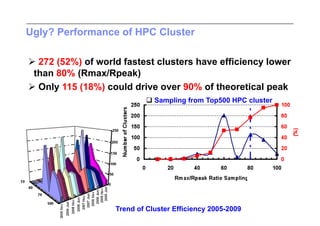
Ugly? Performance of HPC Cluster

 272 (52%) of world fastest clusters have efficiency lower
 than 80% (Rmax/Rpeak)
 Only 115 (18%) could drive over 90% of theoretical peak
                            Sampling from Top500 HPC cluster


                   Trend of Cluster Efficiency 2005-2009
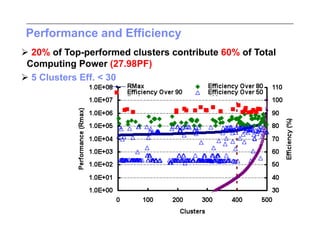
Performance and Efficiency
 20% of Top-performed clusters contribute 60% of Total
 Computing Power (27.98PF)
 5 Clusters Eff. < 30
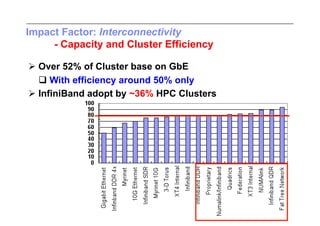
Impact Factor: Interconnectivity
     - Capacity and Cluster Efficiency

 Over 52% of Cluster base on GbE
   With efficiency around 50% only
 InfiniBand adopt by ~36% HPC Clusters
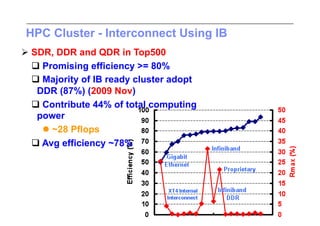
HPC Cluster - Interconnect Using IB
 SDR, DDR and QDR in Top500
   Promising efficiency >= 80%
   Majority of IB ready cluster adopt
   DDR (87%) (2009 Nov)
   Contribute 44% of total computing
   power
     ~28 Pflops
   Avg efficiency ~78%
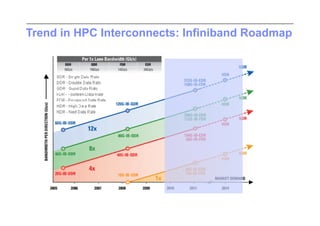
Trend in HPC Interconnects: Infiniband Roadmap
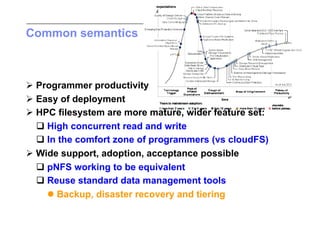
Common semantics


 Programmer productivity
 Easy of deployment
 HPC filesystem are more mature, wider feature set:
   High concurrent read and write
   In the comfort zone of programmers (vs cloudFS)
 Wide support, adoption, acceptance possible
   pNFS working to be equivalent
   Reuse standard data management tools
     Backup, disaster recovery and tiering
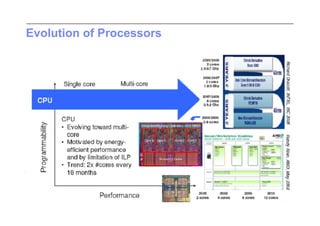
Evolution of Processors
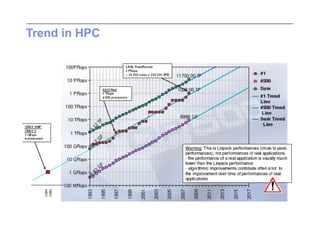
Trend in HPC
Some Observations & Looking for Future (I)
 Computing Paradigm
  (Almost) Free FLOPS
  (Almost) Logic Operation
  Data Access (Memory) Is A Major Bottleneck
  Synchronization Is the Most Expensive
  Data Communication Is A Big Factor in Performance
  I/O Still A Major Programming Consideration
  MPI Coding Is the Motherhood of Large Scale Computing
  Computing in Conjunction of Massive Data Management
  Finding Parallelism Is Not A Whole Issue In Programming
  Data Layout
  Data Movement
  Data Reuse
  Frequency of Interconnected Data Communication
Some Observations & Looking for Future (II)
 Emerging New Possibility
   Massive “Small” Computing Elements with On Board Memory
   Computing Node Can Be Caonfigured Dynamically (including Failure
   recovery)
   Network Switch (within on site complex) Will Nearly Match Memory
   Performance
   Parallel I/O Support for Massive Parallel System
   Asynchronous Computing/Communication Operation
   Sophisticate Data Pre-fetch Scheme (Hardware/Algorithm)
   Automate Dynamic Load Balance Method
   Very High Order Difference Scheme (also Implicit Method)
   Full Coupling of Formerly Split Operators
   Fine Numerical Computational Grid (grid number > 10,000)
   Full Simulation of Protein
   Full Coupling of Computational Model
   Grid Computing for All
Some Observations & Looking for Future (3)


          System will get more complicate &
      Computing Tool will get more sophisticated:


          Vendor Support & User Readiness?
Grid: eScience Research @ PetaScale
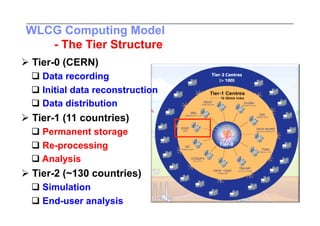
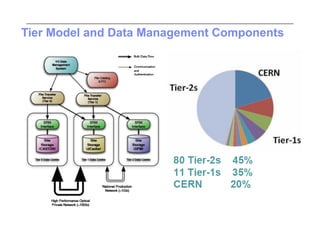
WLCG Computing Model
   - The Tier Structure
 Tier-0 (CERN)
   Data recording
   Initial data reconstruction
   Data distribution
 Tier-1 (11 countries)
   Permanent storage
   Re-processing
   Analysis
 Tier-2 (~130 countries)
   Simulation
   End-user analysis
Enabling Grids for E-sciencE


 Archeology
 Astronomy
 Astrophysics
 Civil Protection
 Comp. Chemistry
 Earth Sciences
 Finance
 Fusion
 Geophysics
 High Energy Physics
 Life Sciences
 Multimedia
 Material Sciences
 …

EGEE-II INFSO-RI-031688                                  EGEE07, Budapest, 1-5 October 2007   4
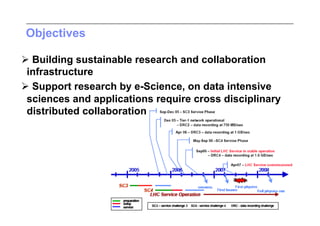
Objectives

 Building sustainable research and collaboration
 infrastructure
 Support research by e-Science, on data intensive
 sciences and applications require cross disciplinary
 distributed collaboration
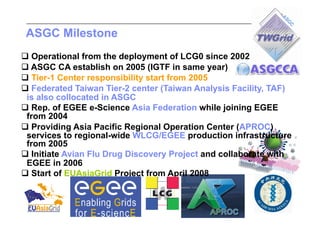
ASGC Milestone
 Operational from the deployment of LCG0 since 2002
 ASGC CA establish on 2005 (IGTF in same year)
 Tier-1 Center responsibility start from 2005
 Federated Taiwan Tier-2 center (Taiwan Analysis Facility, TAF)
 is also collocated in ASGC
 Rep. of EGEE e-Science Asia Federation while joining EGEE
 from 2004
 Providing Asia Pacific Regional Operation Center (APROC)
 services to regional-wide WLCG/EGEE production infrastructure
 from 2005
 Initiate Avian Flu Drug Discovery Project and collaborate with
 EGEE in 2006
 Start of EUAsiaGrid Project from April 2008
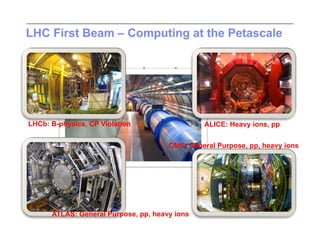
LHC First Beam – Computing at the Petascale


 General Purpose, pp, heavy ions


LHCb: B-physics, CP Violation                  ALICE: Heavy ions, pp


                                      CMS: General Purpose, pp, heavy ions


      ATLAS: General Purpose, pp, heavy ions
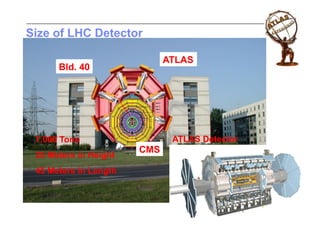
Size of LHC Detector

                             ATLAS
      Bld. 40


 7,000 Tons                   ATLAS Detector
                       CMS
 25 Meters in Height
 45 Meters in Length
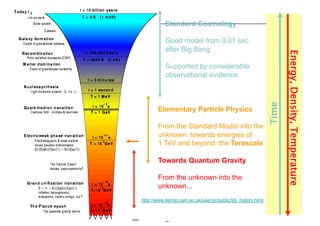
Standard Cosmology

                   Good model from 0.01 sec
                   after Big Bang


                                                                            Energy, Density, Temperature
                   Supported by considerable
                   observational evidence


                                                                    Time
               Elementary Particle Physics

               From the Standard Model into the
               unknown: towards energies of
               1 TeV and beyond: the Terascale

               Towards Quantum Gravity

               From the unknown into the
               unknown...
        http://www.damtp.cam.ac.uk/user/gr/public/bb_history.html
     UNESCO Information                                                25
Preservation debate, April 2007 -
    Jamie.Shiers@cern.ch
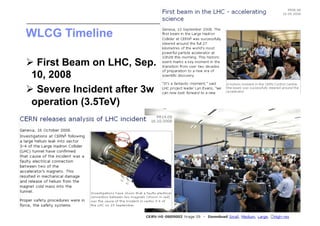
WLCG Timeline

 First Beam on LHC, Sep.
 10, 2008
 Severe Incident after 3w
 operation (3.5TeV)
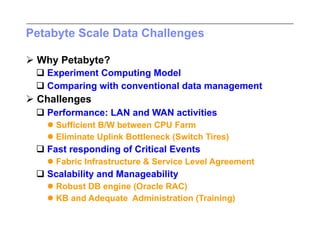
Petabyte Scale Data Challenges

 Why Petabyte?
  Experiment Computing Model
  Comparing with conventional data management
 Challenges
  Performance: LAN and WAN activities
    Sufficient B/W between CPU Farm
    Eliminate Uplink Bottleneck (Switch Tires)
  Fast responding of Critical Events
    Fabric Infrastructure & Service Level Agreement
  Scalability and Manageability
    Robust DB engine (Oracle RAC)
    KB and Adequate Administration (Training)
Tier Model and Data Management Components
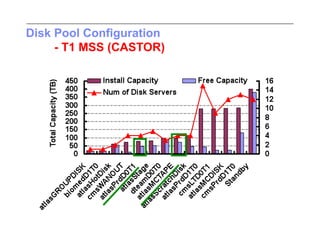
Disk Pool Configuration
     - T1 MSS (CASTOR)
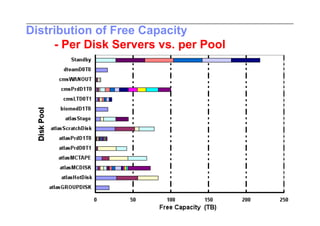
Distribution of Free Capacity
     - Per Disk Servers vs. per Pool
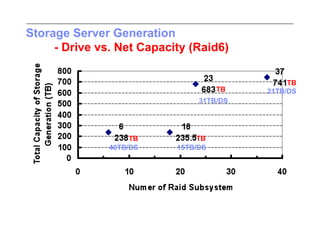
Storage Server Generation
     - Drive vs. Net Capacity (Raid6)

                                               TB
                                     TB   21TB/DS
                                31TB/DS


                    TB          TB
               40TB/DS     15TB/DS
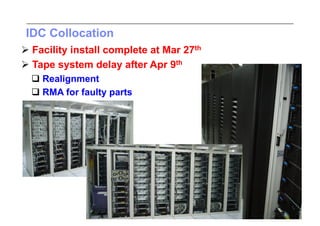
IDC Collocation
 Facility install complete at Mar 27th
 Tape system delay after Apr 9th
   Realignment
   RMA for faulty parts
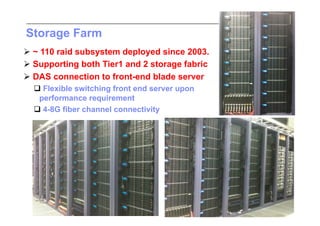
Storage Farm
 ~ 110 raid subsystem deployed since 2003.
 Supporting both Tier1 and 2 storage fabric
 DAS connection to front-end blade server
   Flexible switching front end server upon
   performance requirement
   4-8G fiber channel connectivity
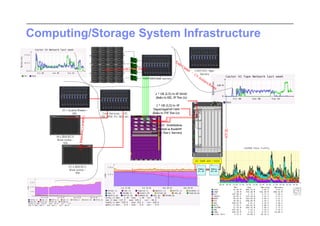
Computing/Storage System Infrastructure
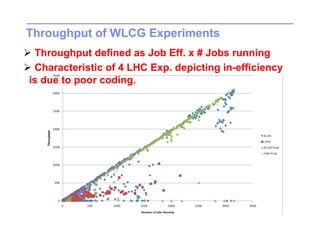
Throughput of WLCG Experiments
 Throughput defined as Job Eff. x # Jobs running
 Characteristic of 4 LHC Exp. depicting in-efficiency
 is due to poor coding.
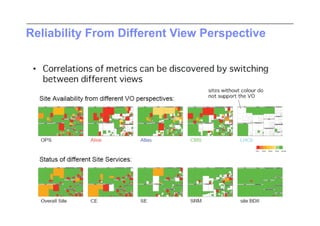
Reliability From Different View Perspective
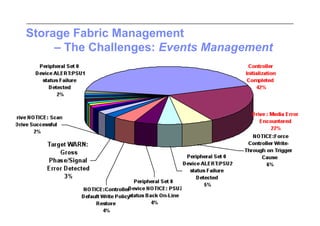
Storage Fabric Management
     – The Challenges: Events Management
Open Cloud Consortium


Cloud Hype and Observation
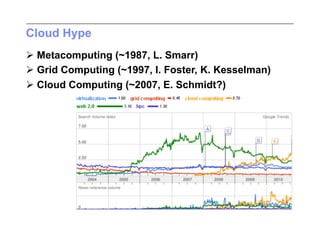
Cloud Hype
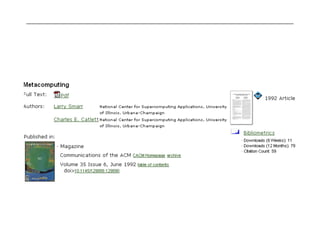
 Metacomputing (~1987, L. Smarr)
 Grid Computing (~1997, I. Foster, K. Kesselman)
 Cloud Computing (~2007, E. Schmidt?)
Type of Infrastructure

  roprietary solutions by public providers
 P
   Turnkey solutions developed internally as they own
    the software and hardware solution/tech.
  loud specific support
 C
   Developers of specific hardware and/or software
    solutions that are utilized by service providers or used
    internally when building private cloud
  raditional providers
 T
   Leverage or tweak their existing
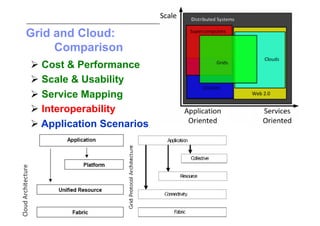
Grid and Cloud:
     Comparison
 Cost & Performance
 Scale & Usability
 Service Mapping
 Interoperability
 Application Scenarios
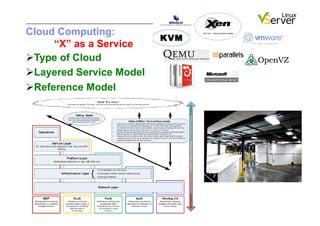
Cloud Computing:
      “X” as a Service
  ype of Cloud
 T
  ayered Service Model
 L
  eference Model
 R
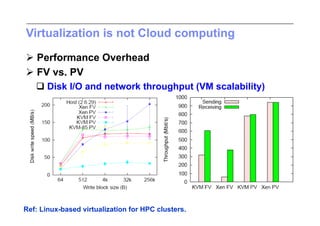
Virtualization is not Cloud computing

 Performance Overhead
 FV vs. PV
    Disk I/O and network throughput (VM scalability)


Ref: Linux-based virtualization for HPC clusters.
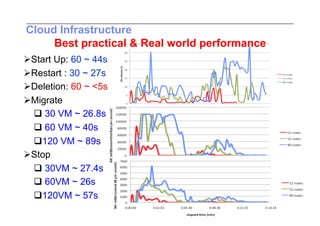
Cloud Infrastructure
     Best practical & Real world performance
  tart Up: 60 ~ 44s
 S
  estart : 30 ~ 27s
 R
  eletion: 60 ~ <5s
 D
  igrate
 M
   30 VM ~ 26.8s
   60 VM ~ 40s
    20 VM ~ 89s
    1
  top
 S
   30VM ~ 27.4s
   60VM ~ 26s
    20VM ~ 57s
    1
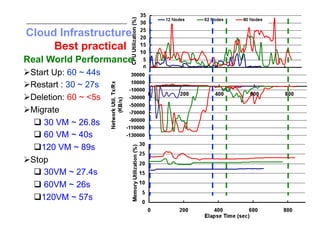
Cloud Infrastructure
     Best practical
Real World Performance
  tart Up: 60 ~ 44s
 S
  estart : 30 ~ 27s
 R
  eletion: 60 ~ <5s
 D
  igrate
 M
   30 VM ~ 26.8s
   60 VM ~ 40s
    20 VM ~ 89s
     1
  top
 S
   30VM ~ 27.4s
   60VM ~ 26s
    20VM ~ 57s
     1
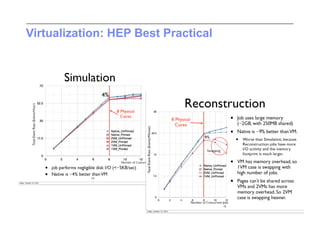
Virtualization: HEP Best Practical
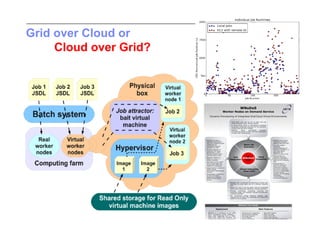
Grid over Cloud or
     Cloud over Grid?
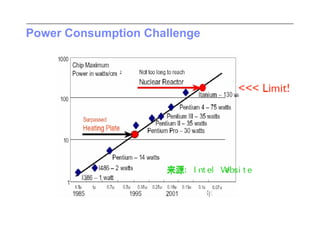
Power Consumption Challenge
Conclusion: My Opinion


 Future of Computing: Technology-Push & Demand-
 Pull
 Emerging of new science paradigm
 Virtualization: Promising Technology but being
 overemphasized
 Green: Cloud Service Transparency & Common
 Platform
  More Computing Power ~ Power Consumption
  Challenge
 Private Clouds Will be predominant way
  Commercial Cloud (Public) expect not evolving fast
Acknowledgment


 Thanks valuable discussion/inputs from TCloud
 (Cloud OS: Elaster)
 Professional Technical Support from Silvershine
 Tech. at beginning of the collaboration.

The interesting thing about Cloud Computing is that we’ve
defined Cloud Computing to include everything that we
already do….. I don’t understand what we would do
differently in the light of Cloud Computing other than
change the wording of some of our ads.
      Larry Ellison, quote in the Wall Street Journal, Sep 26, 2008
Issues

 Scalability?
   Infrastructure operation vs. performance
 Assessment
 Application aware – Cloud service
 Cost analysis
 Data center power usage – PUE
 Cloud Myth
 Top 10 Cloud Computing Trend
   http://www.focus.com/articles/hosting-bandwidth/
   top-10-cloud-computing-trends/
 Use Cases & Best Practical
Issues (II)


 Volunteer computing (boinc)?
   Total capacity & performance
   successful stories & research Despines
 What’s hindering cloud adoption? Try human.
   http://gigaom.com/cloud/whats-hindering-cloud-
   adoption-how-about-humans/
 Future projection?
   service readiness? Service level? Technical barriers?

Hpc, grid and cloud computing - the past, present, and future challenge

  • 1.
    HPC, Grid andCloud Computing - The Past, Present and Future Jason Shih Academia Sinica Grid computing FBI 極簡主義, Nov 3rd, 2010
  • 2.
    Outline  Trend in HPC  Grid:eScience Research @ PetaScale  Cloud Hype and Observation  Future Exploration Path of Computing  Summary
  • 3.
    Max CERN/T1-ASGC Point2Point About ASGC Inbound : 9.3 Gbps! 1. Most Reliable T1: 98.83%! 2. Very Highly Performing and most Stable Site in CCRC08! Asia Pacific Regional Operation Center A Worldwide Grid Infrastructure >280 sites, >45 countries >80,000 CPUs, >20 PetaBytes 100 meters underground >14,000 users, >200 VOs 27km of circumstances; >250,000 jobs/day locate in Geneva Best Demo Award of EGEE’07! Grid Application Platform Avian Flu Drug Discovery Lightweight Problem Solving Large Hadron Collider (LHC) Framework! 21
  • 4.
    Emerging Trend andTechnologies: 2009 -2010
  • 5.
    Hype Cycle forStorage Technologies - 2010
  • 6.
    Trend in HighPerformance Computing
  • 7.
    Ugly? Performance ofHPC Cluster  272 (52%) of world fastest clusters have efficiency lower than 80% (Rmax/Rpeak)  Only 115 (18%) could drive over 90% of theoretical peak  Sampling from Top500 HPC cluster Trend of Cluster Efficiency 2005-2009
  • 8.
    Performance and Efficiency  20%of Top-performed clusters contribute 60% of Total Computing Power (27.98PF)  5 Clusters Eff. < 30
  • 9.
    Impact Factor: Interconnectivity - Capacity and Cluster Efficiency  Over 52% of Cluster base on GbE  With efficiency around 50% only  InfiniBand adopt by ~36% HPC Clusters
  • 10.
    HPC Cluster -Interconnect Using IB  SDR, DDR and QDR in Top500  Promising efficiency >= 80%  Majority of IB ready cluster adopt DDR (87%) (2009 Nov)  Contribute 44% of total computing power  ~28 Pflops  Avg efficiency ~78%
  • 11.
    Trend in HPCInterconnects: Infiniband Roadmap
  • 12.
    Common semantics  Programmer productivity  Easyof deployment  HPC filesystem are more mature, wider feature set:  High concurrent read and write  In the comfort zone of programmers (vs cloudFS)  Wide support, adoption, acceptance possible  pNFS working to be equivalent  Reuse standard data management tools  Backup, disaster recovery and tiering
  • 13.
  • 14.
  • 15.
    Some Observations &Looking for Future (I)  Computing Paradigm  (Almost) Free FLOPS  (Almost) Logic Operation  Data Access (Memory) Is A Major Bottleneck  Synchronization Is the Most Expensive  Data Communication Is A Big Factor in Performance  I/O Still A Major Programming Consideration  MPI Coding Is the Motherhood of Large Scale Computing  Computing in Conjunction of Massive Data Management  Finding Parallelism Is Not A Whole Issue In Programming  Data Layout  Data Movement  Data Reuse  Frequency of Interconnected Data Communication
  • 16.
    Some Observations &Looking for Future (II)  Emerging New Possibility  Massive “Small” Computing Elements with On Board Memory  Computing Node Can Be Caonfigured Dynamically (including Failure recovery)  Network Switch (within on site complex) Will Nearly Match Memory Performance  Parallel I/O Support for Massive Parallel System  Asynchronous Computing/Communication Operation  Sophisticate Data Pre-fetch Scheme (Hardware/Algorithm)  Automate Dynamic Load Balance Method  Very High Order Difference Scheme (also Implicit Method)  Full Coupling of Formerly Split Operators  Fine Numerical Computational Grid (grid number > 10,000)  Full Simulation of Protein  Full Coupling of Computational Model  Grid Computing for All
  • 17.
    Some Observations &Looking for Future (3) System will get more complicate & Computing Tool will get more sophisticated: Vendor Support & User Readiness?
  • 18.
  • 19.
    WLCG Computing Model - The Tier Structure  Tier-0 (CERN)  Data recording  Initial data reconstruction  Data distribution  Tier-1 (11 countries)  Permanent storage  Re-processing  Analysis  Tier-2 (~130 countries)  Simulation  End-user analysis
  • 20.
    Enabling Grids forE-sciencE Archeology Astronomy Astrophysics Civil Protection Comp. Chemistry Earth Sciences Finance Fusion Geophysics High Energy Physics Life Sciences Multimedia Material Sciences … EGEE-II INFSO-RI-031688 EGEE07, Budapest, 1-5 October 2007 4
  • 21.
    Objectives  Building sustainable researchand collaboration infrastructure  Support research by e-Science, on data intensive sciences and applications require cross disciplinary distributed collaboration
  • 22.
    ASGC Milestone  Operational fromthe deployment of LCG0 since 2002  ASGC CA establish on 2005 (IGTF in same year)  Tier-1 Center responsibility start from 2005  Federated Taiwan Tier-2 center (Taiwan Analysis Facility, TAF) is also collocated in ASGC  Rep. of EGEE e-Science Asia Federation while joining EGEE from 2004  Providing Asia Pacific Regional Operation Center (APROC) services to regional-wide WLCG/EGEE production infrastructure from 2005  Initiate Avian Flu Drug Discovery Project and collaborate with EGEE in 2006  Start of EUAsiaGrid Project from April 2008
  • 23.
    LHC First Beam– Computing at the Petascale  General Purpose, pp, heavy ions LHCb: B-physics, CP Violation ALICE: Heavy ions, pp CMS: General Purpose, pp, heavy ions ATLAS: General Purpose, pp, heavy ions
  • 24.
    Size of LHCDetector ATLAS Bld. 40 7,000 Tons ATLAS Detector CMS 25 Meters in Height 45 Meters in Length
  • 25.
    Standard Cosmology Good model from 0.01 sec after Big Bang Energy, Density, Temperature Supported by considerable observational evidence Time Elementary Particle Physics From the Standard Model into the unknown: towards energies of 1 TeV and beyond: the Terascale Towards Quantum Gravity From the unknown into the unknown... http://www.damtp.cam.ac.uk/user/gr/public/bb_history.html UNESCO Information 25 Preservation debate, April 2007 - Jamie.Shiers@cern.ch
  • 26.
    WLCG Timeline  First Beamon LHC, Sep. 10, 2008  Severe Incident after 3w operation (3.5TeV)
  • 27.
    Petabyte Scale DataChallenges  Why Petabyte?  Experiment Computing Model  Comparing with conventional data management  Challenges  Performance: LAN and WAN activities  Sufficient B/W between CPU Farm  Eliminate Uplink Bottleneck (Switch Tires)  Fast responding of Critical Events  Fabric Infrastructure & Service Level Agreement  Scalability and Manageability  Robust DB engine (Oracle RAC)  KB and Adequate Administration (Training)
  • 28.
    Tier Model andData Management Components
  • 29.
    Disk Pool Configuration - T1 MSS (CASTOR)
  • 30.
    Distribution of FreeCapacity - Per Disk Servers vs. per Pool
  • 31.
    Storage Server Generation - Drive vs. Net Capacity (Raid6) TB TB 21TB/DS 31TB/DS TB TB 40TB/DS 15TB/DS
  • 32.
    IDC Collocation  Facility installcomplete at Mar 27th  Tape system delay after Apr 9th  Realignment  RMA for faulty parts
  • 33.
    Storage Farm  ~ 110raid subsystem deployed since 2003.  Supporting both Tier1 and 2 storage fabric  DAS connection to front-end blade server  Flexible switching front end server upon performance requirement  4-8G fiber channel connectivity
  • 34.
  • 35.
    Throughput of WLCGExperiments  Throughput defined as Job Eff. x # Jobs running  Characteristic of 4 LHC Exp. depicting in-efficiency is due to poor coding.
  • 36.
  • 37.
    Storage Fabric Management – The Challenges: Events Management
  • 38.
    Open Cloud Consortium CloudHype and Observation
  • 40.
    Cloud Hype  Metacomputing (~1987,L. Smarr)  Grid Computing (~1997, I. Foster, K. Kesselman)  Cloud Computing (~2007, E. Schmidt?)
  • 41.
    Type of Infrastructure  roprietary solutions by public providers P  Turnkey solutions developed internally as they own the software and hardware solution/tech.   loud specific support C  Developers of specific hardware and/or software solutions that are utilized by service providers or used internally when building private cloud   raditional providers T  Leverage or tweak their existing
  • 42.
    Grid and Cloud: Comparison  Cost & Performance  Scale & Usability  Service Mapping  Interoperability  Application Scenarios
  • 43.
    Cloud Computing: “X” as a Service   ype of Cloud T   ayered Service Model L   eference Model R
  • 44.
    Virtualization is notCloud computing  Performance Overhead  FV vs. PV  Disk I/O and network throughput (VM scalability) Ref: Linux-based virtualization for HPC clusters.
  • 45.
    Cloud Infrastructure Best practical & Real world performance   tart Up: 60 ~ 44s S   estart : 30 ~ 27s R   eletion: 60 ~ <5s D   igrate M  30 VM ~ 26.8s  60 VM ~ 40s   20 VM ~ 89s 1   top S  30VM ~ 27.4s  60VM ~ 26s   20VM ~ 57s 1
  • 46.
    Cloud Infrastructure Best practical Real World Performance   tart Up: 60 ~ 44s S   estart : 30 ~ 27s R   eletion: 60 ~ <5s D   igrate M  30 VM ~ 26.8s  60 VM ~ 40s   20 VM ~ 89s 1   top S  30VM ~ 27.4s  60VM ~ 26s   20VM ~ 57s 1
  • 47.
  • 49.
    Grid over Cloudor Cloud over Grid?
  • 50.
  • 51.
    Conclusion: My Opinion  Futureof Computing: Technology-Push & Demand- Pull  Emerging of new science paradigm  Virtualization: Promising Technology but being overemphasized  Green: Cloud Service Transparency & Common Platform  More Computing Power ~ Power Consumption Challenge  Private Clouds Will be predominant way  Commercial Cloud (Public) expect not evolving fast
  • 52.
    Acknowledgment  Thanks valuable discussion/inputsfrom TCloud (Cloud OS: Elaster)  Professional Technical Support from Silvershine Tech. at beginning of the collaboration. The interesting thing about Cloud Computing is that we’ve defined Cloud Computing to include everything that we already do….. I don’t understand what we would do differently in the light of Cloud Computing other than change the wording of some of our ads. Larry Ellison, quote in the Wall Street Journal, Sep 26, 2008
  • 53.
    Issues  Scalability?  Infrastructureoperation vs. performance  Assessment  Application aware – Cloud service  Cost analysis  Data center power usage – PUE  Cloud Myth  Top 10 Cloud Computing Trend  http://www.focus.com/articles/hosting-bandwidth/ top-10-cloud-computing-trends/  Use Cases & Best Practical
  • 54.
    Issues (II)  Volunteer computing(boinc)?  Total capacity & performance  successful stories & research Despines  What’s hindering cloud adoption? Try human.  http://gigaom.com/cloud/whats-hindering-cloud- adoption-how-about-humans/  Future projection?  service readiness? Service level? Technical barriers?