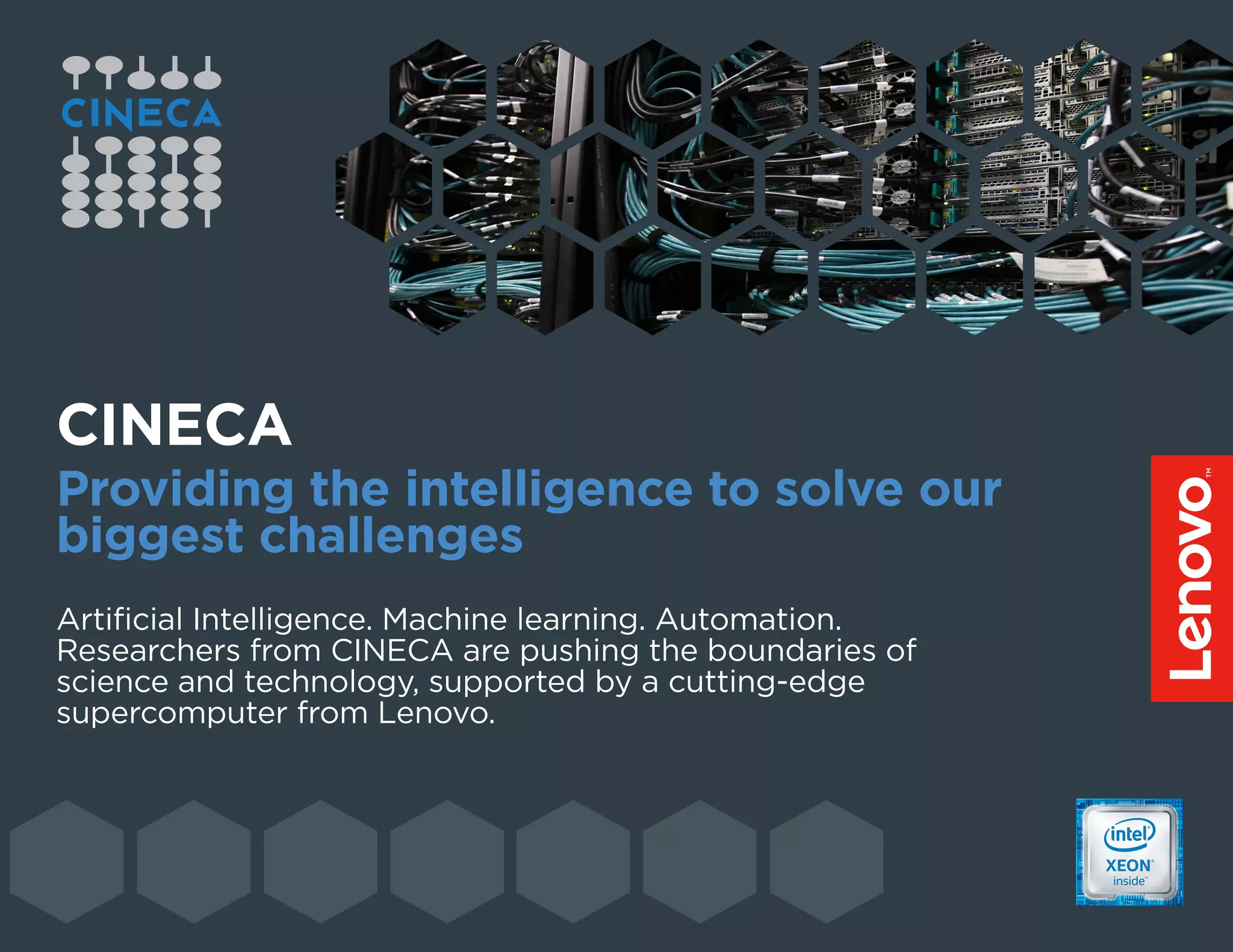
Artificial Intelligence. Machine learning. Automation.
Researchers from CINECA are pushing the boundaries of
science and technology, supported by a cutting-edge
supercomputer from Lenovo.
CINECA
Providing the intelligence to solve our
biggest challenges
What was once purely the realm of science fiction is fast
becoming reality. For example, driverless cars, advanced
robotics and increasing automation look set to transform
society in the coming decades. It’s an exciting time for
scientists working with these technologies.
Sanzio Bassini, HPC Director at CINECA, a non-profit
consortium of Italian universities and research institution,
notes: “Interest in artificial intelligence is at an all-time high.
For instance, we currently have researchers working with major
automotive companies, including Ferrari, Lamborghini and
Bugatti, that are looking to harness these emerging
technologies to bring self‑driving cars to the market in the
coming years.”
CINECA, one of the world’s most renowned scientific
computing centers, is proud to bridge the gap between
academic research and industry. Scientists from all over Europe
turn to CINECA for the HPC resources and data processing
capabilities they need to further research on everything from
artificial intelligence and automation to nuclear physics and
nanotechnology.
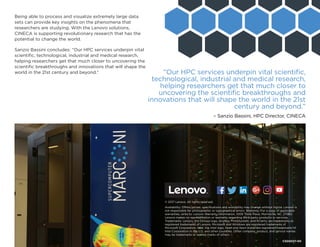
To meet growing demand from scientists for compute
resources, CINECA partnered with Lenovo to design, build and
deploy a new supercomputing environment. Named Marconi,
the cluster is made up of 1,500 Lenovo ThinkSystem SD530
servers, which are equipped with next-generation Intel® Xeon®
E5, Intel Xeon Phi™, and Intel Xeon Scalable System Family
Platinum processors.
Marconi was carefully co-designed by CINECA and Lenovo to
include three different microprocessor architectures, ensuring
that the organization can support a diverse range of research
workloads. Rapid data transfer between nodes is delivered
through Intel Omni-Path Architecture, boosting overall system
and application performance.
Sanzio Bassini recalls: “We worked very closely with the Lenovo
team during the design process, and it was a real collaborative
effort. The Marconi environment is an extension of our existing
Lenovo NeXtScale platform. Combined, we now have over
7,000 servers in our data center, delivering 20 PFLOPS peak
performance. This means that researchers can run extremely
compute-intensive workloads without our supercomputing
environment even breaking a sweat.”
“Support from the Lenovo team during the implementation was
invaluable,” he adds. “They helped us to tune and optimize the
systems to meet all of our requirements. So, when physicists
from the Italian National Institute of Nuclear Physics [INFN]
working at CERN to conduct their experiements come and ask
us for a certain amount of compute power and a certain
amount of bandwidth to process experimental data from the
Large Hadron Collider, for example, we can provide them with
the resources they need very quickly.”
Being able to process and visualize extremely large data
sets can provide key insights on the phenomena that
researchers are studying. With the Lenovo solutions,
CINECA is supporting revolutionary research that has the
potential to change the world.
Sanzio Bassini concludes: “Our HPC services underpin vital
scientific, technological, industrial and medical research,
helping researchers get that much closer to uncovering the
scientific breakthroughs and innovations that will shape the
world in the 21st century and beyond.”
© 2017 Lenovo. All rights reserved.
Availability: Offers, prices, specifications and availability may change without notice. Lenovo is
not responsible for photographic or typographical errors. Warranty: For a copy of applicable
warranties, write to: Lenovo Warranty Information, 1009 Think Place, Morrisville, NC, 27560.
Lenovo makes no representation or warranty regarding third-party products or services.
Trademarks: Lenovo, the Lenovo logo, AnyBay, ThinkSystem, and XClarity are trademarks or
registered trademarks of Lenovo. Microsoft and Windows are registered trademarks of
Microsoft Corporation. Intel, the Intel logo, Xeon and Xeon Inside are registered trademarks of
Intel Corporation in the U.S. and other countries. Other company, product, and service names
may be trademarks or service marks of others.
Facebook “f” Logo CMYK / .eps Facebook “f” Logo CMYK / .eps
CS00037-00
“Our HPC services underpin vital scientific,
technological, industrial and medical research,
helping researchers get that much closer to
uncovering the scientific breakthroughs and
innovations that will shape the world in the 21st
century and beyond.”
– Sanzio Bassini, HPC Director, CINECA
Same customer image as p1
With a new HPC environment based on Lenovo
ThinkSystem SD530 servers with powerful Intel® Xeon®
processors and Xeon Phi™ accelerators, CINECA offers
researchers easy access to state-of-the-art scientific
computing resources to support ground-breaking
research into emerging technologies, nuclear physics
and more.
CINECA
Helping to solve our biggest challenges
ACADEMIC RESEARCH
Solution components
Hardware
Marconi system: 1,500 Lenovo ThinkSystem SD530
nodes with Intel® Xeon® E5, Intel Xeon Phi™ and Intel
Xeon Scalable System Family Platinum processors
Intel Omni-Path Architecture
Additional systems: Lenovo NeXtScale System nx360
M5 with Intel Xeon E5 processor family
Services
Lenovo Professional Services
“Our HPC services underpin vital scientific,
technological, industrial and medical research,
helping researchers get closer to uncovering the
scientific breakthroughs and innovations that will
shape the world in the 21st century and beyond.”
—Sanzio Bassini, HPC Director, CINECA

CINECA -- Providing the intelligence to solve our biggest challenges

  • 1.
    Artificial Intelligence. Machinelearning. Automation. Researchers from CINECA are pushing the boundaries of science and technology, supported by a cutting-edge supercomputer from Lenovo. CINECA Providing the intelligence to solve our biggest challenges
  • 2.
    What was oncepurely the realm of science fiction is fast becoming reality. For example, driverless cars, advanced robotics and increasing automation look set to transform society in the coming decades. It’s an exciting time for scientists working with these technologies. Sanzio Bassini, HPC Director at CINECA, a non-profit consortium of Italian universities and research institution, notes: “Interest in artificial intelligence is at an all-time high. For instance, we currently have researchers working with major automotive companies, including Ferrari, Lamborghini and Bugatti, that are looking to harness these emerging technologies to bring self‑driving cars to the market in the coming years.” CINECA, one of the world’s most renowned scientific computing centers, is proud to bridge the gap between academic research and industry. Scientists from all over Europe turn to CINECA for the HPC resources and data processing capabilities they need to further research on everything from artificial intelligence and automation to nuclear physics and nanotechnology. To meet growing demand from scientists for compute resources, CINECA partnered with Lenovo to design, build and deploy a new supercomputing environment. Named Marconi, the cluster is made up of 1,500 Lenovo ThinkSystem SD530 servers, which are equipped with next-generation Intel® Xeon® E5, Intel Xeon Phi™, and Intel Xeon Scalable System Family Platinum processors.
  • 3.
    Marconi was carefullyco-designed by CINECA and Lenovo to include three different microprocessor architectures, ensuring that the organization can support a diverse range of research workloads. Rapid data transfer between nodes is delivered through Intel Omni-Path Architecture, boosting overall system and application performance. Sanzio Bassini recalls: “We worked very closely with the Lenovo team during the design process, and it was a real collaborative effort. The Marconi environment is an extension of our existing Lenovo NeXtScale platform. Combined, we now have over 7,000 servers in our data center, delivering 20 PFLOPS peak performance. This means that researchers can run extremely compute-intensive workloads without our supercomputing environment even breaking a sweat.” “Support from the Lenovo team during the implementation was invaluable,” he adds. “They helped us to tune and optimize the systems to meet all of our requirements. So, when physicists from the Italian National Institute of Nuclear Physics [INFN] working at CERN to conduct their experiements come and ask us for a certain amount of compute power and a certain amount of bandwidth to process experimental data from the Large Hadron Collider, for example, we can provide them with the resources they need very quickly.”
  • 4.
    Being able toprocess and visualize extremely large data sets can provide key insights on the phenomena that researchers are studying. With the Lenovo solutions, CINECA is supporting revolutionary research that has the potential to change the world. Sanzio Bassini concludes: “Our HPC services underpin vital scientific, technological, industrial and medical research, helping researchers get that much closer to uncovering the scientific breakthroughs and innovations that will shape the world in the 21st century and beyond.” © 2017 Lenovo. All rights reserved. Availability: Offers, prices, specifications and availability may change without notice. Lenovo is not responsible for photographic or typographical errors. Warranty: For a copy of applicable warranties, write to: Lenovo Warranty Information, 1009 Think Place, Morrisville, NC, 27560. Lenovo makes no representation or warranty regarding third-party products or services. Trademarks: Lenovo, the Lenovo logo, AnyBay, ThinkSystem, and XClarity are trademarks or registered trademarks of Lenovo. Microsoft and Windows are registered trademarks of Microsoft Corporation. Intel, the Intel logo, Xeon and Xeon Inside are registered trademarks of Intel Corporation in the U.S. and other countries. Other company, product, and service names may be trademarks or service marks of others. Facebook “f” Logo CMYK / .eps Facebook “f” Logo CMYK / .eps CS00037-00 “Our HPC services underpin vital scientific, technological, industrial and medical research, helping researchers get that much closer to uncovering the scientific breakthroughs and innovations that will shape the world in the 21st century and beyond.” – Sanzio Bassini, HPC Director, CINECA
  • 5.
    Same customer imageas p1 With a new HPC environment based on Lenovo ThinkSystem SD530 servers with powerful Intel® Xeon® processors and Xeon Phi™ accelerators, CINECA offers researchers easy access to state-of-the-art scientific computing resources to support ground-breaking research into emerging technologies, nuclear physics and more. CINECA Helping to solve our biggest challenges ACADEMIC RESEARCH Solution components Hardware Marconi system: 1,500 Lenovo ThinkSystem SD530 nodes with Intel® Xeon® E5, Intel Xeon Phi™ and Intel Xeon Scalable System Family Platinum processors Intel Omni-Path Architecture Additional systems: Lenovo NeXtScale System nx360 M5 with Intel Xeon E5 processor family Services Lenovo Professional Services “Our HPC services underpin vital scientific, technological, industrial and medical research, helping researchers get closer to uncovering the scientific breakthroughs and innovations that will shape the world in the 21st century and beyond.” —Sanzio Bassini, HPC Director, CINECA