


COLLABORATIVE COMPUTING
BY SUSHMITA DEY
SAN JOSE STATE UNIVERSITY
DR. RAMAMURTI SRIDAR
BACKGROUND
• When multiple and distributed computers cooperate to solve a large computing
problem then it is known as Collaborative Computing .
• In Collaborative Computing resources of 100 thousands or more computers in a
network around the world are used to solve a single large computing problem,
which cannot be solved by a single machine and require more CPU cycles.
• Scientists working in space technology and particle physics laboratory require a
large computing resources to analyze and process Big Data created during their
research experiments
BACKGROUND
• In United States, NASA uses collaborative computing
to build Climate models for weather forecasting.
• CERN at Switzerland is the largest particle physics
laboratory.
• Scientist use large particle accelerator to conduct
fundamental research on matters and particles to learn
about our Universe.
USE CASE
• CERN hosts Large Hadron Collider (LHC) is the world’s
largest and most powerful particle accelerator.
• CERN requires very large computing resources to store,
distribute and analyze the ~30 Petabytes (30 million
Gigabytes) of data annually generated by the Large
Hadron Collider (LHC) at CERN on the Franco-Swiss
border
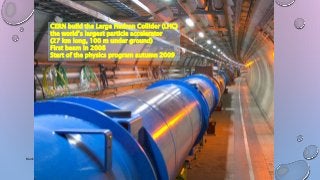
VIEW OF THE LHC TUNNEL
Markus Schulz, CERN, IT Department
CERN build the Large Hadron Collider (LHC)
the world’s largest particle accelerator
(27 km long, 100 m under ground)
First beam in 2008
Start of the physics program autumn 2009
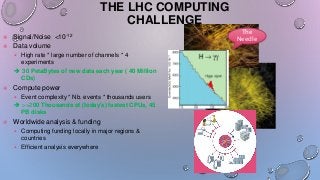
THE LHC COMPUTING
CHALLENGE
 Signal/Noise <10-12
 Data volume
 High rate * large number of channels * 4
experiments
 30 PetaBytes of new data each year ( 40 Million
CDs)
 Compute power
 Event complexity * Nb. events * thousands users
 >>200 Thousands of (today's) fastest CPUs, 45
PB disks
 Worldwide analysis & funding
 Computing funding locally in major regions &
countries
 Efficient analysis everywhere
The
Needle
USE CASE
• CERN uses Worldwide LHC Computing Grid (WLCG) project, a global collaboration
of more than 170 computing centers in 42 countries, linking up national and
international grid infrastructures to meet its very large computing resources
requirements.
• Every day WLCG processes more than 1.5 million 'jobs', corresponding to a single
computer running for more than 600 years.
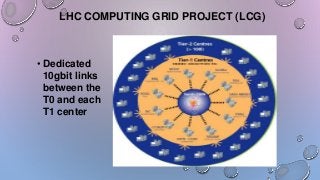
LHC COMPUTING GRID PROJECT (LCG)
• Dedicated
10gbit links
between the
T0 and each
T1 center
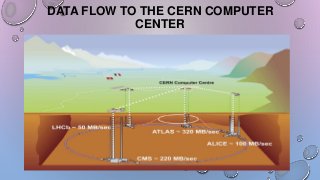
DATA FLOW TO THE CERN COMPUTER
CENTER
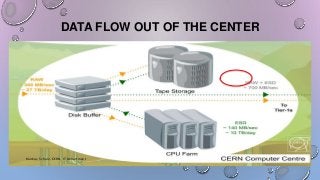
DATA FLOW OUT OF THE CENTER
Markus Schulz, CERN, IT Department
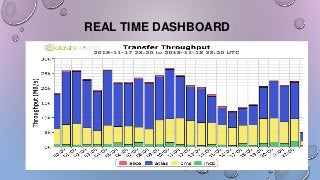
REAL TIME DASHBOARD
CERN VIDEO
HTTPS://WWW.YOUTUBE.COM/WATCH?V=BCRSBUGBRO0
WHAT ARE THE WEAKNESS/THREATS FOR THIS
TECHNICAL ENTITY?
• RELIABILITY
• INTEROPERABI
LITY
WHAT ARE THE STRENGTH/OPPORTUNITIES FOR THIS
TECHNICAL ENTITY?
• Worldwide LHC Computing Grid (WLCG) project is a successful example of
Collaborative Computing.
• UC Berkeley has created BONIC, a software platform for creating collaborative
computing for volunteer computing and desktop Grid computing.
• Volunteer computing is a special case of Collaborative Computing where people
can donate idle cycles of their home computer to support scientific research.
• Universities can use collaborative computing to create a virtual supercomputing
center for their academics and researchers working on computing-intensive
experiments.
• Scientists can access a powerful collaborative computing machine using the idle
time on your computer (windows, mac, Linux, or android) to cure diseases, study
global warming, discover pulsars, and do many other types of scientific research.
WHAT IS THE FUTURE FOR THIS TECHNICAL
ENTITY?
• Future of collaborative computing will be evolving to meet the
growing need from Scientific Community from around the world.
• Research is going to support Computing as Service – similar to
public clouds like AWS
• Self-healing of the Collaborative Computing Grid to improve the
availability and reliability of the computing grid.
• Monitoring of the computers by host organization.
WHO ARE THE CURRENT PLAYERS – GIVE EXAMPLES OF
CURRENT USAGE/USERS IN BUSINESS?
• AWS – AMAZON WEB SERVICES
• AZURE - MICROSOFT
• GCE- GOOGLE COMPUTING ENGINE
CITATION
• HTTP://HOME.CERN/ABOUT
• HTTP://BOINC.BERKELEY.EDU/
• HTTPS://RUN2-13TEV.WEB.CERN.CH/?PAGE=3
• HTTP://INDICO.CERN.CH/EVENT/68690/CONTRIBUTION/2/ATTACHMENTS/1026356/1461
428/CMS_COMPUTING_MODEL.PDF
• HTTP://HOME.CERN/ABOUT/COMPUTING/WORLDWIDE-LHC-COMPUTING-GRID

Colloborative computing

  • 1.
    COLLABORATIVE COMPUTING BY SUSHMITADEY SAN JOSE STATE UNIVERSITY DR. RAMAMURTI SRIDAR
  • 2.
    BACKGROUND • When multipleand distributed computers cooperate to solve a large computing problem then it is known as Collaborative Computing . • In Collaborative Computing resources of 100 thousands or more computers in a network around the world are used to solve a single large computing problem, which cannot be solved by a single machine and require more CPU cycles. • Scientists working in space technology and particle physics laboratory require a large computing resources to analyze and process Big Data created during their research experiments
  • 3.
    BACKGROUND • In UnitedStates, NASA uses collaborative computing to build Climate models for weather forecasting. • CERN at Switzerland is the largest particle physics laboratory. • Scientist use large particle accelerator to conduct fundamental research on matters and particles to learn about our Universe.
  • 4.
    USE CASE • CERNhosts Large Hadron Collider (LHC) is the world’s largest and most powerful particle accelerator. • CERN requires very large computing resources to store, distribute and analyze the ~30 Petabytes (30 million Gigabytes) of data annually generated by the Large Hadron Collider (LHC) at CERN on the Franco-Swiss border
  • 5.
    VIEW OF THELHC TUNNEL Markus Schulz, CERN, IT Department CERN build the Large Hadron Collider (LHC) the world’s largest particle accelerator (27 km long, 100 m under ground) First beam in 2008 Start of the physics program autumn 2009
  • 6.
    THE LHC COMPUTING CHALLENGE Signal/Noise <10-12  Data volume  High rate * large number of channels * 4 experiments  30 PetaBytes of new data each year ( 40 Million CDs)  Compute power  Event complexity * Nb. events * thousands users  >>200 Thousands of (today's) fastest CPUs, 45 PB disks  Worldwide analysis & funding  Computing funding locally in major regions & countries  Efficient analysis everywhere The Needle
  • 7.
    USE CASE • CERNuses Worldwide LHC Computing Grid (WLCG) project, a global collaboration of more than 170 computing centers in 42 countries, linking up national and international grid infrastructures to meet its very large computing resources requirements. • Every day WLCG processes more than 1.5 million 'jobs', corresponding to a single computer running for more than 600 years.
  • 8.
    LHC COMPUTING GRIDPROJECT (LCG) • Dedicated 10gbit links between the T0 and each T1 center
  • 9.
    DATA FLOW TOTHE CERN COMPUTER CENTER
  • 10.
    DATA FLOW OUTOF THE CENTER Markus Schulz, CERN, IT Department
  • 11.
  • 12.
  • 13.
    WHAT ARE THEWEAKNESS/THREATS FOR THIS TECHNICAL ENTITY? • RELIABILITY • INTEROPERABI LITY
  • 14.
    WHAT ARE THESTRENGTH/OPPORTUNITIES FOR THIS TECHNICAL ENTITY? • Worldwide LHC Computing Grid (WLCG) project is a successful example of Collaborative Computing. • UC Berkeley has created BONIC, a software platform for creating collaborative computing for volunteer computing and desktop Grid computing. • Volunteer computing is a special case of Collaborative Computing where people can donate idle cycles of their home computer to support scientific research. • Universities can use collaborative computing to create a virtual supercomputing center for their academics and researchers working on computing-intensive experiments. • Scientists can access a powerful collaborative computing machine using the idle time on your computer (windows, mac, Linux, or android) to cure diseases, study global warming, discover pulsars, and do many other types of scientific research.
  • 15.
    WHAT IS THEFUTURE FOR THIS TECHNICAL ENTITY? • Future of collaborative computing will be evolving to meet the growing need from Scientific Community from around the world. • Research is going to support Computing as Service – similar to public clouds like AWS • Self-healing of the Collaborative Computing Grid to improve the availability and reliability of the computing grid. • Monitoring of the computers by host organization.
  • 16.
    WHO ARE THECURRENT PLAYERS – GIVE EXAMPLES OF CURRENT USAGE/USERS IN BUSINESS? • AWS – AMAZON WEB SERVICES • AZURE - MICROSOFT • GCE- GOOGLE COMPUTING ENGINE
  • 17.
    CITATION • HTTP://HOME.CERN/ABOUT • HTTP://BOINC.BERKELEY.EDU/ •HTTPS://RUN2-13TEV.WEB.CERN.CH/?PAGE=3 • HTTP://INDICO.CERN.CH/EVENT/68690/CONTRIBUTION/2/ATTACHMENTS/1026356/1461 428/CMS_COMPUTING_MODEL.PDF • HTTP://HOME.CERN/ABOUT/COMPUTING/WORLDWIDE-LHC-COMPUTING-GRID