TRADITIONAL
MODELS FOR
UNDERSTANDIN
G LEADERSHIP
THE NATURE OF LEADERSHIP
 LEADERSHIP- it is a term that is often used
in everyday conversation, you might
assume that it has a common and
accepted meaning. In fact just the
opposite true like several other key
organizational behavior term such as
personality and motivation.
THE MEANING OF LEADERSHIP
 We will define leadership in terms of both
process and property, as a process
leadership is the use of noncoercive
influence to direct and coordinate the
activities of group members to meet a
goal.
LEADERSHIP VERSUS
MANAGEMENT
 Leadership and management are related
but they are not the same. A person can
be manager a leader both or neither
some of the basic distinctions between
the two
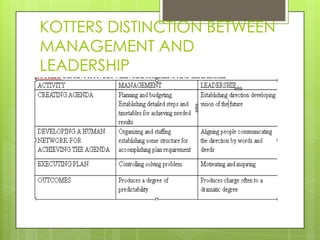
KOTTERS DISTINCTION BETWEEN
MANAGEMENT AND
LEADERSHIP
EARLY APPROACHES TO
LEADERSHIP
 Although leaders and leadership have
profoundly influenced the course of
human events , careful scientific study of
them began only about a centure ago.
Early studies focused on the traits, or
personal characteristics of leaders
TRAIT APPROACHES
 Lincoln. Napoleon, joan of arc, Hitler and
Gandhi are names that most of us know
quite well early researchers believed that
leaders such as these had some unique
set of qualities or traitsthat distinguish
them from their peers.
BEHAVIORAL APPROACHES TO
LEADERSHIP
 In the late 1940s most researchers began
to shift away from the traits approach and
started to look at leadership as an
observable to process or activity.
THE MICHIGAN STUDIES
 The Michigan studies leadership studies
were a program of research conducted
at the university of Michigan. The goal of
this work was to determine the patterns of
leadership behaviors that results in
effective group performance.
LEADERSHIP GRID
Provides a means for evaluating leadership styles and
then training managers to move toward an ideal style
of behavior
THE EMERGENCE SITUATIONAL LEADERSHIP MODELS
The leader- behavior theories have played an
importantant role in the development of more realistic,
albeit more complex approaches to leadership.in
particular urge us not to be so preoccupied with what
properties may be possessed by leaders but to instead
concentrate on that leaders actually to do.
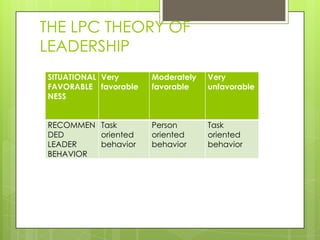
THE LPC THEORY OF
LEADERSHIP
SITUATIONAL
FAVORABLE
NESS
Very
favorable
Moderately
favorable
Very
unfavorable
RECOMMEN
DED
LEADER
BEHAVIOR
Task
oriented
behavior
Person
oriented
behavior
Task
oriented
behavior
LEADER SITUATION MATCH
What happens if a person oriented leader faces a very
favorable or very un favorable situation or a task
oriented leaders faces a situation of intermediate
favorable
VROOMS DECISION TREE APPROACH TO LEADERSHIP
 The third major contemporary approach
to leadership is vroomS decision tree
approach. The earliest version of this
model was propoed by victor vroom and
Philip yetton and latter revided and
expanded by vroom and Arthur jago.
BASIC PREMISES
 Vrooms decision tree approach assumes
that the degree to which subordinates
should be encouraged to participate in
decision making depends on the
characteristic of the situation
EVALUATION AND
IMPLICATIONS
 Because Vrooms current approach is
lelatively new it has not been fully
scientifically tested. The original model
and its subsequent refinement however
attracted a great deal of attention and
were generally supported by research.
 END

TRADITIONAL MODELS FOR UNDERSTANDING LEADERSHIP

  • 1.
  • 2.
    THE NATURE OFLEADERSHIP  LEADERSHIP- it is a term that is often used in everyday conversation, you might assume that it has a common and accepted meaning. In fact just the opposite true like several other key organizational behavior term such as personality and motivation.
  • 3.
    THE MEANING OFLEADERSHIP  We will define leadership in terms of both process and property, as a process leadership is the use of noncoercive influence to direct and coordinate the activities of group members to meet a goal.
  • 4.
    LEADERSHIP VERSUS MANAGEMENT  Leadershipand management are related but they are not the same. A person can be manager a leader both or neither some of the basic distinctions between the two
  • 5.
  • 6.
    EARLY APPROACHES TO LEADERSHIP Although leaders and leadership have profoundly influenced the course of human events , careful scientific study of them began only about a centure ago. Early studies focused on the traits, or personal characteristics of leaders
  • 7.
    TRAIT APPROACHES  Lincoln.Napoleon, joan of arc, Hitler and Gandhi are names that most of us know quite well early researchers believed that leaders such as these had some unique set of qualities or traitsthat distinguish them from their peers.
  • 8.
    BEHAVIORAL APPROACHES TO LEADERSHIP In the late 1940s most researchers began to shift away from the traits approach and started to look at leadership as an observable to process or activity.
  • 9.
    THE MICHIGAN STUDIES The Michigan studies leadership studies were a program of research conducted at the university of Michigan. The goal of this work was to determine the patterns of leadership behaviors that results in effective group performance.
  • 10.
    LEADERSHIP GRID Provides ameans for evaluating leadership styles and then training managers to move toward an ideal style of behavior THE EMERGENCE SITUATIONAL LEADERSHIP MODELS The leader- behavior theories have played an importantant role in the development of more realistic, albeit more complex approaches to leadership.in particular urge us not to be so preoccupied with what properties may be possessed by leaders but to instead concentrate on that leaders actually to do.
  • 11.
    THE LPC THEORYOF LEADERSHIP SITUATIONAL FAVORABLE NESS Very favorable Moderately favorable Very unfavorable RECOMMEN DED LEADER BEHAVIOR Task oriented behavior Person oriented behavior Task oriented behavior
  • 12.
    LEADER SITUATION MATCH Whathappens if a person oriented leader faces a very favorable or very un favorable situation or a task oriented leaders faces a situation of intermediate favorable
  • 13.
    VROOMS DECISION TREEAPPROACH TO LEADERSHIP  The third major contemporary approach to leadership is vroomS decision tree approach. The earliest version of this model was propoed by victor vroom and Philip yetton and latter revided and expanded by vroom and Arthur jago.
  • 14.
    BASIC PREMISES  Vroomsdecision tree approach assumes that the degree to which subordinates should be encouraged to participate in decision making depends on the characteristic of the situation
  • 15.
    EVALUATION AND IMPLICATIONS  BecauseVrooms current approach is lelatively new it has not been fully scientifically tested. The original model and its subsequent refinement however attracted a great deal of attention and were generally supported by research.
  • 16.