SUPERCAPACITO
R
BY SABARINATH S
INTRODUCTION
• Rapid increase in the global energy
consumption
• Need for clean and renewable energy
sources
• Efficient mode of storing energy
• Efficiency of an energy storage devices
depends on the structure and
properties of the corresponding
component materials
Fig: Global supercapacitor market,2014-2025
CAPACITOR
• A passive two terminal electrical component
• Store energy in the form of an electrical charge
• Capacitors contain metallic plates or surfaces separated by a dielectric
medium
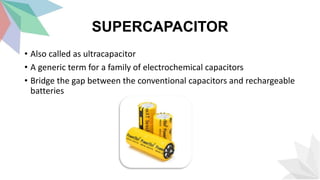
SUPERCAPACITOR
• Also called as ultracapacitor
• A generic term for a family of electrochemical capacitors
• Bridge the gap between the conventional capacitors and rechargeable
batteries
• Power density is 10-100 times
greater
• Energy density is 10 percent
• More charge and discharge
cycles
• Can handle quick load
fluctuations
HISTORY
1957
• First electrochemical capacitor was patented by General Electric’s H.I. Becker
• used a double layer charge storage with this device
.
• Standard electrochemical (EC) design used today was invented by Robert A
Rightmire
1999
• Brian Evans Conway coined the term supercapacitor
CONSTRUCTION
• Generally consists of two
electrodes, an electrolyte and a
separator
• Coating is implemented on metal
foils which serves as the current
collector and are immersed in an
electrolyte
• separator or paper membrane does
the function of separating electrode
coated current collectors
WORKING
Electrostatic Double Layer Capacitance
• When voltage is applied, the negative electrode attracts positive ions
from the electrolyte.
• Then the positive electrode attracts negative ions from the
electrolyte.
• supercapacitor forms an electrical double layer
• Due to decrease in distance of electrons the capacitance is very large
• Charge carriers are retained until there is a change in polarity or
decrease in potential
• No chemical reaction taking place charging and discharging can be
done many times
• Electrochemical Pseudocapacitance is another method where energy
is stored faradaically.
TYPES OF SUPERCAPACITORS
PSEUDOCAPACITOR
• Fast and reversible redox reaction
• Energy is stored faradaic charge
transfer
• Accomplished through
underpotential deposition, redox
reactions and intercalation
processes.
• Conductive polymers and metal
oxides are used for the
construction
HYBRID CAPACITORS
• Combination of the EDLCs and
pseudocapacitor storage
principles
• Elimination of limitations of the
combining components
• Example: Lithium-ion capacitor
• Can achieve very high energy
and power densities
SUPERCAPACITOR VS BATTERY
APPLICATION
Used in Electric Vehicles Used to power stylus of smart phones Used in car dashcam recorder
Solar supercapacitor for
wearable sensors
For IoT Used to light LEDs
ADVANTAGES
• Offer high capacitance (From 1 mF
to >10,000F)
• High power density and compact
size
• Have good life span (10-15years)
• Capable of low temperature
operations (-400C to +700C)
• Can supply large power bursts for
short duration of time
• capable of charging and discharging
in very short time
DISADVANTAGES
• Low energy density compared to
battery
• High self-discharge
• Low cell voltage
• Cannot be used in AC and high
frequency circuits
THANK YOU

Supercapacitor

  • 1.
  • 2.
    INTRODUCTION • Rapid increasein the global energy consumption • Need for clean and renewable energy sources • Efficient mode of storing energy • Efficiency of an energy storage devices depends on the structure and properties of the corresponding component materials Fig: Global supercapacitor market,2014-2025
  • 3.
    CAPACITOR • A passivetwo terminal electrical component • Store energy in the form of an electrical charge • Capacitors contain metallic plates or surfaces separated by a dielectric medium
  • 4.
    SUPERCAPACITOR • Also calledas ultracapacitor • A generic term for a family of electrochemical capacitors • Bridge the gap between the conventional capacitors and rechargeable batteries
  • 5.
    • Power densityis 10-100 times greater • Energy density is 10 percent • More charge and discharge cycles • Can handle quick load fluctuations
  • 6.
    HISTORY 1957 • First electrochemicalcapacitor was patented by General Electric’s H.I. Becker • used a double layer charge storage with this device . • Standard electrochemical (EC) design used today was invented by Robert A Rightmire 1999 • Brian Evans Conway coined the term supercapacitor
  • 7.
    CONSTRUCTION • Generally consistsof two electrodes, an electrolyte and a separator • Coating is implemented on metal foils which serves as the current collector and are immersed in an electrolyte • separator or paper membrane does the function of separating electrode coated current collectors
  • 8.
    WORKING Electrostatic Double LayerCapacitance • When voltage is applied, the negative electrode attracts positive ions from the electrolyte. • Then the positive electrode attracts negative ions from the electrolyte. • supercapacitor forms an electrical double layer
  • 9.
    • Due todecrease in distance of electrons the capacitance is very large • Charge carriers are retained until there is a change in polarity or decrease in potential • No chemical reaction taking place charging and discharging can be done many times • Electrochemical Pseudocapacitance is another method where energy is stored faradaically.
  • 10.
  • 11.
    PSEUDOCAPACITOR • Fast andreversible redox reaction • Energy is stored faradaic charge transfer • Accomplished through underpotential deposition, redox reactions and intercalation processes. • Conductive polymers and metal oxides are used for the construction
  • 12.
    HYBRID CAPACITORS • Combinationof the EDLCs and pseudocapacitor storage principles • Elimination of limitations of the combining components • Example: Lithium-ion capacitor • Can achieve very high energy and power densities
  • 13.
  • 14.
    APPLICATION Used in ElectricVehicles Used to power stylus of smart phones Used in car dashcam recorder Solar supercapacitor for wearable sensors For IoT Used to light LEDs
  • 16.
    ADVANTAGES • Offer highcapacitance (From 1 mF to >10,000F) • High power density and compact size • Have good life span (10-15years) • Capable of low temperature operations (-400C to +700C) • Can supply large power bursts for short duration of time • capable of charging and discharging in very short time DISADVANTAGES • Low energy density compared to battery • High self-discharge • Low cell voltage • Cannot be used in AC and high frequency circuits
  • 17.