+
Chronic
Pancreatitis
Christina Kalafsky, Dietetic Intern
University of Maryland College Park
Major Case Study
February 12, 2014
+
Overview
Chronic Pancreatitis
Case Study
 Medial Treatment
 Nutritional Treatment
Implications to the Field of Dietetics
+
Chronic Pancreatitis (CP)
 Pancreas
 Endocrine Functions: Produces
glucagon and insulin
 Exocrine Functions: Secretes
bicarbonate and digestive
enzymes
 Pancreatitis
 Enzymes activate within the
pancreas and auto-digest the
pancreatic tissue
 Acute  Chronic
Image from emedicinehealth.com/pancreatitis/article_em.htm
+
Chronic
Pancreatitis
Chronic
Alcoholism
Hereditary
Disorders
Hypertriglyceridemia
Hypercalcemia
Biliary Tract
Disease Gallstones
Certain
Medications
Viral Infections
Unknown
Etiology
+
Chronic Pancreatitis
 Prevalence:
 2 out of every 25,000
 Men > Women
 Blacks > Whites
 30 – 40 years old
 Diagnosis:
 Lab Values
 Abdominal CT Scan
 Abdominal Ultrasound
 Endoscopic Retrograde Cholangiopancreatography (ERCP)
 Magnetic Resonance Cholangiopancreatography (MRCP)
+
Chronic Pancreatitis
 Symptoms:
 Abdominal Pain
 Diarrhea
 Nausea
 Vomiting
 Steatorrhea
 Nutritional Implications: Malnutrition
 Inadequate Oral Intake
 Malabsorption
 Fat Soluble Vitamin Deficiency
 Poor Bone Health
+
Chronic Pancreatitis
 Treatment:
 Pancreatic Enzyme Replacement Therapy (PERT)
 Nutrition
 EN: ~5%, PN <1%
 NPO  Small, frequent meals with highest amount of fat
tolerated
 Alcohol Avoidance
 Fiber
 High CHO
 Diabetes
 Pain Relief
 Narcotics
 Nerve Blocks
+
Chronic Pancreatitis
 Treatment:
 Surgical Options:
 Drainage Procedures
 Resection Procedures
 Whipple
 CAM:
 Antioxidants, Herbs
 Discuss with doctor
Whipple Procedure
Image from Mayoclinic.com Health Library
+
Case Study
+
General Information
 AH is a 36-year-old obese Black female
 Admitted to BWMC on 11/11/13 for a planned Whipple
procedure for chronic pancreatitis.
 Hospital Duration: 7 days
+
Past Medical History
 Cardiomyopathy with AICD
 Congestive Heart Failure
 Dyslipidemia
 Hypertension
 Obesity
 Type II Diabetes
 GERD
 Chronic anemia
 Major Depressive Disorder
+
Past Medical History
 Pancreatitis:
 Initial Onset- 5 years ago (2008)
 CP- 3 years ago (2010)
 Initial Etiology: Hypertriglyceridemia
 Possible Current Etiology: Common bile duct stones
 Attempted Interventions:
 Partial cholecystectomy
 Remaining gallbladder contains gallstones
 ERCP’s- Unsuccessful due to severe duodenal stenosis
 MRCP- Unable to perform due to pt’s AICD
+
Social History
 Independent in ADLs and IADLs
 Currently unemployed, receiving disability since 2012
 Single and lives with her mother
 Insured with prescription coverage
 Former cigar smoker (quit in 2000)
 Denies alcohol use, recreational drug use, or prescription
drug abuse
 Decreased social life due to current condition
+
Medical Treatment
 Plan: Surgical Intervention – Whipple
 11/11/13:The laparoscopic Whipple was converted to an
open-cholecystojejunostomy and gastrojejunostomy due to
significant inflammation of the pancreas, affecting safe
dissection of blood vessels around the pancreas.
 11/12/13: POD 1. Patient recovering well from surgery.
Documenting effective biliary bypass.Wound drainage
serosanguineous with no evidence of leak from biliary
anastomosis.
 GI Status: Abdominal soft, non-distended, and appropriately
tender. Continue NPO secondary to gastrojejunal anastomosis;
will start sips tomorrow.
+
Medical Treatment
 11/13/13: POD 2- Given nature of wound drain output and
presence of biliary drainage in NGT, ongoing bleeding or
biliary stricture not suspected. Low NG output suggests good
gastric emptying through gastrojejunstomy.
 GI Status: Abdominal soft, non-distended, and appropriately
tender. Bowel sounds are present. Sips of clear liquid diet- will
likely further advance diet tomorrow if patient stable.
 11/14/13: POD 3- NGT has been removed and patient has
been restarted on medications for cardiomyopathy.
 GI Status: Abdominal soft, non-distended, and appropriately
tender. Bowel sounds are present. Patient is tolerating sips of clear
liquids. AH denies flatus or BM, as well as N/V.Will hold on
advancing diet.
+
Medical Treatment
 11/15/13: POD 4- Patient was transferred to 6W telemetry
floor from SICU with a cardiac monitor.
 GI Status: Patient with one episode of bilious vomiting yesterday,
but reports feeling better this AM. Diet to be advanced from sips
to clear liquid diet.
 11/16/13: POD 5-
 GI Status: Abdominal soft, RLQ tender to touch; Bowel sounds are
normal; patient passing gas but denies BM. No vomiting but
patient reports some nausea of which is now controlled with
medications around the clock. Patient tolerating the clear liquid
diet. Diet to be advanced to regular diet with small frequent
meals. Reglan will be added to improve gastric emptying.
+
Medical Treatment
 11/17/13: POD 6- Patient found with a magnesium level of 1.4
and given 4 gms of magnesium sulfate for repletion. Patient
continues to ambulate hallway independently with no shortness
of breath. Patient’s activity level is returning to normal. Remains
stable from a cardiac perspective.
 GI Status: Patient tolerating diet with adequate intake; no N/V.
 11/18/13: POD 7- Patient hemodynamically stable and pain is
well controlled. Hypomagnesaemia has been resolved. Patient to
be discharged home today.
 GI Status: Abdominal soft, non-tender, and non-distended. Patient had
a BM this AM and is tolerating a regular diet. Reported one episode of
yellow liquid emesis of small amount. No further N/V. Reglan to be
continued to improve gastric emptying.The importance of 6 small
meals per day was discussed with the patient for discharge.
 Plan: Patient to follow-up with her pain management physician upon
discharge to discuss weaning of chronic pain medication.
+
Nutrition History
 TPN x 2 weeks PTA
 Prior to Nutrition Support: Only able to consume small
amounts of food due to N/V
 Low Fat/Fat-Free Diet
 Previous Education:
 CHO Counting: Unsuccessful
 Weight Management Classes
 Low Fiber Diet
 Physical Activity Level: Sedentary
 No known food allergies
+
Anthropometrics
Height Weight BMI IBW %IBW
154.9 cm
(5 ft 1 in)
81.6 kg
(180 lbs)
34.0 kg/m2
Obese
47.7 kg
(105 lbs)
171%
Obese
+
Weight History
70
75
80
85
90
95
100
9/8/12 10/8/12 11/8/12 12/8/12 1/8/13 2/8/13 3/8/13 4/8/13 5/8/13 6/8/13 7/8/13 8/8/13 9/8/13 10/8/13 11/8/13 12/8/13
Weight(kg)
Date
+
Pertinent Lab Values
Lab 11/12/13 Significance
Na 132 (L) Overhydration, vomiting,
tissue injury, gastric suction,
hyperglycemia
K+ 4.2
Creat 0.61
BUN 10
Glucose 121 (H) DM, acute stress, surgery,
chronic pancreatitis
POC Glucose 109 (H) DM, acute stress, surgery,
chronic pancreatitis
Mg 2.0
Phos 3.9
Lipase 69 (H) Chronic pancreatitis,
gallstones, cholecystitis
+
Medications
Medication Dosage Medical Function Nutrition Implication
Acetaminophen
(Ofirmev)
Injection
1,000 mg 3x daily Analgesic,antipyretic
Avoid alcohol; N/V, headache,
constipation
Enoxaparin
Sodium (Lovenox)
Injection
40 mg nightly Anticoagulant
Cannot be used in those with
pork allergies-derived from
porcine intestinal mucosa
Fentanyl
(Duragesic) Patch
1 patch every 72
hours
Analgesic,narcotic,
opioid.
Anorexia,mood changes,dry
mouth, stomach pan, gas,
diarrhea, N/V/D/C
Hydromorphone
PF (Dilaudid)
Injection
2 mg every 3
hours PRN
Analgesic,opioid.
Relieves severe pain
N/V/D/C, ileus, taste changes,
xerostomia, stomach cramps,
anorexia, ↓ gastric motility,
impaction. May enhance EtOH, St.
John’s wort effects on CNS
depression
Insulin Lispro
(Humalog)
Injection
0-12 Units 4 x
daily- before
meals and nightly
Rapid acting bolus
insulin
Hypoglycemia,↑ weight
+
Medications
Medication Dosage Medical Function Nutrition Implication
Metoclopramide
(Reglan)
Injection
10 mg every
6 hours PRN
Antiemetic, anti-GERD,
diabetic gastroparesis
treatment
Dry mouth, ↑ gastric emptying, nausea,
constipation;may alter insulin
requirements for those with DM; does
not cause diarrhea—its prokinetic
effects do not extend beyond the
duodenum
Metroprolol
(Lopressor)
Injection
2.5 mg 4x
daily
Antihypertensive,anti-
angina, CHF treatment
Diarrhea, dry mouth, N/V, dyspepsia,
flatulence, constipation, hyperglycemia.
Grapefruit juice interaction. Avoid
natural licorice and EtOH. It may be
necessary to decrease dietary calcium
and sodium, which may decrease
absorption.
Pantoprazole
(Protonix)
Injection
40 mg daily
PPI. Anti-GERD,
Antisecretory
Diarrhea, ↓ gastric acid secretion, ↑
gastric pH, N/V/D/C, flatulence,
dyspepsia,gastroenteritis
0.9% Sodium
Chloride
Continuous
Infusion
75 ml/hr Hydration, repletion
+
Initial Nutrition Assessment
 Screened for TPN
 POD 1
 NPO x 1 day- to be advanced to sips tomorrow
 GI: Pt reports nausea but no vomiting since surgery; LBM
11/10; 150 mL bilious output from NGT
 Weight stable since admission- at pt’s baseline; no edema
 Pt interested in CHO counting
+
Nutrition Diagnosis
 (NI-2.1): Inadequate oral intake related to s/p open
cholecystojejunostomy and gastrojejunostomy due to chronic
pancreatitis as evidenced by NPO status.
 (NC-1.4): Altered GI function related to compromised
exocrine function of pancreas as evidenced by diagnosis of
chronic pancreatitis, abdominal pain, N/V, and s/p open
cholecystojejunostomy and gastrojejunostomy.
+
Estimated Nutrient Needs
Source Kcal Requirements
Protein
Requirements
Fluid
Requirements
Facility
Standards
1580-1880 kcal/day
60-70 gm
protein/day
1580-1880 ml/day
Evidence
Analysis
Library
1445 kcal/day
No
Recommendation
No
Recommendation
Nutrition Care
Manual
1880 kcal/day
55 – 70 gm
pro/day
1880 ml/day or
2448-2856 ml/day
+
Nutrition Intervention
 Food &/or Nutrient Delivery:
 ND-1.3: Recommend advancing diet beyond NPO/clear liquids by
POD 5. Pt likely not meeting estimated needs on clear diet alone.
 ND-1.2: Recommend low fiber, cardiac, CHO controlled diet in 6 small
meals per day once PO diet initiated.
 Nutrition Education:
 GI diet: Diet recommendations post-GI surgery/post gastric surgery
discussed and handout given to patient (11/14/13)
 DM: E-1.5: CHO-Counting and sick days DM education provided
(11/15/13)
 Coordination of Care: Collaboration with Other Providers- RC-
1.4
 Doctor to advance patient’s diet
 Nursing to monitor intake of food/fluid at meals
 Recommend optimal glucose control for wound healing
+
Nutrition Monitoring and
Evaluation AD-1.1.2:Weight
 FH-1.1.1.1: PO Intake/Tolerance
 BD-1.2, 1.4, 1.5 Nutrition-Related Labs
 PD-1.1.5: GI Function
 FH-1.2.2.2 Advancement of Diet
+
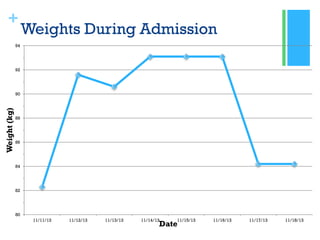
Weights During Admission
80
82
84
86
88
90
92
94
11/11/13 11/12/13 11/13/13 11/14/13 11/15/13 11/16/13 11/17/13 11/18/13
Weight(kg)
Date
+
Nutrition Monitoring and
EvaluationDate Diet Breakfast Lunch Dinner
11/11/13 NPO
Pt received D5 ½ NaCl with KCl 20 mEq
Continuous Infusion @ 120 ml/hr- this provided
489.6 kcal/day
11/12/13
NPO Except For Sips with Medications
11/13/13
11/13/13 Clear Liquid Diet
Sips Only
11/14/13 Clear Liquid Diet
11/14/13
Clear Liquid Diet- Sips Only
Pt received D5 ½ NaCl Continuous Infusion @
120 ml/hr from 11/14-11/16- this provided 489.6
kcal/day (1,468.8 kcal over three days)
11/15/13
11/16/13
11/16/13
Cardiac, Carbohydrate Controlled Standard Diet,
small frequent meals
100%
11/17/13 100% 100%
11/18/13 25% 50%
Average Intake 75% 75%
+
Nutrition Follow-Ups
 11/14/13:
 GI diet: Diet recommendations post-GI surgery/post gastric
surgery discussed and handout given to patient
+
Nutrition Follow-Ups
 11/15/13:
 DM: E-1.5: CHO-Counting and sick days DM education provided
+
Where is she now? (as of 1/11/14)
 Outpatient Follow-Up, 11/26/13:
 Tolerating a regular diet, eating 5 small meals per day, and continues
Reglan.
 Denies N/V; pt with BMs daily.
 Patient reports 5 out of 10 incisional pain that she continues to
manage with pain medication.
 ER Observation, 12/9/13:
 Pain feels like pancreatitis.
 Abdominal ultrasound reveals possible gallbladder stone.
 Patient attributed abdominal pain to overeating.
 Outpatient Follow-Up, 12/27/13:
 Denies similar episodes of abdominal pain since ER or pain similar
prior to surgical intervention.
 Tolerating regular diet, eating 2 large meals per day and some
snacks, and continues Reglan.
 Denies N/V; pt with BMs daily.
+
Implications to the Practice of Dietetics
 High Risk for Malnutrition
 Nutritional Complications
 Maldigestion
 Malabsorption,
 Abdominal Pain
 Vitamin Deficiency
 Poor Bone Health
 RDs = Vital Component of Treatment
+
References
1. Mahan LK, Escott-Stump S, Raymond JL. Medical Nutrition Therapy for Hepatobiliary and Pancreatic
Disorders. Krause’s Food and the Nutrition Care Process. 13th ed. St. Louis, MO: Elsevier Health
Sciences; 2012
2. UCLA Center for Pancreatic Diseases. Chronic Pancreatitis. UCLA Web site. Available at:
http://pancreas.ucla.edu/body.cfm?id=36. Accessed January 2, 2014.
3. The National Digestive Diseases Information Clearinghouse. Pancreatitis. National Institute of
Diabetes and Digestive and Kidney Diseases of the NIH Web site. Available at:
http://www.digestive.niddk.nih.gov/ddiseases/pubs/pancreatitis/. Published July 2008. Updated
August 16, 2012. Accessed January 3, 2014.
4. Academy of Nutrition and Dietetics. Nutrition Care Manual. http://www.nutritioncaremanual.org.
Accessed December 10, 2013, December 18, 2013, December 27, 2013, January 2, 2014, January 3,
2014, January 4, 2014, and January 5, 2014.
5. Medline Plus. Chronic Pancreatitis. U.S. National Library of Medicine Web site. Available at:
http://www.nlm.nih.gov/medlineplus/ency/article/000221.htm. Accessed February 5, 2014.
6. Springfield. Pancreatitis. Nurse's 3-Minute Clinical Reference. 2nd ed. Philadelphia, PA:Wolters Kluwer
Health/Lippincott Williams & Wilkins, 2008.
7. Duggan SN, Conlon KC. A Practical Guide to the Nutritional Management of Chronic Pancreatitis.
Practical Gastroenterology. 2013; 24-26, 29-30.
8. Decher N, Berry A. Post-Whipple: A Practical Approach to Nutrition Management. Practical
Gastroenterology. 2012; 30-42.
9. University of Southern California Center for Pancreatic and Biliary Diseases.What is Chronic
Pancreatitis. USC Web site. Available at:
http://www.surgery.usc.edu/divisions/tumor/pancreasdiseases/web%20pages/PANCREATITIS/what
%20is%20chronic%20pancreatit.html. Accessed January 4, 2014.
10. University of Maryland Medical Center. Pancreatitis. UMM Web site. Available at:
http://umm.edu/health/medical/altmed/condition/pancreatitis. Updated June 24, 2013. Accessed
January 19, 2014.
+
QUESTIONS??

Kalafsky Major

  • 1.
    + Chronic Pancreatitis Christina Kalafsky, DieteticIntern University of Maryland College Park Major Case Study February 12, 2014
  • 2.
    + Overview Chronic Pancreatitis Case Study Medial Treatment  Nutritional Treatment Implications to the Field of Dietetics
  • 3.
    + Chronic Pancreatitis (CP) Pancreas  Endocrine Functions: Produces glucagon and insulin  Exocrine Functions: Secretes bicarbonate and digestive enzymes  Pancreatitis  Enzymes activate within the pancreas and auto-digest the pancreatic tissue  Acute  Chronic Image from emedicinehealth.com/pancreatitis/article_em.htm
  • 4.
  • 5.
    + Chronic Pancreatitis  Prevalence: 2 out of every 25,000  Men > Women  Blacks > Whites  30 – 40 years old  Diagnosis:  Lab Values  Abdominal CT Scan  Abdominal Ultrasound  Endoscopic Retrograde Cholangiopancreatography (ERCP)  Magnetic Resonance Cholangiopancreatography (MRCP)
  • 6.
    + Chronic Pancreatitis  Symptoms: Abdominal Pain  Diarrhea  Nausea  Vomiting  Steatorrhea  Nutritional Implications: Malnutrition  Inadequate Oral Intake  Malabsorption  Fat Soluble Vitamin Deficiency  Poor Bone Health
  • 7.
    + Chronic Pancreatitis  Treatment: Pancreatic Enzyme Replacement Therapy (PERT)  Nutrition  EN: ~5%, PN <1%  NPO  Small, frequent meals with highest amount of fat tolerated  Alcohol Avoidance  Fiber  High CHO  Diabetes  Pain Relief  Narcotics  Nerve Blocks
  • 8.
    + Chronic Pancreatitis  Treatment: Surgical Options:  Drainage Procedures  Resection Procedures  Whipple  CAM:  Antioxidants, Herbs  Discuss with doctor Whipple Procedure Image from Mayoclinic.com Health Library
  • 9.
  • 10.
    + General Information  AHis a 36-year-old obese Black female  Admitted to BWMC on 11/11/13 for a planned Whipple procedure for chronic pancreatitis.  Hospital Duration: 7 days
  • 11.
    + Past Medical History Cardiomyopathy with AICD  Congestive Heart Failure  Dyslipidemia  Hypertension  Obesity  Type II Diabetes  GERD  Chronic anemia  Major Depressive Disorder
  • 12.
    + Past Medical History Pancreatitis:  Initial Onset- 5 years ago (2008)  CP- 3 years ago (2010)  Initial Etiology: Hypertriglyceridemia  Possible Current Etiology: Common bile duct stones  Attempted Interventions:  Partial cholecystectomy  Remaining gallbladder contains gallstones  ERCP’s- Unsuccessful due to severe duodenal stenosis  MRCP- Unable to perform due to pt’s AICD
  • 13.
    + Social History  Independentin ADLs and IADLs  Currently unemployed, receiving disability since 2012  Single and lives with her mother  Insured with prescription coverage  Former cigar smoker (quit in 2000)  Denies alcohol use, recreational drug use, or prescription drug abuse  Decreased social life due to current condition
  • 14.
    + Medical Treatment  Plan:Surgical Intervention – Whipple  11/11/13:The laparoscopic Whipple was converted to an open-cholecystojejunostomy and gastrojejunostomy due to significant inflammation of the pancreas, affecting safe dissection of blood vessels around the pancreas.  11/12/13: POD 1. Patient recovering well from surgery. Documenting effective biliary bypass.Wound drainage serosanguineous with no evidence of leak from biliary anastomosis.  GI Status: Abdominal soft, non-distended, and appropriately tender. Continue NPO secondary to gastrojejunal anastomosis; will start sips tomorrow.
  • 15.
    + Medical Treatment  11/13/13:POD 2- Given nature of wound drain output and presence of biliary drainage in NGT, ongoing bleeding or biliary stricture not suspected. Low NG output suggests good gastric emptying through gastrojejunstomy.  GI Status: Abdominal soft, non-distended, and appropriately tender. Bowel sounds are present. Sips of clear liquid diet- will likely further advance diet tomorrow if patient stable.  11/14/13: POD 3- NGT has been removed and patient has been restarted on medications for cardiomyopathy.  GI Status: Abdominal soft, non-distended, and appropriately tender. Bowel sounds are present. Patient is tolerating sips of clear liquids. AH denies flatus or BM, as well as N/V.Will hold on advancing diet.
  • 16.
    + Medical Treatment  11/15/13:POD 4- Patient was transferred to 6W telemetry floor from SICU with a cardiac monitor.  GI Status: Patient with one episode of bilious vomiting yesterday, but reports feeling better this AM. Diet to be advanced from sips to clear liquid diet.  11/16/13: POD 5-  GI Status: Abdominal soft, RLQ tender to touch; Bowel sounds are normal; patient passing gas but denies BM. No vomiting but patient reports some nausea of which is now controlled with medications around the clock. Patient tolerating the clear liquid diet. Diet to be advanced to regular diet with small frequent meals. Reglan will be added to improve gastric emptying.
  • 17.
    + Medical Treatment  11/17/13:POD 6- Patient found with a magnesium level of 1.4 and given 4 gms of magnesium sulfate for repletion. Patient continues to ambulate hallway independently with no shortness of breath. Patient’s activity level is returning to normal. Remains stable from a cardiac perspective.  GI Status: Patient tolerating diet with adequate intake; no N/V.  11/18/13: POD 7- Patient hemodynamically stable and pain is well controlled. Hypomagnesaemia has been resolved. Patient to be discharged home today.  GI Status: Abdominal soft, non-tender, and non-distended. Patient had a BM this AM and is tolerating a regular diet. Reported one episode of yellow liquid emesis of small amount. No further N/V. Reglan to be continued to improve gastric emptying.The importance of 6 small meals per day was discussed with the patient for discharge.  Plan: Patient to follow-up with her pain management physician upon discharge to discuss weaning of chronic pain medication.
  • 18.
    + Nutrition History  TPNx 2 weeks PTA  Prior to Nutrition Support: Only able to consume small amounts of food due to N/V  Low Fat/Fat-Free Diet  Previous Education:  CHO Counting: Unsuccessful  Weight Management Classes  Low Fiber Diet  Physical Activity Level: Sedentary  No known food allergies
  • 19.
    + Anthropometrics Height Weight BMIIBW %IBW 154.9 cm (5 ft 1 in) 81.6 kg (180 lbs) 34.0 kg/m2 Obese 47.7 kg (105 lbs) 171% Obese
  • 20.
    + Weight History 70 75 80 85 90 95 100 9/8/12 10/8/1211/8/12 12/8/12 1/8/13 2/8/13 3/8/13 4/8/13 5/8/13 6/8/13 7/8/13 8/8/13 9/8/13 10/8/13 11/8/13 12/8/13 Weight(kg) Date
  • 21.
    + Pertinent Lab Values Lab11/12/13 Significance Na 132 (L) Overhydration, vomiting, tissue injury, gastric suction, hyperglycemia K+ 4.2 Creat 0.61 BUN 10 Glucose 121 (H) DM, acute stress, surgery, chronic pancreatitis POC Glucose 109 (H) DM, acute stress, surgery, chronic pancreatitis Mg 2.0 Phos 3.9 Lipase 69 (H) Chronic pancreatitis, gallstones, cholecystitis
  • 22.
    + Medications Medication Dosage MedicalFunction Nutrition Implication Acetaminophen (Ofirmev) Injection 1,000 mg 3x daily Analgesic,antipyretic Avoid alcohol; N/V, headache, constipation Enoxaparin Sodium (Lovenox) Injection 40 mg nightly Anticoagulant Cannot be used in those with pork allergies-derived from porcine intestinal mucosa Fentanyl (Duragesic) Patch 1 patch every 72 hours Analgesic,narcotic, opioid. Anorexia,mood changes,dry mouth, stomach pan, gas, diarrhea, N/V/D/C Hydromorphone PF (Dilaudid) Injection 2 mg every 3 hours PRN Analgesic,opioid. Relieves severe pain N/V/D/C, ileus, taste changes, xerostomia, stomach cramps, anorexia, ↓ gastric motility, impaction. May enhance EtOH, St. John’s wort effects on CNS depression Insulin Lispro (Humalog) Injection 0-12 Units 4 x daily- before meals and nightly Rapid acting bolus insulin Hypoglycemia,↑ weight
  • 23.
    + Medications Medication Dosage MedicalFunction Nutrition Implication Metoclopramide (Reglan) Injection 10 mg every 6 hours PRN Antiemetic, anti-GERD, diabetic gastroparesis treatment Dry mouth, ↑ gastric emptying, nausea, constipation;may alter insulin requirements for those with DM; does not cause diarrhea—its prokinetic effects do not extend beyond the duodenum Metroprolol (Lopressor) Injection 2.5 mg 4x daily Antihypertensive,anti- angina, CHF treatment Diarrhea, dry mouth, N/V, dyspepsia, flatulence, constipation, hyperglycemia. Grapefruit juice interaction. Avoid natural licorice and EtOH. It may be necessary to decrease dietary calcium and sodium, which may decrease absorption. Pantoprazole (Protonix) Injection 40 mg daily PPI. Anti-GERD, Antisecretory Diarrhea, ↓ gastric acid secretion, ↑ gastric pH, N/V/D/C, flatulence, dyspepsia,gastroenteritis 0.9% Sodium Chloride Continuous Infusion 75 ml/hr Hydration, repletion
  • 24.
    + Initial Nutrition Assessment Screened for TPN  POD 1  NPO x 1 day- to be advanced to sips tomorrow  GI: Pt reports nausea but no vomiting since surgery; LBM 11/10; 150 mL bilious output from NGT  Weight stable since admission- at pt’s baseline; no edema  Pt interested in CHO counting
  • 25.
    + Nutrition Diagnosis  (NI-2.1):Inadequate oral intake related to s/p open cholecystojejunostomy and gastrojejunostomy due to chronic pancreatitis as evidenced by NPO status.  (NC-1.4): Altered GI function related to compromised exocrine function of pancreas as evidenced by diagnosis of chronic pancreatitis, abdominal pain, N/V, and s/p open cholecystojejunostomy and gastrojejunostomy.
  • 26.
    + Estimated Nutrient Needs SourceKcal Requirements Protein Requirements Fluid Requirements Facility Standards 1580-1880 kcal/day 60-70 gm protein/day 1580-1880 ml/day Evidence Analysis Library 1445 kcal/day No Recommendation No Recommendation Nutrition Care Manual 1880 kcal/day 55 – 70 gm pro/day 1880 ml/day or 2448-2856 ml/day
  • 27.
    + Nutrition Intervention  Food&/or Nutrient Delivery:  ND-1.3: Recommend advancing diet beyond NPO/clear liquids by POD 5. Pt likely not meeting estimated needs on clear diet alone.  ND-1.2: Recommend low fiber, cardiac, CHO controlled diet in 6 small meals per day once PO diet initiated.  Nutrition Education:  GI diet: Diet recommendations post-GI surgery/post gastric surgery discussed and handout given to patient (11/14/13)  DM: E-1.5: CHO-Counting and sick days DM education provided (11/15/13)  Coordination of Care: Collaboration with Other Providers- RC- 1.4  Doctor to advance patient’s diet  Nursing to monitor intake of food/fluid at meals  Recommend optimal glucose control for wound healing
  • 28.
    + Nutrition Monitoring and EvaluationAD-1.1.2:Weight  FH-1.1.1.1: PO Intake/Tolerance  BD-1.2, 1.4, 1.5 Nutrition-Related Labs  PD-1.1.5: GI Function  FH-1.2.2.2 Advancement of Diet
  • 29.
    + Weights During Admission 80 82 84 86 88 90 92 94 11/11/1311/12/13 11/13/13 11/14/13 11/15/13 11/16/13 11/17/13 11/18/13 Weight(kg) Date
  • 30.
    + Nutrition Monitoring and EvaluationDateDiet Breakfast Lunch Dinner 11/11/13 NPO Pt received D5 ½ NaCl with KCl 20 mEq Continuous Infusion @ 120 ml/hr- this provided 489.6 kcal/day 11/12/13 NPO Except For Sips with Medications 11/13/13 11/13/13 Clear Liquid Diet Sips Only 11/14/13 Clear Liquid Diet 11/14/13 Clear Liquid Diet- Sips Only Pt received D5 ½ NaCl Continuous Infusion @ 120 ml/hr from 11/14-11/16- this provided 489.6 kcal/day (1,468.8 kcal over three days) 11/15/13 11/16/13 11/16/13 Cardiac, Carbohydrate Controlled Standard Diet, small frequent meals 100% 11/17/13 100% 100% 11/18/13 25% 50% Average Intake 75% 75%
  • 31.
    + Nutrition Follow-Ups  11/14/13: GI diet: Diet recommendations post-GI surgery/post gastric surgery discussed and handout given to patient
  • 32.
    + Nutrition Follow-Ups  11/15/13: DM: E-1.5: CHO-Counting and sick days DM education provided
  • 33.
    + Where is shenow? (as of 1/11/14)  Outpatient Follow-Up, 11/26/13:  Tolerating a regular diet, eating 5 small meals per day, and continues Reglan.  Denies N/V; pt with BMs daily.  Patient reports 5 out of 10 incisional pain that she continues to manage with pain medication.  ER Observation, 12/9/13:  Pain feels like pancreatitis.  Abdominal ultrasound reveals possible gallbladder stone.  Patient attributed abdominal pain to overeating.  Outpatient Follow-Up, 12/27/13:  Denies similar episodes of abdominal pain since ER or pain similar prior to surgical intervention.  Tolerating regular diet, eating 2 large meals per day and some snacks, and continues Reglan.  Denies N/V; pt with BMs daily.
  • 34.
    + Implications to thePractice of Dietetics  High Risk for Malnutrition  Nutritional Complications  Maldigestion  Malabsorption,  Abdominal Pain  Vitamin Deficiency  Poor Bone Health  RDs = Vital Component of Treatment
  • 35.
    + References 1. Mahan LK,Escott-Stump S, Raymond JL. Medical Nutrition Therapy for Hepatobiliary and Pancreatic Disorders. Krause’s Food and the Nutrition Care Process. 13th ed. St. Louis, MO: Elsevier Health Sciences; 2012 2. UCLA Center for Pancreatic Diseases. Chronic Pancreatitis. UCLA Web site. Available at: http://pancreas.ucla.edu/body.cfm?id=36. Accessed January 2, 2014. 3. The National Digestive Diseases Information Clearinghouse. Pancreatitis. National Institute of Diabetes and Digestive and Kidney Diseases of the NIH Web site. Available at: http://www.digestive.niddk.nih.gov/ddiseases/pubs/pancreatitis/. Published July 2008. Updated August 16, 2012. Accessed January 3, 2014. 4. Academy of Nutrition and Dietetics. Nutrition Care Manual. http://www.nutritioncaremanual.org. Accessed December 10, 2013, December 18, 2013, December 27, 2013, January 2, 2014, January 3, 2014, January 4, 2014, and January 5, 2014. 5. Medline Plus. Chronic Pancreatitis. U.S. National Library of Medicine Web site. Available at: http://www.nlm.nih.gov/medlineplus/ency/article/000221.htm. Accessed February 5, 2014. 6. Springfield. Pancreatitis. Nurse's 3-Minute Clinical Reference. 2nd ed. Philadelphia, PA:Wolters Kluwer Health/Lippincott Williams & Wilkins, 2008. 7. Duggan SN, Conlon KC. A Practical Guide to the Nutritional Management of Chronic Pancreatitis. Practical Gastroenterology. 2013; 24-26, 29-30. 8. Decher N, Berry A. Post-Whipple: A Practical Approach to Nutrition Management. Practical Gastroenterology. 2012; 30-42. 9. University of Southern California Center for Pancreatic and Biliary Diseases.What is Chronic Pancreatitis. USC Web site. Available at: http://www.surgery.usc.edu/divisions/tumor/pancreasdiseases/web%20pages/PANCREATITIS/what %20is%20chronic%20pancreatit.html. Accessed January 4, 2014. 10. University of Maryland Medical Center. Pancreatitis. UMM Web site. Available at: http://umm.edu/health/medical/altmed/condition/pancreatitis. Updated June 24, 2013. Accessed January 19, 2014.
  • 36.