The Pancreas Diseases of the Pancreas By  Marjorie Smith
The Pancreas The pancreas is a unique gland The pancreas is both a exocrine and endocrine gland It is a duct gland, pancreatic duct It is a ductless gland, islet of Langerhans
Duct Gland As a duct gland or exocrine gland, the pancreas aids in digestion It secretes pancreatic enzymes into the small intestines It aids in digestion as a part of the digestive system It is also an endocrine gland, too
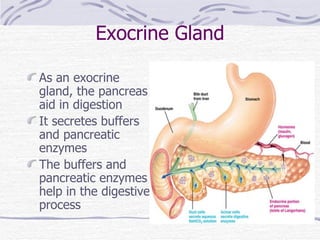
Exocrine Gland As an exocrine gland, the pancreas aid in digestion It secretes buffers and pancreatic enzymes The buffers and pancreatic enzymes help in the digestive process
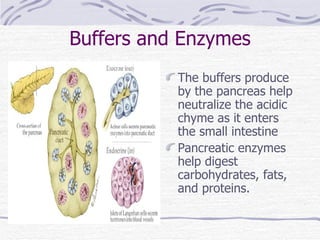
Buffers and Enzymes The buffers produce by the pancreas help neutralize the acidic chyme as it enters the small intestine Pancreatic enzymes help digest carbohydrates, fats, and proteins.
Buffers and Enzymes Without the buffers and enzymes, food is not digested and absorbed Can lead to malnurtition Weight loss diarrhea
Ductless Gland As a ductless or endocrine gland, the pancreas regulates blood glucose levels Cells of the islet of Langerhans secretes these hormones These hormones are responsible for increase and decrease blood glucose levels Secretes these hormones directly into the bloodstream
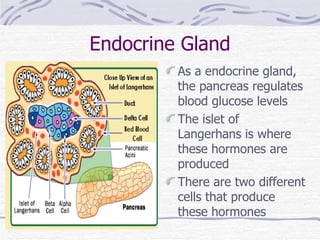
Endocrine Gland As a endocrine gland, the pancreas regulates blood glucose levels The islet of Langerhans is where these hormones are produced There are two different cells that produce these hormones
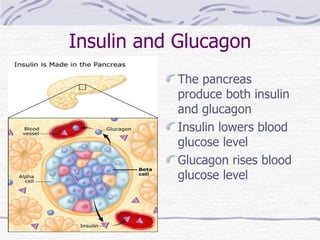
Insulin and Glucagon The pancreas produce both insulin and glucagon Insulin lowers blood glucose level Glucagon rises blood glucose level
Insulin and Glucagon Insulin is produced in the beta islet cells Insulin causes the body to absorb glucose from the blood Insulin lowers the blood sugar levers Glucagon is produced in the alpha islet cells Glucagon causes the liver to release glucose This causes the blood glucose levels to rise Glucagon is antagonist of insulin
Diseases that Affect the Pancreas These diseases can cause the pancreas to over produce or under produce its products Diabetes mellitus Insulin-dependent diabetes mellitus (IDDM) Non-insulin dependent diabetes mellitus (NIDDM) Diabetic retinopathy,  Insulinoma ketoacidosis
Diseases that Affect the Pancreas Peripheral neuropathy Acute pancreatitis Chronic pancreatitis Hereditary pancreatitis Pancreatic cancer Nephropathy stroke
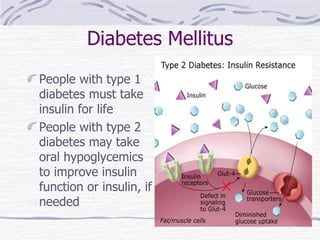
Diabetes Mellitus Diabetes Mellitus is characterized by the body inability to metabolize carbohydrates This may lead to hyperglycemia and glycosuria The body makes excessive amount of insulin or the body does not absorb the insulin produce into the cells
Diabetes Mellitus Insulin-dependent diabetes mellitus develops early in life It is known as childhood or type 1 diabetes The pancreas is not able to produce insulin in adequate amounts Non-insulin dependent diabetes mellitus develops later in life It is known as type 2 diabetes The pancreas produce normal to high levels of insulin
Diabetes Mellitus People with type 1 diabetes must take insulin for life People with type 2 diabetes may take oral hypoglycemics to improve insulin function or insulin, if needed
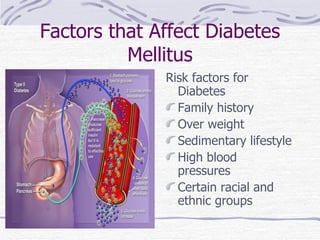
Factors that Affect Diabetes Mellitus Risk factors for Diabetes  Family history Over weight Sedimentary lifestyle High blood pressures Certain racial and ethnic groups
Diagnostic Tests Blood tests are helpful in determining pancreas diseases Blood tests include: Fasting Blood Sugar (FBS) Glucose Tolerance test (GTT Radiographic tests are best to evaluate structure of pancreas Computed tomography scan (CAT) Endoscopic ultrasound
Diagnostic Tests Magnetic resonance imaging (MRI) Magnetic resonance cholangiopancreatigraphy (MRCP) Endoscopic retrograde cholangiopancreatophy (ERCP) Used for evaluating the pancreatic duct
Therapeutic Procedures Treatment of pancreatic diseases include: Hormone replacement Chemotherapy Radiation therapy In some instance surgery may be needed
Medications Medication may be used to treat diabetes mellitus and other pancreatic diseases Insulin  Rapid-acting Short-acting Intermediate-acting Long-acting Pre-mixed Oral hypoglycemic agents and other forms of delivery: Oral insulin Insulin pump Inhaled insulin Transdermal insulin (patch) Intranasal insulin
Medications Rapid-acting: Humalog Short-acting: Novolin Intermediate-acting: Lente Long-acting:Lantus Pre-mixed: Humulin OmniPod and Animas make insulin pumps Exubera is an inhaled insulin Cellnovo is an insulin patch being used Pass port (R) is being tested as an insulin delivery system
Works Cited American Diabetes Association, Web. 9 Nov 2011. “ Common Disorders of the Pancreas ”.   National Pancreas Foundation Web.  9 Nov 2011. Fremgen, Bonnie F, Suzanne S. Frucht.  Medical Terminology: A Living   Language . 4 th  ed. New York. Pearson Education, Inc. 2009. Print Images.Search.yahoo.com. Web 9 Nov 2011 OmniPod.com Web. 9 Nov 2011. Transdermal Basal Insulin Patch Study.ClinicalTrials.gov   Web. 9 Nov 2011.   “ Types of Insulin for Diabetes Treatment”. WebMD. Web 9 Nov 2011.

The pancreas

  • 1.
    The Pancreas Diseasesof the Pancreas By Marjorie Smith
  • 2.
    The Pancreas Thepancreas is a unique gland The pancreas is both a exocrine and endocrine gland It is a duct gland, pancreatic duct It is a ductless gland, islet of Langerhans
  • 3.
    Duct Gland Asa duct gland or exocrine gland, the pancreas aids in digestion It secretes pancreatic enzymes into the small intestines It aids in digestion as a part of the digestive system It is also an endocrine gland, too
  • 4.
    Exocrine Gland Asan exocrine gland, the pancreas aid in digestion It secretes buffers and pancreatic enzymes The buffers and pancreatic enzymes help in the digestive process
  • 5.
    Buffers and EnzymesThe buffers produce by the pancreas help neutralize the acidic chyme as it enters the small intestine Pancreatic enzymes help digest carbohydrates, fats, and proteins.
  • 6.
    Buffers and EnzymesWithout the buffers and enzymes, food is not digested and absorbed Can lead to malnurtition Weight loss diarrhea
  • 7.
    Ductless Gland Asa ductless or endocrine gland, the pancreas regulates blood glucose levels Cells of the islet of Langerhans secretes these hormones These hormones are responsible for increase and decrease blood glucose levels Secretes these hormones directly into the bloodstream
  • 8.
    Endocrine Gland Asa endocrine gland, the pancreas regulates blood glucose levels The islet of Langerhans is where these hormones are produced There are two different cells that produce these hormones
  • 9.
    Insulin and GlucagonThe pancreas produce both insulin and glucagon Insulin lowers blood glucose level Glucagon rises blood glucose level
  • 10.
    Insulin and GlucagonInsulin is produced in the beta islet cells Insulin causes the body to absorb glucose from the blood Insulin lowers the blood sugar levers Glucagon is produced in the alpha islet cells Glucagon causes the liver to release glucose This causes the blood glucose levels to rise Glucagon is antagonist of insulin
  • 11.
    Diseases that Affectthe Pancreas These diseases can cause the pancreas to over produce or under produce its products Diabetes mellitus Insulin-dependent diabetes mellitus (IDDM) Non-insulin dependent diabetes mellitus (NIDDM) Diabetic retinopathy, Insulinoma ketoacidosis
  • 12.
    Diseases that Affectthe Pancreas Peripheral neuropathy Acute pancreatitis Chronic pancreatitis Hereditary pancreatitis Pancreatic cancer Nephropathy stroke
  • 13.
    Diabetes Mellitus DiabetesMellitus is characterized by the body inability to metabolize carbohydrates This may lead to hyperglycemia and glycosuria The body makes excessive amount of insulin or the body does not absorb the insulin produce into the cells
  • 14.
    Diabetes Mellitus Insulin-dependentdiabetes mellitus develops early in life It is known as childhood or type 1 diabetes The pancreas is not able to produce insulin in adequate amounts Non-insulin dependent diabetes mellitus develops later in life It is known as type 2 diabetes The pancreas produce normal to high levels of insulin
  • 15.
    Diabetes Mellitus Peoplewith type 1 diabetes must take insulin for life People with type 2 diabetes may take oral hypoglycemics to improve insulin function or insulin, if needed
  • 16.
    Factors that AffectDiabetes Mellitus Risk factors for Diabetes Family history Over weight Sedimentary lifestyle High blood pressures Certain racial and ethnic groups
  • 17.
    Diagnostic Tests Bloodtests are helpful in determining pancreas diseases Blood tests include: Fasting Blood Sugar (FBS) Glucose Tolerance test (GTT Radiographic tests are best to evaluate structure of pancreas Computed tomography scan (CAT) Endoscopic ultrasound
  • 18.
    Diagnostic Tests Magneticresonance imaging (MRI) Magnetic resonance cholangiopancreatigraphy (MRCP) Endoscopic retrograde cholangiopancreatophy (ERCP) Used for evaluating the pancreatic duct
  • 19.
    Therapeutic Procedures Treatmentof pancreatic diseases include: Hormone replacement Chemotherapy Radiation therapy In some instance surgery may be needed
  • 20.
    Medications Medication maybe used to treat diabetes mellitus and other pancreatic diseases Insulin Rapid-acting Short-acting Intermediate-acting Long-acting Pre-mixed Oral hypoglycemic agents and other forms of delivery: Oral insulin Insulin pump Inhaled insulin Transdermal insulin (patch) Intranasal insulin
  • 21.
    Medications Rapid-acting: HumalogShort-acting: Novolin Intermediate-acting: Lente Long-acting:Lantus Pre-mixed: Humulin OmniPod and Animas make insulin pumps Exubera is an inhaled insulin Cellnovo is an insulin patch being used Pass port (R) is being tested as an insulin delivery system
  • 22.
    Works Cited AmericanDiabetes Association, Web. 9 Nov 2011. “ Common Disorders of the Pancreas ”. National Pancreas Foundation Web. 9 Nov 2011. Fremgen, Bonnie F, Suzanne S. Frucht. Medical Terminology: A Living Language . 4 th ed. New York. Pearson Education, Inc. 2009. Print Images.Search.yahoo.com. Web 9 Nov 2011 OmniPod.com Web. 9 Nov 2011. Transdermal Basal Insulin Patch Study.ClinicalTrials.gov Web. 9 Nov 2011. “ Types of Insulin for Diabetes Treatment”. WebMD. Web 9 Nov 2011.