KAIZEN
B A S I C S O F M A R K E T I N G
• Kaizen (改善) is the Sino-Japanese word for "improvement". In business, kaizen refers
to activities that continuously improve all functions and involve all employees from
the CEO to the assembly line workers. It also applies to processes, such as purchasing
and logistics, that cross organizational boundaries into the supply chain.[1] It has been
applied in healthcare,[2] psychotherapy,[3] life coaching, government, and banking.
• By improving standardized programmes and processes, kaizen aims to eliminate
(see lean manufacturing). Kaizen was first practiced in Japanese
War II, influenced in part by American business and quality-management teachers,
most notably as part of The Toyota Way. It has since spread throughout the world
has been applied to environments outside business and productivity.[4]
• Key 1 - Cleaning and Organizing to Make Work Easy, which is based on the 5S
methodology.
• Key 2 - Goal Alignment/Rationalizing the System
• Key 3 - Small Group Activities
• Key 4 - Leading and Site Technology
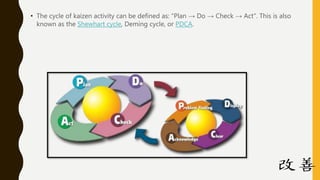
• The cycle of kaizen activity can be defined as: "Plan → Do → Check → Act". This is also
known as the Shewhart cycle, Deming cycle, or PDCA.
• Point Kaizen
• It is one of the most commonly implemented types of Kaizen. It happens very quickly and
without much planning. As soon as something is found broken or incorrect, quick and
measures are taken to correct the issues.
• These measures are generally small, isolated and easy to implement, however they can have a
huge impact.
• In some cases, it is also possible that the positive effects of point kaizen in one area can reduce
or eliminate benefits of point Kaizen in some other area. An example of Point Kaizen could be
shop inspection by a supervisor and he finds broken materials or other small issues, and then
asks the owner of the shop to perform a quick Kaizen (5S) to rectify those issues.
• System Kaizen
• System Kaizen is accomplished in an organized manner and is devised to address system level
problems in an organization.
• It is an upper level strategic planning method which results in a number of planned Kaizen
events over a long period of time. It is in contrast to point Kaizen which generally happens as a
result of identification of a small issue which is resolved in a short period of time.
• Line Kaizen
• Line in this context refers to a structured spreading of Lean
from point or discrete to the line. For example, Kaizen might
be applied to a process (point), but also to the downstream
process. Those two points constitute a Line Kaizen.
• Another example might be in Lean implemented in
procurement, but also being implemented in the planning
department. Here in this case, planning is upstream from
procurement and Kaizen is performed at those two points,
which thus forms a line.
• Plane Kaizen
• It is the next upper level of Line Kaizen, in that several lines are connected together. In
modern terminologies, this can also be described as value stream, where instead of
traditional departments, the organization is structured into product lines or families
and value streams. It can be visualized as changes or improvements made to one line
being implemented to multiple other lines or processes.
• Cube Kaizen
• Cube Kaizen describes the situation where all the points of the planes are connected
each other and no point is disjointed from each other. This would resemble a
where Lean has spread across the entire organization. Improvements are made up
down through the plane, or upstream or downstream, including the complete
organization, suppliers and customers. This might require some changes in the
standard business processes as well.
Toyota
The Japanese automotive manufacturer is one of the most famous
companies using Kaizen and they are responsible for making this method
known and for proving that its results are measurable, proven and
extremely effective. Kaizen’s methodology is one that focuses on the
constant improvement of processes by making small and gradual
adjustments to the way things are done. Toyota has used this method for
decades and has the taken advantage of its principles in many different
levels of the organization.
Ford Motor Company
While Toyota may be the most famous car manufacturer to use Kaizen, they
are by no means the only ones. Ford adopted the Kaizen philosophy since
Alan Mulally was appointed CEO in 2006 and under the leadership of Mark
Fields they continued using the same principles that helped them gain an
advantage in the industry. Ford decided to focus on implementing practices
that allow them to make their processes more efficient and finding ways to
reduce times by slowly but surely, correcting procedures in ways that ensure
that every single time a process is repeated, it is done in a more efficient
manner than before.
Nestlé
Nestlé is a great example of how Kaizen can be used across different
industries, in this case, the food industry with one of the most important
firms worldwide who have implemented Kaizen. Lean production has
been an aspect of Kaizen that Nestlé has taken seriously and they have
made great improvements in the reduction of waste by lowering the time
and materials wasted on their processes. Lean production is focused on
finding ways to not only reduce waste, but also in finding methods to best
use the space available, the resources on hand and the best utilization of
talent and technology the company has in their arsenal.
Kizen

Kizen

  • 1.
    KAIZEN B A SI C S O F M A R K E T I N G
  • 2.
    • Kaizen (改善)is the Sino-Japanese word for "improvement". In business, kaizen refers to activities that continuously improve all functions and involve all employees from the CEO to the assembly line workers. It also applies to processes, such as purchasing and logistics, that cross organizational boundaries into the supply chain.[1] It has been applied in healthcare,[2] psychotherapy,[3] life coaching, government, and banking. • By improving standardized programmes and processes, kaizen aims to eliminate (see lean manufacturing). Kaizen was first practiced in Japanese War II, influenced in part by American business and quality-management teachers, most notably as part of The Toyota Way. It has since spread throughout the world has been applied to environments outside business and productivity.[4]
  • 3.
    • Key 1- Cleaning and Organizing to Make Work Easy, which is based on the 5S methodology. • Key 2 - Goal Alignment/Rationalizing the System • Key 3 - Small Group Activities • Key 4 - Leading and Site Technology
  • 4.
    • The cycleof kaizen activity can be defined as: "Plan → Do → Check → Act". This is also known as the Shewhart cycle, Deming cycle, or PDCA.
  • 5.
    • Point Kaizen •It is one of the most commonly implemented types of Kaizen. It happens very quickly and without much planning. As soon as something is found broken or incorrect, quick and measures are taken to correct the issues. • These measures are generally small, isolated and easy to implement, however they can have a huge impact. • In some cases, it is also possible that the positive effects of point kaizen in one area can reduce or eliminate benefits of point Kaizen in some other area. An example of Point Kaizen could be shop inspection by a supervisor and he finds broken materials or other small issues, and then asks the owner of the shop to perform a quick Kaizen (5S) to rectify those issues. • System Kaizen • System Kaizen is accomplished in an organized manner and is devised to address system level problems in an organization. • It is an upper level strategic planning method which results in a number of planned Kaizen events over a long period of time. It is in contrast to point Kaizen which generally happens as a result of identification of a small issue which is resolved in a short period of time.
  • 6.
    • Line Kaizen •Line in this context refers to a structured spreading of Lean from point or discrete to the line. For example, Kaizen might be applied to a process (point), but also to the downstream process. Those two points constitute a Line Kaizen. • Another example might be in Lean implemented in procurement, but also being implemented in the planning department. Here in this case, planning is upstream from procurement and Kaizen is performed at those two points, which thus forms a line.
  • 7.
    • Plane Kaizen •It is the next upper level of Line Kaizen, in that several lines are connected together. In modern terminologies, this can also be described as value stream, where instead of traditional departments, the organization is structured into product lines or families and value streams. It can be visualized as changes or improvements made to one line being implemented to multiple other lines or processes. • Cube Kaizen • Cube Kaizen describes the situation where all the points of the planes are connected each other and no point is disjointed from each other. This would resemble a where Lean has spread across the entire organization. Improvements are made up down through the plane, or upstream or downstream, including the complete organization, suppliers and customers. This might require some changes in the standard business processes as well.
  • 8.
    Toyota The Japanese automotivemanufacturer is one of the most famous companies using Kaizen and they are responsible for making this method known and for proving that its results are measurable, proven and extremely effective. Kaizen’s methodology is one that focuses on the constant improvement of processes by making small and gradual adjustments to the way things are done. Toyota has used this method for decades and has the taken advantage of its principles in many different levels of the organization.
  • 9.
    Ford Motor Company WhileToyota may be the most famous car manufacturer to use Kaizen, they are by no means the only ones. Ford adopted the Kaizen philosophy since Alan Mulally was appointed CEO in 2006 and under the leadership of Mark Fields they continued using the same principles that helped them gain an advantage in the industry. Ford decided to focus on implementing practices that allow them to make their processes more efficient and finding ways to reduce times by slowly but surely, correcting procedures in ways that ensure that every single time a process is repeated, it is done in a more efficient manner than before.
  • 10.
    Nestlé Nestlé is agreat example of how Kaizen can be used across different industries, in this case, the food industry with one of the most important firms worldwide who have implemented Kaizen. Lean production has been an aspect of Kaizen that Nestlé has taken seriously and they have made great improvements in the reduction of waste by lowering the time and materials wasted on their processes. Lean production is focused on finding ways to not only reduce waste, but also in finding methods to best use the space available, the resources on hand and the best utilization of talent and technology the company has in their arsenal.