A. Y. Dadabhai Technical Institute
Departmentof
MechanicalEngineering
KAIZEN
Guide By:
Mr S. H. Patel
Prepared By:
Tushar Solanki
116010319094
INDUSTRIAL ENGINEERING (3351904)
A. Y. Dadabhai Technical Institute
CERTIFICATE
This is to certify that Mr. Solanki Tushar B. of A.Y. Dadabhai
Technical Institute form Mechanical Engineering Department,
Enrollment No. 116010319094 Studies in 5th semester has
satisfactorily complete term work in the term ending in October-
November 2016, in partial fulfillment of requirement for the
diploma mechanical engineering of the Gujarat Technological
university (GTU).
__________________
Guide
Introduction
• Masaaki Imai is known as the developer of KAIZEN.
• ‘KAI’ means ‘Change or the action to correct’.
• ‘ZEN’ means ‘Good’.
• Kaizen is small incremental changes made for improving productivity
and minimizing wastes.
1
KAIZEN
2
Kaizen is a Japanese Technique of improving
production quality of industries. In this method slow, steady
but firm improvements in processes of industries and
commerce are introduce and maintained. This method is very
extensive as well as effective. Management, Supervisors and
workers are simultaneously involved in this technique.
 Continues, firm or stable but slow improvements is done.
Kaizen does not make 100% improvement.
 Kaizen considers workers as an best capital instead of industrial
properties. Mangers are giving suggestions for processes and
Quality. Same thing are also done by workers. Therefore
involvement and participation of all are obtained.
 The statistical analysis is carried for the improvement in process
or production.
 The aim is not obtain radical improvement, hence the cost of
improvements is comparatively less.
3 Main Principles of KAIZEN
1. Consider the process and the results.
2. The need to look at the entire process of the job at hand and to
evaluate the job as to the best way to get the job done.
3. Kaizen must be approached in such a way that no one is blamed
and that best process is put into place.
3
Features Of Kaizen
• Widely applicable.
• Highly effective and result oriented.
• A learning experience.
• Team based and cross-functional.
4
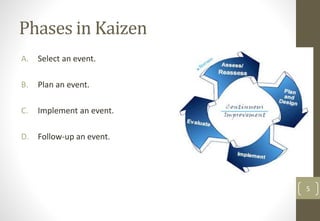
Phases in Kaizen
A. Select an event.
B. Plan an event.
C. Implement an event.
D. Follow-up an event.
5
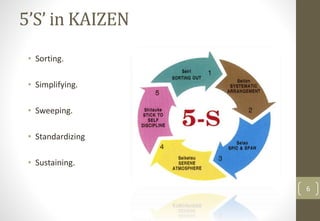
5’S’ in KAIZEN
• Sorting.
• Simplifying.
• Sweeping.
• Standardizing
• Sustaining.
6
Benefits Of Kaizen
• Kaizen reduces waste - like inventory waste, time waste and
workers motion.
• Kaizen improves space utilization and product quality.
• Results in higher employee moral and job satisfaction.
• Teaches workers how to solve everyday problems.
7
An Example
Toyota production system is know for kaizen, where all line personnel
are expected to stop their moving production line in case 0f any
abnormality and, along with their supervisor, suggest an
improvement to resolve the abnormality which may initiate a kaizen.
8
Pit Falls in Kaizen
• Resistance to change.
• Lack of proper procedure to implement.
• Too much suggestion may lead to confusion and time wastage.
• Difficult to implement in large scale process, where analyzing
requires a lot of time.
9
Uses of Kaizen
1. To reduce wastage & rejection of process & method.
2. To bring slow but stable improvement in product quality.
3. To reduce cost of production.
4. To provide delivery of product timely & as per their demand.
5. BY considering workers as best capital, their suggestions for to bring
improvement should be accepted.
6. To analysis record statistically for production.
7. Instead of talking & showing enthusiasm, to carry out the work by
unfailing efforts.
10
KAIZEN HELPS YOU TO ….
SEE THE WASTE.
TURN PROBLEMS INTO PROFIT.
CONSTANTLY CHANGE FOR THE BETTER..

Kaizen 116010319094

  • 1.
    A. Y. DadabhaiTechnical Institute Departmentof MechanicalEngineering KAIZEN Guide By: Mr S. H. Patel Prepared By: Tushar Solanki 116010319094 INDUSTRIAL ENGINEERING (3351904)
  • 2.
    A. Y. DadabhaiTechnical Institute CERTIFICATE This is to certify that Mr. Solanki Tushar B. of A.Y. Dadabhai Technical Institute form Mechanical Engineering Department, Enrollment No. 116010319094 Studies in 5th semester has satisfactorily complete term work in the term ending in October- November 2016, in partial fulfillment of requirement for the diploma mechanical engineering of the Gujarat Technological university (GTU). __________________ Guide
  • 3.
    Introduction • Masaaki Imaiis known as the developer of KAIZEN. • ‘KAI’ means ‘Change or the action to correct’. • ‘ZEN’ means ‘Good’. • Kaizen is small incremental changes made for improving productivity and minimizing wastes. 1
  • 4.
    KAIZEN 2 Kaizen is aJapanese Technique of improving production quality of industries. In this method slow, steady but firm improvements in processes of industries and commerce are introduce and maintained. This method is very extensive as well as effective. Management, Supervisors and workers are simultaneously involved in this technique.  Continues, firm or stable but slow improvements is done. Kaizen does not make 100% improvement.  Kaizen considers workers as an best capital instead of industrial properties. Mangers are giving suggestions for processes and Quality. Same thing are also done by workers. Therefore involvement and participation of all are obtained.  The statistical analysis is carried for the improvement in process or production.  The aim is not obtain radical improvement, hence the cost of improvements is comparatively less.
  • 5.
    3 Main Principlesof KAIZEN 1. Consider the process and the results. 2. The need to look at the entire process of the job at hand and to evaluate the job as to the best way to get the job done. 3. Kaizen must be approached in such a way that no one is blamed and that best process is put into place. 3
  • 6.
    Features Of Kaizen •Widely applicable. • Highly effective and result oriented. • A learning experience. • Team based and cross-functional. 4
  • 7.
    Phases in Kaizen A.Select an event. B. Plan an event. C. Implement an event. D. Follow-up an event. 5
  • 8.
    5’S’ in KAIZEN •Sorting. • Simplifying. • Sweeping. • Standardizing • Sustaining. 6
  • 9.
    Benefits Of Kaizen •Kaizen reduces waste - like inventory waste, time waste and workers motion. • Kaizen improves space utilization and product quality. • Results in higher employee moral and job satisfaction. • Teaches workers how to solve everyday problems. 7
  • 10.
    An Example Toyota productionsystem is know for kaizen, where all line personnel are expected to stop their moving production line in case 0f any abnormality and, along with their supervisor, suggest an improvement to resolve the abnormality which may initiate a kaizen. 8
  • 11.
    Pit Falls inKaizen • Resistance to change. • Lack of proper procedure to implement. • Too much suggestion may lead to confusion and time wastage. • Difficult to implement in large scale process, where analyzing requires a lot of time. 9
  • 12.
    Uses of Kaizen 1.To reduce wastage & rejection of process & method. 2. To bring slow but stable improvement in product quality. 3. To reduce cost of production. 4. To provide delivery of product timely & as per their demand. 5. BY considering workers as best capital, their suggestions for to bring improvement should be accepted. 6. To analysis record statistically for production. 7. Instead of talking & showing enthusiasm, to carry out the work by unfailing efforts. 10
  • 13.
    KAIZEN HELPS YOUTO …. SEE THE WASTE. TURN PROBLEMS INTO PROFIT. CONSTANTLY CHANGE FOR THE BETTER..