KAIZEN AND QUALITY
CIRCLES IN TQM
WHAT IS KAIZEN??????
Kaizen , Japanese for
"improvement" or "change for
the better" refers to philosophy
or practices that focus upon
continuous improvement of
processes in manufacturing,
engineering, game
development, and business
management.
.
EVOLUTION
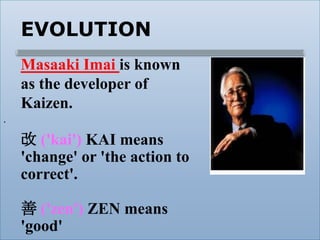
Masaaki Imai is known
as the developer of
Kaizen.
改 ('kai') KAI means
'change' or 'the action to
correct'.
善 ('zen') ZEN means
'good'
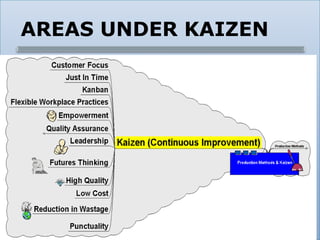
AREAS UNDER KAIZEN
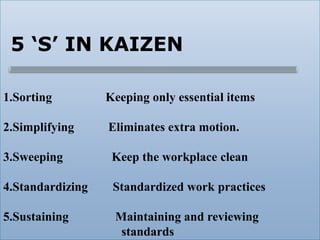
5 ‘S’ IN KAIZEN
1.Sorting Keeping only essential items
2.Simplifying Eliminates extra motion.
3.Sweeping Keep the workplace clean
4.Standardizing Standardized work practices
5.Sustaining Maintaining and reviewing
standards
QUALITY CIRCLES
Quality circles were developed by Dr, Kaoru
Ishikawa
in Japan in the 1960’s.
Voluntary groups of employees who work on similar
tasks or share an area of responsibility.
They agree to meet on a regular basis to discuss &
solve problems related to work.
They operate on the principle that employee
participation in decision-making and problem-solving
improves the quality of work.
STRUCTURE OF QUALITY
CIRCLES
Top management
Coordinator
Steering committee
Facilitator
Leader
Members
Non members
PROBLEM WITH
QUALITY CIRCLES
Inadequate Training
Resistance to change
Lack of proper procedure to
implement
Too much suggestion may lead to
confusion and time wastage
Quality Circles are not really
empowered to make decisions
COMPANIES
IMPLEMENTING
QUALITY CIRCLES
Honda of America
 Mitsubishi
Toyota
BHEL
 Larsen & Turbo
CASE OF QUALITY CIRCLE
Tata Steels, a world leader in the steel
industry started its QC journey way
back in 1990 with a negligible number
of Quality Circles. As per the recent
statistics, the number of quality circles
operating in Tata Steel has risen to
over 7500. It proudly declares that
more than 96% of its employees are
involved in this quality movement.

Kaizen and qc

  • 1.
  • 2.
    WHAT IS KAIZEN?????? Kaizen, Japanese for "improvement" or "change for the better" refers to philosophy or practices that focus upon continuous improvement of processes in manufacturing, engineering, game development, and business management.
  • 3.
    . EVOLUTION Masaaki Imai isknown as the developer of Kaizen. 改 ('kai') KAI means 'change' or 'the action to correct'. 善 ('zen') ZEN means 'good'
  • 4.
  • 5.
    5 ‘S’ INKAIZEN 1.Sorting Keeping only essential items 2.Simplifying Eliminates extra motion. 3.Sweeping Keep the workplace clean 4.Standardizing Standardized work practices 5.Sustaining Maintaining and reviewing standards
  • 6.
    QUALITY CIRCLES Quality circleswere developed by Dr, Kaoru Ishikawa in Japan in the 1960’s. Voluntary groups of employees who work on similar tasks or share an area of responsibility. They agree to meet on a regular basis to discuss & solve problems related to work. They operate on the principle that employee participation in decision-making and problem-solving improves the quality of work.
  • 7.
    STRUCTURE OF QUALITY CIRCLES Topmanagement Coordinator Steering committee Facilitator Leader Members Non members
  • 8.
    PROBLEM WITH QUALITY CIRCLES InadequateTraining Resistance to change Lack of proper procedure to implement Too much suggestion may lead to confusion and time wastage Quality Circles are not really empowered to make decisions
  • 9.
    COMPANIES IMPLEMENTING QUALITY CIRCLES Honda ofAmerica  Mitsubishi Toyota BHEL  Larsen & Turbo
  • 10.
    CASE OF QUALITYCIRCLE Tata Steels, a world leader in the steel industry started its QC journey way back in 1990 with a negligible number of Quality Circles. As per the recent statistics, the number of quality circles operating in Tata Steel has risen to over 7500. It proudly declares that more than 96% of its employees are involved in this quality movement.