KAIZEN
Kaizen is core to lean
manufacturing, or The Toyota
Way. It was developed in the
manufacturing sector to lower
defects, eliminate waste,
boost productivity, encourage
worker purpose and
accountability, and promote
innovation.
• Kaizen - compound of two Japanese words - together translate as
"good change" or "improvement”.
• Kaizen - "continuous improvement" through its association with
lean methodology.
• Kaizen – origin - post-World War II - Japanese quality circles of
workers - focused on preventing defects - Toyota and were
developed partly in response to American management and
productivity consultants who visited the country, especially W.
• Edwards Deming - argued - quality control should be put more
directly in the hands of line workers.
• Kaizen was brought to the West and popularized by Masaaki Imai
via his book Kaizen: The Key to Japan's Competitive Success in
1986.
Ten
principles
of
Kaizen
• Let go of assumptions.
• Be proactive about solving
problems.
• Don't accept the status quo.
• Let go of perfectionism and
take an attitude of iterative,
adaptive change.
• Look for solutions as you
find mistakes.
• Never stop improving.
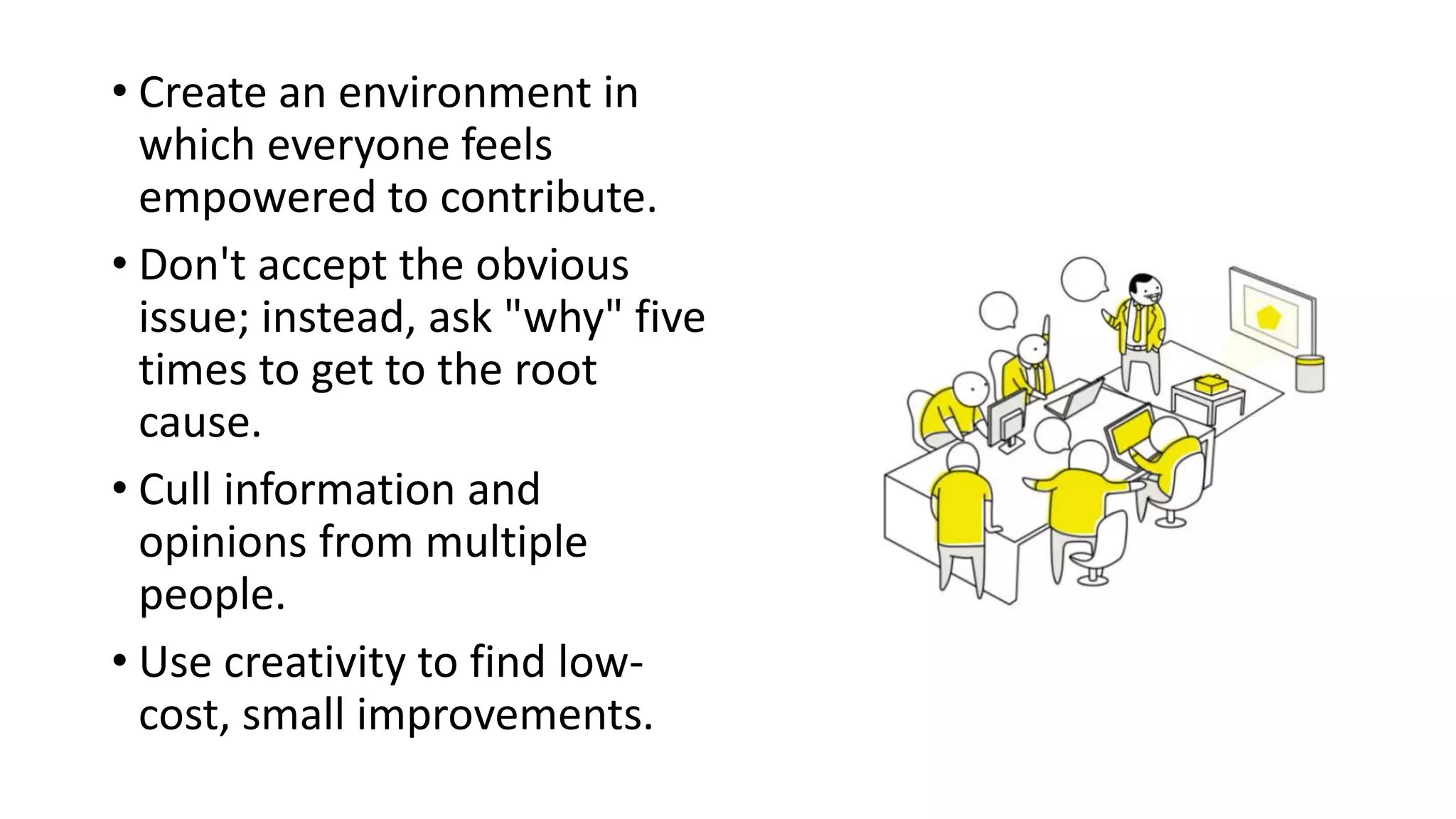
• Create an environment in
which everyone feels
empowered to contribute.
• Don't accept the obvious
issue; instead, ask "why" five
times to get to the root
cause.
• Cull information and
opinions from multiple
people.
• Use creativity to find low-
cost, small improvements.
PDCA CYLCE
Kaizen 5S framework
A 5S framework is a critical part of the
Kaizen system and establishes an ideal
physical workplace. The 5Ses focus on
creating visual order, organization,
cleanliness and standardization to
improve profitability, efficiency, service
and safety. Below are the original
Japanese 5Ses and their common English
translations.
• Seiri/Sort (organize) -- Separate necessary workplace items from
unnecessary ones and remove unnecessary items.
• Seiton/Set in order (create orderliness) -- Arrange items to allow for
easy access in the way that makes the most sense for work.
• Seiso/Shine (cleanliness) -- Keep the workspace clean and tidy.
• Seiketsu/Standardize (standardized cleaning) -- Systematize
workplace cleanup best practices.
• Shitsuke/Sustain (discipline) -- Keep the effort going.
Kaizen advantages
• With its focus on gradual improvement, Kaizen can create a gentler
approach to change in contrast to big efforts that may be abandoned due
to their tendency to provoke change resistance and abandonment.
• Kaizen encourages scrutiny of processes so that mistakes and waste can
be reduced.
• Inspection needs are lessened, because errors are reduced.
• Employee morale grows, because it engenders a sense of value and
purposefulness.
• Teamwork increases as employees think beyond the specific issues of
their department.
• Client focus increases as customer requirements awareness is raised.
• Systems are in place to ensure improvements are encouraged both short
and long term.
Kaizen disadvantages
• Companies with cultures of territorialism and
closed communication may first need to focus
on cultural changes to create a receptive
environment.
• Short-term Kaizen events may create a burst
of excitement that is shallow and short-lived
and, therefore, gets abandoned before long.
Real-life Kaizen examples
• Lockheed Martin. The aerospace company is a well-known
proponent of Kaizen. Through the use of Kaizen, it has
successfully reduced manufacturing costs, reduced inventory and
cut delivery time.
• Ford Motor Company. When lean devotee Alan Mulally became
CEO of Ford in 2006, the auto giant was on the brink of
bankruptcy. Mulally used Kaizen to execute one of the most
famous corporate turnarounds in history.
• Pixar Animation Studios. Pixar has taken a continuous
improvement model that reduced risks of expensive movie
failure by using quality control checks and iterative processes.
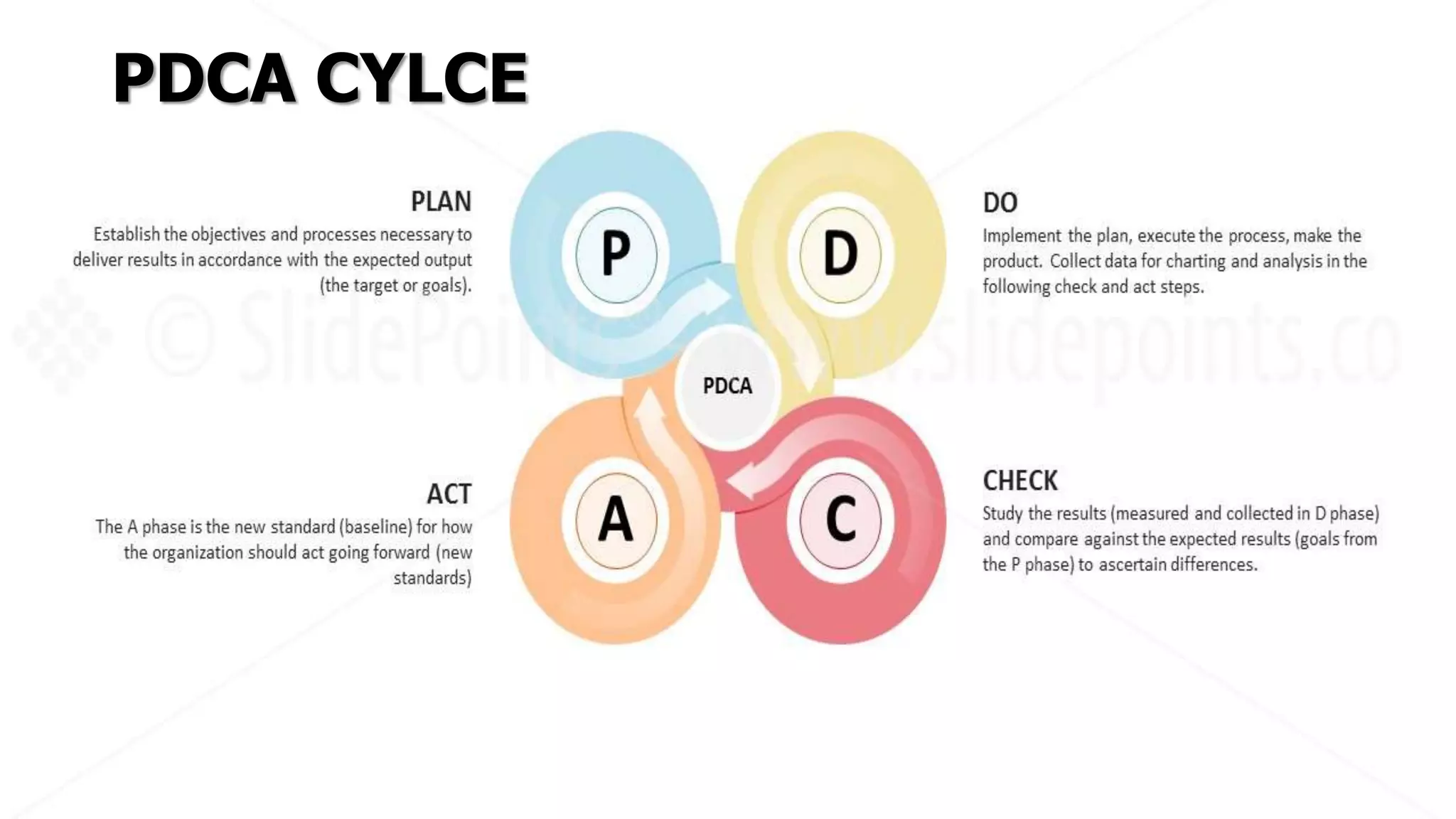
Improvement generally follow the PDCA cycle format,
which stands for "plan-do-check-act." The "plan"
portion includes mapping out the changes so that
everyone knows what to expect when teams try to solve
a problem. The "do" means implementing the best
solution to the problem. The "check" step involves
evaluating the solution to the problem to see if it
worked. When a company performs the "act" stage, it
determines whether or not the solution should become
a company standard or if it needs further changes. If
managers decide to implement more changes, kaizen
goes back to the plan step and the process starts over.
In April 2011, Toyota Production System Support Center, Inc. (TSSC)
became a non-profit corporation. In June 2011, TSSC announced efforts
to support more public service and non-profit organizations, and its
support to the St. Bernard Project.
The St Bernard Project is a non-profit organization to restore
communities in New Orleans and St. Bernard, the areas devastated by
the Hurricane Katrina in 2005. With the help of veterans and
volunteers, over 400 homes have been rebuilt. Yet there was a need for
speeding up the rebuilding process to help families still living in trailers.
TSSC undertook a task of reviewing the rebuilding processes and
making them more efficient based on TPS.
The first step began with comprehensive discussions with site
supervisors and clarification of construction plans. The second step
involved bringing problems to the surface and investigating the causes
of operational delays (process sequence, etc.), then defining work
standard, implementing standardized work and implementing concept
of Jikoutei-Kanketsu (defect free process completion). As a result, the
lead time for rebuilding a home has been greatly reduced.
With the philosophy of Toyota Production System, TSSC will continue to
support more companies, public service and non-profit organizations
through development of people.
Kaizen

Kaizen

  • 1.
  • 2.
    Kaizen is coreto lean manufacturing, or The Toyota Way. It was developed in the manufacturing sector to lower defects, eliminate waste, boost productivity, encourage worker purpose and accountability, and promote innovation.
  • 3.
    • Kaizen -compound of two Japanese words - together translate as "good change" or "improvement”. • Kaizen - "continuous improvement" through its association with lean methodology. • Kaizen – origin - post-World War II - Japanese quality circles of workers - focused on preventing defects - Toyota and were developed partly in response to American management and productivity consultants who visited the country, especially W. • Edwards Deming - argued - quality control should be put more directly in the hands of line workers. • Kaizen was brought to the West and popularized by Masaaki Imai via his book Kaizen: The Key to Japan's Competitive Success in 1986.
  • 4.
  • 5.
    • Let goof assumptions. • Be proactive about solving problems. • Don't accept the status quo. • Let go of perfectionism and take an attitude of iterative, adaptive change. • Look for solutions as you find mistakes. • Never stop improving.
  • 6.
    • Create anenvironment in which everyone feels empowered to contribute. • Don't accept the obvious issue; instead, ask "why" five times to get to the root cause. • Cull information and opinions from multiple people. • Use creativity to find low- cost, small improvements.
  • 7.
  • 8.
    Kaizen 5S framework A5S framework is a critical part of the Kaizen system and establishes an ideal physical workplace. The 5Ses focus on creating visual order, organization, cleanliness and standardization to improve profitability, efficiency, service and safety. Below are the original Japanese 5Ses and their common English translations.
  • 9.
    • Seiri/Sort (organize)-- Separate necessary workplace items from unnecessary ones and remove unnecessary items. • Seiton/Set in order (create orderliness) -- Arrange items to allow for easy access in the way that makes the most sense for work. • Seiso/Shine (cleanliness) -- Keep the workspace clean and tidy. • Seiketsu/Standardize (standardized cleaning) -- Systematize workplace cleanup best practices. • Shitsuke/Sustain (discipline) -- Keep the effort going.
  • 10.
    Kaizen advantages • Withits focus on gradual improvement, Kaizen can create a gentler approach to change in contrast to big efforts that may be abandoned due to their tendency to provoke change resistance and abandonment. • Kaizen encourages scrutiny of processes so that mistakes and waste can be reduced. • Inspection needs are lessened, because errors are reduced. • Employee morale grows, because it engenders a sense of value and purposefulness. • Teamwork increases as employees think beyond the specific issues of their department. • Client focus increases as customer requirements awareness is raised. • Systems are in place to ensure improvements are encouraged both short and long term.
  • 11.
    Kaizen disadvantages • Companieswith cultures of territorialism and closed communication may first need to focus on cultural changes to create a receptive environment. • Short-term Kaizen events may create a burst of excitement that is shallow and short-lived and, therefore, gets abandoned before long.
  • 12.
    Real-life Kaizen examples •Lockheed Martin. The aerospace company is a well-known proponent of Kaizen. Through the use of Kaizen, it has successfully reduced manufacturing costs, reduced inventory and cut delivery time. • Ford Motor Company. When lean devotee Alan Mulally became CEO of Ford in 2006, the auto giant was on the brink of bankruptcy. Mulally used Kaizen to execute one of the most famous corporate turnarounds in history. • Pixar Animation Studios. Pixar has taken a continuous improvement model that reduced risks of expensive movie failure by using quality control checks and iterative processes.
  • 13.
    Improvement generally followthe PDCA cycle format, which stands for "plan-do-check-act." The "plan" portion includes mapping out the changes so that everyone knows what to expect when teams try to solve a problem. The "do" means implementing the best solution to the problem. The "check" step involves evaluating the solution to the problem to see if it worked. When a company performs the "act" stage, it determines whether or not the solution should become a company standard or if it needs further changes. If managers decide to implement more changes, kaizen goes back to the plan step and the process starts over.
  • 14.
    In April 2011,Toyota Production System Support Center, Inc. (TSSC) became a non-profit corporation. In June 2011, TSSC announced efforts to support more public service and non-profit organizations, and its support to the St. Bernard Project. The St Bernard Project is a non-profit organization to restore communities in New Orleans and St. Bernard, the areas devastated by the Hurricane Katrina in 2005. With the help of veterans and volunteers, over 400 homes have been rebuilt. Yet there was a need for speeding up the rebuilding process to help families still living in trailers. TSSC undertook a task of reviewing the rebuilding processes and making them more efficient based on TPS.
  • 15.
    The first stepbegan with comprehensive discussions with site supervisors and clarification of construction plans. The second step involved bringing problems to the surface and investigating the causes of operational delays (process sequence, etc.), then defining work standard, implementing standardized work and implementing concept of Jikoutei-Kanketsu (defect free process completion). As a result, the lead time for rebuilding a home has been greatly reduced. With the philosophy of Toyota Production System, TSSC will continue to support more companies, public service and non-profit organizations through development of people.