KAIZEN
SYED MOHAMMAD HASSAN
NOUKHAIZ ASLAM
AWAIS AHMED
ABUZAR KHAN
WHAT IS KAIZEN?
 A Japanese term for improvement.
 Derived from two terms
 KAI meaning Change
 ZEN meaning Continuous Improvement
 Improvement in
 Manufacturing
 Engineering
 Business management
 First implemented in Japan.
 Involves all employees.
PDCA MODEL
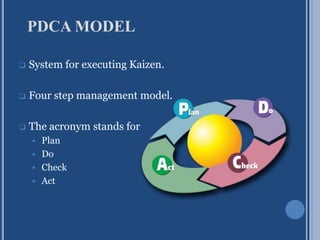
 System for executing Kaizen.
 Four step management model.
 The acronym stands for
 Plan
 Do
 Check
 Act
KAIZEN'S ADVANTAGES
 Reduces waste
 Improves employee utilization
 Improves production
 Reduces completion cycle time
 Higher job satisfaction
PERSONS INVOLVED
 Praise and encourage participation.
 People at every level are involved.
 The key people involved are;
 The subject matter expert
 The process owner
 Front-line workers
 An outside novice
IMPLEMENTING KAIZEN
 A critical business issue is identified.
 A Project Leader is selected.
 Project Leader selects a team
 Train the event team
 Gather data and facts
 Report and implementation plan is created.
 Implementation on small scale.
 A Final Report is presented
TOYOTA PRODUCTION SYSTEM
 Kaizen resulted from the competition between Nissan
and Toyota.
 Nissan won 'Deming' prize in 1961.
 Toyota became more aggressive.
 Developed the Toyota Quality Circles in 1962.
TECHNIQUES USED IN TPS
 The Production Cell
 Just in Time (JIT)
 Total productive maintenance
 5s
 Single Piece Flow
 Quality Control Circle
 Waste
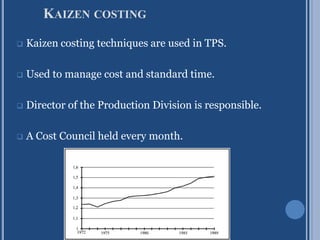
KAIZEN COSTING
 Kaizen costing techniques are used in TPS.
 Used to manage cost and standard time.
 Director of the Production Division is responsible.
 A Cost Council held every month.
KAIZEN PRODUCTION EFFICIENCY MANAGEMENT
 Toyota production line “Shôjinka”.
 Group leaders are in charge of reducing the cycle time.
 Increasing production efficiency.
 Lowering production cost.
KAIZEN MIND
 Workers are encouraged to suggest ideas.
 Thinking about workplace is important.
 Such voluntary activities increases efficiency.
 Helps to obtain the abilities required for becoming
supervisory.
KAIZEN FOR MAKING ASSEMBLY WORK
MORE ATTRACTIVE
 A new concept of assembly line developed.
 Assembly line was divided into about ten segments.
 A buffer between two segments.
 Group leader is allowed to stop the segment during the
buffer.
 A group can hold a meeting during buffer time.
 Each segment also has a quality checking post.
PIT FALLS IN KAIZEN
 Resistance to change.
 Lack of proper procedure to implement.
 Too much suggestion may lead to confusion and time
wastage.
RECOMMENDATIONS
 Employees consent and views must be taken into
account.
 Use of well defined procedures.
 Well defined procedures must be observed.
THANK YOU

Kaizen

  • 1.
    KAIZEN SYED MOHAMMAD HASSAN NOUKHAIZASLAM AWAIS AHMED ABUZAR KHAN
  • 2.
    WHAT IS KAIZEN? A Japanese term for improvement.  Derived from two terms  KAI meaning Change  ZEN meaning Continuous Improvement  Improvement in  Manufacturing  Engineering  Business management  First implemented in Japan.  Involves all employees.
  • 3.
    PDCA MODEL  Systemfor executing Kaizen.  Four step management model.  The acronym stands for  Plan  Do  Check  Act
  • 4.
    KAIZEN'S ADVANTAGES  Reduceswaste  Improves employee utilization  Improves production  Reduces completion cycle time  Higher job satisfaction
  • 5.
    PERSONS INVOLVED  Praiseand encourage participation.  People at every level are involved.  The key people involved are;  The subject matter expert  The process owner  Front-line workers  An outside novice
  • 6.
    IMPLEMENTING KAIZEN  Acritical business issue is identified.  A Project Leader is selected.  Project Leader selects a team  Train the event team  Gather data and facts  Report and implementation plan is created.  Implementation on small scale.  A Final Report is presented
  • 7.
    TOYOTA PRODUCTION SYSTEM Kaizen resulted from the competition between Nissan and Toyota.  Nissan won 'Deming' prize in 1961.  Toyota became more aggressive.  Developed the Toyota Quality Circles in 1962.
  • 8.
    TECHNIQUES USED INTPS  The Production Cell  Just in Time (JIT)  Total productive maintenance  5s  Single Piece Flow  Quality Control Circle  Waste
  • 9.
    KAIZEN COSTING  Kaizencosting techniques are used in TPS.  Used to manage cost and standard time.  Director of the Production Division is responsible.  A Cost Council held every month.
  • 10.
    KAIZEN PRODUCTION EFFICIENCYMANAGEMENT  Toyota production line “Shôjinka”.  Group leaders are in charge of reducing the cycle time.  Increasing production efficiency.  Lowering production cost.
  • 11.
    KAIZEN MIND  Workersare encouraged to suggest ideas.  Thinking about workplace is important.  Such voluntary activities increases efficiency.  Helps to obtain the abilities required for becoming supervisory.
  • 12.
    KAIZEN FOR MAKINGASSEMBLY WORK MORE ATTRACTIVE  A new concept of assembly line developed.  Assembly line was divided into about ten segments.  A buffer between two segments.  Group leader is allowed to stop the segment during the buffer.  A group can hold a meeting during buffer time.  Each segment also has a quality checking post.
  • 13.
    PIT FALLS INKAIZEN  Resistance to change.  Lack of proper procedure to implement.  Too much suggestion may lead to confusion and time wastage.
  • 14.
    RECOMMENDATIONS  Employees consentand views must be taken into account.  Use of well defined procedures.  Well defined procedures must be observed.
  • 15.