Kaizen Principle
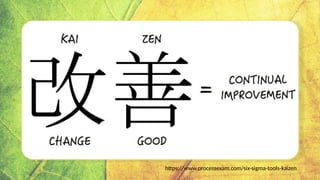
https://www.processexam.com/six-sigma-tools-kaizen
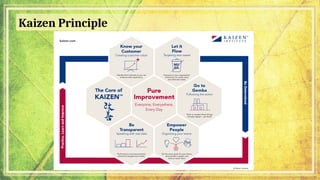
Kaizen Principle
• An approach to creating continuous improvement
based on the idea that small, ongoing positive
changes can reap significant improvements
• Based on cooperation and commitment and stands
in contrast to approaches that use radical or top-
down changes to achieve transformation
• Core to lean manufacturing and the Toyota Way, the
most popular example
KAIZEN™ Methodology Development
History
1930 - Masaaki Imai is born in Tokyo, Japan. The first domestic
automotive production is planned in Japan, and the Just-In-Time
concept is observed.
1940 - World War II post-war economic reform period commences in
Japan
1950 - Imai works at the Japan Productivity Center in the USA and
accompanies Japanese executives to visit and learn from US
manufacturers. Japanese companies gain strength in their quality
and worldwide competitiveness.
1960 - Imai works with Shoichiro Toyoda to observe the American way of
business.
1986 - KAIZEN™ is introduced to the world for the first time, as a
systematic management methodology.
1990s - KAIZEN™ appears for the first time as a word in the Oxford
dictionary.
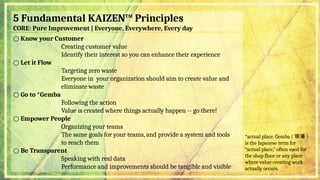
5 Fundamental KAIZEN™ Principles
CORE: Pure Improvement | Everyone, Everywhere, Every day
○ Know your Customer
Creating customer value
Identify their interest so you can enhance their experience
○ Let it Flow
Targeting zero waste
Everyone in your organization should aim to create value and
eliminate waste
○ Go to *Gemba
Following the action
Value is created where things actually happen -- go there!
○ Empower People
Organizing your teams
The same goals for your teams, and provide a system and tools
to reach them
○ Be Transparent
Speaking with real data
Performance and improvements should be tangible and visible
*actual place. Gemba ( 現場 )
is the Japanese term for
“actual place,” often used for
the shop floor or any place
where value-creating work
actually occurs.
Examples of Kaizen
Toyota is arguably the most famous for its use of Kaizen, but other companies
have successfully used the approach. Here are three examples:
Lockheed Martin. The aerospace company is a well-known proponent of Kaizen.
It has used the method to successfully reduce manufacturing costs, inventory and
delivery time.
Ford Motor Company. When lean devotee Alan Mulally became CEO of Ford in
2006, the automaker was on the brink of bankruptcy. Mulally used Kaizen to
execute one of the most famous corporate turnarounds in history.
Pixar Animation Studios. Pixar applied the continuous improvement model to
reduce the risks of expensive movie failure by using quality control checks and
iterative processes.
Kaizen advantages
1. Kaizen's focus on gradual improvement can create a
gentler approach to change in contrast to big efforts
that may be abandoned due to their tendency to
provoke change resistance and pushback.
2. Kaizen encourages scrutiny of processes so that
mistakes and waste are reduced.
3. With fewer errors, oversight and inspection needs
are minimized.
4. Employee morale improves because Kaizen
encourages a sense of value and purpose.
5. Teamwork increases as employees think beyond the
specific issues of their department.
6. Client focus expands as employees become more
aware of customer requirements.
7. Systems are in place to ensure improvements are
encouraged both in the short and long terms.
Kaizen Disadvantages
• Companies with cultures of territorialism and closed
communication may first need to focus on cultural
changes to create a receptive environment.
• Short-term Kaizen events may create a burst of
excitement that is shallow and short-lived and, therefore,
is not sustained.
Resources:
• https://kaizen.com/what-is-kaizen/
• https://www.techtarget.com/searcherp/definition/kaizen-or-continuous-
improvement
• https://youtu.be/4pHgXhv611g?si=ihtA_xdqkWCFAOcD
• https://www.toyota-europe.com/about-us/toyota-vision-and-philosophy/the-toyota-
way
Thank you.

Recent Trends in Management - Kaizen Principle

  • 1.
  • 2.
  • 3.
  • 4.
    • An approachto creating continuous improvement based on the idea that small, ongoing positive changes can reap significant improvements • Based on cooperation and commitment and stands in contrast to approaches that use radical or top- down changes to achieve transformation • Core to lean manufacturing and the Toyota Way, the most popular example
  • 5.
    KAIZEN™ Methodology Development History 1930- Masaaki Imai is born in Tokyo, Japan. The first domestic automotive production is planned in Japan, and the Just-In-Time concept is observed. 1940 - World War II post-war economic reform period commences in Japan 1950 - Imai works at the Japan Productivity Center in the USA and accompanies Japanese executives to visit and learn from US manufacturers. Japanese companies gain strength in their quality and worldwide competitiveness. 1960 - Imai works with Shoichiro Toyoda to observe the American way of business. 1986 - KAIZEN™ is introduced to the world for the first time, as a systematic management methodology. 1990s - KAIZEN™ appears for the first time as a word in the Oxford dictionary.
  • 6.
    5 Fundamental KAIZEN™Principles CORE: Pure Improvement | Everyone, Everywhere, Every day ○ Know your Customer Creating customer value Identify their interest so you can enhance their experience ○ Let it Flow Targeting zero waste Everyone in your organization should aim to create value and eliminate waste ○ Go to *Gemba Following the action Value is created where things actually happen -- go there! ○ Empower People Organizing your teams The same goals for your teams, and provide a system and tools to reach them ○ Be Transparent Speaking with real data Performance and improvements should be tangible and visible *actual place. Gemba ( 現場 ) is the Japanese term for “actual place,” often used for the shop floor or any place where value-creating work actually occurs.
  • 7.
    Examples of Kaizen Toyotais arguably the most famous for its use of Kaizen, but other companies have successfully used the approach. Here are three examples: Lockheed Martin. The aerospace company is a well-known proponent of Kaizen. It has used the method to successfully reduce manufacturing costs, inventory and delivery time. Ford Motor Company. When lean devotee Alan Mulally became CEO of Ford in 2006, the automaker was on the brink of bankruptcy. Mulally used Kaizen to execute one of the most famous corporate turnarounds in history. Pixar Animation Studios. Pixar applied the continuous improvement model to reduce the risks of expensive movie failure by using quality control checks and iterative processes.
  • 8.
    Kaizen advantages 1. Kaizen'sfocus on gradual improvement can create a gentler approach to change in contrast to big efforts that may be abandoned due to their tendency to provoke change resistance and pushback. 2. Kaizen encourages scrutiny of processes so that mistakes and waste are reduced. 3. With fewer errors, oversight and inspection needs are minimized.
  • 9.
    4. Employee moraleimproves because Kaizen encourages a sense of value and purpose. 5. Teamwork increases as employees think beyond the specific issues of their department. 6. Client focus expands as employees become more aware of customer requirements. 7. Systems are in place to ensure improvements are encouraged both in the short and long terms.
  • 10.
    Kaizen Disadvantages • Companieswith cultures of territorialism and closed communication may first need to focus on cultural changes to create a receptive environment. • Short-term Kaizen events may create a burst of excitement that is shallow and short-lived and, therefore, is not sustained.
  • 11.
    Resources: • https://kaizen.com/what-is-kaizen/ • https://www.techtarget.com/searcherp/definition/kaizen-or-continuous- improvement •https://youtu.be/4pHgXhv611g?si=ihtA_xdqkWCFAOcD • https://www.toyota-europe.com/about-us/toyota-vision-and-philosophy/the-toyota- way
  • 12.

Editor's Notes

  • #10 https://youtu.be/vjzycXupydU
  • #11 https://youtu.be/vjzycXupydU