Biotechnology Skill Enhancement Program
(BiSEP)
Domain: Fermentation and Bio-
processing
Seminar Presentation
by:- SACHIN .B .H
Seminar Topic: Types Of
Bioreactors.
Department of Biotechnology,
GUK
CONTENTS:-
 Introduction.
 Types of bioreactors.
 Conclusion.
 References.
INTRODUCTION:-
A fermentor (bioreactor) is a closed vessel with adequate
arrangement for aeration, agitation, temperature and pH control,
and drain or overflow vent to remove the waste biomass of
cultured microorganisms along with their products.
Bioreactors are extensively used for food processing,
fermentation, waste treatment ,etc.
TYPES OF
BIOREACTORS:-
1. Continuous Stirred Tank
Bioreactor.
2. Bubble Column Bioreactor.
3. Airlift Bioreactor.
4. Fluidized Bed Bioreactor.
5. Packed Bed Bioreactor.
6. Photo- Bioreactor.
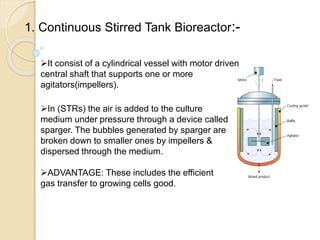
1. Continuous Stirred Tank Bioreactor:-
It consist of a cylindrical vessel with motor driven
central shaft that supports one or more
agitators(impellers).
In (STRs) the air is added to the culture
medium under pressure through a device called
sparger. The bubbles generated by sparger are
broken down to smaller ones by impellers &
dispersed through the medium.
ADVANTAGE: These includes the efficient
gas transfer to growing cells good.
2. Bubble column Bioreactor:
 In the bubble column bioreactors, the air is introduced
at the base of column through perforated pipes or plates.
The flow rate of air influences the performance
factors – oxygen transfer, mixing.
The bubble column bioreactors may be
fitted with performed plates to improve
performance & the vessel used for
bubble column bioreactors is usually
cylindrical.
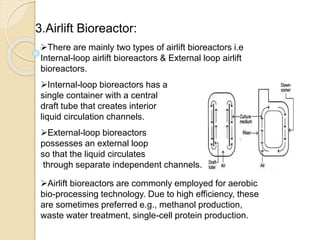
3.Airlift Bioreactor:
There are mainly two types of airlift bioreactors i.e
Internal-loop airlift bioreactors & External loop airlift
bioreactors.
Internal-loop bioreactors has a
single container with a central
draft tube that creates interior
liquid circulation channels.
External-loop bioreactors
possesses an external loop
so that the liquid circulates
through separate independent channels.
Airlift bioreactors are commonly employed for aerobic
bio-processing technology. Due to high efficiency, these
are sometimes preferred e.g., methanol production,
waste water treatment, single-cell protein production.
4. Fluidized Bed Bioreactors:
Fluidized bed bioreactor is comparable to bubble
column bioreactor except the top position is expanded to
reduce the velocity of the fluid.
The design of the fluidized bioreactors is such
that the solids are retained in the reactor while
the liquid flows out.
These bioreactors are suitable for use to
carry
out reactions involving fluid suspended
biocatalyst
such as immobilized enzymes& cells.Recycling of the liquid is important to maintain
continuous contact between the reaction contents
and biocatalysts. This enable good efficiency of
bio-processing.
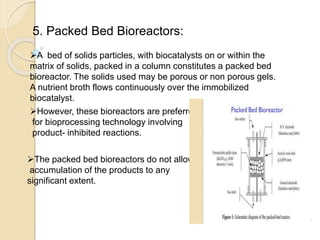
5. Packed Bed Bioreactors:
A bed of solids particles, with biocatalysts on or within the
matrix of solids, packed in a column constitutes a packed bed
bioreactor. The solids used may be porous or non porous gels.
A nutrient broth flows continuously over the immobilized
biocatalyst.
However, these bioreactors are preferred
for bioprocessing technology involving
product- inhibited reactions.
The packed bed bioreactors do not allow
accumulation of the products to any
significant extent.
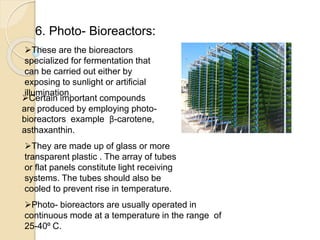
6. Photo- Bioreactors:
These are the bioreactors
specialized for fermentation that
can be carried out either by
exposing to sunlight or artificial
illumination.
Certain important compounds
are produced by employing photo-
bioreactors example β-carotene,
asthaxanthin.
They are made up of glass or more
transparent plastic . The array of tubes
or flat panels constitute light receiving
systems. The tubes should also be
cooled to prevent rise in temperature.
Photo- bioreactors are usually operated in
continuous mode at a temperature in the range of
25-40⁰ C.
REFERENCES
Thank
You

Jyoti bioreactors

  • 1.
    Biotechnology Skill EnhancementProgram (BiSEP) Domain: Fermentation and Bio- processing Seminar Presentation by:- SACHIN .B .H Seminar Topic: Types Of Bioreactors. Department of Biotechnology, GUK
  • 2.
    CONTENTS:-  Introduction.  Typesof bioreactors.  Conclusion.  References.
  • 3.
    INTRODUCTION:- A fermentor (bioreactor)is a closed vessel with adequate arrangement for aeration, agitation, temperature and pH control, and drain or overflow vent to remove the waste biomass of cultured microorganisms along with their products. Bioreactors are extensively used for food processing, fermentation, waste treatment ,etc.
  • 4.
    TYPES OF BIOREACTORS:- 1. ContinuousStirred Tank Bioreactor. 2. Bubble Column Bioreactor. 3. Airlift Bioreactor. 4. Fluidized Bed Bioreactor. 5. Packed Bed Bioreactor. 6. Photo- Bioreactor.
  • 5.
    1. Continuous StirredTank Bioreactor:- It consist of a cylindrical vessel with motor driven central shaft that supports one or more agitators(impellers). In (STRs) the air is added to the culture medium under pressure through a device called sparger. The bubbles generated by sparger are broken down to smaller ones by impellers & dispersed through the medium. ADVANTAGE: These includes the efficient gas transfer to growing cells good.
  • 6.
    2. Bubble columnBioreactor:  In the bubble column bioreactors, the air is introduced at the base of column through perforated pipes or plates. The flow rate of air influences the performance factors – oxygen transfer, mixing. The bubble column bioreactors may be fitted with performed plates to improve performance & the vessel used for bubble column bioreactors is usually cylindrical.
  • 7.
    3.Airlift Bioreactor: There aremainly two types of airlift bioreactors i.e Internal-loop airlift bioreactors & External loop airlift bioreactors. Internal-loop bioreactors has a single container with a central draft tube that creates interior liquid circulation channels. External-loop bioreactors possesses an external loop so that the liquid circulates through separate independent channels. Airlift bioreactors are commonly employed for aerobic bio-processing technology. Due to high efficiency, these are sometimes preferred e.g., methanol production, waste water treatment, single-cell protein production.
  • 8.
    4. Fluidized BedBioreactors: Fluidized bed bioreactor is comparable to bubble column bioreactor except the top position is expanded to reduce the velocity of the fluid. The design of the fluidized bioreactors is such that the solids are retained in the reactor while the liquid flows out. These bioreactors are suitable for use to carry out reactions involving fluid suspended biocatalyst such as immobilized enzymes& cells.Recycling of the liquid is important to maintain continuous contact between the reaction contents and biocatalysts. This enable good efficiency of bio-processing.
  • 9.
    5. Packed BedBioreactors: A bed of solids particles, with biocatalysts on or within the matrix of solids, packed in a column constitutes a packed bed bioreactor. The solids used may be porous or non porous gels. A nutrient broth flows continuously over the immobilized biocatalyst. However, these bioreactors are preferred for bioprocessing technology involving product- inhibited reactions. The packed bed bioreactors do not allow accumulation of the products to any significant extent.
  • 10.
    6. Photo- Bioreactors: Theseare the bioreactors specialized for fermentation that can be carried out either by exposing to sunlight or artificial illumination. Certain important compounds are produced by employing photo- bioreactors example β-carotene, asthaxanthin. They are made up of glass or more transparent plastic . The array of tubes or flat panels constitute light receiving systems. The tubes should also be cooled to prevent rise in temperature. Photo- bioreactors are usually operated in continuous mode at a temperature in the range of 25-40⁰ C.
  • 11.
  • 12.