

DIFFERENT TYPES OF
BIOREACTER
PREPARED BY: SHIVAM PATEL
SUBJECT: BIOPROCESS ENGINEERING
ENROLLMENT NO.:14BT001830
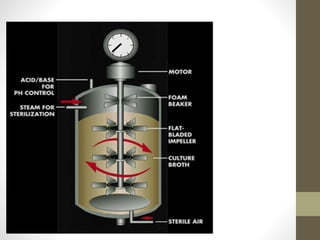
Stirred Tank Bioreactor
• In this bioreactor air is dispersed by mechanical
agitation. Temperature, pH, amount of dissolved
oxygen and nutrient concentration can be
controlled better with this reactor compared to other
reactors.
• Impeller speed is reduced to 50-150 rpm
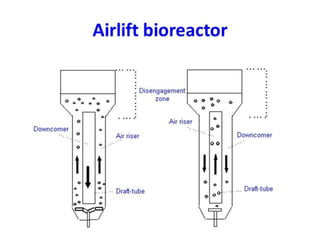
Air lift bioreactor
• Compressed air is used for aeration and mixing of the
contents.
• This is one of the most suitable bioreactor types for
cultivation of plant cells on a large scale.
Merits:
• It provides reasonable mixing and oxygen transfer at low
shear.
• As it has no moving parts, it has less contamination
problem.
• Operating cost is lower than stirred tank reactor.
Demerit:
• Develop dead zones, due to insufficient mixing at high cell
density
Bubble column bioreactor
• This is one of the simplest bioreactor. It consists of a
cylindrical vessel aerated at the bottom.
• Provide high mass and heat transfer areas without
the input of mechanical energy.
• Require minimum maintenance.
Fluidized Bed Bioreactors
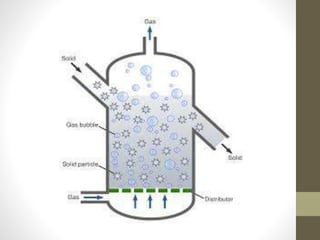
• Fluidized bed bioreactor is comparable to bubble
column bioreactor except the top position is
expanded to reduce the velocity of the fluid.
• The design of the fluidized bioreactors (expanded top
and narrow reaction column) is such that the solids
are retained in the reactor while the liquid flows out.
• These bioreactors are suitable for use to carry out
reactions involving fluid suspended biocatalysts such
as immobilized enzymes, immobilized cells, and
microbial flocs.
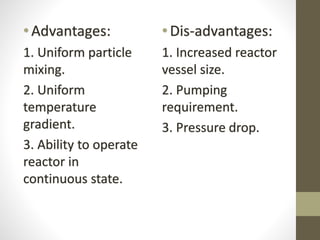
•Advantages:
1. Uniform particle
mixing.
2. Uniform
temperature
gradient.
3. Ability to operate
reactor in
continuous state.
•Dis-advantages:
1. Increased reactor
vessel size.
2. Pumping
requirement.
3. Pressure drop.

Different types of bioreacter

  • 1.
    DIFFERENT TYPES OF BIOREACTER PREPAREDBY: SHIVAM PATEL SUBJECT: BIOPROCESS ENGINEERING ENROLLMENT NO.:14BT001830
  • 2.
    Stirred Tank Bioreactor •In this bioreactor air is dispersed by mechanical agitation. Temperature, pH, amount of dissolved oxygen and nutrient concentration can be controlled better with this reactor compared to other reactors. • Impeller speed is reduced to 50-150 rpm
  • 5.
    Air lift bioreactor •Compressed air is used for aeration and mixing of the contents. • This is one of the most suitable bioreactor types for cultivation of plant cells on a large scale. Merits: • It provides reasonable mixing and oxygen transfer at low shear. • As it has no moving parts, it has less contamination problem. • Operating cost is lower than stirred tank reactor. Demerit: • Develop dead zones, due to insufficient mixing at high cell density
  • 7.
    Bubble column bioreactor •This is one of the simplest bioreactor. It consists of a cylindrical vessel aerated at the bottom. • Provide high mass and heat transfer areas without the input of mechanical energy. • Require minimum maintenance.
  • 8.
    Fluidized Bed Bioreactors •Fluidized bed bioreactor is comparable to bubble column bioreactor except the top position is expanded to reduce the velocity of the fluid. • The design of the fluidized bioreactors (expanded top and narrow reaction column) is such that the solids are retained in the reactor while the liquid flows out. • These bioreactors are suitable for use to carry out reactions involving fluid suspended biocatalysts such as immobilized enzymes, immobilized cells, and microbial flocs.
  • 10.
    •Advantages: 1. Uniform particle mixing. 2.Uniform temperature gradient. 3. Ability to operate reactor in continuous state. •Dis-advantages: 1. Increased reactor vessel size. 2. Pumping requirement. 3. Pressure drop.