MOST PROBABLE NUMBER (MPN)
TECHNIQUE
DEBORAH A R
AGENDA
MPN
TECHNIQUE
2
 WATER
 MOST PROBABLE
NUMBER
 PRINCIPLE
 MATERIAL REQUIRED
 PRESUMPTIVE TEST
 CONFIRMATIVE TEST
 COMPLETE TEST
WATER
MPN
TECHNIQUE
3
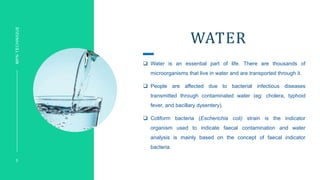
 Water is an essential part of life. There are thousands of
microorganisms that live in water and are transported through it.
 People are affected due to bacterial infectious diseases
transmitted through contaminated water (eg: cholera, typhoid
fever, and bacillary dysentery).
 Coliform bacteria (Escherichia coli) strain is the indicator
organism used to indicate faecal contamination and water
analysis is mainly based on the concept of faecal indicator
bacteria.
MOST PROBABLE NUMBER
Most Probable Number (MPN) is a method used to check
the water.
MPN is most commonly applied for quality testing of water.
In drinking water, the presence of very few faecal coliform
bacteria would indicate that water probably contains no
disease-causing organisms.
While the presence of large numbers of faecal coliform
bacteria would indicate a very high probability that the water
could contain disease-producing organisms making the water
unsafe for consumption.
4
MPN
TECHNIQUE
PRINCIPLE
The most probable number (MPN) is a statistical method.
The coliform groups comprise all aerobic and cultivating anaerobic
bacteria.
Coliform bacterial densities can be determined by either the Multiple
tube fermentation technique (MPN Test). The Multiple tube
fermentation technique providing the Most portable number (MPN) is
an Indirect count technique relying on statistical interpretation of
growth. The test was conducted in three steps Presumptive test,
Confirmatory test, and Complete test.
5
MPN
TECHNIQUE
MATERIALS REQUIRED
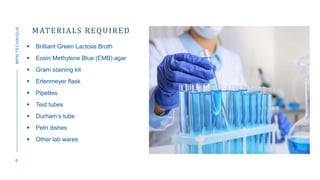
 Brilliant Green Lactose Broth
 Eosin Methylene Blue (EMB) agar
 Gram staining kit
 Erlenmeyer flask
 Pipettes
 Test tubes
 Durham’s tube
 Petri dishes
 Other lab wares
6
MPN
TECHNIQUE
PRESUMPTIVE TEST - PROCEDURE
Distribute 10 ml Single strength lactose broth (SSLB) each to 10 test tubes and
Double distilled strength Lactose broth (DSLB) to 5 test tubes.
Add the Durham's tube in inverted position and sterile them at a time.
After autoclave, Inoculate the 0.1 ml of water sample to each 5 tubes of SSLB, 1 ml
of water sample to each 5 tubes of SSLB tubes and 10 ml of water sample in 5 tubes
of DSLB correspondingly.
Incubate the tubes at 37 °C and examine the gas formation in Durham’s tubes at 24
hours (positive test) or not 48 hours (doubt full tests) proceed to confirmed.
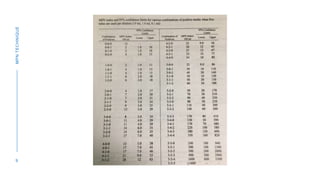
Compare the number of tubes giving positive reaction to a standard chart and record
the number of bacteria present in it.
7
MPN
TECHNIQUE
8
MPN
TECHNIQUE
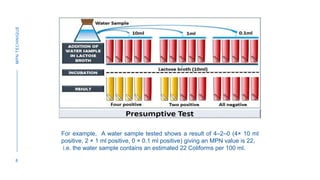
For example, A water sample tested shows a result of 4–2–0 (4× 10 ml
positive, 2 × 1 ml positive, 0 × 0.1 ml positive) giving an MPN value is 22,
i.e. the water sample contains an estimated 22 Coliforms per 100 ml.
9
MPN
TECHNIQUE
1 0
PRESENTATION
TITLE
CONFIRMATIVE TEST - PROCEDURE
Take a loopful culture from the Lactose broth tube from the highest
dilution that still showed a positive test and streaks it on the EMB agar
plate.
Incubate the plates at 37 °C for 24 hours.
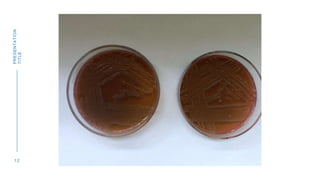
Observe the typical Escherichia coli colonies showing a greenish
metallic sheen.
1 1
MPN
TECHNIQUE
1 2
PRESENTATION
TITLE
COMPLETE TEST
Pick up a suspicious colony (Escherichia coli) from EMB agar plate,
make a smear and conduct Gram staining.
1 3
MPN
TECHNIQUE
HTTPS://YOUTU.BE/VOB9AQO54VU
THANK YOU

Most probable number MPN.pptx

  • 1.
    MOST PROBABLE NUMBER(MPN) TECHNIQUE DEBORAH A R
  • 2.
    AGENDA MPN TECHNIQUE 2  WATER  MOSTPROBABLE NUMBER  PRINCIPLE  MATERIAL REQUIRED  PRESUMPTIVE TEST  CONFIRMATIVE TEST  COMPLETE TEST
  • 3.
    WATER MPN TECHNIQUE 3  Water isan essential part of life. There are thousands of microorganisms that live in water and are transported through it.  People are affected due to bacterial infectious diseases transmitted through contaminated water (eg: cholera, typhoid fever, and bacillary dysentery).  Coliform bacteria (Escherichia coli) strain is the indicator organism used to indicate faecal contamination and water analysis is mainly based on the concept of faecal indicator bacteria.
  • 4.
    MOST PROBABLE NUMBER MostProbable Number (MPN) is a method used to check the water. MPN is most commonly applied for quality testing of water. In drinking water, the presence of very few faecal coliform bacteria would indicate that water probably contains no disease-causing organisms. While the presence of large numbers of faecal coliform bacteria would indicate a very high probability that the water could contain disease-producing organisms making the water unsafe for consumption. 4 MPN TECHNIQUE
  • 5.
    PRINCIPLE The most probablenumber (MPN) is a statistical method. The coliform groups comprise all aerobic and cultivating anaerobic bacteria. Coliform bacterial densities can be determined by either the Multiple tube fermentation technique (MPN Test). The Multiple tube fermentation technique providing the Most portable number (MPN) is an Indirect count technique relying on statistical interpretation of growth. The test was conducted in three steps Presumptive test, Confirmatory test, and Complete test. 5 MPN TECHNIQUE
  • 6.
    MATERIALS REQUIRED  BrilliantGreen Lactose Broth  Eosin Methylene Blue (EMB) agar  Gram staining kit  Erlenmeyer flask  Pipettes  Test tubes  Durham’s tube  Petri dishes  Other lab wares 6 MPN TECHNIQUE
  • 7.
    PRESUMPTIVE TEST -PROCEDURE Distribute 10 ml Single strength lactose broth (SSLB) each to 10 test tubes and Double distilled strength Lactose broth (DSLB) to 5 test tubes. Add the Durham's tube in inverted position and sterile them at a time. After autoclave, Inoculate the 0.1 ml of water sample to each 5 tubes of SSLB, 1 ml of water sample to each 5 tubes of SSLB tubes and 10 ml of water sample in 5 tubes of DSLB correspondingly. Incubate the tubes at 37 °C and examine the gas formation in Durham’s tubes at 24 hours (positive test) or not 48 hours (doubt full tests) proceed to confirmed. Compare the number of tubes giving positive reaction to a standard chart and record the number of bacteria present in it. 7 MPN TECHNIQUE
  • 8.
    8 MPN TECHNIQUE For example, Awater sample tested shows a result of 4–2–0 (4× 10 ml positive, 2 × 1 ml positive, 0 × 0.1 ml positive) giving an MPN value is 22, i.e. the water sample contains an estimated 22 Coliforms per 100 ml.
  • 9.
  • 10.
  • 11.
    CONFIRMATIVE TEST -PROCEDURE Take a loopful culture from the Lactose broth tube from the highest dilution that still showed a positive test and streaks it on the EMB agar plate. Incubate the plates at 37 °C for 24 hours. Observe the typical Escherichia coli colonies showing a greenish metallic sheen. 1 1 MPN TECHNIQUE
  • 12.
  • 13.
    COMPLETE TEST Pick upa suspicious colony (Escherichia coli) from EMB agar plate, make a smear and conduct Gram staining. 1 3 MPN TECHNIQUE
  • 14.