


 Evolved in Japan after World War II, as a result
of their diminishing market share in the auto
industry.
 Toyota Motor Company- first to implement
fully functioning and successful JIT system, in
1970’s.
 Japanese Manufacturers looked for a way to
gain the most efficient use of limited resources.
They worked on "optimal cost/quality
relationship.
 Eliminating wastes
 Total quality management
 Parallel processing
 Jit purchasing
 E-commerce and JIT purchasing
 Reducing inventories through setup reduction
 working towards repetitive manufacturing
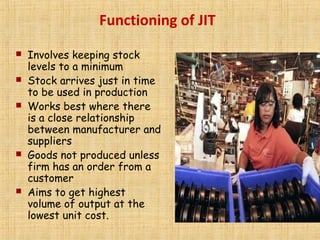
 Involves keeping stock
levels to a minimum
 Stock arrives just in time
to be used in production
 Works best where there
is a close relationship
between manufacturer and
suppliers
 Goods not produced unless
firm has an order from a
customer
 Aims to get highest
volume of output at the
lowest unit cost.
Functioning of JIT
Functioning of JIT
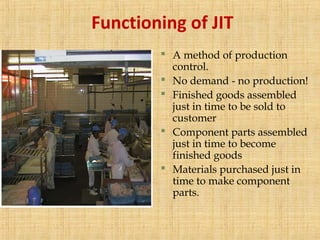
 A method of production
control.
 No demand - no production!
 Finished goods assembled
just in time to be sold to
customer
 Component parts assembled
just in time to become
finished goods
 Materials purchased just in
time to make component
parts.
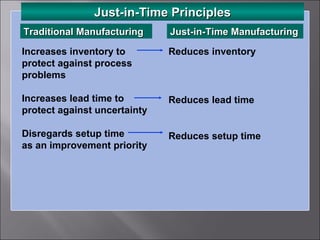
Reduces inventory
Reduces lead time
Reduces setup time
Just-in-Time ManufacturingJust-in-Time ManufacturingTraditional ManufacturingTraditional Manufacturing
Increases inventory to
protect against process
problems
Increases lead time to
protect against uncertainty
Disregards setup time
as an improvement priority
Just-in-Time PrinciplesJust-in-Time Principles
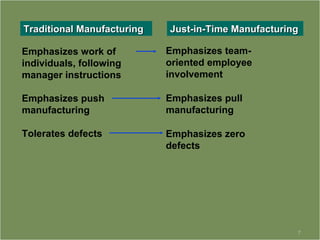
Emphasizes team-
oriented employee
involvement
Emphasizes pull
manufacturing
Emphasizes zero
defects
7
Just-in-Time ManufacturingJust-in-Time ManufacturingTraditional ManufacturingTraditional Manufacturing
Emphasizes work of
individuals, following
manager instructions
Emphasizes push
manufacturing
Tolerates defects
• Dell do not have to tie up capital in stock which means they can
invest it in other areas of the business, such as R&D or promotion,
to increase sales.
• Dell require less space for stock which means they save money on
storage facilities which will increase their profit margins.
• Dell have a high dependence on their suppliers and should the
suppliers fail them, it is Dell’s reputation and sales which would
suffer if they were unable to meet demand from their customers.
• Dell may be unable to benefit from bulk-buy discounts which
leaves them with an option of increasing the price to the customer
or reducing their own profit margin.
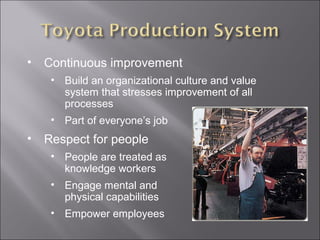
• Continuous improvement
• Build an organizational culture and value
system that stresses improvement of all
processes
• Part of everyone’s job
• Respect for people
• People are treated as
knowledge workers
• Engage mental and
physical capabilities
• Empower employees
• Standard work practice
• Work shall be completely specified as to
content, sequence, timing, and outcome
• Internal and external customer-supplier
connection are direct
• Product and service flows must be simple
and direct
• Any improvement must be made in
accordance with the scientific method at
the lowest possible level of the
organization
Toyota Production System
 Capital not tied up in stocks
 Less space required for stock
 Closer relationships with suppliers
 Reduced deterioration
 Less vulnerability to fashion and
technology changes
 Reduction in stockholding costs
 Increase in cash flow
 Danger of disrupted production due to non-
arrival of supplies
 Danger of lost sales
 High dependence on suppliers
 Less time for quality control on arrival of
materials
 Increased ordering and admin costs
 May lose bulk-buying discounts

just in time

  • 2.
     Evolved inJapan after World War II, as a result of their diminishing market share in the auto industry.  Toyota Motor Company- first to implement fully functioning and successful JIT system, in 1970’s.  Japanese Manufacturers looked for a way to gain the most efficient use of limited resources. They worked on "optimal cost/quality relationship.
  • 3.
     Eliminating wastes Total quality management  Parallel processing  Jit purchasing  E-commerce and JIT purchasing  Reducing inventories through setup reduction  working towards repetitive manufacturing
  • 4.
     Involves keepingstock levels to a minimum  Stock arrives just in time to be used in production  Works best where there is a close relationship between manufacturer and suppliers  Goods not produced unless firm has an order from a customer  Aims to get highest volume of output at the lowest unit cost. Functioning of JIT
  • 5.
    Functioning of JIT A method of production control.  No demand - no production!  Finished goods assembled just in time to be sold to customer  Component parts assembled just in time to become finished goods  Materials purchased just in time to make component parts.
  • 6.
    Reduces inventory Reduces leadtime Reduces setup time Just-in-Time ManufacturingJust-in-Time ManufacturingTraditional ManufacturingTraditional Manufacturing Increases inventory to protect against process problems Increases lead time to protect against uncertainty Disregards setup time as an improvement priority Just-in-Time PrinciplesJust-in-Time Principles
  • 7.
    Emphasizes team- oriented employee involvement Emphasizespull manufacturing Emphasizes zero defects 7 Just-in-Time ManufacturingJust-in-Time ManufacturingTraditional ManufacturingTraditional Manufacturing Emphasizes work of individuals, following manager instructions Emphasizes push manufacturing Tolerates defects
  • 10.
    • Dell donot have to tie up capital in stock which means they can invest it in other areas of the business, such as R&D or promotion, to increase sales. • Dell require less space for stock which means they save money on storage facilities which will increase their profit margins. • Dell have a high dependence on their suppliers and should the suppliers fail them, it is Dell’s reputation and sales which would suffer if they were unable to meet demand from their customers. • Dell may be unable to benefit from bulk-buy discounts which leaves them with an option of increasing the price to the customer or reducing their own profit margin.
  • 11.
    • Continuous improvement •Build an organizational culture and value system that stresses improvement of all processes • Part of everyone’s job • Respect for people • People are treated as knowledge workers • Engage mental and physical capabilities • Empower employees
  • 12.
    • Standard workpractice • Work shall be completely specified as to content, sequence, timing, and outcome • Internal and external customer-supplier connection are direct • Product and service flows must be simple and direct • Any improvement must be made in accordance with the scientific method at the lowest possible level of the organization Toyota Production System
  • 13.
     Capital nottied up in stocks  Less space required for stock  Closer relationships with suppliers  Reduced deterioration  Less vulnerability to fashion and technology changes  Reduction in stockholding costs  Increase in cash flow
  • 14.
     Danger ofdisrupted production due to non- arrival of supplies  Danger of lost sales  High dependence on suppliers  Less time for quality control on arrival of materials  Increased ordering and admin costs  May lose bulk-buying discounts