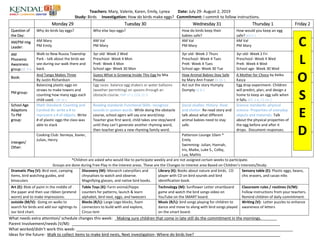
Teachers: Mary, Valerie, Karen, Emily, Lynea Date: July 29- August 2, 2019
Study: Birds Investigation: How do birds make eggs? Commitment: I commit to follow instructions.
Monday 29 Tuesday 30 Wednesday 31 Thursday 1 Friday 2
Question of
the Day:
Why do birds lay eggs? Who else lays eggs? How do birds keep their
babies safe?
How would you keep an egg
safe? SED 4-2
AM/PM mtg
Leader:
AM Mary
PM Emily
AM Val
PM Mary
AM Val
PM Mary
AM Val
PM Mary
AM
Phonemic
Awareness
group: LC 7-5
Walk to New Russia Township
Park - talk about the birds we
see during our walk there and
back.
3yr old- Week 2 Wed
Preschool- Week 4 Mon
PreK- Week 4 Mon
School age- Week 30 Mon
3yr old- Week 2 Thurs
Preschool- Week 4 Tues
PreK- Week 4 Tues
School age- Week 30 Tue
3yr old- Week 2 Fri
Preschool- Week 4 Wed
PreK- Week 4 Wed
School age- Week 30 Wed
Book:
And Tango Makes Three
By Justin Richardson
Guess What Is Growing Inside This Egg by Mia
Posada
How Animal Babies Stay Safe
by Mary Ann Fraser SS 16-1
A Mother for Choco by Keiko
Kasza
PM group:
Balancing plastic eggs on
straws to make towers and
counting how many eggs each
child used. CM 10-1
Egg races- balance egg shakers or water balloons
(weather permitting) on spoons through an
obstacle course. PMP 17-1, CCA 21-3
Act out the story Humpty
Dumpty LK 8-1
Egg drop experiment- Children
will predict, plan, and design a
home to keep an egg safe when
it falls. ATL 1-6, CS 14-2
School Age
Adaptions
To PM
group:
Math Standard: Counting and
Cardinal #s- write a # to
represent a # of objects. Write
# of plastic eggs the class was
able to stack
Reading standards Functional Skills- recognize
sounds in spoken words. While doing the obstacle
course, school agers will say one word/step
Teacher give first word, child takes one step/word
until they can’t generate another rhyming word,
then teacher gives a new rhyming family word.
Social studies: History- food
and shelter. Re-read story and
talk about what different
animal babies need to stay
safe.
Science standards: physical
science- Properties of everyday
objects and materials. Talk
about the physical properties of
the egg before and after it
drops. Document responses.
Intergen/
Other:
Cooking Club: Xenieya, Xavier,
Julian, Henry
Patterson Lounge 10am *
Emily
Swimming- Julian, Hannah,
Iris, Maike, Luke S., Colby,
Lua, Mathis
*Children are asked who would like to participate weekly and are not assigned certain weeks to participate.
Groups are done during Free Play in the Interest areas. These are the Changes to Interest area Based on Children’s Interests/Study:
Dramatic Play (V): Bird nest, camping
items, bird watching guides, and
binoculars
Discovery (M): Monarch caterpillars and
chrysalises to watch and observe.
Magnifying glasses, and native bird books.
Library (K): Books about nature and birds. CD
player with CD on bird sounds and bird
identification book.
Sensory table (E): Plastic eggs, beans,
chic erasers, and cacao nibs
Art (E): Blob of paint in the middle of
the paper and then use ribbon (pretend
worm) and to make impressions.
Table Toys (K): Farm animal/hippo
counters for patterns, launch & learn
alphabet, bird nest, eggs, and tweezers
Technology (M): Sunflower Letter smartboard
game and watch the bird songs video on
YouTube on the SMART board.
Classroom rules / routines (V/M):
Follow instructions from your teachers.
Remind children of daily commitment.
outside (M/V): Going on walks to
search for birds and add our sightings to
our bird chart.
Blocks (R/L): Large Lego blocks, foam
connectors to build with and explore,
Circus tent
Music (R/L): bird songs playing for children to
dance and move to along with bird songs played
on the smart board.
Writing (V): Letter puzzles to enhance
awareness of letters
What needs extra attention/ schedule changes this week: _Making sure children that come in late still do the commitment in the mornings._______
Parent Involvement/needs (V/M): ______________________________________________________________________________________________
What worked/didn’t work this week: __________________________________________________________________________________________________
Ideas for the future: Walk to collect items to make bird nests, Next investigation- Where do birds live?_______________________________________
C
L
O
S
E
D
Standard Description Standard Description
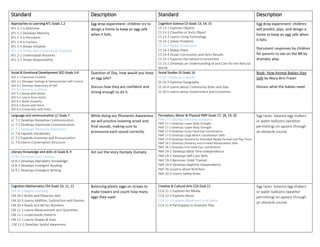
Approaches to Learning ATL Goals 1,2
ATL 1-1 Is Attentive
ATL 1-2 Develops Memory
ATL 1-3 Is Persistent
ATL 1-4 Is Curious
ATL 1-5 Shows Initiative
ATL 1-6 Thinks with Creativity & Flexibility
ATL 2-1 Understands Routines
ATL 2-2 Shows Responsibility
Egg drop experiment- children try to
design a home to keep an egg safe
when it falls.
Cognition Science CS Goals 13, 14, 15
CS 13-1 Explores Objects
CS 13-2 Classifies or Sorts Object
CS 13-3 Learns Using Technology
CS 14-1 Solves Problems
CS 14-2 Makes Predictions
CS 14-3 Makes Plans
CS 14-4 Draws Conclusions and Sorts Results
CS 15-1 Explores the natural Environment
CS 15-2 Develops an Understanding of and Care for the Natural
World
Egg drop experiment- children
will predict, plan, and design a
home to keep an egg safe when
it falls.
Document responses by children
for parents to see on the BB by
dramatic play.
Social & Emotional Development SED Goals 3-6
SED 3-1 Expresses Emotion
SED 3-2 Manages Feelings & Demonstrates Self-Control
SED 4-1 Develops Awareness of Self
SED 4-2 Becomes Confident
SED 5-1 Bonds with Adults
SED 5-2 Learns from Adults
SED 6-1 Builds Empathy
SED 6-2 Bonds with Peers
SED 6-3 Cooperates with Peers
Question of Day, how would you keep
an egg safe?
Discuss how they are confident and
strong enough to do it.
Social Studies SS Goals 16
SS 16-1 Explores Cultures
SS 16-3 Explores Geography
SS 16-4 Learns about Community Roles and Jobs
SS 16-5 Learns about Government and Economics
Book- How Animal Babies Stay
Safe by Mary Ann Fraser
Discuss what the babies need
Language and communication LC Goals 7
LC 7-1 Develops Receptive Communication
LC 7-2 Develops Expressive Communication
LC 7-3 Develops Phonemic Awareness
LC 7-4 Expands Vocabulary
LC 7-5 Expands Grammar and Pronunciation
LC 7-6 Learns Conversation Structure
While doing our Phonemic Awareness
we will practice isolating onset and
final sounds, making sure to
pronounce each sound correctly.
Perception, Motor & Physical PMP Goals 17, 18, 19, 20
PMP 17-1 Develops Perception & Balance
PMP 17-2 Develops Lower Body Strength
PMP 17-3 Develops Upper Body Strength
PMP 17-4 Develops Gross Hand-Eye Coordination
PMP 17-5 Develops Large Motor Coordination Skills
PMP 17-6 Develops Stamina for Extended Awake Periods and Play Times
PMP 18-1 Develops Dexterity and In-Hand Manipulation Skills
PMP 18-2 Develops Fine Hand-Eye Coordination
PMP 19-1 Develops Meal Time Independence
PMP 19-2 Develops Self-Care Skills
PMP 19-3 Becomes Toilet Trained
PMP 19-4 Develops Naptime Independence
PMP 20-1Learns about Nutrition
PMP 20-2 Learns Safety Rules
Egg races- balance egg shakers
or water balloons (weather
permitting) on spoons through
an obstacle course.
Literacy Knowledge and skills LK Goals 8, 9
LK 8-1 Develops Early Literacy
LK 8-2 Develops Alphabetic Knowledge
LK 8-3 Develops Emergent Reading
LK 9-1 Develops Emergent Writing
Act out the story Humpty Dumpty
Cognition Mathematics CM Goals 10, 11, 12
CM 10-1 Begins Counting
CM 10-2 Builds and Observes Sets
CM 10-3 Learns Addition, Subtraction and Division
CM 10-4 Reads and Writes Numbers
CM 11-1 Learns Measurement and Quantities
CM 11-2 Understands Patterns
CM 12-1 Learns Shapes & Sizes
CM 12-2 Develops Spatial Awareness
Balancing plastic eggs on straws to
make towers and count how many
eggs they used
Creative & Cultural Arts CCA Goal 21
CCA 21-1 Explores Art Media
CCA 12-2 Explores Music
CCA 21-3 Explores Movement and Dance
CCA 21-4 Participates in Dramatic Play
Egg races- balance egg shakers
or water balloons (weather
permitting) on spoons through
an obstacle course.

July week 5 birds

  • 1.
    Teachers: Mary, Valerie,Karen, Emily, Lynea Date: July 29- August 2, 2019 Study: Birds Investigation: How do birds make eggs? Commitment: I commit to follow instructions. Monday 29 Tuesday 30 Wednesday 31 Thursday 1 Friday 2 Question of the Day: Why do birds lay eggs? Who else lays eggs? How do birds keep their babies safe? How would you keep an egg safe? SED 4-2 AM/PM mtg Leader: AM Mary PM Emily AM Val PM Mary AM Val PM Mary AM Val PM Mary AM Phonemic Awareness group: LC 7-5 Walk to New Russia Township Park - talk about the birds we see during our walk there and back. 3yr old- Week 2 Wed Preschool- Week 4 Mon PreK- Week 4 Mon School age- Week 30 Mon 3yr old- Week 2 Thurs Preschool- Week 4 Tues PreK- Week 4 Tues School age- Week 30 Tue 3yr old- Week 2 Fri Preschool- Week 4 Wed PreK- Week 4 Wed School age- Week 30 Wed Book: And Tango Makes Three By Justin Richardson Guess What Is Growing Inside This Egg by Mia Posada How Animal Babies Stay Safe by Mary Ann Fraser SS 16-1 A Mother for Choco by Keiko Kasza PM group: Balancing plastic eggs on straws to make towers and counting how many eggs each child used. CM 10-1 Egg races- balance egg shakers or water balloons (weather permitting) on spoons through an obstacle course. PMP 17-1, CCA 21-3 Act out the story Humpty Dumpty LK 8-1 Egg drop experiment- Children will predict, plan, and design a home to keep an egg safe when it falls. ATL 1-6, CS 14-2 School Age Adaptions To PM group: Math Standard: Counting and Cardinal #s- write a # to represent a # of objects. Write # of plastic eggs the class was able to stack Reading standards Functional Skills- recognize sounds in spoken words. While doing the obstacle course, school agers will say one word/step Teacher give first word, child takes one step/word until they can’t generate another rhyming word, then teacher gives a new rhyming family word. Social studies: History- food and shelter. Re-read story and talk about what different animal babies need to stay safe. Science standards: physical science- Properties of everyday objects and materials. Talk about the physical properties of the egg before and after it drops. Document responses. Intergen/ Other: Cooking Club: Xenieya, Xavier, Julian, Henry Patterson Lounge 10am * Emily Swimming- Julian, Hannah, Iris, Maike, Luke S., Colby, Lua, Mathis *Children are asked who would like to participate weekly and are not assigned certain weeks to participate. Groups are done during Free Play in the Interest areas. These are the Changes to Interest area Based on Children’s Interests/Study: Dramatic Play (V): Bird nest, camping items, bird watching guides, and binoculars Discovery (M): Monarch caterpillars and chrysalises to watch and observe. Magnifying glasses, and native bird books. Library (K): Books about nature and birds. CD player with CD on bird sounds and bird identification book. Sensory table (E): Plastic eggs, beans, chic erasers, and cacao nibs Art (E): Blob of paint in the middle of the paper and then use ribbon (pretend worm) and to make impressions. Table Toys (K): Farm animal/hippo counters for patterns, launch & learn alphabet, bird nest, eggs, and tweezers Technology (M): Sunflower Letter smartboard game and watch the bird songs video on YouTube on the SMART board. Classroom rules / routines (V/M): Follow instructions from your teachers. Remind children of daily commitment. outside (M/V): Going on walks to search for birds and add our sightings to our bird chart. Blocks (R/L): Large Lego blocks, foam connectors to build with and explore, Circus tent Music (R/L): bird songs playing for children to dance and move to along with bird songs played on the smart board. Writing (V): Letter puzzles to enhance awareness of letters What needs extra attention/ schedule changes this week: _Making sure children that come in late still do the commitment in the mornings._______ Parent Involvement/needs (V/M): ______________________________________________________________________________________________ What worked/didn’t work this week: __________________________________________________________________________________________________ Ideas for the future: Walk to collect items to make bird nests, Next investigation- Where do birds live?_______________________________________ C L O S E D
  • 2.
    Standard Description StandardDescription Approaches to Learning ATL Goals 1,2 ATL 1-1 Is Attentive ATL 1-2 Develops Memory ATL 1-3 Is Persistent ATL 1-4 Is Curious ATL 1-5 Shows Initiative ATL 1-6 Thinks with Creativity & Flexibility ATL 2-1 Understands Routines ATL 2-2 Shows Responsibility Egg drop experiment- children try to design a home to keep an egg safe when it falls. Cognition Science CS Goals 13, 14, 15 CS 13-1 Explores Objects CS 13-2 Classifies or Sorts Object CS 13-3 Learns Using Technology CS 14-1 Solves Problems CS 14-2 Makes Predictions CS 14-3 Makes Plans CS 14-4 Draws Conclusions and Sorts Results CS 15-1 Explores the natural Environment CS 15-2 Develops an Understanding of and Care for the Natural World Egg drop experiment- children will predict, plan, and design a home to keep an egg safe when it falls. Document responses by children for parents to see on the BB by dramatic play. Social & Emotional Development SED Goals 3-6 SED 3-1 Expresses Emotion SED 3-2 Manages Feelings & Demonstrates Self-Control SED 4-1 Develops Awareness of Self SED 4-2 Becomes Confident SED 5-1 Bonds with Adults SED 5-2 Learns from Adults SED 6-1 Builds Empathy SED 6-2 Bonds with Peers SED 6-3 Cooperates with Peers Question of Day, how would you keep an egg safe? Discuss how they are confident and strong enough to do it. Social Studies SS Goals 16 SS 16-1 Explores Cultures SS 16-3 Explores Geography SS 16-4 Learns about Community Roles and Jobs SS 16-5 Learns about Government and Economics Book- How Animal Babies Stay Safe by Mary Ann Fraser Discuss what the babies need Language and communication LC Goals 7 LC 7-1 Develops Receptive Communication LC 7-2 Develops Expressive Communication LC 7-3 Develops Phonemic Awareness LC 7-4 Expands Vocabulary LC 7-5 Expands Grammar and Pronunciation LC 7-6 Learns Conversation Structure While doing our Phonemic Awareness we will practice isolating onset and final sounds, making sure to pronounce each sound correctly. Perception, Motor & Physical PMP Goals 17, 18, 19, 20 PMP 17-1 Develops Perception & Balance PMP 17-2 Develops Lower Body Strength PMP 17-3 Develops Upper Body Strength PMP 17-4 Develops Gross Hand-Eye Coordination PMP 17-5 Develops Large Motor Coordination Skills PMP 17-6 Develops Stamina for Extended Awake Periods and Play Times PMP 18-1 Develops Dexterity and In-Hand Manipulation Skills PMP 18-2 Develops Fine Hand-Eye Coordination PMP 19-1 Develops Meal Time Independence PMP 19-2 Develops Self-Care Skills PMP 19-3 Becomes Toilet Trained PMP 19-4 Develops Naptime Independence PMP 20-1Learns about Nutrition PMP 20-2 Learns Safety Rules Egg races- balance egg shakers or water balloons (weather permitting) on spoons through an obstacle course. Literacy Knowledge and skills LK Goals 8, 9 LK 8-1 Develops Early Literacy LK 8-2 Develops Alphabetic Knowledge LK 8-3 Develops Emergent Reading LK 9-1 Develops Emergent Writing Act out the story Humpty Dumpty Cognition Mathematics CM Goals 10, 11, 12 CM 10-1 Begins Counting CM 10-2 Builds and Observes Sets CM 10-3 Learns Addition, Subtraction and Division CM 10-4 Reads and Writes Numbers CM 11-1 Learns Measurement and Quantities CM 11-2 Understands Patterns CM 12-1 Learns Shapes & Sizes CM 12-2 Develops Spatial Awareness Balancing plastic eggs on straws to make towers and count how many eggs they used Creative & Cultural Arts CCA Goal 21 CCA 21-1 Explores Art Media CCA 12-2 Explores Music CCA 21-3 Explores Movement and Dance CCA 21-4 Participates in Dramatic Play Egg races- balance egg shakers or water balloons (weather permitting) on spoons through an obstacle course.