Swazi Nontobeko
Mhlongo
Grade 10
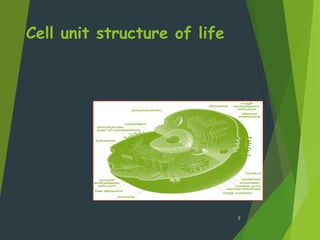
Cell unit structure of life
2
What is Biology?
Biology is the study of all
living things
 Living things are called
organisms
Organisms include bacteria,
protists, fungi, plants, &
animals
3
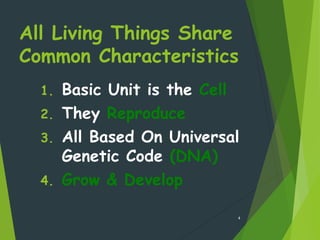
All Living Things Share
Common Characteristics
1. Basic Unit is the Cell
2. They Reproduce
3. All Based On Universal
Genetic Code (DNA)
4. Grow & Develop
4
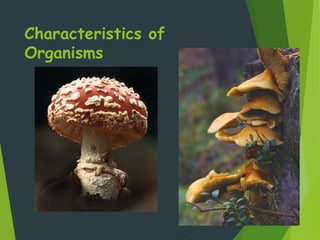
Characteristics of
Organisms
5
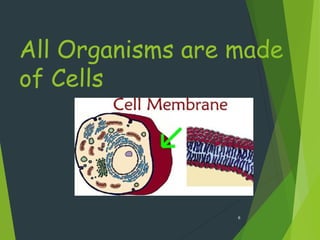
All Organisms are made
of Cells
6
Facts About Cells
Cells are the smallest living
unit of an organism
All cells contain living
material called cytoplasm
All cells are surrounded by
a cell membrane that
controls what enters &
leaves the cell
7
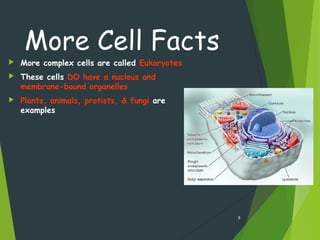
More Cell Facts
 More complex cells are called Eukaryotes
 These cells DO have a nucleus and
membrane-bound organelles
 Plants, animals, protists, & fungi are
examples
8
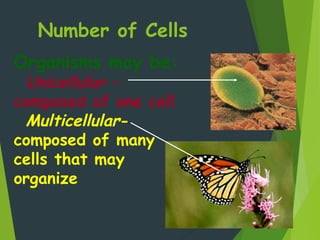
Number of Cells
9
Organisms may be:
• Unicellular –
composed of one cell
• Multicellular-
composed of many
cells that may
organize
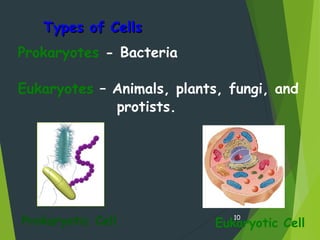
Types of CellsTypes of Cells
Prokaryotes - Bacteria
Eukaryotes – Animals, plants, fungi, and
protists.
10
Eukaryotic CellProkaryotic Cell
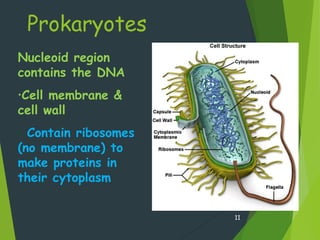
Prokaryotes
11
Nucleoid region
contains the DNA
•Cell membrane &
cell wall
• Contain ribosomes
(no membrane) to
make proteins in
their cytoplasm
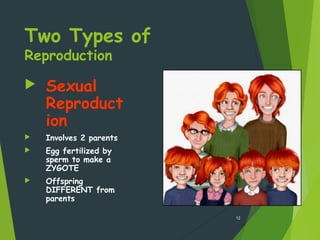
Two Types of
Reproduction
 Sexual
Reproduct
ion
 Involves 2 parents
 Egg fertilized by
sperm to make a
ZYGOTE
 Offspring
DIFFERENT from
parents
12
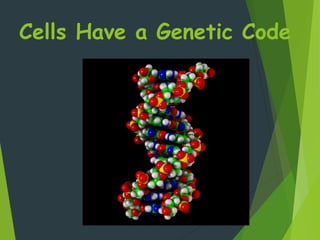
Cells Have a Genetic Code
13
Genetic Code
DNA (deoxyribose nucleic acid)
carries the genetic code for all
organisms
All organisms contain DNA
DNA codes for the proteins that
make up cells & do all the work
14
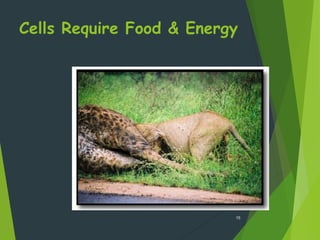
Cells Require Food & Energy
15
Food Requirements
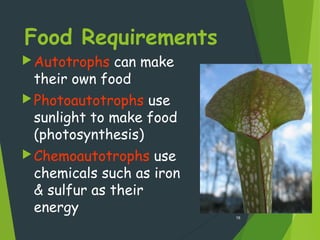
Autotrophs can make
their own food
Photoautotrophs use
sunlight to make food
(photosynthesis)
Chemoautotrophs use
chemicals such as iron
& sulfur as their
energy
16
Food Requirements
Heterotrophs can NOT make
their own food
They must consume other
organisms
Herbivores eat plants
Carnivores eat meat
Omnivores eat plants &
animals
17
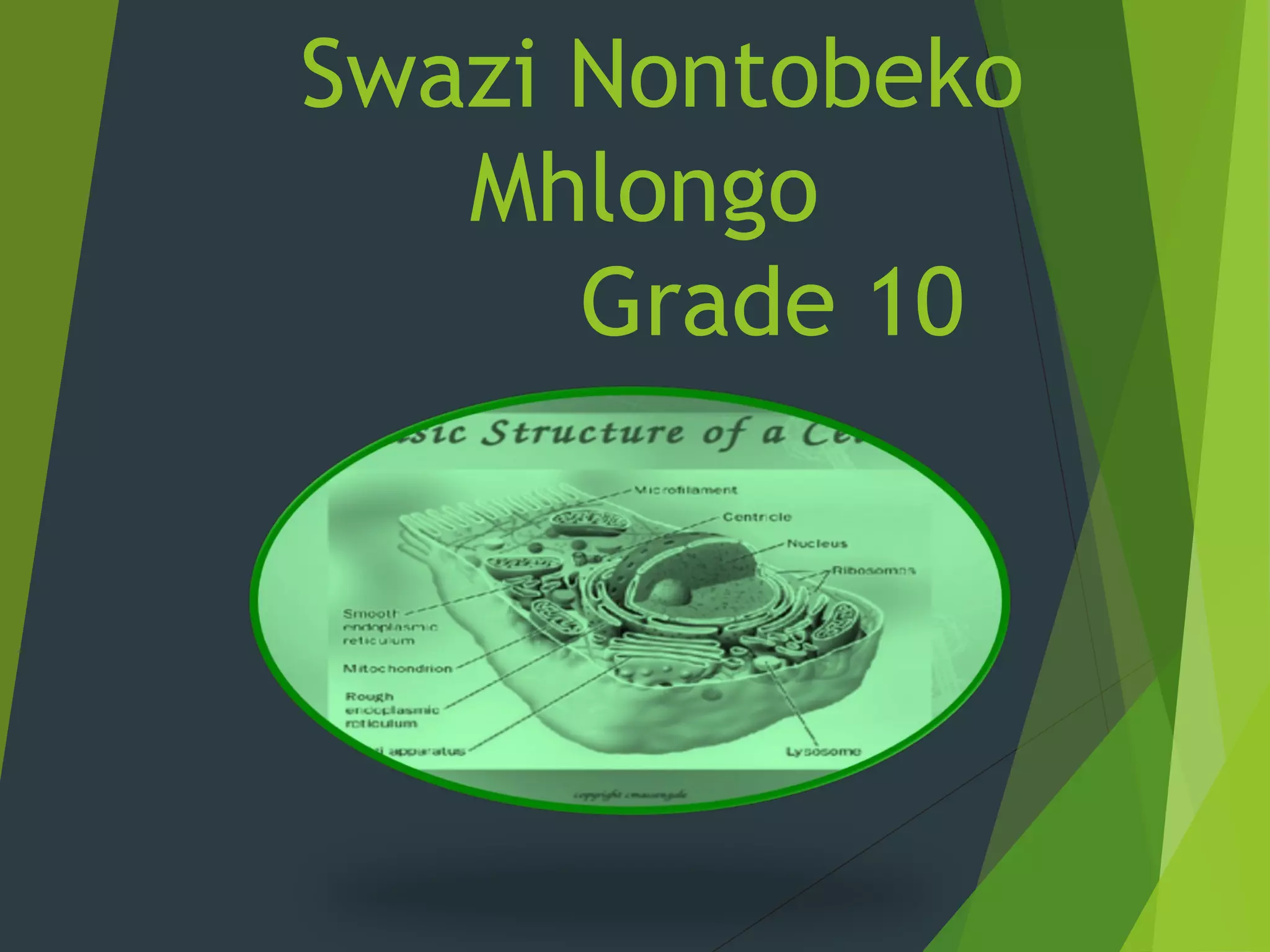
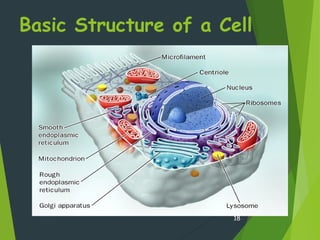
Basic Structure of a Cell
18
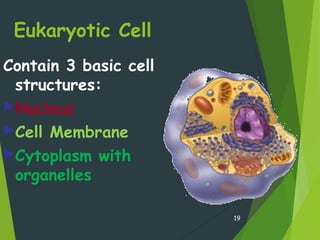
Eukaryotic Cell
Contain 3 basic cell
structures:
Nucleus
Cell Membrane
Cytoplasm with
organelles
19
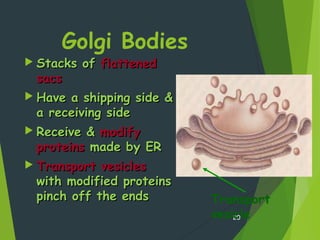
Golgi Bodies
 Stacks ofStacks of flattenedflattened
sacssacs
 Have a shipping side &Have a shipping side &
a receiving sidea receiving side
 Receive &Receive & modifymodify
proteinsproteins made by ERmade by ER
 Transport vesiclesTransport vesicles
with modified proteinswith modified proteins
pinch off the endspinch off the ends
20
Transport
vesicle
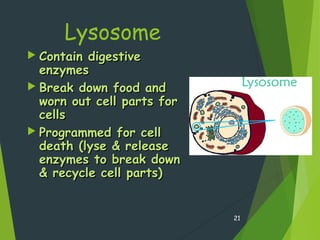
Lysosome
 Contain digestiveContain digestive
enzymesenzymes
 Break down food andBreak down food and
worn out cell parts forworn out cell parts for
cellscells
 Programmed for cellProgrammed for cell
death (lyse & releasedeath (lyse & release
enzymes to break downenzymes to break down
& recycle cell parts)& recycle cell parts)
21
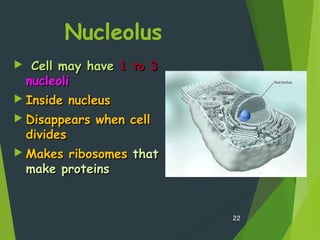
Nucleolus
 Cell may haveCell may have 1 to 31 to 3
nucleolinucleoli
 Inside nucleusInside nucleus
 Disappears when cellDisappears when cell
dividesdivides
 Makes ribosomesMakes ribosomes thatthat
make proteinsmake proteins
22
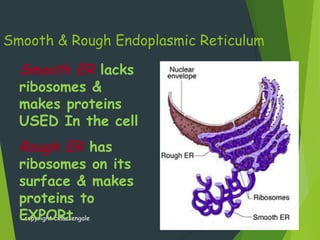
Smooth & Rough Endoplasmic Reticulum
copyright cmassengale 23
Smooth ER lacks
ribosomes &
makes proteins
USED In the cell
Rough ER has
ribosomes on its
surface & makes
proteins to
EXPORt
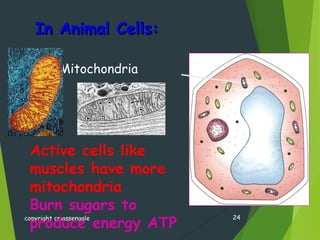
In Animal Cells:In Animal Cells:
copyright cmassengale 24
Active cells like
muscles have more
mitochondria
Burn sugars to
produce energy ATP
Mitochondria
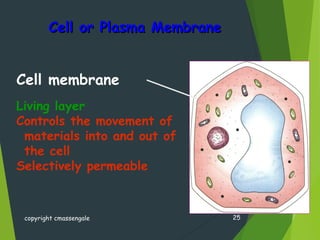
Cell or Plasma MembraneCell or Plasma Membrane
copyright cmassengale 25
Living layer
Controls the movement of
materials into and out of
the cell
Selectively permeable
Cell membrane
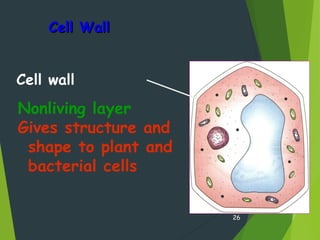
Cell WallCell Wall
26
Nonliving layer
Gives structure and
shape to plant and
bacterial cells
Cell wall
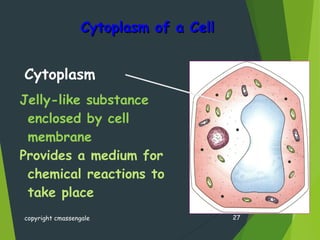
Cytoplasm of a CellCytoplasm of a Cell
copyright cmassengale 27
Jelly-like substance
enclosed by cell
membrane
Provides a medium for
chemical reactions to
take place
Cytoplasm
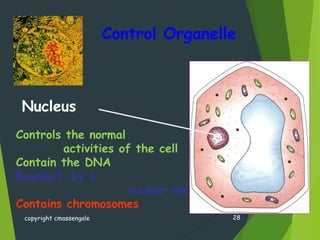
Control Organelle
copyright cmassengale 28
Controls the normal
activities of the cell
Contain the DNA
Bounded by a
nuclear membrane
Contains chromosomes
Nucleus
Plant CellPlant Cell
29
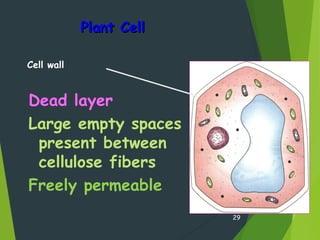
Dead layer
Large empty spaces
present between
cellulose fibers
Freely permeable
Cell wall
Plant CellPlant Cell
copyright cmassengale 30
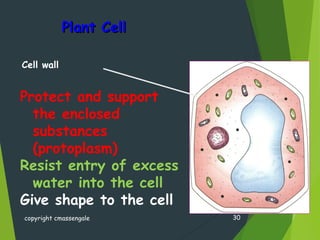
Protect and support
the enclosed
substances
(protoplasm)
Resist entry of excess
water into the cell
Give shape to the cell
Cell wall
Plant Cell OrganellesPlant Cell Organelles
31
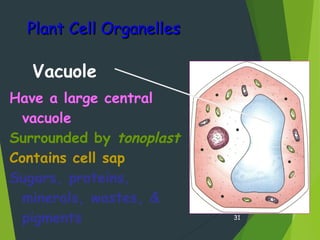
Have a large central
vacuole
Surrounded by tonoplast
Contains cell sap
Sugars, proteins,
minerals, wastes, &
pigments
Vacuole
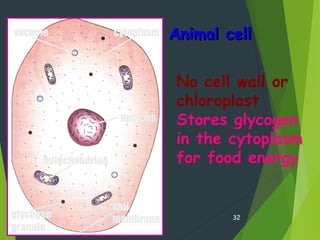
Animal cellAnimal cell
copyright cmassengale 32
mitochondrion
nucleus
glycogen
granule
cell
membrane
cytoplasm
No cell wall or
chloroplast
Stores glycogen
in the cytoplasm
for food energy
vacuole
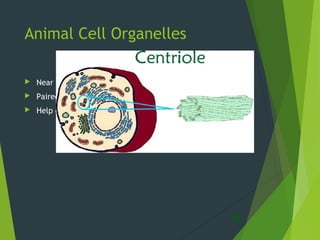
Animal Cell Organelles
 Near the nucleus
 Paired structures
 Help cell divide
33
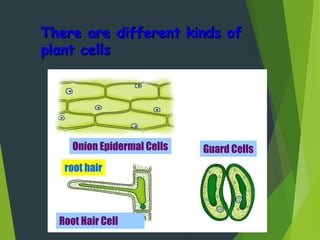
There are different kinds ofThere are different kinds of
plant cellsplant cells
34
Onion Epidermal Cells
Root Hair Cell
root hair
Guard Cells
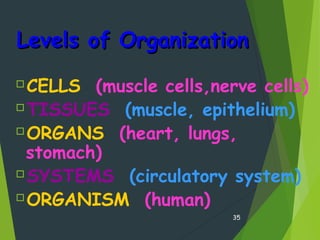
Levels of OrganizationLevels of Organization
CELLS (muscle cells,nerve cells)
TISSUES (muscle, epithelium)
ORGANS (heart, lungs,
stomach)
SYSTEMS (circulatory system)
ORGANISM (human)
35
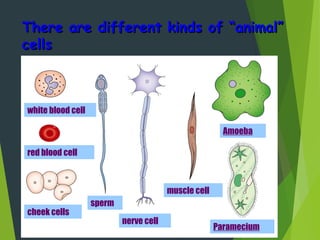
There are different kinds of “animal”There are different kinds of “animal”
cellscells
36
white blood cell
red blood cell
cheek cells
sperm
nerve cell
muscle cell
Amoeba
Paramecium
TissueTissue
A group of similar cells to
perform a particular function
Animals : epithelial tissue,
muscular tissue, nervous
tissue, and connective tissue
37
Similarities between plant cells andSimilarities between plant cells and
animal cellsanimal cells
Both have a cell membrane,
ribosomes, cytoplasm, and DNA
38
Both share many organelles,
including mitochondria
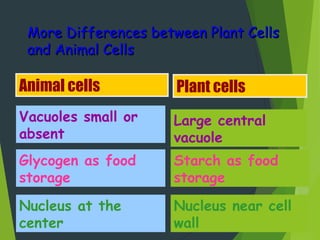
More Differences between Plant CellsMore Differences between Plant Cells
and Animal Cellsand Animal Cells
39
Animal cells Plant cells
Vacuoles small or
absent
Glycogen as food
storage
Nucleus at the
center
Large central
vacuole
Starch as food
storage
Nucleus near cell
wall
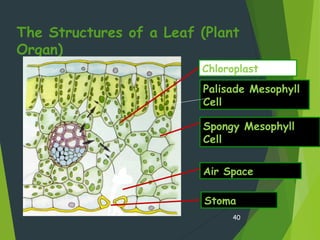
The Structures of a Leaf (Plant
Organ)
40
Stoma
Air Space
Spongy Mesophyll
Cell
Chloroplast
Palisade Mesophyll
Cell
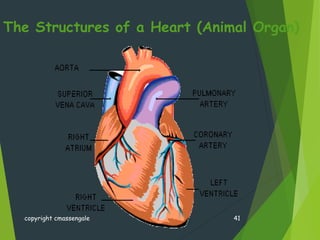
The Structures of a Heart (Animal Organ)
copyright cmassengale 41
OrganOrgan
Different tissues group together
to carry out specialized functions
Heart : consists of muscles,
nervous tissue and blood
vessels
Leaf : consists of epidermis,
mesophyll and vascular tissue
42
References
 This presentation is a mashup of 3 different sources. They are:
 Nardella .M.(2010) Cell structure
http://www.slideshare.net/mnardell103/cell-structure-5702506
Accessed 05 March 2014
 Mcnewbold. S. (2012) Cell structure
http://www.slideshare.net/mcnewbold/cell-structure-11143207
Accessed 05 March 2014
 Tas11244 .v. (2011) Characteristics of lifeii
http://www.slideshare.net/tas11244/characteristics-of-life-ii
Accessed 05 March 2014
43

Cell Structures

  • 1.
  • 2.
  • 3.
    What is Biology? Biologyis the study of all living things  Living things are called organisms Organisms include bacteria, protists, fungi, plants, & animals 3
  • 4.
    All Living ThingsShare Common Characteristics 1. Basic Unit is the Cell 2. They Reproduce 3. All Based On Universal Genetic Code (DNA) 4. Grow & Develop 4
  • 5.
  • 6.
    All Organisms aremade of Cells 6
  • 7.
    Facts About Cells Cellsare the smallest living unit of an organism All cells contain living material called cytoplasm All cells are surrounded by a cell membrane that controls what enters & leaves the cell 7
  • 8.
    More Cell Facts More complex cells are called Eukaryotes  These cells DO have a nucleus and membrane-bound organelles  Plants, animals, protists, & fungi are examples 8
  • 9.
    Number of Cells 9 Organismsmay be: • Unicellular – composed of one cell • Multicellular- composed of many cells that may organize
  • 10.
    Types of CellsTypesof Cells Prokaryotes - Bacteria Eukaryotes – Animals, plants, fungi, and protists. 10 Eukaryotic CellProkaryotic Cell
  • 11.
    Prokaryotes 11 Nucleoid region contains theDNA •Cell membrane & cell wall • Contain ribosomes (no membrane) to make proteins in their cytoplasm
  • 12.
    Two Types of Reproduction Sexual Reproduct ion  Involves 2 parents  Egg fertilized by sperm to make a ZYGOTE  Offspring DIFFERENT from parents 12
  • 13.
    Cells Have aGenetic Code 13
  • 14.
    Genetic Code DNA (deoxyribosenucleic acid) carries the genetic code for all organisms All organisms contain DNA DNA codes for the proteins that make up cells & do all the work 14
  • 15.
    Cells Require Food& Energy 15
  • 16.
    Food Requirements Autotrophs canmake their own food Photoautotrophs use sunlight to make food (photosynthesis) Chemoautotrophs use chemicals such as iron & sulfur as their energy 16
  • 17.
    Food Requirements Heterotrophs canNOT make their own food They must consume other organisms Herbivores eat plants Carnivores eat meat Omnivores eat plants & animals 17
  • 18.
  • 19.
    Eukaryotic Cell Contain 3basic cell structures: Nucleus Cell Membrane Cytoplasm with organelles 19
  • 20.
    Golgi Bodies  StacksofStacks of flattenedflattened sacssacs  Have a shipping side &Have a shipping side & a receiving sidea receiving side  Receive &Receive & modifymodify proteinsproteins made by ERmade by ER  Transport vesiclesTransport vesicles with modified proteinswith modified proteins pinch off the endspinch off the ends 20 Transport vesicle
  • 21.
    Lysosome  Contain digestiveContaindigestive enzymesenzymes  Break down food andBreak down food and worn out cell parts forworn out cell parts for cellscells  Programmed for cellProgrammed for cell death (lyse & releasedeath (lyse & release enzymes to break downenzymes to break down & recycle cell parts)& recycle cell parts) 21
  • 22.
    Nucleolus  Cell mayhaveCell may have 1 to 31 to 3 nucleolinucleoli  Inside nucleusInside nucleus  Disappears when cellDisappears when cell dividesdivides  Makes ribosomesMakes ribosomes thatthat make proteinsmake proteins 22
  • 23.
    Smooth & RoughEndoplasmic Reticulum copyright cmassengale 23 Smooth ER lacks ribosomes & makes proteins USED In the cell Rough ER has ribosomes on its surface & makes proteins to EXPORt
  • 24.
    In Animal Cells:InAnimal Cells: copyright cmassengale 24 Active cells like muscles have more mitochondria Burn sugars to produce energy ATP Mitochondria
  • 25.
    Cell or PlasmaMembraneCell or Plasma Membrane copyright cmassengale 25 Living layer Controls the movement of materials into and out of the cell Selectively permeable Cell membrane
  • 26.
    Cell WallCell Wall 26 Nonlivinglayer Gives structure and shape to plant and bacterial cells Cell wall
  • 27.
    Cytoplasm of aCellCytoplasm of a Cell copyright cmassengale 27 Jelly-like substance enclosed by cell membrane Provides a medium for chemical reactions to take place Cytoplasm
  • 28.
    Control Organelle copyright cmassengale28 Controls the normal activities of the cell Contain the DNA Bounded by a nuclear membrane Contains chromosomes Nucleus
  • 29.
    Plant CellPlant Cell 29 Deadlayer Large empty spaces present between cellulose fibers Freely permeable Cell wall
  • 30.
    Plant CellPlant Cell copyrightcmassengale 30 Protect and support the enclosed substances (protoplasm) Resist entry of excess water into the cell Give shape to the cell Cell wall
  • 31.
    Plant Cell OrganellesPlantCell Organelles 31 Have a large central vacuole Surrounded by tonoplast Contains cell sap Sugars, proteins, minerals, wastes, & pigments Vacuole
  • 32.
    Animal cellAnimal cell copyrightcmassengale 32 mitochondrion nucleus glycogen granule cell membrane cytoplasm No cell wall or chloroplast Stores glycogen in the cytoplasm for food energy vacuole
  • 33.
    Animal Cell Organelles Near the nucleus  Paired structures  Help cell divide 33
  • 34.
    There are differentkinds ofThere are different kinds of plant cellsplant cells 34 Onion Epidermal Cells Root Hair Cell root hair Guard Cells
  • 35.
    Levels of OrganizationLevelsof Organization CELLS (muscle cells,nerve cells) TISSUES (muscle, epithelium) ORGANS (heart, lungs, stomach) SYSTEMS (circulatory system) ORGANISM (human) 35
  • 36.
    There are differentkinds of “animal”There are different kinds of “animal” cellscells 36 white blood cell red blood cell cheek cells sperm nerve cell muscle cell Amoeba Paramecium
  • 37.
    TissueTissue A group ofsimilar cells to perform a particular function Animals : epithelial tissue, muscular tissue, nervous tissue, and connective tissue 37
  • 38.
    Similarities between plantcells andSimilarities between plant cells and animal cellsanimal cells Both have a cell membrane, ribosomes, cytoplasm, and DNA 38 Both share many organelles, including mitochondria
  • 39.
    More Differences betweenPlant CellsMore Differences between Plant Cells and Animal Cellsand Animal Cells 39 Animal cells Plant cells Vacuoles small or absent Glycogen as food storage Nucleus at the center Large central vacuole Starch as food storage Nucleus near cell wall
  • 40.
    The Structures ofa Leaf (Plant Organ) 40 Stoma Air Space Spongy Mesophyll Cell Chloroplast Palisade Mesophyll Cell
  • 41.
    The Structures ofa Heart (Animal Organ) copyright cmassengale 41
  • 42.
    OrganOrgan Different tissues grouptogether to carry out specialized functions Heart : consists of muscles, nervous tissue and blood vessels Leaf : consists of epidermis, mesophyll and vascular tissue 42
  • 43.
    References  This presentationis a mashup of 3 different sources. They are:  Nardella .M.(2010) Cell structure http://www.slideshare.net/mnardell103/cell-structure-5702506 Accessed 05 March 2014  Mcnewbold. S. (2012) Cell structure http://www.slideshare.net/mcnewbold/cell-structure-11143207 Accessed 05 March 2014  Tas11244 .v. (2011) Characteristics of lifeii http://www.slideshare.net/tas11244/characteristics-of-life-ii Accessed 05 March 2014 43