JOURNAL ENTRY
What is a journal entry?
A journal entry is a record of a business
transaction in your business books. In double-
entry bookkeeping, you make at least two
journal entries for every transaction.
The purpose of a journal entry is to
physically or digitally record every
transaction properly and accurately. If a
transaction affects multiple accounts, the
journal entry will detail that information as
well.
Because a transaction can create a lot of changes in a
business, a bookkeeper tracks them all with journal
entries. A transaction might, for example, affect:
•how much cash the business has (revenue or expense)
•how much money it owes (liability)
•what it owns (assets)
•the value of the business itself (equity)
•how tax is treated
Each account that’s affected receives its own journal
entry.
What goes into an accounting journal entry?
Each accounting journal entry should contain the
following:
•An entry date and reference number that can be used
to find the entry later if needed
•A column showing what accounts are affected
(revenue, expense, liability, asset, equity)
•Columns for the debit and credit amounts
•A footer line with a brief description of the reason for
the entry
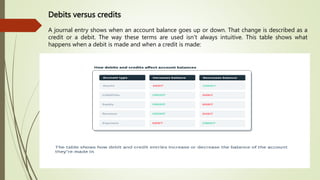
Debits versus credits
A journal entry shows when an account balance goes up or down. That change is described as a
credit or a debit. The way these terms are used isn’t always intuitive. This table shows what
happens when a debit is made and when a credit is made:
How journal entries are made?
• Journal entries used to be done for
every business transaction in separate
journals and entered or posted to the
relevant accounts in the general ledger
at the end of the accounting cycle.
• Accounting software now makes the
majority of journal entries directly into
the general ledger as you receive
invoices and reconcile payments using
the linked business bank account.
• Businesses may still need to make
manual journal entries for month-
end adjustments, depreciation
expenses and transactions that
haven’t used the business bank
accounts.
What do you learn from journal
entries?
An easy way to understand journal entries is
to think of Isaac Newton's third law of
motion, which states that for every action,
there is an equal and opposite reaction. So,
whenever a transaction occurs within a
company, there must be at least two
accounts affected in opposite ways.
THANK YOU AND MAY
GOD BLESS US ALL!!

JOURNAL ENTRIES.pptx

  • 1.
  • 2.
    What is ajournal entry? A journal entry is a record of a business transaction in your business books. In double- entry bookkeeping, you make at least two journal entries for every transaction.
  • 3.
    The purpose ofa journal entry is to physically or digitally record every transaction properly and accurately. If a transaction affects multiple accounts, the journal entry will detail that information as well.
  • 4.
    Because a transactioncan create a lot of changes in a business, a bookkeeper tracks them all with journal entries. A transaction might, for example, affect: •how much cash the business has (revenue or expense) •how much money it owes (liability) •what it owns (assets) •the value of the business itself (equity) •how tax is treated Each account that’s affected receives its own journal entry.
  • 5.
    What goes intoan accounting journal entry? Each accounting journal entry should contain the following: •An entry date and reference number that can be used to find the entry later if needed •A column showing what accounts are affected (revenue, expense, liability, asset, equity) •Columns for the debit and credit amounts •A footer line with a brief description of the reason for the entry
  • 6.
    Debits versus credits Ajournal entry shows when an account balance goes up or down. That change is described as a credit or a debit. The way these terms are used isn’t always intuitive. This table shows what happens when a debit is made and when a credit is made:
  • 7.
    How journal entriesare made? • Journal entries used to be done for every business transaction in separate journals and entered or posted to the relevant accounts in the general ledger at the end of the accounting cycle.
  • 8.
    • Accounting softwarenow makes the majority of journal entries directly into the general ledger as you receive invoices and reconcile payments using the linked business bank account.
  • 9.
    • Businesses maystill need to make manual journal entries for month- end adjustments, depreciation expenses and transactions that haven’t used the business bank accounts.
  • 10.
    What do youlearn from journal entries? An easy way to understand journal entries is to think of Isaac Newton's third law of motion, which states that for every action, there is an equal and opposite reaction. So, whenever a transaction occurs within a company, there must be at least two accounts affected in opposite ways.
  • 11.
    THANK YOU ANDMAY GOD BLESS US ALL!!