1
Chapter 3: Double-Entry Bookkeeping
•Double-entry bookkeeping underpins accounting
•A way of systematically recording the financial transactions of a
company so that each transaction is recorded twice.
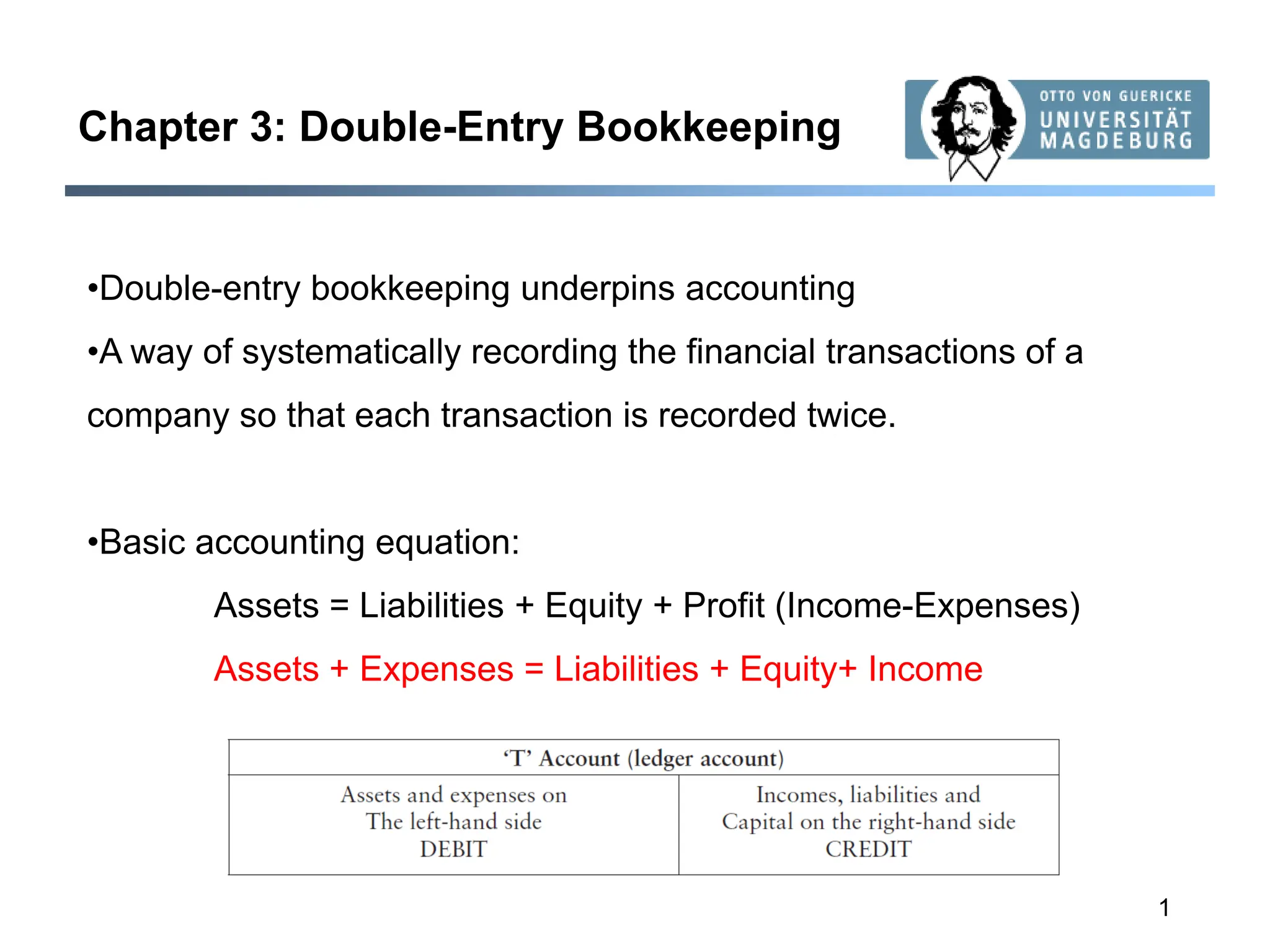
•Basic accounting equation:
Assets = Liabilities + Equity + Profit (Income-Expenses)
Assets + Expenses = Liabilities + Equity+ Income
2
Basic Rules
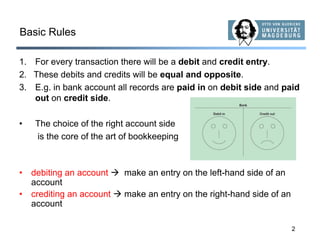
1. For every transaction there will be a debit and credit entry.
2. These debits and credits will be equal and opposite.
3. E.g. in bank account all records are paid in on debit side and paid
out on credit side.
• The choice of the right account side
is the core of the art of bookkeeping
• debiting an account Æ make an entry on the left-hand side of an
account
• crediting an account Æ make an entry on the right-hand side of an
account
3
Derived rules
Recall the basic accounting equation
Assets + Expenses = Liabilities + Equity+ Income
Ö if a debit increases assets, then a credit counter item has to
increase liabilities or owner‘s equity
Ö i.e. increases and decreases in assets and liabilities (or
owner‘s equity) must be recorded opposite to each other!
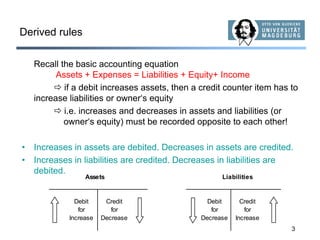
• Increases in assets are debited. Decreases in assets are credited.
• Increases in liabilities are credited. Decreases in liabilities are
debited.
Assets Liabilities
Debit Credit Debit Credit
for for for for
Increase Decrease Decrease Increase
4
Owner‘s Equity
• Recall that owner‘s investments and revenues increase owner‘s
equity, while owner‘s withdrawals and expenses decrease owner‘s
equity.
• Frequently separate accounts are kept for these items.
(a) Owner‘s Capital. This account is affected by, for example,
owner‘s investment.
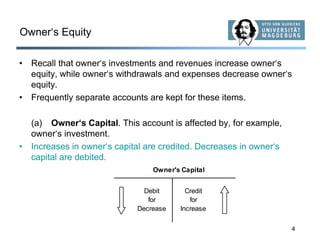
• Increases in owner‘s capital are credited. Decreases in owner‘s
capital are debited.
Owner's Capital
Debit Credit
for for
Decrease Increase
5
Owner‘s Withdrawals
(b) Owner‘s Withdrawals
• The owner may, for example, withdraw cash for personal use. It
could be debited directly to Owner‘s Capital but a separate account
is kept to determine total withdrawals.
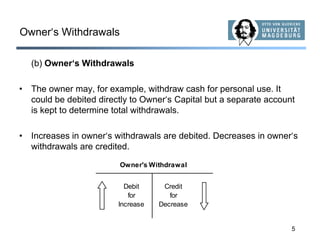
• Increases in owner‘s withdrawals are debited. Decreases in owner‘s
withdrawals are credited.
Owner's Withdrawal
Debit Credit
for for
Increase Decrease
6
Revenues and Expenses
• Revenues increase owner‘s equity, just as an increase in owner‘s
capital does. Thus, debiting and crediting of a revenue account is
the same as debiting and crediting of owner‘s capital account.
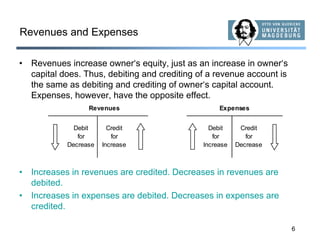
Expenses, however, have the opposite effect.
• Increases in revenues are credited. Decreases in revenues are
debited.
• Increases in expenses are debited. Decreases in expenses are
credited.
Revenues Expenses
Debit Credit Debit Credit
for for for for
Decrease Increase Increase Decrease
7
Balancing off the accounts
When all entries completed, we need to balance
off the accounts
• All Income Statement items will be closed off
• All Balance Sheet items brought forward
• Balancing off enables us to:
1. Prepare a trial balance
2. Close down income and expense accounts
3. Bring forward assets, liabilities and equity
8
Balancing off the cash account
1. Sum the entries on the larger side below the line
2. repeat the sum below the line on the other side
3. strike the balance: insert the amount missing such that the sums of
entries on both sides are equal (i.e. solving the account equation)
4. enter the counter item to the appropriate account e.g. Trial Balance
Beginning balance 100
Inflows 400
200
300
Outflows 400
Cash
1. 1000
4. Beginning balance 600
Trial Balance
2. 1000
3. Balance 600
9
Debit and Credit Balance
• note that a debit balance occurs on the credit side on account
closing and vice versa.
• normal balance ≡ side (debit or credit) that increases the stock or
flow represented in the account
total of debit amounts > total of credit amounts debit balance
total of debit amounts < total of credit amounts credit balance
10
Booking of the counter item (in theory)
• appropriate account need not be the trial balance
– could be a hierarchically superior closing account, e.g. “cash and cash
equivalents”
– this could be closed to the balance sheet
– in order to reopen accounts for the next period the line item cash and
cash equivalents in the balance sheet could be counterbooked to an
account which is closed by booking out the individual items to the
respective accounts, e.g. the cash account for the next period
• This is not the practical procedure, this theoretically possible
procedure shall only make clear the mechanics of double entry
bookkeeping
11
Example
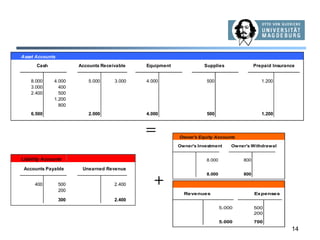
A small company named ZiscoSys. The transactions are stated in
chronological order:
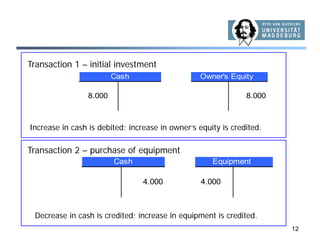
(1) € 8.000 Owner‘s Investment to start up the business
(2) Purchase of equipment for € 4.000 paid in cash
(3) Purchase of supplies on credit for € 500
(4) € 400 payment of a liability (accounts payable resulting from
delivery of supplies)
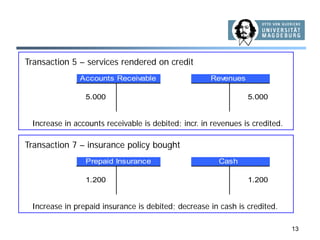
(5) € 5.000 revenues earned on credit
(6) € 3.000 collection of accounts receivable
(7) Incurring expenses of € 500 for rent (cash) and € 200 (on credit) for
utility and prepaid insurance of € 1.200
(8) reception of a down payment of € 2.400 for services to be
performed (unearned revenue or deferred revenue), and
(9) Owner‘s withdrawal of € 800.
12
Cash Owner's Equity
8.000 8.000
Transaction 1 – initial investment
Increase in cash is debited; increase in owner‘s equity is credited.
Cash Equipment
4.000 4.000
Transaction 2 – purchase of equipment
Decrease in cash is credited; increase in equipment is credited.
13
Accounts Receivable Revenues
5.000 5.000
Transaction 5 – services rendered on credit
Increase in accounts receivable is debited; incr. in revenues is credited.
Prepaid Insurance Cash
1.200 1.200
Transaction 7 – insurance policy bought
Increase in prepaid insurance is debited; decrease in cash is credited.
14
Asset Accounts
Cash Accounts Receivable Equipment Supplies Prepaid Insurance
8.000 4.000 5.000 3.000 4.000 500 1.200
3.000 400
2.400 500
1.200
800
6.500 2.000 4.000 500 1.200
=
Liability Accounts
Accounts Payable Unearned Revenue
400 500 2.400
200
300 2.400
Owner's Equity Accounts
Owner's Investment Owner's Withdrawal
8.000 800
8.000 800
Revenues Expenses
5.000 500
200
5.000 700
+
15
Commonly Used Accounts
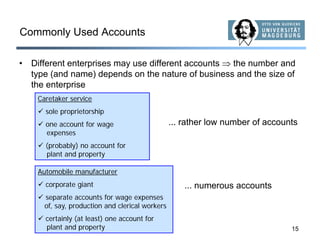
• Different enterprises may use different accounts ⇒ the number and
type (and name) depends on the nature of business and the size of
the enterprise
Caretaker service
9 sole proprietorship
9 one account for wage
expenses
9 (probably) no account for
plant and property
Automobile manufacturer
9 corporate giant
9 separate accounts for wage expenses
of, say, production and clerical workers
9 certainly (at least) one account for
plant and property
... rather low number of accounts
... numerous accounts
16
Some important accounts common
to most enterprises
Chart of Accounts for a Small Business
Assets Liabilities Revenues
Cash 111 Notes Payable 211 Sales 411
Notes Receivable 112 Accounts Payable 212 Commissions Earned 412
Accounts Receivable 113 Wages Payable 213
Fees Receivable 114 Unearned Revenues 231 Expenses
Office Supplies 115
Prepaid Rent 116 Owner's Equity Wages Expense 511
Prepaid Insurance 117 Utility Expense 512
Land 141 Capital 311 Telephone Expense 513
Building 142 Withdrawal 312 Insurance Expense 514
Equipment 148 Income Summary 313 Depreciation Expense, 521
Equipment
Depreciation Expense, 522
Building
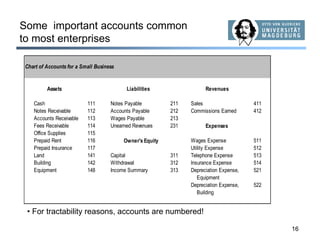
• For tractability reasons, accounts are numbered!
17
The Recording Process
Step 1: Journalizing
• The journal is a complete and chronological list of all transactions
that occurred.
 journal is the book of original entry!
• common to have more than one kind of journal  special purpose
journals, e.g. cash receipts journal or sales journal
• general journal: all transactions are recorded in this journal
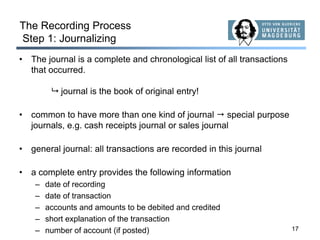
• a complete entry provides the following information
– date of recording
– date of transaction
– accounts and amounts to be debited and credited
– short explanation of the transaction
– number of account (if posted)
18
ZiscoSys‘ general journal
General Journal Page 1
Description Post. Ref. Debit Credit
2013 1 Cash 8.000
Sept. Owner´s Investment 8.000
Personal funds transferred to
the account of ZiscoSys
3 Equipment 4.000
Cash 4.000
Equipment bought with cash
payment
8 Supplies 500
Cash 400
Accounts Payable 100
Purchase of supplies partially
with cash and on credit
Date
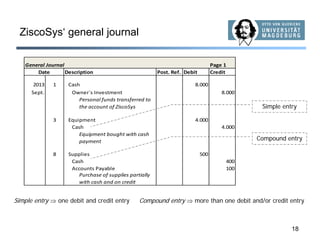
Simple entry ⇒ one debit and credit entry
Simple entry
Compound entry ⇒ more than one debit and/or credit entry
Compound entry
19
Journal: the basic accounting document
• The journal contains the complete information on transactions that
enter the accounting system
– it is the basic documentation and serves as instrument of evidence in
litigation
– it is not allowed to cancel journal entries
• mistaken entries have to be reversed by a contra-entry
• In electronic accounting systems the journal is the only data base on
transactions
– the system has to assure that once an entry is made, it can no longer be
influenced or altered by anyone
– ledger accounts are „views“ of the data base that are generated online,
they are not records in their own right (Principle of data integrity: any
information is only stored once)
• the system of ledger accounts can thus be altered at any time
according to new needs for analysis
– A sufficient number of safety copies (mirror images) of the journal have
to be kept up-to-date.
20
Step 2: Posting
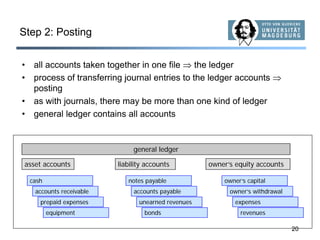
• all accounts taken together in one file ⇒ the ledger
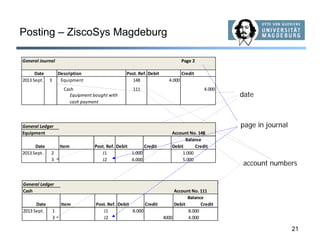
• process of transferring journal entries to the ledger accounts ⇒
posting
• as with journals, there may be more than one kind of ledger
• general ledger contains all accounts
general ledger
asset accounts owner‘s equity accounts
liability accounts
accounts receivable
prepaid expenses
equipment
cash
accounts payable
unearned revenues
bonds
notes payable
owner‘s withdrawal
expenses
revenues
owner‘s capital
21
Posting – ZiscoSys Magdeburg
date
account numbers
General Journal Page 2
Description Post. Ref. Debit Credit
2013 Sept. 3 Equipment 148 4.000
Cash 111 4.000
Equipment bought with
cash payment
Date
General Ledger
Equipment
Item Post. Ref. Debit Credit Debit Credit
2013 Sept. 2 J1 1.000 1.000
3 J2 4.000 5.000
Account No. 148
Balance
Date
General Ledger
Cash
Item Post. Ref. Debit Credit Debit Credit
2013 Sept. 1 J1 8.000 8.000
3 J2 4000 4.000
Account No. 111
Balance
Date
page in journal
22
The Trial Balance
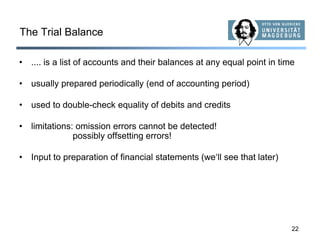
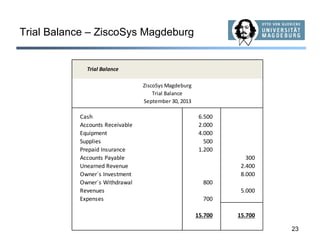
• .... is a list of accounts and their balances at any equal point in time
• usually prepared periodically (end of accounting period)
• used to double-check equality of debits and credits
• limitations: omission errors cannot be detected!
possibly offsetting errors!
• Input to preparation of financial statements (we‘ll see that later)
23
Trial Balance – ZiscoSys Magdeburg
6.500
2.000
4.000
500
1.200
300
2.400
8.000
800
5.000
700
15.700 15.700
Expenses
Prepaid Insurance
Accounts Payable
Unearned Revenue
Owner´s Investment
Owner´s Withdrawal
Revenues
Supplies
Trial Balance
ZiscoSys Magdeburg
Trial Balance
September 30, 2013
Cash
Accounts Receivable
Equipment

Accounts - Double Entry Bookkeeping. Pdf

  • 1.
    1 Chapter 3: Double-EntryBookkeeping •Double-entry bookkeeping underpins accounting •A way of systematically recording the financial transactions of a company so that each transaction is recorded twice. •Basic accounting equation: Assets = Liabilities + Equity + Profit (Income-Expenses) Assets + Expenses = Liabilities + Equity+ Income
  • 2.
    2 Basic Rules 1. Forevery transaction there will be a debit and credit entry. 2. These debits and credits will be equal and opposite. 3. E.g. in bank account all records are paid in on debit side and paid out on credit side. • The choice of the right account side is the core of the art of bookkeeping • debiting an account Æ make an entry on the left-hand side of an account • crediting an account Æ make an entry on the right-hand side of an account
  • 3.
    3 Derived rules Recall thebasic accounting equation Assets + Expenses = Liabilities + Equity+ Income Ö if a debit increases assets, then a credit counter item has to increase liabilities or owner‘s equity Ö i.e. increases and decreases in assets and liabilities (or owner‘s equity) must be recorded opposite to each other! • Increases in assets are debited. Decreases in assets are credited. • Increases in liabilities are credited. Decreases in liabilities are debited. Assets Liabilities Debit Credit Debit Credit for for for for Increase Decrease Decrease Increase
  • 4.
    4 Owner‘s Equity • Recallthat owner‘s investments and revenues increase owner‘s equity, while owner‘s withdrawals and expenses decrease owner‘s equity. • Frequently separate accounts are kept for these items. (a) Owner‘s Capital. This account is affected by, for example, owner‘s investment. • Increases in owner‘s capital are credited. Decreases in owner‘s capital are debited. Owner's Capital Debit Credit for for Decrease Increase
  • 5.
    5 Owner‘s Withdrawals (b) Owner‘sWithdrawals • The owner may, for example, withdraw cash for personal use. It could be debited directly to Owner‘s Capital but a separate account is kept to determine total withdrawals. • Increases in owner‘s withdrawals are debited. Decreases in owner‘s withdrawals are credited. Owner's Withdrawal Debit Credit for for Increase Decrease
  • 6.
    6 Revenues and Expenses •Revenues increase owner‘s equity, just as an increase in owner‘s capital does. Thus, debiting and crediting of a revenue account is the same as debiting and crediting of owner‘s capital account. Expenses, however, have the opposite effect. • Increases in revenues are credited. Decreases in revenues are debited. • Increases in expenses are debited. Decreases in expenses are credited. Revenues Expenses Debit Credit Debit Credit for for for for Decrease Increase Increase Decrease
  • 7.
    7 Balancing off theaccounts When all entries completed, we need to balance off the accounts • All Income Statement items will be closed off • All Balance Sheet items brought forward • Balancing off enables us to: 1. Prepare a trial balance 2. Close down income and expense accounts 3. Bring forward assets, liabilities and equity
  • 8.
    8 Balancing off thecash account 1. Sum the entries on the larger side below the line 2. repeat the sum below the line on the other side 3. strike the balance: insert the amount missing such that the sums of entries on both sides are equal (i.e. solving the account equation) 4. enter the counter item to the appropriate account e.g. Trial Balance Beginning balance 100 Inflows 400 200 300 Outflows 400 Cash 1. 1000 4. Beginning balance 600 Trial Balance 2. 1000 3. Balance 600
  • 9.
    9 Debit and CreditBalance • note that a debit balance occurs on the credit side on account closing and vice versa. • normal balance ≡ side (debit or credit) that increases the stock or flow represented in the account total of debit amounts > total of credit amounts debit balance total of debit amounts < total of credit amounts credit balance
  • 10.
    10 Booking of thecounter item (in theory) • appropriate account need not be the trial balance – could be a hierarchically superior closing account, e.g. “cash and cash equivalents” – this could be closed to the balance sheet – in order to reopen accounts for the next period the line item cash and cash equivalents in the balance sheet could be counterbooked to an account which is closed by booking out the individual items to the respective accounts, e.g. the cash account for the next period • This is not the practical procedure, this theoretically possible procedure shall only make clear the mechanics of double entry bookkeeping
  • 11.
    11 Example A small companynamed ZiscoSys. The transactions are stated in chronological order: (1) € 8.000 Owner‘s Investment to start up the business (2) Purchase of equipment for € 4.000 paid in cash (3) Purchase of supplies on credit for € 500 (4) € 400 payment of a liability (accounts payable resulting from delivery of supplies) (5) € 5.000 revenues earned on credit (6) € 3.000 collection of accounts receivable (7) Incurring expenses of € 500 for rent (cash) and € 200 (on credit) for utility and prepaid insurance of € 1.200 (8) reception of a down payment of € 2.400 for services to be performed (unearned revenue or deferred revenue), and (9) Owner‘s withdrawal of € 800.
  • 12.
    12 Cash Owner's Equity 8.0008.000 Transaction 1 – initial investment Increase in cash is debited; increase in owner‘s equity is credited. Cash Equipment 4.000 4.000 Transaction 2 – purchase of equipment Decrease in cash is credited; increase in equipment is credited.
  • 13.
    13 Accounts Receivable Revenues 5.0005.000 Transaction 5 – services rendered on credit Increase in accounts receivable is debited; incr. in revenues is credited. Prepaid Insurance Cash 1.200 1.200 Transaction 7 – insurance policy bought Increase in prepaid insurance is debited; decrease in cash is credited.
  • 14.
    14 Asset Accounts Cash AccountsReceivable Equipment Supplies Prepaid Insurance 8.000 4.000 5.000 3.000 4.000 500 1.200 3.000 400 2.400 500 1.200 800 6.500 2.000 4.000 500 1.200 = Liability Accounts Accounts Payable Unearned Revenue 400 500 2.400 200 300 2.400 Owner's Equity Accounts Owner's Investment Owner's Withdrawal 8.000 800 8.000 800 Revenues Expenses 5.000 500 200 5.000 700 +
  • 15.
    15 Commonly Used Accounts •Different enterprises may use different accounts ⇒ the number and type (and name) depends on the nature of business and the size of the enterprise Caretaker service 9 sole proprietorship 9 one account for wage expenses 9 (probably) no account for plant and property Automobile manufacturer 9 corporate giant 9 separate accounts for wage expenses of, say, production and clerical workers 9 certainly (at least) one account for plant and property ... rather low number of accounts ... numerous accounts
  • 16.
    16 Some important accountscommon to most enterprises Chart of Accounts for a Small Business Assets Liabilities Revenues Cash 111 Notes Payable 211 Sales 411 Notes Receivable 112 Accounts Payable 212 Commissions Earned 412 Accounts Receivable 113 Wages Payable 213 Fees Receivable 114 Unearned Revenues 231 Expenses Office Supplies 115 Prepaid Rent 116 Owner's Equity Wages Expense 511 Prepaid Insurance 117 Utility Expense 512 Land 141 Capital 311 Telephone Expense 513 Building 142 Withdrawal 312 Insurance Expense 514 Equipment 148 Income Summary 313 Depreciation Expense, 521 Equipment Depreciation Expense, 522 Building • For tractability reasons, accounts are numbered!
  • 17.
    17 The Recording Process Step1: Journalizing • The journal is a complete and chronological list of all transactions that occurred. journal is the book of original entry! • common to have more than one kind of journal special purpose journals, e.g. cash receipts journal or sales journal • general journal: all transactions are recorded in this journal • a complete entry provides the following information – date of recording – date of transaction – accounts and amounts to be debited and credited – short explanation of the transaction – number of account (if posted)
  • 18.
    18 ZiscoSys‘ general journal GeneralJournal Page 1 Description Post. Ref. Debit Credit 2013 1 Cash 8.000 Sept. Owner´s Investment 8.000 Personal funds transferred to the account of ZiscoSys 3 Equipment 4.000 Cash 4.000 Equipment bought with cash payment 8 Supplies 500 Cash 400 Accounts Payable 100 Purchase of supplies partially with cash and on credit Date Simple entry ⇒ one debit and credit entry Simple entry Compound entry ⇒ more than one debit and/or credit entry Compound entry
  • 19.
    19 Journal: the basicaccounting document • The journal contains the complete information on transactions that enter the accounting system – it is the basic documentation and serves as instrument of evidence in litigation – it is not allowed to cancel journal entries • mistaken entries have to be reversed by a contra-entry • In electronic accounting systems the journal is the only data base on transactions – the system has to assure that once an entry is made, it can no longer be influenced or altered by anyone – ledger accounts are „views“ of the data base that are generated online, they are not records in their own right (Principle of data integrity: any information is only stored once) • the system of ledger accounts can thus be altered at any time according to new needs for analysis – A sufficient number of safety copies (mirror images) of the journal have to be kept up-to-date.
  • 20.
    20 Step 2: Posting •all accounts taken together in one file ⇒ the ledger • process of transferring journal entries to the ledger accounts ⇒ posting • as with journals, there may be more than one kind of ledger • general ledger contains all accounts general ledger asset accounts owner‘s equity accounts liability accounts accounts receivable prepaid expenses equipment cash accounts payable unearned revenues bonds notes payable owner‘s withdrawal expenses revenues owner‘s capital
  • 21.
    21 Posting – ZiscoSysMagdeburg date account numbers General Journal Page 2 Description Post. Ref. Debit Credit 2013 Sept. 3 Equipment 148 4.000 Cash 111 4.000 Equipment bought with cash payment Date General Ledger Equipment Item Post. Ref. Debit Credit Debit Credit 2013 Sept. 2 J1 1.000 1.000 3 J2 4.000 5.000 Account No. 148 Balance Date General Ledger Cash Item Post. Ref. Debit Credit Debit Credit 2013 Sept. 1 J1 8.000 8.000 3 J2 4000 4.000 Account No. 111 Balance Date page in journal
  • 22.
    22 The Trial Balance •.... is a list of accounts and their balances at any equal point in time • usually prepared periodically (end of accounting period) • used to double-check equality of debits and credits • limitations: omission errors cannot be detected! possibly offsetting errors! • Input to preparation of financial statements (we‘ll see that later)
  • 23.
    23 Trial Balance –ZiscoSys Magdeburg 6.500 2.000 4.000 500 1.200 300 2.400 8.000 800 5.000 700 15.700 15.700 Expenses Prepaid Insurance Accounts Payable Unearned Revenue Owner´s Investment Owner´s Withdrawal Revenues Supplies Trial Balance ZiscoSys Magdeburg Trial Balance September 30, 2013 Cash Accounts Receivable Equipment