BOOKKEEPIN
G
 to record business
transactions,
 prepare journal entries
 general ledger
 trial balance report.
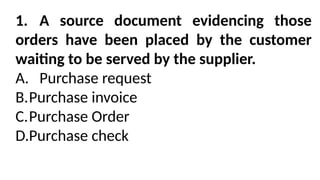
1. A source document evidencing those
orders have been placed by the customer
waiting to be served by the supplier.
A. Purchase request
B.Purchase invoice
C.Purchase Order
D.Purchase check
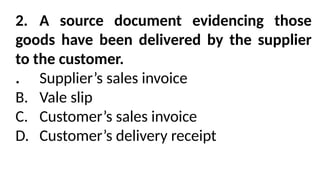
2. A source document evidencing those
goods have been delivered by the supplier
to the customer.
. Supplier’s sales invoice
B. Vale slip
C. Customer’s sales invoice
D. Customer’s delivery receipt
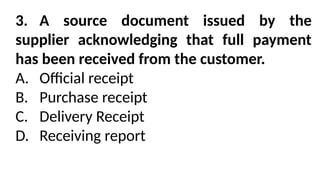
3. A source document issued by the
supplier acknowledging that full payment
has been received from the customer.
A. Official receipt
B. Purchase receipt
C. Delivery Receipt
D. Receiving report
4. All of the following are examples
of source documents, except
A. Check
B. Invoices
C. Contract
D. Journal
5. A source document which shows that
the customer has already made partial
payment to the supplier through
issuance of.
A. Check
B. Voucher
C. Official receipt
D. Sales invoice
6. An example of asset that can be
used in the business for a long period
of time, usually more than a year.
A. Inventories
B. Computer
C. Receivables
D. Cash
7. A type of business that is purely
engaged in providing all types of
service activities such as medical or
legal services.
A. Service business
B. Merchandising business
C. Manufacturing business
D. Trading business
8. A type of business that is engaged in
buying and selling of food products
such as grocery/convenient stores.
A. Service business
B. Merchandising business
C. Manufacturing business
D. Forex Trading business
9. Referred to as the book of original
entry
A. Ledger
B. Journal
C. Accounts Receivable Ledger
D. Purchase Journal
10. Referred to as the book of
final entry
A. General Ledger
B. General Journal
C. Accounts Receivable Ledge
D. Purchase Journal
•In this lesson you will learn how to keep your
business records and be able to perform the
bookkeeping tasks.
•How does bookkeeping
and accounting differ?
•Accounting/accountant
•Bookkeeping/bookkeeper
•Accounting is
“language of
business
•Accounting is a process
of recording financial
transactions pertaining
to a business.(Alicia,2020.)
•Accountant
Bookkeeping- the process of recording
business transactions in a systematic
and chronological manner. It is
systematic because it follows
procedures and principles. It is
chronological because the
transactions are recorded in order of
the date of occurrence.
•Bookkeeping is the process of
recording transactions made by a
business and the process of keeping track
of every financial transactions made by
a business firm from the opening of the
firm to the closing of the firm.
•Bookkeeper are responsible for
recording, classifying, and
organizing every financial
transaction made through the
course of business operations.
Bookkeeper
-Collects the documentation for each financial
transaction
-Records the transactions in the accounting journal
-Classifies each transaction as one or more debits
and one or more credits
-Organizes the transactions according to the firm’s
chart of account
Bookkeeper
-Collects the documentation for each financial
transaction
-Records the transactions in the accounting journal
-Classifies each transaction as one or more debits
and one or more credits
-Organizes the transactions according to the firm’s
chart of account
Accountant
-Takes over to analyze, review,
interpret, and report financial
information for the business firm.
Bookkeeper will record
the transaction happen in
a day, week, months and
year.
Good records will help you do the
following
-Monitor the progress of your business.
-Prepare your financial statements.
-Identify sources of your income.
-Keep track of your deductible expenses.
-Keep track of your basis in property.
Keeping records is important to you business.
Good records will help you do the following.
•Prepare your tax returns
•Support items report on your tax returns
•Give companies reliable measure of their performance.
•Provides information on general strategic decisions and a
benchmark for its revenue and income goals.
•It is crucial for businesses to keep records of every penny
spent.
Keeping records is important to you business.
Good records will help you do the following.
•Prepare your tax returns
•Support items report on your tax returns
•Give companies reliable measure of their performance.
•Provides information on general strategic decisions and a
benchmark for its revenue and income goals.
•It is crucial for businesses to keep records of every penny
spent.
Book of Accounts. The book of
accounts is composed of the Journal and
Ledger.
Journal. Referred to as the book of
original entry
Ledger. Referred to as the book of final
entry.
General Journal is the most basic
journal which provides columns for
date, account titles and explanations,
folio or references and a separate
column for debit and credit entries.
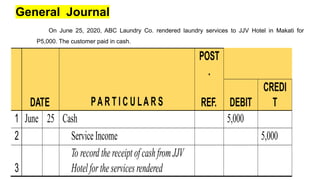
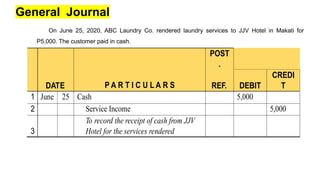
General Journal
DATE PA R T I C U LA R S
POST
.
REF. DEBIT
CREDI
T
1 June 25 Cash 5,000
2 ServiceIncome 5,000
3
To record the receipt ofcashfrom JJV
Hotelfor theservices rendered
On June 25, 2020, ABC Laundry Co. rendered laundry services to JJV Hotel in Makati for
P5,000. The customer paid in cash.
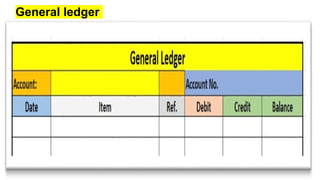
General Ledger is a group of all
accounts that can be found in the chart
of accounts. These accounts will be
reflected in the trial balance as a
summary of all financial activities that
have taken place as recorded in the
general journal and subsidiary ledgers.
General ledger
Subsidiary Ledger is a group of accounts
directly associated with the general ledger.
This record is created to maintain individual
accounts for customers and vendors whose
cash is not being used as a medium of
exchange when purchasing or selling
merchandise.
Account
Receivable
Ledger
The accounts receivable ledger is a sub-ledger which
records
all credit sales made by a business. It is useful for
segregating into one location a record of all amounts
invoiced to customers. A typical transaction entered
into the accounts receivable ledger which records all
account receivables, followed at a later date by a
payment transaction from a customer that
eliminates the accounts receivable. More
importantly, it is a subsidiary ledger which records a
customer’s accounts in the business.
Account
Payable
Ledger
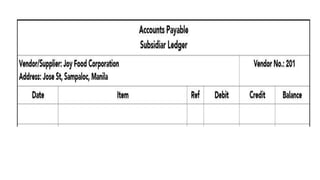
An accounts payable ledger contains the detail
for all invoices received from suppliers. This
ledger is used as a subsidiary ledger, from
which summary-level information is
periodically posted to the general ledger.
Having a separate accounts payable ledger
keeps a large amount of detailed payables t
ransactions from cluttering up the general
ledger.
Debit
The left-hand side entry also known in
accounting as “Value Received.” When cash
or non-cash items are received, the said cash
or non-cash items must be recorded in the
debit column. This means that the debit
balance has increased.
Credit
The right-hand side entry also known in
accounting as “Value Parted With.” When
cash or non-cash items are given, the said cash
or non-cash items must be recorded in the
credit column.
This means that the credit balance has
increased.
The Rules of Debit and Credit
In the process of journalizing business transactions, the
rules of Debit and Credit are essential to ensure accurate
recording and sound decision making. Debit is
abbreviated as DR while CR for Credit. Further, it
is deemed a requirement that the bookkeeper should be
able to master the normal balance of each account title
being used in the process of recording.
The Rules of Debit and Credit
The following steps will be undertaken in determining account balances for every
account title such as cash, account receivable, etc.:
1. Add all the debit side to generate total
debit
2. Add all the credit side to generate total
credit.
3.Subtract total debit to the total credit.
4.Determine the balance of each account.
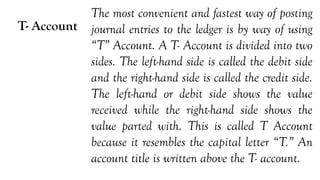
T- Account
The most convenient and fastest way of posting
journal entries to the ledger is by way of using
“T” Account. A T- Account is divided into two
sides. The left-hand side is called the debit side
and the right-hand side is called the credit side.
The left-hand or debit side shows the value
received while the right-hand side shows the
value parted with. This is called T Account
because it resembles the capital letter “T.” An
account title is written above the T- account.
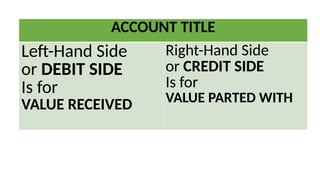
ACCOUNT TITLE
Left-Hand Side
or DEBIT SIDE
Is for
VALUE RECEIVED
Right-Hand Side
or CREDIT SIDE
Is for
VALUE PARTED WITH
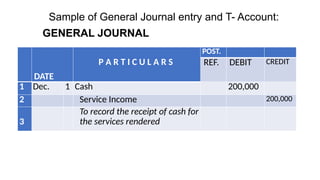
Sample of General Journal entry and T- Account:
GENERAL JOURNAL
DATE
P A R T I C U L A R S
POST.
REF. DEBIT CREDIT
1 Dec. 1 Cash 200,000
2 Service Income 200,000
3
To record the receipt of cash for
the services rendered
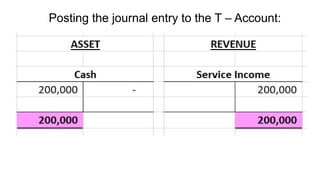
Posting the journal entry to the T – Account:
To strengthen your understanding about
posting of journal entries to the general
ledger, it is suggested to create T– Account
and label them with the account title and
group them according to Assets, Liabilities,
Owner’s Equity, Revenue and Expense.
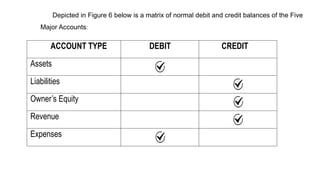
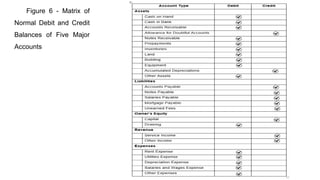
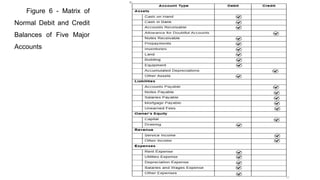
Depicted in Figure 6 below is a matrix of normal debit and credit balances of the Five
Major Accounts:
ACCOUNT TYPE DEBIT CREDIT
Assets
Liabilities
Owner’s Equity
Revenue
Expenses
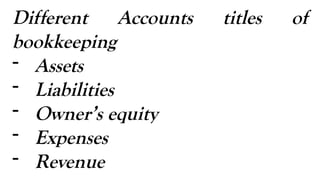
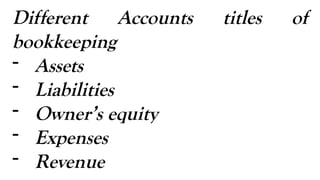
Different Accounts titles of
bookkeeping
- Assets
- Liabilities
- Owner’s equity
- Expenses
- Revenue
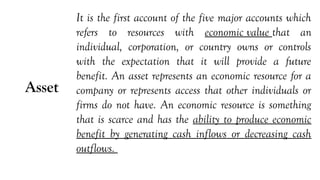
Asset
It is the first account of the five major accounts which
refers to resources with economic value that an
individual, corporation, or country owns or controls
with the expectation that it will provide a future
benefit. An asset represents an economic resource for a
company or represents access that other individuals or
firms do not have. An economic resource is something
that is scarce and has the ability to produce economic
benefit by generating cash inflows or decreasing cash
outflows.
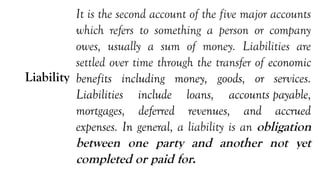
Liability
It is the second account of the five major accounts
which refers to something a person or company
owes, usually a sum of money. Liabilities are
settled over time through the transfer of economic
benefits including money, goods, or services.
Liabilities include loans, accounts payable,
mortgages, deferred revenues, and accrued
expenses. In general, a liability is an obligation
between one party and another not yet
completed or paid for.
Owner’s
Equity
It is the third account of the five major
accounts which refers to as shareholders'
equity (or owner’s equity for privately held
companies). Owner’s equity is a degree of
residual ownership in a firm or asset after
subtracting all liabilities associated with
that asset.
Revenue
It is the fourth account of the five
major accounts which refers to
money brought into a company by
its business activities. Revenue is
commonly known as service
income or fees, sales, and sales
discount.
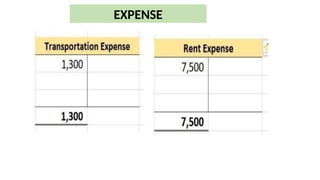
Expense
It is the fifth and last account of the five
major accounts which refers to the cost of
operations that a company incurs to
generate revenue. Common expenses
include payments to suppliers, employee
wages, factory leases, and equipment
depreciation.
Figure 6 - Matrix of
Normal Debit and Credit
Balances of Five Major
Accounts
Acquiring Equipment or Supply:
XYZ Company purchased ten (10) latest
models of Samsung cellular phones for the
company’s staff to be given as Christmas
giveaways, for a total amount of
P 350,000.00.
Types of records that you should keep as
bookkeeper
• Cash Receipts
• Purchases
• Expenses
• Assets
• Employer taxes
Functions of Bookkeeping
•Recording Financial transactions
DATE P A R T I C U L A R S
POST
.
REF. DEBIT
CREDI
T
1 June 25 Cash 5,000
2 Service Income 5,000
3
To record the receipt of cash from JJV
Hotel for the services rendered
Functions of Bookkeeping
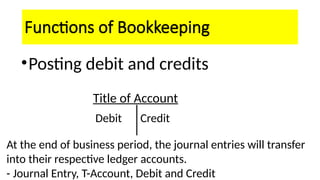
•Posting debit and credits
Title of Account
Debit Credit
At the end of business period, the journal entries will transfer
into their respective ledger accounts.
- Journal Entry, T-Account, Debit and Credit
General Journal
DATE P A R T I C U L A R S
POST
.
REF. DEBIT
CREDI
T
1 June 25 Cash 5,000
2 Service Income 5,000
3
To record the receipt of cash from JJV
Hotel for the services rendered
On June 25, 2020, ABC Laundry Co. rendered laundry services to JJV Hotel in Makati for
P5,000. The customer paid in cash.
Understanding Basic Accounting Equation
Assets=Liabilities +Owner’s Equity (A=L+E)
Different Accounts titles of
bookkeeping
- Assets
- Liabilities
- Owner’s equity
- Expenses
- Revenue
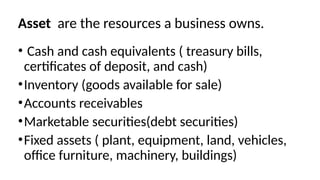
Asset are the resources a business owns.
• Cash and cash equivalents ( treasury bills,
certificates of deposit, and cash)
•Inventory (goods available for sale)
•Accounts receivables
•Marketable securities(debt securities)
•Fixed assets ( plant, equipment, land, vehicles,
office furniture, machinery, buildings)
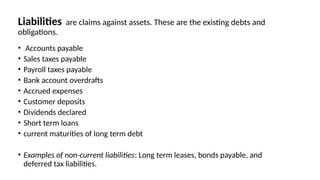
Liabilities are claims against assets. These are the existing debts and
obligations.
• Accounts payable
• Sales taxes payable
• Payroll taxes payable
• Bank account overdrafts
• Accrued expenses
• Customer deposits
• Dividends declared
• Short term loans
• current maturities of long term debt
• Examples of non-current liabilities: Long term leases, bonds payable, and
deferred tax liabilities.
Equity refers to shareholders’ equity or
owner’s equity, represents the amount that
will return to a company’s shareholders if all
of the assets are liquidate.
Figure 6 - Matrix of
Normal Debit and Credit
Balances of Five Major
Accounts
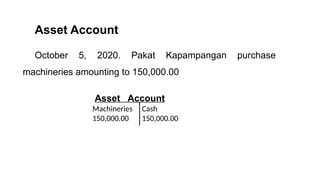
Asset Account
October 5, 2020. Pakat Kapampangan purchase
machineries amounting to 150,000.00
Asset Account
Machineries
150,000.00
Cash
150,000.00
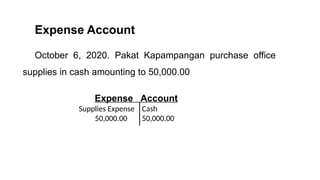
Expense Account
October 6, 2020. Pakat Kapampangan purchase office
supplies in cash amounting to 50,000.00
Expense Account
Supplies Expense
50,000.00
Cash
50,000.00
Liability Account
October 7, 2020. Pakat Kapampangan borrowed money from the bank
amounting to 100,000.00. Pakat Kapampangan promise to pay after one month with
10% interest of the principal amount.
Liability Account
Cash
100,000.00
Accounts Payable
100,000.00
Equity Account
October 4, 2020. Mr. Grant invested 100,000.00 in their sticker business “Pakat
Kapampangan”
Equity Account
Cash
100,000.00
Mr. Flores Capital
100,000.00
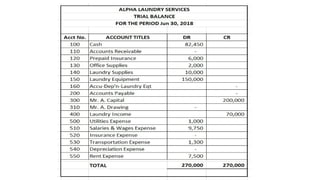
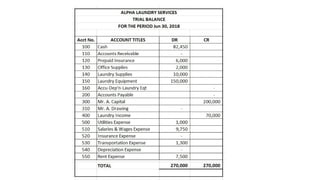
TRIAL BALANCE
- is a list of all ledger accounts with
closed or final balances on a certain
period arranged according to the
assets, liabilities, capital, revenue and
expense.
TRIAL BALANCE
The debit and credit columns must be
equal in total amount. This is the first
report prior to financial statement
preparation.
TRIAL BALANCE
Bookkeeping Practice Set 1.
Identifying and Recording a
business transaction using the
General Journal
TRIAL BALANCE
Bookkeeping Practice Set 1.
Identifying and Recording a
business transaction using the
General Journal
Bookkeeping Practice Set 1.
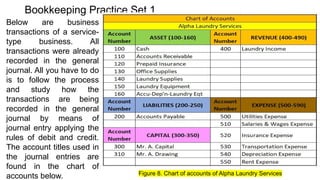
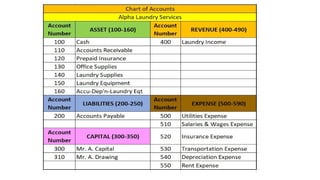
Below are business
transactions of a service-
type business. All
transactions were already
recorded in the general
journal. All you have to do
is to follow the process
and study how the
transactions are being
recorded in the general
journal by means of
journal entry applying the
rules of debit and credit.
The account titles used in
the journal entries are
found in the chart of
accounts below. Figure 8. Chart of accounts of Alpha Laundry Services
Mr. Denver Ambrose, a retired public school teacher,
started his laundry business in the beginning of
June 2018. He used all of his savings to start a “coin-
operated” laundry business. He named it Alpha
Laundry Services (ALS). The following are the
business transactions for the month of June 2018,
the first month of business operation:
Let’s Begin!
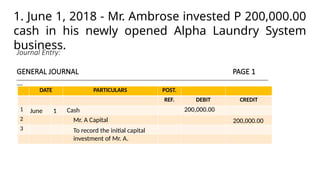
1. June 1, 2018 - Mr. Ambrose invested P 200,000.00
cash in his newly opened Alpha Laundry System
business.
Journal Entry:
GENERAL JOURNAL PAGE 1
______________________________________________________________________________________________________________________________
___
DATE PARTICULARS POST.
REF. DEBIT CREDIT
1
2
3
June 1 Cash
1. June 1, 2018 - Mr. Ambrose invested P 200,000.00
cash in his newly opened Alpha Laundry System
business.
200,000.00
Mr. A Capital 200,000.00
To record the initial capital
investment of Mr. A.
Journal Entry:
GENERAL JOURNAL PAGE 1
______________________________________________________________________________________________________________________________
___
DATE PARTICULARS POST.
REF. DEBIT CREDIT
1
2
3
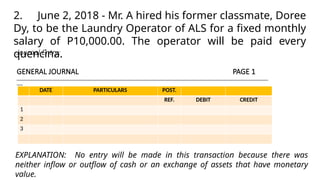
2. June 2, 2018 - Mr. A hired his former classmate, Doree
Dy, to be the Laundry Operator of ALS for a fixed monthly
salary of P10,000.00. The operator will be paid every
quencina.
EXPLANATION: No entry will be made in this transaction because there was
neither inflow or outflow of cash or an exchange of assets that have monetary
value.
Journal Entry:
GENERAL JOURNAL PAGE 1
______________________________________________________________________________________________________________________________
___
DATE PARTICULARS POST.
REF. DEBIT CREDIT
4
5
6
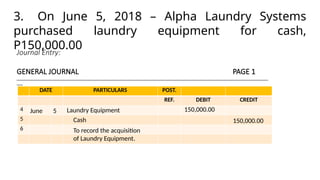
June 5 Laundry Equipment
3. On June 5, 2018 – Alpha Laundry Systems
purchased laundry equipment for cash,
P150,000.00
150,000.00
Cash 150,000.00
To record the acquisition
of Laundry Equipment.
Journal Entry:
GENERAL JOURNAL PAGE 1
______________________________________________________________________________________________________________________________
___
DATE PARTICULARS POST.
REF. DEBIT CREDIT
7
8
9
June 6 Prepaid Insurance
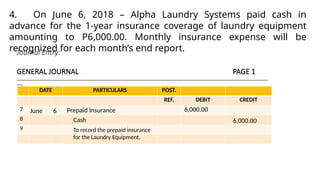
4. On June 6, 2018 – Alpha Laundry Systems paid cash in
advance for the 1-year insurance coverage of laundry equipment
amounting to P6,000.00. Monthly insurance expense will be
recognized for each month’s end report.
6,000.00
Cash 6,000.00
To record the prepaid insurance
for the Laundry Equipment.
Journal Entry:
GENERAL JOURNAL PAGE 1
______________________________________________________________________________________________________________________________
___
DATE PARTICULARS POST.
REF. DEBIT CREDIT
10
11
12
June 7 Laundry Supplies
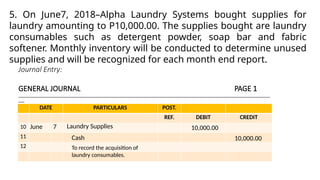
5. On June7, 2018–Alpha Laundry Systems bought supplies for
laundry amounting to P10,000.00. The supplies bought are laundry
consumables such as detergent powder, soap bar and fabric
softener. Monthly inventory will be conducted to determine unused
supplies and will be recognized for each month end report.
10,000.00
Cash 10,000.00
To record the acquisition of
laundry consumables.
Journal Entry:
GENERAL JOURNAL PAGE 1
______________________________________________________________________________________________________________________________
___
DATE PARTICULARS POST.
REF. DEBIT CREDIT
13
14
15
June 15 Salaries and Wages
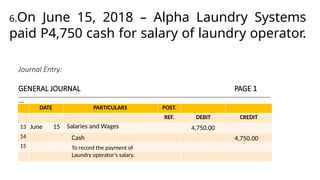
6.On June 15, 2018 – Alpha Laundry Systems
paid P4,750 cash for salary of laundry operator.
4,750.00
Cash 4,750.00
To record the payment of
Laundry operator’s salary.
Journal Entry:
GENERAL JOURNAL PAGE 1
______________________________________________________________________________________________________________________________
___
DATE PARTICULARS POST.
REF. DEBIT CREDIT
16
17
18
June 16 Cash
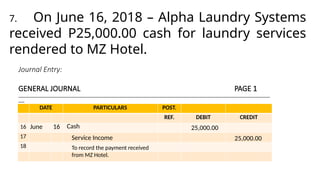
7. On June 16, 2018 – Alpha Laundry Systems
received P25,000.00 cash for laundry services
rendered to MZ Hotel.
25,000.00
Service Income 25,000.00
To record the payment received
from MZ Hotel.
Journal Entry:
GENERAL JOURNAL PAGE 1
______________________________________________________________________________________________________________________________
___
DATE PARTICULARS POST.
REF. DEBIT CREDIT
19
20
21
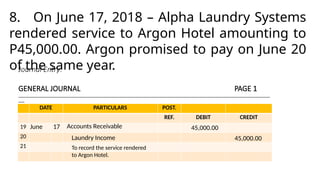
June 17 Accounts Receivable
8. On June 17, 2018 – Alpha Laundry Systems
rendered service to Argon Hotel amounting to
P45,000.00. Argon promised to pay on June 20
of the same year.
45,000.00
Laundry Income 45,000.00
To record the service rendered
to Argon Hotel.
Journal Entry:
GENERAL JOURNAL PAGE 1
______________________________________________________________________________________________________________________________
___
DATE PARTICULARS POST.
REF. DEBIT CREDIT
22
23
24
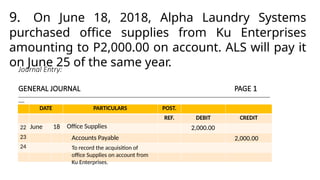
June 18 Office Supplies
9. On June 18, 2018, Alpha Laundry Systems
purchased office supplies from Ku Enterprises
amounting to P2,000.00 on account. ALS will pay it
on June 25 of the same year.
2,000.00
Accounts Payable 2,000.00
To record the acquisition of
office Supplies on account from
Ku Enterprises.
Journal Entry:
GENERAL JOURNAL PAGE 1
______________________________________________________________________________________________________________________________
___
DATE PARTICULARS POST.
REF. DEBIT CREDIT
25
26
27
June 20 Cash
10. On June 20, 2018, Alpha Laundry Systems
collected payment from Argon Hotel.
45,000.00
Accounts Receivable 45,000.00
To record the full payment from
Argon Hotel.
Journal Entry:
GENERAL JOURNAL PAGE 1
______________________________________________________________________________________________________________________________
___
DATE PARTICULARS POST.
REF. DEBIT CREDIT
28
29
30
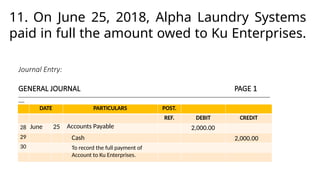
June 25 Accounts Payable
11. On June 25, 2018, Alpha Laundry Systems
paid in full the amount owed to Ku Enterprises.
2,000.00
Cash 2,000.00
To record the full payment of
Account to Ku Enterprises.
Journal Entry:
GENERAL JOURNAL PAGE 1
______________________________________________________________________________________________________________________________
___
DATE PARTICULARS POST.
REF. DEBIT CREDIT
31
32
33
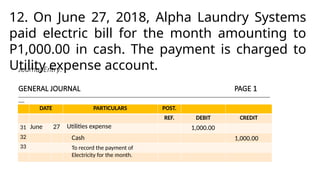
June 27 Utilities expense
12. On June 27, 2018, Alpha Laundry Systems
paid electric bill for the month amounting to
P1,000.00 in cash. The payment is charged to
Utility expense account.
1,000.00
Cash 1,000.00
To record the payment of
Electricity for the month.
Journal Entry:
GENERAL JOURNAL PAGE 1
______________________________________________________________________________________________________________________________
___
DATE PARTICULARS POST.
REF. DEBIT CREDIT
34
35
36
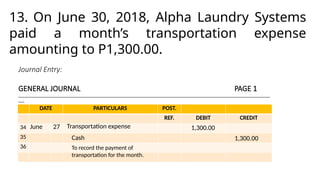
June 27 Transportation expense
13. On June 30, 2018, Alpha Laundry Systems
paid a month’s transportation expense
amounting to P1,300.00.
1,300.00
Cash 1,300.00
To record the payment of
transportation for the month.
Journal Entry:
GENERAL JOURNAL PAGE 1
______________________________________________________________________________________________________________________________
___
DATE PARTICULARS POST.
REF. DEBIT CREDIT
37
38
39
June 30 Salaries and Wages
14. On June 30, 2018, Alpha Laundry Systems
paid P5,000 cash for salary of laundry operator.
5,000.00
Cash 5,000.00
To record the payment of
Laundry operator’s salary.
Journal Entry:
GENERAL JOURNAL PAGE 1
______________________________________________________________________________________________________________________________
___
DATE PARTICULARS POST.
REF. DEBIT CREDIT
40
41
42
June 30 Rent Expense
15. On June 30, 2018, Alpha Laundry Systems
paid P7,500 cash for the month’s rent for
laundry space.
7,500.00
Cash 7,500.00
To record the payment of rent
for laundry space.
The total debit and credit columns of the
general journal should always be equal.
Otherwise, the general journal balances will
affect overall accuracy of the entire financial
report. The error should be properly corrected
before the next step in the recording process
takes place.
Bookkeeping Practice Set 2.
Posting journal entries to the
General Ledger using T-Accounts.
Directions: In this activity, you are supposed to do the posting of general journal entries to the
general ledger using the T-Accounts technique. The following are suggested activities before
posting journal entries to T- Accounts:
1.Group account titles according to the Five Major Accounts.
2.Determine the normal balance of each account title by referring
to the normal balance matrix.
3.Record transactions in sequential order or apply the “First-entry,
First- record” system.
4.After all journal entries are recorded, compute the debit and
credit totals of all accounts. Compute for the running balance.
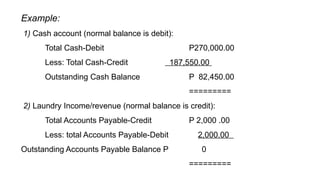
Example:
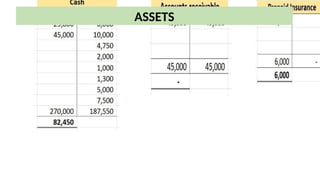
1) Cash account (normal balance is debit):
Total Cash-Debit P270,000.00
Less: Total Cash-Credit 187,550.00
Outstanding Cash Balance P 82,450.00
=========
2) Laundry Income/revenue (normal balance is credit):
Total Accounts Payable-Credit P 2,000 .00
Less: total Accounts Payable-Debit 2,000.00
Outstanding Accounts Payable Balance P 0
=========
Different Accounts titles of
bookkeeping
- Assets
- Liabilities
- Owner’s equity
- Expenses
- Revenue
The Rules of Debit and Credit
The following steps will be undertaken in determining account balances for every
account title such as cash, account receivable, etc.:
1. Add all the debit side to generate total
debit
2. Add all the credit side to generate total
credit.
3.Subtract total debit to the total credit.
4.Determine the balance of each account.
Bookkeeping Practice Set 3.
Preparing trial Balance
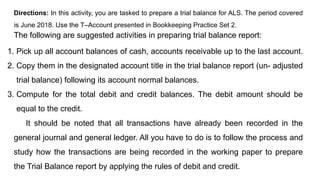
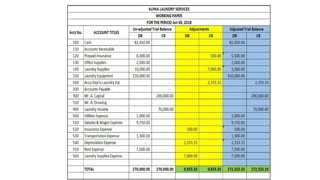
Directions: In this activity, you are tasked to prepare a trial balance for ALS. The period covered
is June 2018. Use the T–Account presented in Bookkeeping Practice Set 2.
The following are suggested activities in preparing trial balance report:
1. Pick up all account balances of cash, accounts receivable up to the last account.
2. Copy them in the designated account title in the trial balance report (un- adjusted
trial balance) following its account normal balances.
3. Compute for the total debit and credit balances. The debit amount should be
equal to the credit.
It should be noted that all transactions have already been recorded in the
general journal and general ledger. All you have to do is to follow the process and
study how the transactions are being recorded in the working paper to prepare
the Trial Balance report by applying the rules of debit and credit.
Journalizing Business Transactions
Directions: Write your answer on a separate
worksheet.
1.Prepare journalized entries on the following
transactions.
2.Compute the total debit and credit balances of
the general journal.
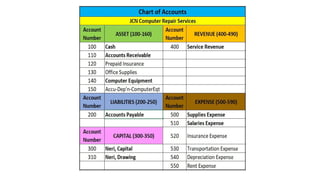
3.Use the JCN Computer Repair Services chart of
accounts below.
Materials Needed:
1. 2-column worksheet (or bond paper) – 1pc
a. If using bond paper, copy the format of a
general journal using pencil and ruler.
2. Calculator and ruler
3. Ball pen / pencil with eraser
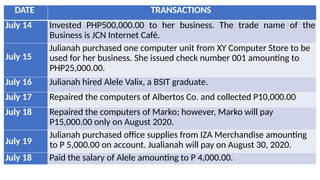
Ms. Julianah Chloe Neri opened her
computer repair business in Cagayan de
Oro City on July 14, 2020. The following
transactions occurred during the month of
July 2020:
DATE TRANSACTIONS
July 14 Invested PHP500,000.00 to her business. The trade name of the
Business is JCN Internet Café.
July 15
Julianah purchased one computer unit from XY Computer Store to be
used for her business. She issued check number 001 amounting to
PHP25,000.00.
July 16 Julianah hired Alele Valix, a BSIT graduate.
July 17 Repaired the computers of Albertos Co. and collected P10,000.00
July 18 Repaired the computers of Marko; however, Marko will pay
P15,000.00 only on August 2020.
July 19
Julianah purchased office supplies from IZA Merchandise amounting
to P 5,000.00 on account. Jualianah will pay on August 30, 2020.
July 18 Paid the salary of Alele amounting to P 4,000.00.
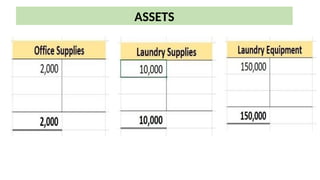
ASSETS
ASSETS
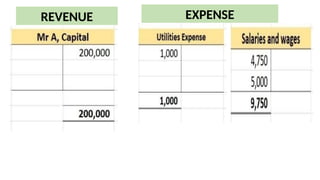
LIABILITIES OWNER’S EQUITY
REVENUE EXPENSE
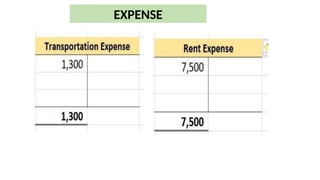
EXPENSE
EXPENSE
Having completed the Trial Balance report is
not yet the end of a
bookkeeper’s responsibility. The
bookkeeper’s responsibility will only end
when the business has closed its books of
accounts.
The books of accounts of a business will be closed at the end of the business’s
calendar or fiscal year.
The calendar year always begins in January 1 and
ends on December 31 of the same year.
The fiscal year begins at any month of the year and
ends on the 12th month of the following year. All
business activities (financial in nature) should be recorded in the books of
accounts even when the financial reports have already been prepared. Business
activities or transactions that were not included in the financial reports will be
recorded to reflect necessary adjustments.
What is an Adjusting Entry?
Adjusting entry is an entry made to update
the financial data already recorded. Making
an adjusting entry helps the bookkeeper
capture all financial events that happened
over a period of time with in the accounting
cycle. It is essential in keeping the
financial record updated.
What is an Adjusting Entry?
Adjusting entry is an entry made to update
the financial data already recorded. Making
an adjusting entry helps the bookkeeper
capture all financial events that happened
over a period of time with in the accounting
cycle. It is essential in keeping the
financial record updated.
The bookkeeper is going to look or examine accounts that
needs to be updated. Outlined below are the five basic
sources of adjusting entries:
1. Depreciation expense
2. Deferred expenses of prepaid expenses
3. Deferred income of unearned income
4. Accrued expenses of accrued liabilities
5. Accrued income or accrued assets
1. Depreciation
This is a method of allocating
the cost of an asset to an
expense over the accounting
periods that make up the
asset’s useful life.
Examples of assets subject to depreciation are:
Store, Office,
Building, and
Transportation
Equipment.
These types of assets lose
their ability to provide
useful service as time
passes.
Depreciation can also be referred
to as the decrease in the
usefulness of these types of assets.
Take note that Land is not subject to
depreciation because the value of land mostly
increases as time passes.
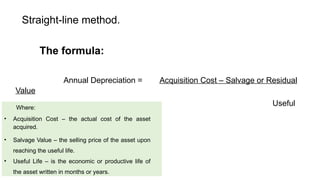
Straight-line method.
The formula:
Annual Depreciation = Acquisition Cost – Salvage or Residual
Value
Useful
Life
Where:
• Acquisition Cost – the actual cost of the asset
acquired.
• Salvage Value – the selling price of the asset upon
reaching the useful life.
• Useful Life – is the economic or productive life of
the asset written in months or years.
2. Deferred expenses or prepaid
expenses. These are items that have been
initially recorded as assets but are expected
to become expenses over time or through the
operations of the business. In order to
recognize the correct amount of expenses,
prepayments shall be amortized weekly,
semi-monthly or monthly, depending on its
nature and purpose.
3. Deferred income or unearned income.
These are items that have been initially
recorded as liabilities but are expected to
become income over time or through the
operations of the business.
4. Accrued expenses or accrued
liabilities. These are items of expenses
that have been incurred but have not been
recorded and paid.
5. Accrued income or accrued assets.
These are income items that have been
earned but have not been recorded and
paid by the customer. In short, these are
receivables of the business.
Bookkeeping Practice Set 4.
Record adjusting journal entries
in the general journal
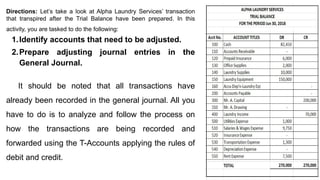
Directions: Let’s take a look at Alpha Laundry Services’ transaction
that transpired after the Trial Balance have been prepared. In this
activity, you are tasked to do the following:
1.Identify accounts that need to be adjusted.
2.Prepare adjusting journal entries in the
General Journal.
It should be noted that all transactions have
already been recorded in the general journal. All you
have to do is to analyze and follow the process on
how the transactions are being recorded and
forwarded using the T-Accounts applying the rules of
debit and credit.
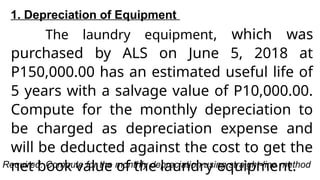
1. Depreciation of Equipment
The laundry equipment, which was
purchased by ALS on June 5, 2018 at
P150,000.00 has an estimated useful life of
5 years with a salvage value of P10,000.00.
Compute for the monthly depreciation to
be charged as depreciation expense and
will be deducted against the cost to get the
net book value of the laundry equipment.
Required: Compute for the monthly depreciation using straight-line method
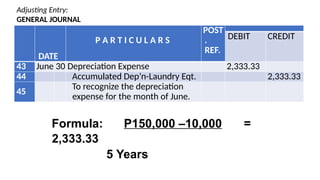
DATE
P A R T I C U L A R S
POST
.
REF.
DEBIT CREDIT
43 June 30 Depreciation Expense 2,333.33
44 Accumulated Dep’n-Laundry Eqt. 2,333.33
45
To recognize the depreciation
expense for the month of June.
Formula: P150,000 –10,000 =
2,333.33
5 Years
Adjusting Entry:
GENERAL JOURNAL
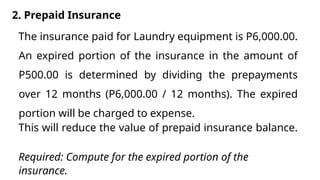
2. Prepaid Insurance
The insurance paid for Laundry equipment is P6,000.00.
An expired portion of the insurance in the amount of
P500.00 is determined by dividing the prepayments
over 12 months (P6,000.00 / 12 months). The expired
portion will be charged to expense.
This will reduce the value of prepaid insurance balance.
Required: Compute for the expired portion of the
insurance.
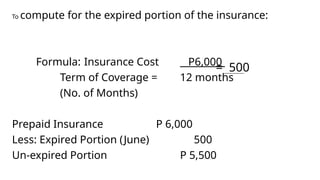
To compute for the expired portion of the insurance:
Formula: Insurance Cost P6,000
Term of Coverage = 12 months
(No. of Months)
Prepaid Insurance P 6,000
Less: Expired Portion (June) 500
Un-expired Portion P 5,500
= 500
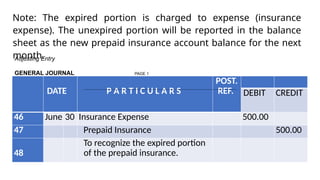
Note: The expired portion is charged to expense (insurance
expense). The unexpired portion will be reported in the balance
sheet as the new prepaid insurance account balance for the next
month.
DATE P A R T I C U L A R S
POST.
REF. DEBIT CREDIT
46 June 30 Insurance Expense 500.00
47 Prepaid Insurance 500.00
48
To recognize the expired portion
of the prepaid insurance.
Adjusting Entry
GENERAL JOURNAL PAGE 1
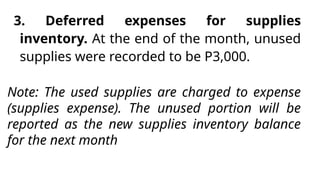
3. Deferred expenses for supplies
inventory. At the end of the month, unused
supplies were recorded to be P3,000.
Note: The used supplies are charged to expense
(supplies expense). The unused portion will be
reported as the new supplies inventory balance
for the next month
Adjusting Entry:
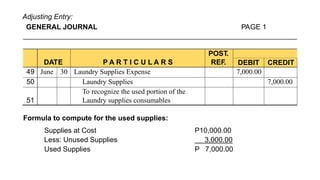
GENERAL JOURNAL PAGE 1
DATE P A R T I C U L A R S
POST.
REF. DEBIT CREDIT
49 June 30 Laundry Supplies Expense 7,000.00
50 Laundry Supplies 7,000.00
51
To recognize the used portion of the
Laundry supplies consumables
Formula to compute for the used supplies:
Supplies at Cost P10,000.00
Less: Unused Supplies 3,000.00
Used Supplies P 7,000.00
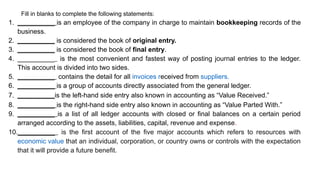
Fill in blanks to complete the following statements:
1. __________ is an employee of the company in charge to maintain bookkeeping records of the
business.
2. __________ is considered the book of original entry.
3. __________ is considered the book of final entry.
4. __________ is the most convenient and fastest way of posting journal entries to the ledger.
This account is divided into two sides.
5. __________ contains the detail for all invoices received from suppliers.
6. __________ is a group of accounts directly associated from the general ledger.
7. __________is the left-hand side entry also known in accounting as “Value Received.”
8. __________ is the right-hand side entry also known in accounting as “Value Parted With.”
9. __________ is a list of all ledger accounts with closed or final balances on a certain period
arranged according to the assets, liabilities, capital, revenue and expense.
10.__________ is the first account of the five major accounts which refers to resources with
economic value that an individual, corporation, or country owns or controls with the expectation
that it will provide a future benefit.
Bookkeeping Practice Set 5: Posting the adjusting entries
in the General Ledger by using T – Account
Directions: In this activity, you are tasked to do the following:
1. Using the completed adjusting journal entries in the general journal,
update the General Ledger records by adding or subtracting the affected
accounts.
It should be noted that all transactions have already been recorded in the
general ledger. All you have to do is to follow the process and study how the
transactions are being computed and posted by means of applying the rules
of debit and credit.
Bookkeeping Practice Set 5: Posting the adjusting entries
in the General Ledger by using T – Account
Directions: In this activity, you are tasked to do the following:
1. Using the completed adjusting journal entries in the general journal,
update the General Ledger records by adding or subtracting the affected
accounts.
It should be noted that all transactions have already been recorded in the
general ledger. All you have to do is to follow the process and study how the
transactions are being computed and posted by means of applying the rules
of debit and credit.

BOOKKEEPING entrep12 module_LAst wk.pptx

  • 1.
  • 2.
     to recordbusiness transactions,  prepare journal entries  general ledger  trial balance report.
  • 3.
    1. A sourcedocument evidencing those orders have been placed by the customer waiting to be served by the supplier. A. Purchase request B.Purchase invoice C.Purchase Order D.Purchase check
  • 4.
    2. A sourcedocument evidencing those goods have been delivered by the supplier to the customer. . Supplier’s sales invoice B. Vale slip C. Customer’s sales invoice D. Customer’s delivery receipt
  • 5.
    3. A sourcedocument issued by the supplier acknowledging that full payment has been received from the customer. A. Official receipt B. Purchase receipt C. Delivery Receipt D. Receiving report
  • 6.
    4. All ofthe following are examples of source documents, except A. Check B. Invoices C. Contract D. Journal
  • 7.
    5. A sourcedocument which shows that the customer has already made partial payment to the supplier through issuance of. A. Check B. Voucher C. Official receipt D. Sales invoice
  • 8.
    6. An exampleof asset that can be used in the business for a long period of time, usually more than a year. A. Inventories B. Computer C. Receivables D. Cash
  • 9.
    7. A typeof business that is purely engaged in providing all types of service activities such as medical or legal services. A. Service business B. Merchandising business C. Manufacturing business D. Trading business
  • 10.
    8. A typeof business that is engaged in buying and selling of food products such as grocery/convenient stores. A. Service business B. Merchandising business C. Manufacturing business D. Forex Trading business
  • 11.
    9. Referred toas the book of original entry A. Ledger B. Journal C. Accounts Receivable Ledger D. Purchase Journal
  • 12.
    10. Referred toas the book of final entry A. General Ledger B. General Journal C. Accounts Receivable Ledge D. Purchase Journal
  • 13.
    •In this lessonyou will learn how to keep your business records and be able to perform the bookkeeping tasks.
  • 14.
    •How does bookkeeping andaccounting differ?
  • 15.
  • 16.
  • 17.
    •Accounting is aprocess of recording financial transactions pertaining to a business.(Alicia,2020.)
  • 18.
  • 19.
    Bookkeeping- the processof recording business transactions in a systematic and chronological manner. It is systematic because it follows procedures and principles. It is chronological because the transactions are recorded in order of the date of occurrence.
  • 20.
    •Bookkeeping is theprocess of recording transactions made by a business and the process of keeping track of every financial transactions made by a business firm from the opening of the firm to the closing of the firm.
  • 21.
    •Bookkeeper are responsiblefor recording, classifying, and organizing every financial transaction made through the course of business operations.
  • 22.
    Bookkeeper -Collects the documentationfor each financial transaction -Records the transactions in the accounting journal -Classifies each transaction as one or more debits and one or more credits -Organizes the transactions according to the firm’s chart of account
  • 23.
    Bookkeeper -Collects the documentationfor each financial transaction -Records the transactions in the accounting journal -Classifies each transaction as one or more debits and one or more credits -Organizes the transactions according to the firm’s chart of account
  • 24.
    Accountant -Takes over toanalyze, review, interpret, and report financial information for the business firm.
  • 25.
    Bookkeeper will record thetransaction happen in a day, week, months and year.
  • 26.
    Good records willhelp you do the following -Monitor the progress of your business. -Prepare your financial statements. -Identify sources of your income. -Keep track of your deductible expenses. -Keep track of your basis in property.
  • 27.
    Keeping records isimportant to you business. Good records will help you do the following. •Prepare your tax returns •Support items report on your tax returns •Give companies reliable measure of their performance. •Provides information on general strategic decisions and a benchmark for its revenue and income goals. •It is crucial for businesses to keep records of every penny spent.
  • 28.
    Keeping records isimportant to you business. Good records will help you do the following. •Prepare your tax returns •Support items report on your tax returns •Give companies reliable measure of their performance. •Provides information on general strategic decisions and a benchmark for its revenue and income goals. •It is crucial for businesses to keep records of every penny spent.
  • 29.
    Book of Accounts.The book of accounts is composed of the Journal and Ledger. Journal. Referred to as the book of original entry Ledger. Referred to as the book of final entry.
  • 30.
    General Journal isthe most basic journal which provides columns for date, account titles and explanations, folio or references and a separate column for debit and credit entries.
  • 31.
    General Journal DATE PAR T I C U LA R S POST . REF. DEBIT CREDI T 1 June 25 Cash 5,000 2 ServiceIncome 5,000 3 To record the receipt ofcashfrom JJV Hotelfor theservices rendered On June 25, 2020, ABC Laundry Co. rendered laundry services to JJV Hotel in Makati for P5,000. The customer paid in cash.
  • 32.
    General Ledger isa group of all accounts that can be found in the chart of accounts. These accounts will be reflected in the trial balance as a summary of all financial activities that have taken place as recorded in the general journal and subsidiary ledgers.
  • 33.
  • 34.
    Subsidiary Ledger isa group of accounts directly associated with the general ledger. This record is created to maintain individual accounts for customers and vendors whose cash is not being used as a medium of exchange when purchasing or selling merchandise.
  • 36.
    Account Receivable Ledger The accounts receivableledger is a sub-ledger which records all credit sales made by a business. It is useful for segregating into one location a record of all amounts invoiced to customers. A typical transaction entered into the accounts receivable ledger which records all account receivables, followed at a later date by a payment transaction from a customer that eliminates the accounts receivable. More importantly, it is a subsidiary ledger which records a customer’s accounts in the business.
  • 37.
    Account Payable Ledger An accounts payableledger contains the detail for all invoices received from suppliers. This ledger is used as a subsidiary ledger, from which summary-level information is periodically posted to the general ledger. Having a separate accounts payable ledger keeps a large amount of detailed payables t ransactions from cluttering up the general ledger.
  • 38.
    Debit The left-hand sideentry also known in accounting as “Value Received.” When cash or non-cash items are received, the said cash or non-cash items must be recorded in the debit column. This means that the debit balance has increased.
  • 39.
    Credit The right-hand sideentry also known in accounting as “Value Parted With.” When cash or non-cash items are given, the said cash or non-cash items must be recorded in the credit column. This means that the credit balance has increased.
  • 40.
    The Rules ofDebit and Credit In the process of journalizing business transactions, the rules of Debit and Credit are essential to ensure accurate recording and sound decision making. Debit is abbreviated as DR while CR for Credit. Further, it is deemed a requirement that the bookkeeper should be able to master the normal balance of each account title being used in the process of recording.
  • 41.
    The Rules ofDebit and Credit The following steps will be undertaken in determining account balances for every account title such as cash, account receivable, etc.: 1. Add all the debit side to generate total debit 2. Add all the credit side to generate total credit. 3.Subtract total debit to the total credit. 4.Determine the balance of each account.
  • 42.
    T- Account The mostconvenient and fastest way of posting journal entries to the ledger is by way of using “T” Account. A T- Account is divided into two sides. The left-hand side is called the debit side and the right-hand side is called the credit side. The left-hand or debit side shows the value received while the right-hand side shows the value parted with. This is called T Account because it resembles the capital letter “T.” An account title is written above the T- account.
  • 43.
    ACCOUNT TITLE Left-Hand Side orDEBIT SIDE Is for VALUE RECEIVED Right-Hand Side or CREDIT SIDE Is for VALUE PARTED WITH
  • 44.
    Sample of GeneralJournal entry and T- Account: GENERAL JOURNAL DATE P A R T I C U L A R S POST. REF. DEBIT CREDIT 1 Dec. 1 Cash 200,000 2 Service Income 200,000 3 To record the receipt of cash for the services rendered
  • 45.
    Posting the journalentry to the T – Account:
  • 46.
    To strengthen yourunderstanding about posting of journal entries to the general ledger, it is suggested to create T– Account and label them with the account title and group them according to Assets, Liabilities, Owner’s Equity, Revenue and Expense.
  • 47.
    Depicted in Figure6 below is a matrix of normal debit and credit balances of the Five Major Accounts: ACCOUNT TYPE DEBIT CREDIT Assets Liabilities Owner’s Equity Revenue Expenses
  • 48.
    Different Accounts titlesof bookkeeping - Assets - Liabilities - Owner’s equity - Expenses - Revenue
  • 49.
    Asset It is thefirst account of the five major accounts which refers to resources with economic value that an individual, corporation, or country owns or controls with the expectation that it will provide a future benefit. An asset represents an economic resource for a company or represents access that other individuals or firms do not have. An economic resource is something that is scarce and has the ability to produce economic benefit by generating cash inflows or decreasing cash outflows.
  • 50.
    Liability It is thesecond account of the five major accounts which refers to something a person or company owes, usually a sum of money. Liabilities are settled over time through the transfer of economic benefits including money, goods, or services. Liabilities include loans, accounts payable, mortgages, deferred revenues, and accrued expenses. In general, a liability is an obligation between one party and another not yet completed or paid for.
  • 51.
    Owner’s Equity It is thethird account of the five major accounts which refers to as shareholders' equity (or owner’s equity for privately held companies). Owner’s equity is a degree of residual ownership in a firm or asset after subtracting all liabilities associated with that asset.
  • 52.
    Revenue It is thefourth account of the five major accounts which refers to money brought into a company by its business activities. Revenue is commonly known as service income or fees, sales, and sales discount.
  • 53.
    Expense It is thefifth and last account of the five major accounts which refers to the cost of operations that a company incurs to generate revenue. Common expenses include payments to suppliers, employee wages, factory leases, and equipment depreciation.
  • 54.
    Figure 6 -Matrix of Normal Debit and Credit Balances of Five Major Accounts
  • 55.
    Acquiring Equipment orSupply: XYZ Company purchased ten (10) latest models of Samsung cellular phones for the company’s staff to be given as Christmas giveaways, for a total amount of P 350,000.00.
  • 57.
    Types of recordsthat you should keep as bookkeeper • Cash Receipts • Purchases • Expenses • Assets • Employer taxes
  • 58.
    Functions of Bookkeeping •RecordingFinancial transactions DATE P A R T I C U L A R S POST . REF. DEBIT CREDI T 1 June 25 Cash 5,000 2 Service Income 5,000 3 To record the receipt of cash from JJV Hotel for the services rendered
  • 59.
    Functions of Bookkeeping •Postingdebit and credits Title of Account Debit Credit At the end of business period, the journal entries will transfer into their respective ledger accounts. - Journal Entry, T-Account, Debit and Credit
  • 60.
    General Journal DATE PA R T I C U L A R S POST . REF. DEBIT CREDI T 1 June 25 Cash 5,000 2 Service Income 5,000 3 To record the receipt of cash from JJV Hotel for the services rendered On June 25, 2020, ABC Laundry Co. rendered laundry services to JJV Hotel in Makati for P5,000. The customer paid in cash.
  • 61.
    Understanding Basic AccountingEquation Assets=Liabilities +Owner’s Equity (A=L+E)
  • 62.
    Different Accounts titlesof bookkeeping - Assets - Liabilities - Owner’s equity - Expenses - Revenue
  • 63.
    Asset are theresources a business owns. • Cash and cash equivalents ( treasury bills, certificates of deposit, and cash) •Inventory (goods available for sale) •Accounts receivables •Marketable securities(debt securities) •Fixed assets ( plant, equipment, land, vehicles, office furniture, machinery, buildings)
  • 64.
    Liabilities are claimsagainst assets. These are the existing debts and obligations. • Accounts payable • Sales taxes payable • Payroll taxes payable • Bank account overdrafts • Accrued expenses • Customer deposits • Dividends declared • Short term loans • current maturities of long term debt • Examples of non-current liabilities: Long term leases, bonds payable, and deferred tax liabilities.
  • 65.
    Equity refers toshareholders’ equity or owner’s equity, represents the amount that will return to a company’s shareholders if all of the assets are liquidate.
  • 66.
    Figure 6 -Matrix of Normal Debit and Credit Balances of Five Major Accounts
  • 67.
    Asset Account October 5,2020. Pakat Kapampangan purchase machineries amounting to 150,000.00 Asset Account Machineries 150,000.00 Cash 150,000.00
  • 68.
    Expense Account October 6,2020. Pakat Kapampangan purchase office supplies in cash amounting to 50,000.00 Expense Account Supplies Expense 50,000.00 Cash 50,000.00
  • 69.
    Liability Account October 7,2020. Pakat Kapampangan borrowed money from the bank amounting to 100,000.00. Pakat Kapampangan promise to pay after one month with 10% interest of the principal amount. Liability Account Cash 100,000.00 Accounts Payable 100,000.00
  • 70.
    Equity Account October 4,2020. Mr. Grant invested 100,000.00 in their sticker business “Pakat Kapampangan” Equity Account Cash 100,000.00 Mr. Flores Capital 100,000.00
  • 71.
    TRIAL BALANCE - isa list of all ledger accounts with closed or final balances on a certain period arranged according to the assets, liabilities, capital, revenue and expense.
  • 72.
    TRIAL BALANCE The debitand credit columns must be equal in total amount. This is the first report prior to financial statement preparation.
  • 73.
    TRIAL BALANCE Bookkeeping PracticeSet 1. Identifying and Recording a business transaction using the General Journal
  • 74.
    TRIAL BALANCE Bookkeeping PracticeSet 1. Identifying and Recording a business transaction using the General Journal
  • 75.
    Bookkeeping Practice Set1. Below are business transactions of a service- type business. All transactions were already recorded in the general journal. All you have to do is to follow the process and study how the transactions are being recorded in the general journal by means of journal entry applying the rules of debit and credit. The account titles used in the journal entries are found in the chart of accounts below. Figure 8. Chart of accounts of Alpha Laundry Services
  • 76.
    Mr. Denver Ambrose,a retired public school teacher, started his laundry business in the beginning of June 2018. He used all of his savings to start a “coin- operated” laundry business. He named it Alpha Laundry Services (ALS). The following are the business transactions for the month of June 2018, the first month of business operation: Let’s Begin! 1. June 1, 2018 - Mr. Ambrose invested P 200,000.00 cash in his newly opened Alpha Laundry System business.
  • 77.
    Journal Entry: GENERAL JOURNALPAGE 1 ______________________________________________________________________________________________________________________________ ___ DATE PARTICULARS POST. REF. DEBIT CREDIT 1 2 3 June 1 Cash 1. June 1, 2018 - Mr. Ambrose invested P 200,000.00 cash in his newly opened Alpha Laundry System business. 200,000.00 Mr. A Capital 200,000.00 To record the initial capital investment of Mr. A.
  • 78.
    Journal Entry: GENERAL JOURNALPAGE 1 ______________________________________________________________________________________________________________________________ ___ DATE PARTICULARS POST. REF. DEBIT CREDIT 1 2 3 2. June 2, 2018 - Mr. A hired his former classmate, Doree Dy, to be the Laundry Operator of ALS for a fixed monthly salary of P10,000.00. The operator will be paid every quencina. EXPLANATION: No entry will be made in this transaction because there was neither inflow or outflow of cash or an exchange of assets that have monetary value.
  • 79.
    Journal Entry: GENERAL JOURNALPAGE 1 ______________________________________________________________________________________________________________________________ ___ DATE PARTICULARS POST. REF. DEBIT CREDIT 4 5 6 June 5 Laundry Equipment 3. On June 5, 2018 – Alpha Laundry Systems purchased laundry equipment for cash, P150,000.00 150,000.00 Cash 150,000.00 To record the acquisition of Laundry Equipment.
  • 80.
    Journal Entry: GENERAL JOURNALPAGE 1 ______________________________________________________________________________________________________________________________ ___ DATE PARTICULARS POST. REF. DEBIT CREDIT 7 8 9 June 6 Prepaid Insurance 4. On June 6, 2018 – Alpha Laundry Systems paid cash in advance for the 1-year insurance coverage of laundry equipment amounting to P6,000.00. Monthly insurance expense will be recognized for each month’s end report. 6,000.00 Cash 6,000.00 To record the prepaid insurance for the Laundry Equipment.
  • 81.
    Journal Entry: GENERAL JOURNALPAGE 1 ______________________________________________________________________________________________________________________________ ___ DATE PARTICULARS POST. REF. DEBIT CREDIT 10 11 12 June 7 Laundry Supplies 5. On June7, 2018–Alpha Laundry Systems bought supplies for laundry amounting to P10,000.00. The supplies bought are laundry consumables such as detergent powder, soap bar and fabric softener. Monthly inventory will be conducted to determine unused supplies and will be recognized for each month end report. 10,000.00 Cash 10,000.00 To record the acquisition of laundry consumables.
  • 82.
    Journal Entry: GENERAL JOURNALPAGE 1 ______________________________________________________________________________________________________________________________ ___ DATE PARTICULARS POST. REF. DEBIT CREDIT 13 14 15 June 15 Salaries and Wages 6.On June 15, 2018 – Alpha Laundry Systems paid P4,750 cash for salary of laundry operator. 4,750.00 Cash 4,750.00 To record the payment of Laundry operator’s salary.
  • 83.
    Journal Entry: GENERAL JOURNALPAGE 1 ______________________________________________________________________________________________________________________________ ___ DATE PARTICULARS POST. REF. DEBIT CREDIT 16 17 18 June 16 Cash 7. On June 16, 2018 – Alpha Laundry Systems received P25,000.00 cash for laundry services rendered to MZ Hotel. 25,000.00 Service Income 25,000.00 To record the payment received from MZ Hotel.
  • 84.
    Journal Entry: GENERAL JOURNALPAGE 1 ______________________________________________________________________________________________________________________________ ___ DATE PARTICULARS POST. REF. DEBIT CREDIT 19 20 21 June 17 Accounts Receivable 8. On June 17, 2018 – Alpha Laundry Systems rendered service to Argon Hotel amounting to P45,000.00. Argon promised to pay on June 20 of the same year. 45,000.00 Laundry Income 45,000.00 To record the service rendered to Argon Hotel.
  • 85.
    Journal Entry: GENERAL JOURNALPAGE 1 ______________________________________________________________________________________________________________________________ ___ DATE PARTICULARS POST. REF. DEBIT CREDIT 22 23 24 June 18 Office Supplies 9. On June 18, 2018, Alpha Laundry Systems purchased office supplies from Ku Enterprises amounting to P2,000.00 on account. ALS will pay it on June 25 of the same year. 2,000.00 Accounts Payable 2,000.00 To record the acquisition of office Supplies on account from Ku Enterprises.
  • 86.
    Journal Entry: GENERAL JOURNALPAGE 1 ______________________________________________________________________________________________________________________________ ___ DATE PARTICULARS POST. REF. DEBIT CREDIT 25 26 27 June 20 Cash 10. On June 20, 2018, Alpha Laundry Systems collected payment from Argon Hotel. 45,000.00 Accounts Receivable 45,000.00 To record the full payment from Argon Hotel.
  • 87.
    Journal Entry: GENERAL JOURNALPAGE 1 ______________________________________________________________________________________________________________________________ ___ DATE PARTICULARS POST. REF. DEBIT CREDIT 28 29 30 June 25 Accounts Payable 11. On June 25, 2018, Alpha Laundry Systems paid in full the amount owed to Ku Enterprises. 2,000.00 Cash 2,000.00 To record the full payment of Account to Ku Enterprises.
  • 88.
    Journal Entry: GENERAL JOURNALPAGE 1 ______________________________________________________________________________________________________________________________ ___ DATE PARTICULARS POST. REF. DEBIT CREDIT 31 32 33 June 27 Utilities expense 12. On June 27, 2018, Alpha Laundry Systems paid electric bill for the month amounting to P1,000.00 in cash. The payment is charged to Utility expense account. 1,000.00 Cash 1,000.00 To record the payment of Electricity for the month.
  • 89.
    Journal Entry: GENERAL JOURNALPAGE 1 ______________________________________________________________________________________________________________________________ ___ DATE PARTICULARS POST. REF. DEBIT CREDIT 34 35 36 June 27 Transportation expense 13. On June 30, 2018, Alpha Laundry Systems paid a month’s transportation expense amounting to P1,300.00. 1,300.00 Cash 1,300.00 To record the payment of transportation for the month.
  • 90.
    Journal Entry: GENERAL JOURNALPAGE 1 ______________________________________________________________________________________________________________________________ ___ DATE PARTICULARS POST. REF. DEBIT CREDIT 37 38 39 June 30 Salaries and Wages 14. On June 30, 2018, Alpha Laundry Systems paid P5,000 cash for salary of laundry operator. 5,000.00 Cash 5,000.00 To record the payment of Laundry operator’s salary.
  • 91.
    Journal Entry: GENERAL JOURNALPAGE 1 ______________________________________________________________________________________________________________________________ ___ DATE PARTICULARS POST. REF. DEBIT CREDIT 40 41 42 June 30 Rent Expense 15. On June 30, 2018, Alpha Laundry Systems paid P7,500 cash for the month’s rent for laundry space. 7,500.00 Cash 7,500.00 To record the payment of rent for laundry space.
  • 92.
    The total debitand credit columns of the general journal should always be equal. Otherwise, the general journal balances will affect overall accuracy of the entire financial report. The error should be properly corrected before the next step in the recording process takes place.
  • 93.
    Bookkeeping Practice Set2. Posting journal entries to the General Ledger using T-Accounts.
  • 94.
    Directions: In thisactivity, you are supposed to do the posting of general journal entries to the general ledger using the T-Accounts technique. The following are suggested activities before posting journal entries to T- Accounts: 1.Group account titles according to the Five Major Accounts. 2.Determine the normal balance of each account title by referring to the normal balance matrix. 3.Record transactions in sequential order or apply the “First-entry, First- record” system. 4.After all journal entries are recorded, compute the debit and credit totals of all accounts. Compute for the running balance.
  • 95.
    Example: 1) Cash account(normal balance is debit): Total Cash-Debit P270,000.00 Less: Total Cash-Credit 187,550.00 Outstanding Cash Balance P 82,450.00 ========= 2) Laundry Income/revenue (normal balance is credit): Total Accounts Payable-Credit P 2,000 .00 Less: total Accounts Payable-Debit 2,000.00 Outstanding Accounts Payable Balance P 0 =========
  • 96.
    Different Accounts titlesof bookkeeping - Assets - Liabilities - Owner’s equity - Expenses - Revenue
  • 98.
    The Rules ofDebit and Credit The following steps will be undertaken in determining account balances for every account title such as cash, account receivable, etc.: 1. Add all the debit side to generate total debit 2. Add all the credit side to generate total credit. 3.Subtract total debit to the total credit. 4.Determine the balance of each account.
  • 99.
    Bookkeeping Practice Set3. Preparing trial Balance
  • 100.
    Directions: In thisactivity, you are tasked to prepare a trial balance for ALS. The period covered is June 2018. Use the T–Account presented in Bookkeeping Practice Set 2. The following are suggested activities in preparing trial balance report: 1. Pick up all account balances of cash, accounts receivable up to the last account. 2. Copy them in the designated account title in the trial balance report (un- adjusted trial balance) following its account normal balances. 3. Compute for the total debit and credit balances. The debit amount should be equal to the credit. It should be noted that all transactions have already been recorded in the general journal and general ledger. All you have to do is to follow the process and study how the transactions are being recorded in the working paper to prepare the Trial Balance report by applying the rules of debit and credit.
  • 104.
    Journalizing Business Transactions Directions:Write your answer on a separate worksheet. 1.Prepare journalized entries on the following transactions. 2.Compute the total debit and credit balances of the general journal. 3.Use the JCN Computer Repair Services chart of accounts below.
  • 105.
    Materials Needed: 1. 2-columnworksheet (or bond paper) – 1pc a. If using bond paper, copy the format of a general journal using pencil and ruler. 2. Calculator and ruler 3. Ball pen / pencil with eraser
  • 106.
    Ms. Julianah ChloeNeri opened her computer repair business in Cagayan de Oro City on July 14, 2020. The following transactions occurred during the month of July 2020:
  • 107.
    DATE TRANSACTIONS July 14Invested PHP500,000.00 to her business. The trade name of the Business is JCN Internet Café. July 15 Julianah purchased one computer unit from XY Computer Store to be used for her business. She issued check number 001 amounting to PHP25,000.00. July 16 Julianah hired Alele Valix, a BSIT graduate. July 17 Repaired the computers of Albertos Co. and collected P10,000.00 July 18 Repaired the computers of Marko; however, Marko will pay P15,000.00 only on August 2020. July 19 Julianah purchased office supplies from IZA Merchandise amounting to P 5,000.00 on account. Jualianah will pay on August 30, 2020. July 18 Paid the salary of Alele amounting to P 4,000.00.
  • 110.
  • 111.
  • 112.
  • 113.
  • 114.
  • 115.
  • 118.
    Having completed theTrial Balance report is not yet the end of a bookkeeper’s responsibility. The bookkeeper’s responsibility will only end when the business has closed its books of accounts.
  • 119.
    The books ofaccounts of a business will be closed at the end of the business’s calendar or fiscal year. The calendar year always begins in January 1 and ends on December 31 of the same year. The fiscal year begins at any month of the year and ends on the 12th month of the following year. All business activities (financial in nature) should be recorded in the books of accounts even when the financial reports have already been prepared. Business activities or transactions that were not included in the financial reports will be recorded to reflect necessary adjustments.
  • 120.
    What is anAdjusting Entry? Adjusting entry is an entry made to update the financial data already recorded. Making an adjusting entry helps the bookkeeper capture all financial events that happened over a period of time with in the accounting cycle. It is essential in keeping the financial record updated.
  • 121.
    What is anAdjusting Entry? Adjusting entry is an entry made to update the financial data already recorded. Making an adjusting entry helps the bookkeeper capture all financial events that happened over a period of time with in the accounting cycle. It is essential in keeping the financial record updated.
  • 122.
    The bookkeeper isgoing to look or examine accounts that needs to be updated. Outlined below are the five basic sources of adjusting entries: 1. Depreciation expense 2. Deferred expenses of prepaid expenses 3. Deferred income of unearned income 4. Accrued expenses of accrued liabilities 5. Accrued income or accrued assets
  • 123.
    1. Depreciation This isa method of allocating the cost of an asset to an expense over the accounting periods that make up the asset’s useful life.
  • 124.
    Examples of assetssubject to depreciation are: Store, Office, Building, and Transportation Equipment.
  • 125.
    These types ofassets lose their ability to provide useful service as time passes.
  • 126.
    Depreciation can alsobe referred to as the decrease in the usefulness of these types of assets. Take note that Land is not subject to depreciation because the value of land mostly increases as time passes.
  • 127.
    Straight-line method. The formula: AnnualDepreciation = Acquisition Cost – Salvage or Residual Value Useful Life Where: • Acquisition Cost – the actual cost of the asset acquired. • Salvage Value – the selling price of the asset upon reaching the useful life. • Useful Life – is the economic or productive life of the asset written in months or years.
  • 128.
    2. Deferred expensesor prepaid expenses. These are items that have been initially recorded as assets but are expected to become expenses over time or through the operations of the business. In order to recognize the correct amount of expenses, prepayments shall be amortized weekly, semi-monthly or monthly, depending on its nature and purpose.
  • 129.
    3. Deferred incomeor unearned income. These are items that have been initially recorded as liabilities but are expected to become income over time or through the operations of the business. 4. Accrued expenses or accrued liabilities. These are items of expenses that have been incurred but have not been recorded and paid.
  • 130.
    5. Accrued incomeor accrued assets. These are income items that have been earned but have not been recorded and paid by the customer. In short, these are receivables of the business.
  • 131.
    Bookkeeping Practice Set4. Record adjusting journal entries in the general journal
  • 132.
    Directions: Let’s takea look at Alpha Laundry Services’ transaction that transpired after the Trial Balance have been prepared. In this activity, you are tasked to do the following: 1.Identify accounts that need to be adjusted. 2.Prepare adjusting journal entries in the General Journal. It should be noted that all transactions have already been recorded in the general journal. All you have to do is to analyze and follow the process on how the transactions are being recorded and forwarded using the T-Accounts applying the rules of debit and credit.
  • 133.
    1. Depreciation ofEquipment The laundry equipment, which was purchased by ALS on June 5, 2018 at P150,000.00 has an estimated useful life of 5 years with a salvage value of P10,000.00. Compute for the monthly depreciation to be charged as depreciation expense and will be deducted against the cost to get the net book value of the laundry equipment. Required: Compute for the monthly depreciation using straight-line method
  • 134.
    DATE P A RT I C U L A R S POST . REF. DEBIT CREDIT 43 June 30 Depreciation Expense 2,333.33 44 Accumulated Dep’n-Laundry Eqt. 2,333.33 45 To recognize the depreciation expense for the month of June. Formula: P150,000 –10,000 = 2,333.33 5 Years Adjusting Entry: GENERAL JOURNAL
  • 135.
    2. Prepaid Insurance Theinsurance paid for Laundry equipment is P6,000.00. An expired portion of the insurance in the amount of P500.00 is determined by dividing the prepayments over 12 months (P6,000.00 / 12 months). The expired portion will be charged to expense. This will reduce the value of prepaid insurance balance. Required: Compute for the expired portion of the insurance.
  • 136.
    To compute forthe expired portion of the insurance: Formula: Insurance Cost P6,000 Term of Coverage = 12 months (No. of Months) Prepaid Insurance P 6,000 Less: Expired Portion (June) 500 Un-expired Portion P 5,500 = 500
  • 137.
    Note: The expiredportion is charged to expense (insurance expense). The unexpired portion will be reported in the balance sheet as the new prepaid insurance account balance for the next month. DATE P A R T I C U L A R S POST. REF. DEBIT CREDIT 46 June 30 Insurance Expense 500.00 47 Prepaid Insurance 500.00 48 To recognize the expired portion of the prepaid insurance. Adjusting Entry GENERAL JOURNAL PAGE 1
  • 138.
    3. Deferred expensesfor supplies inventory. At the end of the month, unused supplies were recorded to be P3,000. Note: The used supplies are charged to expense (supplies expense). The unused portion will be reported as the new supplies inventory balance for the next month
  • 139.
    Adjusting Entry: GENERAL JOURNALPAGE 1 DATE P A R T I C U L A R S POST. REF. DEBIT CREDIT 49 June 30 Laundry Supplies Expense 7,000.00 50 Laundry Supplies 7,000.00 51 To recognize the used portion of the Laundry supplies consumables Formula to compute for the used supplies: Supplies at Cost P10,000.00 Less: Unused Supplies 3,000.00 Used Supplies P 7,000.00
  • 141.
    Fill in blanksto complete the following statements: 1. __________ is an employee of the company in charge to maintain bookkeeping records of the business. 2. __________ is considered the book of original entry. 3. __________ is considered the book of final entry. 4. __________ is the most convenient and fastest way of posting journal entries to the ledger. This account is divided into two sides. 5. __________ contains the detail for all invoices received from suppliers. 6. __________ is a group of accounts directly associated from the general ledger. 7. __________is the left-hand side entry also known in accounting as “Value Received.” 8. __________ is the right-hand side entry also known in accounting as “Value Parted With.” 9. __________ is a list of all ledger accounts with closed or final balances on a certain period arranged according to the assets, liabilities, capital, revenue and expense. 10.__________ is the first account of the five major accounts which refers to resources with economic value that an individual, corporation, or country owns or controls with the expectation that it will provide a future benefit.
  • 142.
    Bookkeeping Practice Set5: Posting the adjusting entries in the General Ledger by using T – Account Directions: In this activity, you are tasked to do the following: 1. Using the completed adjusting journal entries in the general journal, update the General Ledger records by adding or subtracting the affected accounts. It should be noted that all transactions have already been recorded in the general ledger. All you have to do is to follow the process and study how the transactions are being computed and posted by means of applying the rules of debit and credit.
  • 143.
    Bookkeeping Practice Set5: Posting the adjusting entries in the General Ledger by using T – Account Directions: In this activity, you are tasked to do the following: 1. Using the completed adjusting journal entries in the general journal, update the General Ledger records by adding or subtracting the affected accounts. It should be noted that all transactions have already been recorded in the general ledger. All you have to do is to follow the process and study how the transactions are being computed and posted by means of applying the rules of debit and credit.