PRESENTED BY
Kent Ginthone P. Nasarondo
Renz Lim
Jay Lestair Beti-an
 Started when U.S. recognized that productivity was declining
 President Reagan signed Legislation mandating a study or conference on
productivity in October 1982.
 Result of conference recommended that there should be a National
Quality Award, similar to the Deming Prize which has been given in Japan
since 1951, to be awarded annually to those firms that successfully
challenge and meet the award requirements.
 The Malcolm Baldridge National Quality Improvement Act was signed into
Law ( Public Law 100-107) on August 20, 1987.
The focus of the program was defined as follows:
 Helping to Stimulate American Companies to improve quality and
productivity
 Recognizing the achievements of those companies that improve the
quality of their goods and services providing an examples to others
 Establishing guidelines and criteria that can be used by business,
industrial, governmental and other enterprises un evaluating their own
quality improvement efforts
 Providing specific guidance for other American Enterprise
 The Malcolm Baldridge National Quality Improvement Act was signed into
Law ( Public Law 100-107) on August 20, 1987
 The award was named The Malcolm Baldridge National Quality Award
 Its categories expanded in Non-Profit Education and Health Care in 1999 as
approved by the Congress
 Expanded award category in other types of Non-Profit sectors in 2007.
 Award evolved into a Comprehensive National Quality Program
 In 2010, via act of Congress, the Program changed its name to The Baldrige
Performance Excellence Program.
Excellence, designed to encourage companies to enhance their
competitiveness through an aligned approach to organizational performance
management that results in:
 Delivery of ever-improving value of customers, resulting in improved
marketplace success
 Improvement of overall company performance and capabilities
 Organizational and Personal Learning
Malcolm Baldridge Award Recipients
 Manufacturing
 Motorola, Inc. (1988)
 Sunny Fresh Food, Inc. (2005)
 Small Business
 Stoner, Inc. (2003)
 MESA Products, Inc. (2012)
 Service
 Federal Express (FedEx) (1990)
 Xerox Business Services (1997)
 Education
 Pearl River School District (2001)
 Health Care
 Saint Luke’s Hospital in Kansas City (2003)
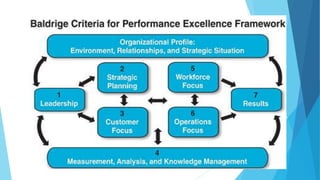
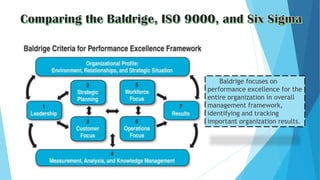
1. Leadership- signifies critical importance of leadership to business success
 Senior Leadership
 Governance and Social Responsibilities
2. Strategic Planning- examines how an organization develops strategic objectives & action plans
 Strategy Development
 Strategy Implementation
3. Customer Focus- examines how organization engages its customers for long term marketplace
success and builds a customer-focused culture.
 Voice of the Consumer
 Customer Engagement
4. Measurements, Analysis and Knowledge Management- this is positioned as the foundation for
all other categories in the systems framework
 Measurement, Analysis, and Improvement
 Management of Information, Knowledge and Information Technology
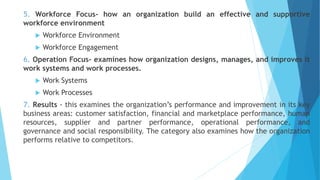
5. Workforce Focus- how an organization build an effective and supportive
workforce environment
 Workforce Environment
 Workforce Engagement
6. Operation Focus- examines how organization designs, manages, and improves it
work systems and work processes.
 Work Systems
 Work Processes
7. Results - this examines the organization’s performance and improvement in its key
business areas: customer satisfaction, financial and marketplace performance, human
resources, supplier and partner performance, operational performance, and
governance and social responsibility. The category also examines how the organization
performs relative to competitors.
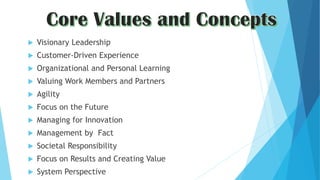
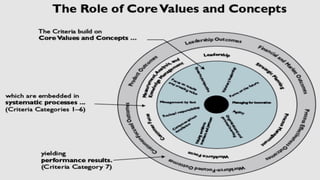
 Visionary Leadership
 Customer-Driven Experience
 Organizational and Personal Learning
 Valuing Work Members and Partners
 Agility
 Focus on the Future
 Managing for Innovation
 Management by Fact
 Societal Responsibility
 Focus on Results and Creating Value
 System Perspective
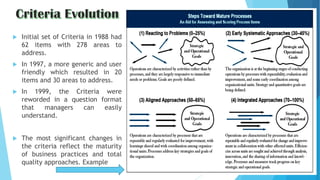
 Initial set of Criteria in 1988 had
62 items with 278 areas to
address.
 In 1997, a more generic and user
friendly which resulted in 20
items and 30 areas to address.
 In 1999, the Criteria were
reworded in a question format
that managers can easily
understand.
 The most significant changes in
the criteria reflect the maturity
of business practices and total
quality approaches. Example
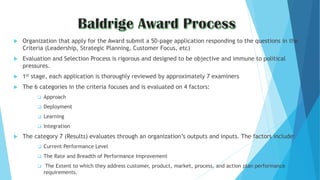
 Organization that apply for the Award submit a 50-page application responding to the questions in the
Criteria (Leadership, Strategic Planning, Customer Focus, etc)
 Evaluation and Selection Process is rigorous and designed to be objective and immune to political
pressures.
 1st stage, each application is thoroughly reviewed by approximately 7 examiners
 The 6 categories in the criteria focuses and is evaluated on 4 factors:
 Approach
 Deployment
 Learning
 Integration
 The category 7 (Results) evaluates through an organization’s outputs and inputs. The factors include:
 Current Performance Level
 The Rate and Breadth of Performance Improvement
 The Extent to which they address customer, product, market, process, and action plan performance
requirements.
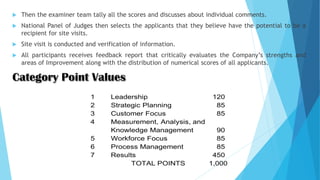
 Then the examiner team tally all the scores and discusses about individual comments.
 National Panel of Judges then selects the applicants that they believe have the potential to be a
recipient for site visits.
 Site visit is conducted and verification of information.
 All participants receives feedback report that critically evaluates the Company’s strengths and
areas of Improvement along with the distribution of numerical scores of all applicants.
 Highly-regarded as role models for others
Their Characteristics that Distinguishes them from other Organization are the following:
 Achievement in Results- attained significant results across all different areas or
categories.
 Entrepreneurship and Innovation- providing of products and services that lead their
marketplace.
 Agility- strategic in decision making and in their ability to adjust strategy.
 Governance and Leadership Metrics- providing themselves with sound guidance like the
conducting of evaluation to measure the performance of their leadership and
governance.
 Work Systems and Work Processes- Understanding their work.
 Creation of the national and international standard
for performance excellence
 Produced role models
 Shared best management practices
 Generated award programs
 Raised U.S. competitiveness
 Established outreach and education systems
 European Quality Award ( 1991)
 Canadian Award for Business Excellence
 Australian Business Excellence Award
 Quality Awards in China
- Philippine Quality Award Program or PQA exist where it is awarded for recognizing Filipino
Businesses for Excellence in Applying the Principles of Total Quality Management where it was
headed by the Former President Fidel V. Ramos in response to growing challenges of
Globalization.
- It was also adapted from the Baldridge Excellence Program but having different kind of grading
system in its criteria
The applicant must comply these criteria:
 Management (45 pts.)
 Planning (35 pts.)
 Customer Focus (35 pts.)
 Measurement and Data Management (35 pts.)
 Workforce Focus (35 pts.)
 Operations Focus (35 pts.)
 Business Results (180 pts.)
Baldrige focuses on
performance excellence for the
entire organization in overall
management framework,
identifying and tracking
important organization results.
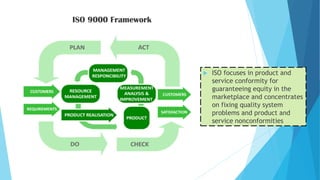
ISO 9000 Framework
 ISO focuses in product and
service conformity for
guaranteeing equity in the
marketplace and concentrates
on fixing quality system
problems and product and
service nonconformities
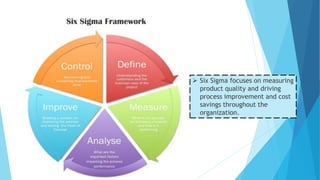
Six Sigma Framework
 Six Sigma focuses on measuring
product quality and driving
process improvement and cost
savings throughout the
organization.
 Even each offers a different emphasis in helping organizations
but it all end up with two very main objectives which are:
 To improve the performance of the Organization/s
 Increase Customer Satisfaction
 Chapter 10, The Baldrige Framework for Performance Excellence, page
521-547
 https://en.wikipedia.org/wiki/Philippine_Quality_Award
 pacweb.alamo.edu/FacultyDev/pdf/Staff_files/ppt/Introduction%20to%2
0Baldrige-EDD%20v2.pptx
 www.nist.gov/baldrige.

The baldrige framework for performance excellence

  • 1.
    PRESENTED BY Kent GinthoneP. Nasarondo Renz Lim Jay Lestair Beti-an
  • 2.
     Started whenU.S. recognized that productivity was declining  President Reagan signed Legislation mandating a study or conference on productivity in October 1982.  Result of conference recommended that there should be a National Quality Award, similar to the Deming Prize which has been given in Japan since 1951, to be awarded annually to those firms that successfully challenge and meet the award requirements.
  • 3.
     The MalcolmBaldridge National Quality Improvement Act was signed into Law ( Public Law 100-107) on August 20, 1987. The focus of the program was defined as follows:  Helping to Stimulate American Companies to improve quality and productivity  Recognizing the achievements of those companies that improve the quality of their goods and services providing an examples to others  Establishing guidelines and criteria that can be used by business, industrial, governmental and other enterprises un evaluating their own quality improvement efforts  Providing specific guidance for other American Enterprise
  • 4.
     The MalcolmBaldridge National Quality Improvement Act was signed into Law ( Public Law 100-107) on August 20, 1987  The award was named The Malcolm Baldridge National Quality Award  Its categories expanded in Non-Profit Education and Health Care in 1999 as approved by the Congress  Expanded award category in other types of Non-Profit sectors in 2007.  Award evolved into a Comprehensive National Quality Program  In 2010, via act of Congress, the Program changed its name to The Baldrige Performance Excellence Program.
  • 5.
    Excellence, designed toencourage companies to enhance their competitiveness through an aligned approach to organizational performance management that results in:  Delivery of ever-improving value of customers, resulting in improved marketplace success  Improvement of overall company performance and capabilities  Organizational and Personal Learning
  • 6.
    Malcolm Baldridge AwardRecipients  Manufacturing  Motorola, Inc. (1988)  Sunny Fresh Food, Inc. (2005)  Small Business  Stoner, Inc. (2003)  MESA Products, Inc. (2012)  Service  Federal Express (FedEx) (1990)  Xerox Business Services (1997)  Education  Pearl River School District (2001)  Health Care  Saint Luke’s Hospital in Kansas City (2003)
  • 7.
    1. Leadership- signifiescritical importance of leadership to business success  Senior Leadership  Governance and Social Responsibilities 2. Strategic Planning- examines how an organization develops strategic objectives & action plans  Strategy Development  Strategy Implementation 3. Customer Focus- examines how organization engages its customers for long term marketplace success and builds a customer-focused culture.  Voice of the Consumer  Customer Engagement 4. Measurements, Analysis and Knowledge Management- this is positioned as the foundation for all other categories in the systems framework  Measurement, Analysis, and Improvement  Management of Information, Knowledge and Information Technology
  • 8.
    5. Workforce Focus-how an organization build an effective and supportive workforce environment  Workforce Environment  Workforce Engagement 6. Operation Focus- examines how organization designs, manages, and improves it work systems and work processes.  Work Systems  Work Processes 7. Results - this examines the organization’s performance and improvement in its key business areas: customer satisfaction, financial and marketplace performance, human resources, supplier and partner performance, operational performance, and governance and social responsibility. The category also examines how the organization performs relative to competitors.
  • 10.
     Visionary Leadership Customer-Driven Experience  Organizational and Personal Learning  Valuing Work Members and Partners  Agility  Focus on the Future  Managing for Innovation  Management by Fact  Societal Responsibility  Focus on Results and Creating Value  System Perspective
  • 12.
     Initial setof Criteria in 1988 had 62 items with 278 areas to address.  In 1997, a more generic and user friendly which resulted in 20 items and 30 areas to address.  In 1999, the Criteria were reworded in a question format that managers can easily understand.  The most significant changes in the criteria reflect the maturity of business practices and total quality approaches. Example
  • 13.
     Organization thatapply for the Award submit a 50-page application responding to the questions in the Criteria (Leadership, Strategic Planning, Customer Focus, etc)  Evaluation and Selection Process is rigorous and designed to be objective and immune to political pressures.  1st stage, each application is thoroughly reviewed by approximately 7 examiners  The 6 categories in the criteria focuses and is evaluated on 4 factors:  Approach  Deployment  Learning  Integration  The category 7 (Results) evaluates through an organization’s outputs and inputs. The factors include:  Current Performance Level  The Rate and Breadth of Performance Improvement  The Extent to which they address customer, product, market, process, and action plan performance requirements.
  • 14.
     Then theexaminer team tally all the scores and discusses about individual comments.  National Panel of Judges then selects the applicants that they believe have the potential to be a recipient for site visits.  Site visit is conducted and verification of information.  All participants receives feedback report that critically evaluates the Company’s strengths and areas of Improvement along with the distribution of numerical scores of all applicants.
  • 15.
     Highly-regarded asrole models for others Their Characteristics that Distinguishes them from other Organization are the following:  Achievement in Results- attained significant results across all different areas or categories.  Entrepreneurship and Innovation- providing of products and services that lead their marketplace.  Agility- strategic in decision making and in their ability to adjust strategy.  Governance and Leadership Metrics- providing themselves with sound guidance like the conducting of evaluation to measure the performance of their leadership and governance.  Work Systems and Work Processes- Understanding their work.
  • 16.
     Creation ofthe national and international standard for performance excellence  Produced role models  Shared best management practices  Generated award programs  Raised U.S. competitiveness  Established outreach and education systems
  • 17.
     European QualityAward ( 1991)  Canadian Award for Business Excellence  Australian Business Excellence Award  Quality Awards in China
  • 18.
    - Philippine QualityAward Program or PQA exist where it is awarded for recognizing Filipino Businesses for Excellence in Applying the Principles of Total Quality Management where it was headed by the Former President Fidel V. Ramos in response to growing challenges of Globalization. - It was also adapted from the Baldridge Excellence Program but having different kind of grading system in its criteria The applicant must comply these criteria:  Management (45 pts.)  Planning (35 pts.)  Customer Focus (35 pts.)  Measurement and Data Management (35 pts.)  Workforce Focus (35 pts.)  Operations Focus (35 pts.)  Business Results (180 pts.)
  • 19.
    Baldrige focuses on performanceexcellence for the entire organization in overall management framework, identifying and tracking important organization results.
  • 20.
    ISO 9000 Framework ISO focuses in product and service conformity for guaranteeing equity in the marketplace and concentrates on fixing quality system problems and product and service nonconformities
  • 21.
    Six Sigma Framework Six Sigma focuses on measuring product quality and driving process improvement and cost savings throughout the organization.
  • 22.
     Even eachoffers a different emphasis in helping organizations but it all end up with two very main objectives which are:  To improve the performance of the Organization/s  Increase Customer Satisfaction
  • 23.
     Chapter 10,The Baldrige Framework for Performance Excellence, page 521-547  https://en.wikipedia.org/wiki/Philippine_Quality_Award  pacweb.alamo.edu/FacultyDev/pdf/Staff_files/ppt/Introduction%20to%2 0Baldrige-EDD%20v2.pptx  www.nist.gov/baldrige.