International Journal ofAgriculture and Food Science Technology (IJAFST)
ISSN No. 2249-3050, Volume 4 No. 2 (2013)
11
ROLE OF ECO-FRIENDLY AGRICULTURAL PRACTICES IN INDIAN
AGRICULTURE DEVELOPMENT
Mandavi Mishra
Bioversity, International Office for South Asia NASC Complex,
Pusa Campus, New Delhi-12
Abstract
Green revolution technologies have more than doubled the yield potential of rice and wheat, especially in Asia.
These high input production systems requiring massive qualities of fertilizers, pesticides, irrigation and
machines, however, disregard the ecological integrity of land, forests and water resources, endanger the flora
and fauna and cannot be sustained over generations. To a great extent, future food security and economic
independence of developing countries would depend on improving the productivity of biophysical resources
through the application of sustainable production methods, by improving tolerance of crops to adverse
environmental conditions and by reducing crop and post-harvest losses caused by pest and diseases. Indigenous
agricultural practices can play a key role in the design of sustainable and eco-friendly agricultural systems,
increasing the likelihood that the rural population will accept, develop and maintain innovations and
interventions. In this context, those eco-friendly methods are being considered as environmentally safe,
selective, biodegradable, economical and renewable alternative for use in organic farming system. Organic
farming implies, that the use of organic nutrients and adoption of natural methods of plant protection in place of
fertilizers and pesticides. To the maximum extent feasible organic farming system rely upon crop rotations, crop
residues, animal manures, legumes, green manures, mineral baring rocks and aspects of biological pest control
to maintain soil productivity and tilth to supply plant nutrients and to control insects, weed and other pests.
Introduction:
Eco-friendly approaches for sustainable agriculture:
Agriculture is the most important enterprise in the world. Agriculture is the process of producing food, feed,
fiber and other desired products by the cultivation of plants and the raising of domesticated animals. In a true
sense, it is a productive unit where human get the free gifts of nature namely, land, light, air, temperature, rain
water, humidity etc. are integrated into a single primary unit indispensable for human beings. The effect of
prolonged and over usage of chemicals in crops production has resulted in human health hazards and pollution
of environment and ground water. At present, the issue is whether to continue with the chemical inputs-based
intensive technologies or to go back to the traditional environment friendly farming practices like organic
farming for sustainable production, income and socio-economic development of the farming community. In this
context that biological pesticides are being considered as environmentally safe, selective, biodegradable,
economical and renewable alternative for use in organic farming system.
Green Pesticides or ecological pesticides which are believe to be environmentally friendly and thus cause less
harm to the eco system and animal health. In agrology, pesticides are evaluated for minimal average
environmental effects. Biocides include germicidal, antibiotic, antibacterial, antiviral, antifungal, antitrotozaols
and antiparasites. Pesticides typically came in the form of sprays and dusts. Many ecological pesticides are
biological pesticides. Environmental friendly agricultural technologies for food safety appropriate technologies,
which do not assault the nature, would have key roles to play in ensuring food security, in improving human
health and in rehabilitating and conserving the environment to safeguard the well being of the posterity. Instead
of striving for more “green revolutions” with emphasis on miracle seeds, hard-hitting, synthetic and engineered
pesticides and increased use of fertilizers, the future must look to natural ways and processes for augmenting
agricultural productivity. In fact, all development efforts and activities should be within well defined ecological
rules rather than within narrow economic gains. Sustainable agricultural systems must be ecologically sound for
long-term food sufficiency, equitable in providing social justice, and ethical in respecting path future
generations and other species.
2.
International Journal ofAgriculture and Food Science Technology (IJAFST)
ISSN No. 2249-3050, Volume 4 No. 2 (2013)
12
Goal of Eco-Agriculture: (Methods/Procedure)
The aim of eco-agriculture is to manage the resources of rural communities to improve their welfare, preserve
biodiversity and ecosystem services, and develop more productive and sustainable farming systems.
Eco-agriculture, now emerging as a holistic approach to ecologically and socially responsible land use,
represents a vision of rural communities managing their landscape and resources to jointly achieve three goals:
Enhance rural livelihoods
Conserve or enhance biodiversity and eco-system services
Develop more sustainable and productive agricultural system
The core of this ecological-based farming is ensuring that business or agricultural activity is consistent with the
natural functions of ecosystems, where for instance, the cycle of soil nutrients and biodiversity structure are
maintained so as to create a system of agriculture that is resistant to pests and has self-maintained natural soil
nutrients. Thus, farmers will no longer depend on costly chemicals and artificial pest control.
In addition, by reviving local or indigenous seed varieties, farmers’ dependence on hybrid seeds commercially
produced by multinational companies can be reduced or even eliminated. This will give farmers the freedom to
plant seeds in accordance with local natural conditions at a reasonable cost. Consequently, agricultural
production costs can be minimized and agricultural commodities sold at a premium price as organic products,
which in turn would improve farmers’ incomes. Also, agricultural commodities that are free from chemicals and
genetically modified organisms are safes and healthier for human consumption.
In short, eco-agriculture tries to combine conservation with development. Farmers and rural communities are
key actors in conserving biodiversity and ecosystems.
Indian farmers have increased production 40 percent by using organic fertilizers in paddy farming systems
similar to conventional rice farming.
Making eco-agriculture work requires a favorable institutional environment, suitable financing and good
dissemination of information.
To boost Agriculture development, we need to create biodiversity reserves that:
benefit local farming communities,
Develop habitat networks in non-farmed areas,
Reduce land conversion to agriculture by increasing farm productivity,
Minimize agricultural pollution,
Modify management of soil,
Water and vegetation resources,
Modify farm systems to mimic natural ecosystems.
These steps can be started through initiatives at the grassroots level, with the coordinated and collaborated
efforts of various stakeholders, but should include government support in promoting eco-agriculture practices
and creating a sustainable agricultural system in India.
Climate change is also having a growing impact on agriculture and requires new practices and approaches to
guarantee the sustainability of farming, which still is the main source of livelihood for most Indonesians.
Agriculture is an activity directly related to the use of natural resources. We now often see and hear of crop
failures due to climatic influences. This is compounded by farming practices that pay little heed to the rules of
ecosystem balance and environmental conservation, which will in turn have an impact on agriculture itself.
Eco-friendly Agricultural practices: are as:
3.
International Journal ofAgriculture and Food Science Technology (IJAFST)
ISSN No. 2249-3050, Volume 4 No. 2 (2013)
13
Agronomy: Cropping pattern, sowing time
Water management: Exp. (SRI Technology, DSR,) collection of rain water in pond
Soil conservation and reclamation
Entomological practices: Exp. (IPM Technology) Control termite, American bollworm, sucking pests,
other insects, spray related practices)
Storage : pulses stored mud containers, Neem leaves (Azadirachta indica)
Zoology: Rat control by cat n pet dogs
Classification of Eco-friendly Agricultural Practices:
The following classification of eco-friendly practices are:
Crop production
Soil management
Water management
Weed control
Insect-pest control
Weather forecast
Agricultural engineering
Home management
Clothing and textile
Animal husbandry
Sustainable Agriculture:
Sustainable agriculture is a complex issue associated with producing food while maintaining our biophysical
resources including soil, water and biota with no adverse impacts on the wider environment. It should:
Maintain or improve the production of clean food
Maintain or improve the quality of landscapes, which includes soils, water, biota and aesthetics
Have minimal impact on the wide environment
Be acceptable to society
Concerns of Eco-friendly sustainable agriculture:
The concept of sustainability has many dimensions. It can be used to mean economic sustainability, social
sustainability, institutional sustainability as well as environmental sustainability. The environmental
sustainability agenda in agriculture, which is the topic of this paper, covers the protection of the resource base,
the reduction of negative externalities and the promotion of positive externalities. Principal issues include water
quality and quantity, air quality, soil erosion, biodiversity, and landscape protection as well as food safety and
animal welfare. The agenda includes:
1. Water quality and quantity concerns: Issues here include leaching of nutrients and pesticides,
water extraction and drainage and flooding. Contamination of both ground and surface waters caused
by high levels of production and use of manure and chemical fertilisers is a serious problem,
particularly in areas of intensive livestock or specialised crop production.
2. Air quality concerns: The issues here are emissions of ammonia and greenhouse gases. At EU
level, agriculture is responsible for about 8% of total greenhouse gas emissions but due to the pastoral
nature of Irish farming, the proportion here rises to 30%.
3. Biodiversity concerns: Issues include genetic, species and ecosystem diversity. The intensification
of agriculture has led to widespread reduction of species and habitats.
4. Landscape concerns: The marginalisation of agricultural land can lead to its abandonment if
farming ceases to be viable. Alternatively, intensification of agriculture can lead to the loss of
important landscape features such as hedges and ponds, the enlargement of fields and the replacement
of traditional farm buildings with industrial structures. Rights of access may be restricted in interests of
more efficient farming.
4.
International Journal ofAgriculture and Food Science Technology (IJAFST)
ISSN No. 2249-3050, Volume 4 No. 2 (2013)
14
5. Soil erosion concerns: Overgrazing particularly in mountain areas has led to the erosion of
vegetation cover with the consequent loss of soil, the silting of rivers, etc.
6. Food safety and animal welfare concern: The issue here is the effect of agricultural practices on
human health and animal well-being rather than the physical environment. There is concern about the
consequences for the quality and safety of the food supply of the increasing use of pesticides and drugs,
as well as the consequences of introducing genetically-modified organisms.
Eco-friendly approaches for farming system:
The following eco-friendly approaches are as:
A. Organic farming: Organic farming is a production system, which avoids or largely excludes the use
of synthetically compounded fertilizers, pesticides, growth regulators, and livestock feed additives. To
the maximum extent feasible, organic farming system rely upon crop rotations, crop residues, animal
manures, lagumes, green manures, off-farm organic wastes, mechanical cultivation, mineral-bearing
rocks, and aspects of biological pest control to maintain soil productivity and tilth, to supply plant
nutrients, and to control insects, weeds, and other pests.
B. Biological farming: Biological farming allows the use of selected chemical fertilize3rs (avoiding
disruptive materials such as anhydrous ammonia and potassium choloride) and adopts low-inputs
approaches to use of herbicides and insecticides. (diagnostic instruments to monitor plant and soil
conditions are frequently used in biological farming. These include refract meters to monitor sugar
content (Brix) in plant tissue sap; electrical conductivity meters to monitor ERGS (or energy released
per gram of soil); ORPS meters (or oxygen reduction potential of soil); and radionics.)
C. Nature farming: In addition to these methods-based approaches to sustainable farming, regenerative
agriculture and permaculture are widely recognized. However, these letter systems, like sustainable
agriculture, are more conceptually oriented than methods-based.
D. Regenerative Agriculture: In regenerative agriculture bunds on nature’s own inherent capacity to
cope with pests, enhance soil fertility, and increase productivity. It implies a continuing ability to re-
create the resources that the system requires. In practice, regenerative agriculture uses low-input and
organic farming systems as a frame work to achieve these goals.
E. Permaculture: Permaculture is concerned with designing ecological human habitats and food
production systems, and follows specific guidelines and principles in the design of these systems. To
the extent that permaculture is not a production system, per se,, but rather a land use planning
philosophy, it is not limited to a specific method of production. Thus, practically any site-specific
ecological farming system is amenable to permaculture.
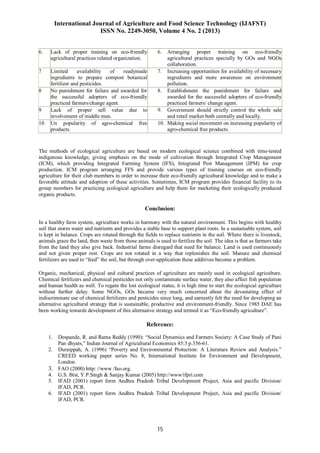
Problems and suggestions on the use of eco-friendly practices in crop production in India:
Sl.
No.
Problems Suggestions
1 Farmers became bound to use chemical
pesticides in case of severe attract.
1. Increasing opportunity for availability of necessary
of raw materials for compost, green manures, bio-
fertilizer, bio- pesticide, etc.
2 Lack of sufficient publicity through
different media regarding the use of eco-
friendly practices.
2. More publicity should be given in different media.
3. Lack of proper technical knowledge about
eco-friendly agricultural practices.
3. Establishment of adult education for increasing eco-
friendly agricultural practices.
4. Lack of awareness of environment pollution. 4. Increasing farmers’ awareness on environmental
pollution.
5. Lake of livestock and poultry for necessary
excreta.
5. Increasing motivational program for rearing more
livestock and poultry.
5.
International Journal ofAgriculture and Food Science Technology (IJAFST)
ISSN No. 2249-3050, Volume 4 No. 2 (2013)
15
6. Lack of proper training on eco-friendly
agricultural practices related organization.
6. Arranging proper training on eco-friendly
agricultural practices specially by GOs and NGOs
collaboration.
7 Limited availability of readymade
ingredients to prepare compost botanical
fertilizer and pesticides.
7. Increasing opportunities for availability of necessary
ingredients and more awareness on environment
pollution.
8 No punishment for failure and awarded for
the successful adopters of eco-friendly
practiced farmers/change agent.
8. Establishment the punishment for failure and
awarded for the successful adopters of eco-friendly
practiced farmers/ change agent.
9 Lack of proper sell value due to
involvement of middle men.
9. Government should strictly control the whole sale
and retail market both centrally and locally.
10 Un popularity of agro-chemical free
products.
10. Making social movement on increasing popularity of
agro-chemical free products.
The methods of ecological agriculture are based on modern ecological science combined with time-tested
indigenous knowledge, giving emphasis on the mode of cultivation through Integrated Crop Management
(ICM), which providing Integrated Farming System (IFS), Integrated Pest Management (IPM) for crop
production. ICM program arranging FFS and provide various types of training courses on eco-friendly
agriculture for their club members in order to increase their eco-friendly agricultural knowledge and to make a
favorable attitude and adoption of these activities. Sometimes, ICM program provides financial facility to its
group members for practicing ecological agriculture and help them for marketing their ecologically produced
organic products.
Conclusion:
In a healthy farm system, agriculture works in harmony with the natural environment. This begins with healthy
soil that stores water and nutrients and provides a stable base to support plant roots. In a sustainable system, soil
is kept in balance. Crops are rotated through the fields to replace nutrients in the soil. Where there is livestock,
animals graze the land, then waste from those animals is used to fertilize the soil. The idea is that as farmers take
from the land they also give back. Industrial farms disregard that need for balance. Land is used continuously
and not given proper rest. Crops are not rotated in a way that replenishes the soil. Manure and chemical
fertilizers are used to “feed” the soil, but through over-application these additives become a problem.
Organic, mechanical, physical and cultural practices of agriculture are mainly used in ecological agriculture.
Chemical fertilizers and chemical pesticides not only contaminate surface water, they also affect fish population
and human health as well. To regain the lost ecological status, it is high time to start the ecological agriculture
without further delay. Some NGOs, GOs became very much concerned about the devastating effect of
indiscriminate use of chemical fertilizers and pesticides since long, and earnestly felt the need for developing an
alternative agricultural strategy that is sustainable, productive and environment-friendly. Since 1985 DAE has
been working towards development of this alternative strategy and termed it as “Eco-friendly agriculture”.
Reference:
1. Despande, R. and Ratna Reddy (1990): “Social Dynamics and Farmers Society: A Case Study of Pani
Pan dhyats,” Indian Journal of Agricultural Economics 45:3 p.356-61.
2. Duraippah, A. (1996) “Poverty and Environmental Protection: A Literature Review and Analysis.”
CREED working paper series No. 8, International Institute for Environment and Development,
London.
3. FAO (2000) http: //www /fao.org.
4. G.S. Bist, Y.P.Singh & Sanjay Kumar (2005) http://www/ifpri.com
5. IFAD (2001) report form Andhra Pradesh Tribal Development Project, Asia and pacific Division/
IFAD, PCR.
6. IFAD (2001) report form Andhra Pradesh Tribal Development Project, Asia and pacific Division/
IFAD, PCR.