Securing the Office of Finance in the Cloud --
       Separating Fact from Fiction

                          Dr. Lothar Determann
                     Partner, Baker & McKenzie LLP

                               John Hugo
        Vice President and Corporate Controller, Life Time Fitness

                              Stan Swete
                   Chief Technology Officer, Workday

     Moderated by: Russ Banham, Contributing Editor, CFO magazine


                         Thursday, April 12, 2012
Securing the Office of Finance in the Cloud --
        Separating Fact from Fiction

According to Forrester Research, the global cloud
computing market is valued at an estimated $40.7 billion. In
the future, this market is expected to grow exponentially, as
companies accelerate their adoption of cloud computing.
It's clear that cloud computing is being widely adopted as a
cost-effective strategy for deploying mission-critical
applications within the enterprise. Yet, myths regarding
privacy and security often cloud the decision making
process.
About Workday


Workday is the leader in enterprise-class, Software-as-a-Service (SaaS)
solutions for managing global businesses, combining a lower cost of ownership
with an innovative approach to business applications.

Founded by PeopleSoft veterans Dave Duffield and Aneel Bhusri, Workday
delivers unified Human Capital Management, Payroll, and Financial
Management solutions designed for today's organizations and the way people
work. Delivered in the cloud leveraging a modern technology platform,
Workday offers a fresh alternative to legacy ERP.

More than 280 customers, spanning medium-sized organizations to Fortune 50
businesses, have selected Workday. Visit us at www.workday.com.
Myths About Cloud Security
• Myths about security, data
  privacy with Cloud
  Computing cloud decisions
• Entrusting data to specialized
  service providers is not new
• Cloud computing does not
  necessarily increase security
  risks
On-premise vs. Cloud Security
• Whether personal data is safer on a system secured by
  the data controller in-house or an external vendor
  depends on security measures deployed by each
  particular organization.
• Fact is that many organizations find it difficult to stay
  in control over modern IT systems, whether they hire
  service providers to provide IT infrastructure or
  whether they host, operate, and maintain systems
  themselves.
• It is important for customer and vendor to reach a
  reasonable agreement about what level of security is
  appropriate for particular types of data and who
  should be doing what… for either type of provider.
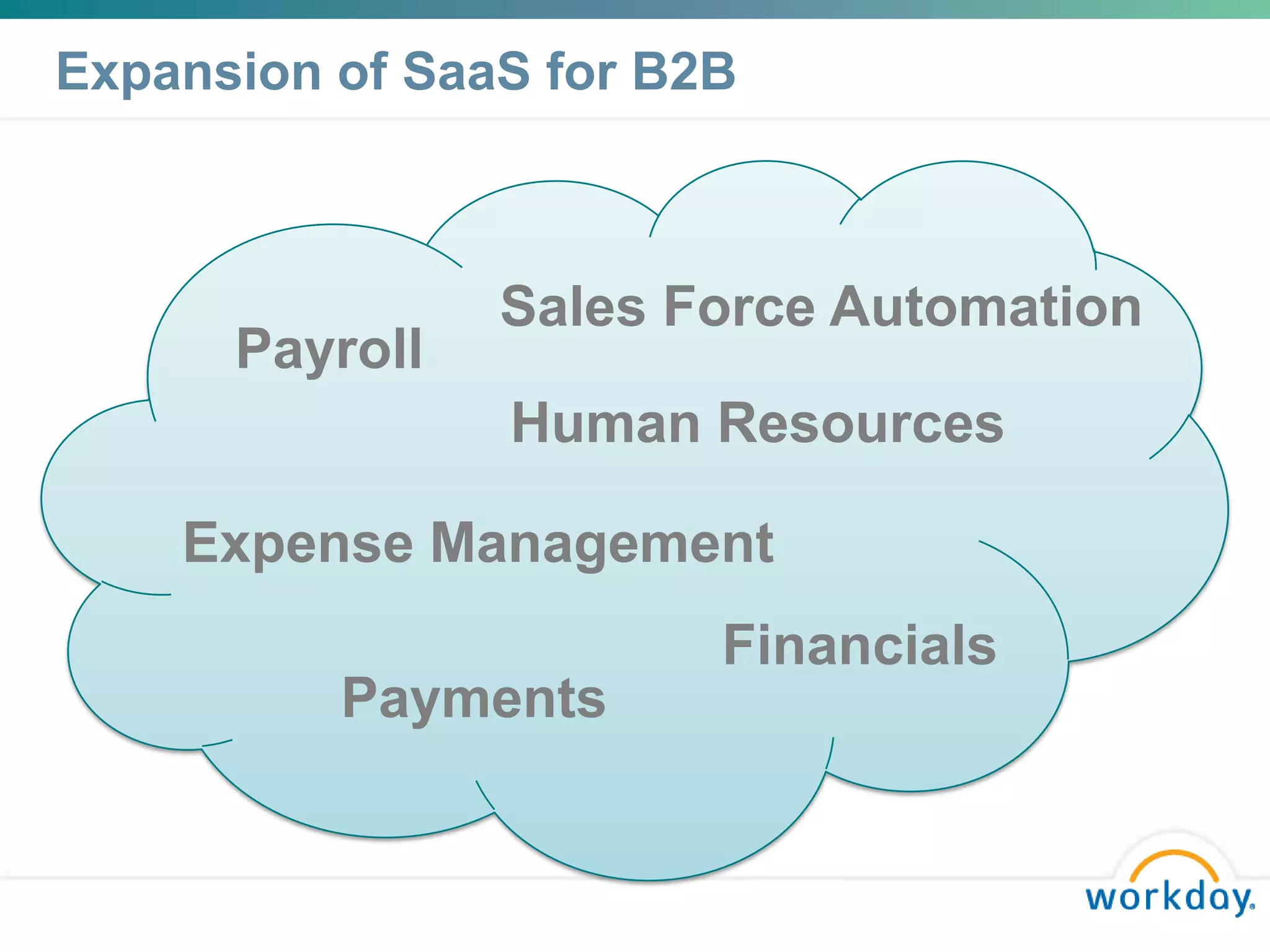
Expansion of SaaS for B2B


                Sales Force Automation
      Payroll
                Human Resources

    Expense Management
                        Financials
          Payments
Key Stakeholders

                    Comprehensive Evaluation
                     – IT
                     – Legal / Procurement
                     – Corporate Leadership
                    Look for vendors who:
                     – Have successful local & global
                       deployments
                     – Are able to respond in detail to
                       requirements
                     – Invest to keep abreast of regulatory
                       changes
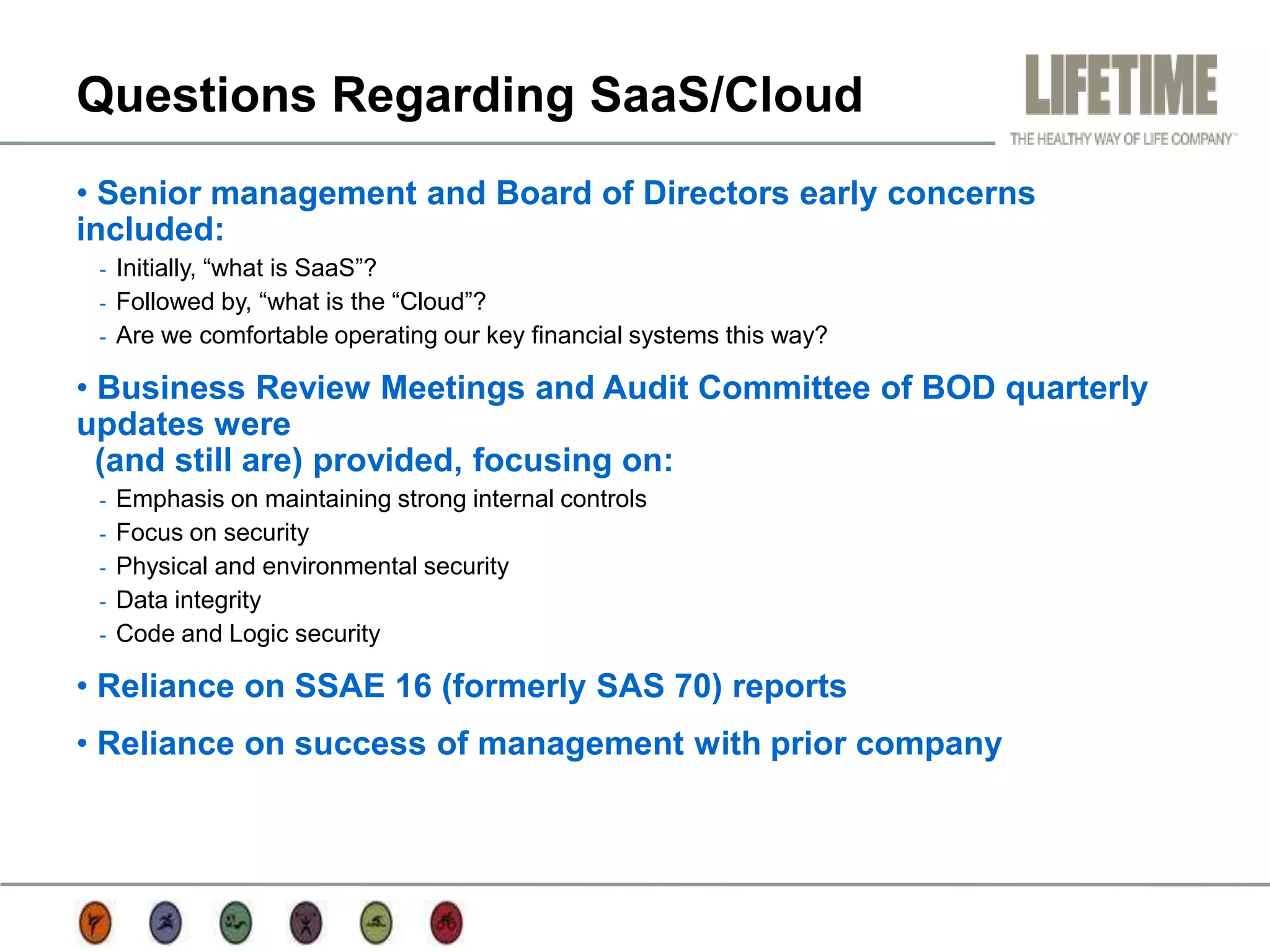
Questions Regarding SaaS/Cloud
• Senior management and Board of Directors early concerns
included:
 -   Initially, “what is SaaS”?
 -   Followed by, “what is the “Cloud”?
 -   Are we comfortable operating our key financial systems this way?

• Business Review Meetings and Audit Committee of BOD quarterly
updates were
  (and still are) provided, focusing on:
 -   Emphasis on maintaining strong internal controls
 -   Focus on security
 -   Physical and environmental security
 -   Data integrity
 -   Code and Logic security

• Reliance on SSAE 16 (formerly SAS 70) reports
• Reliance on success of management with prior company
Business Drivers & Benefits
• Initial interest was with Workday, with cloud an eventual “bonus”
• The off-premise concept, including integration management was
intriguing
• Access to all traditional ERP applications, without traditional
ERP arrangement
• Currently, Workday applications in the cloud:
 - Human Capital Management, Expenses (reimbursement), Payroll [all live at least 2 years]
 - Procurement, Supplier Accounts (AP), Banking [go live during 2012]
 - Financials (GL), Customer Accounts (AR), Fixed Assets, Projects [go live during 2013]

• Cloud strategy supports our project requirements                        of:
  - Increased efficiency (speed of system and business processes)
  - Improved accuracy and reporting
  - Lower overall cost

• Managing security and data privacy with third party vs. internal
 - Ensure highest level of controls around cloud security (internal vs. external expertise)
 - Cost – Benefit of internal controls maintenance internally vs. reliance on third party
 - Zero tolerance for breach
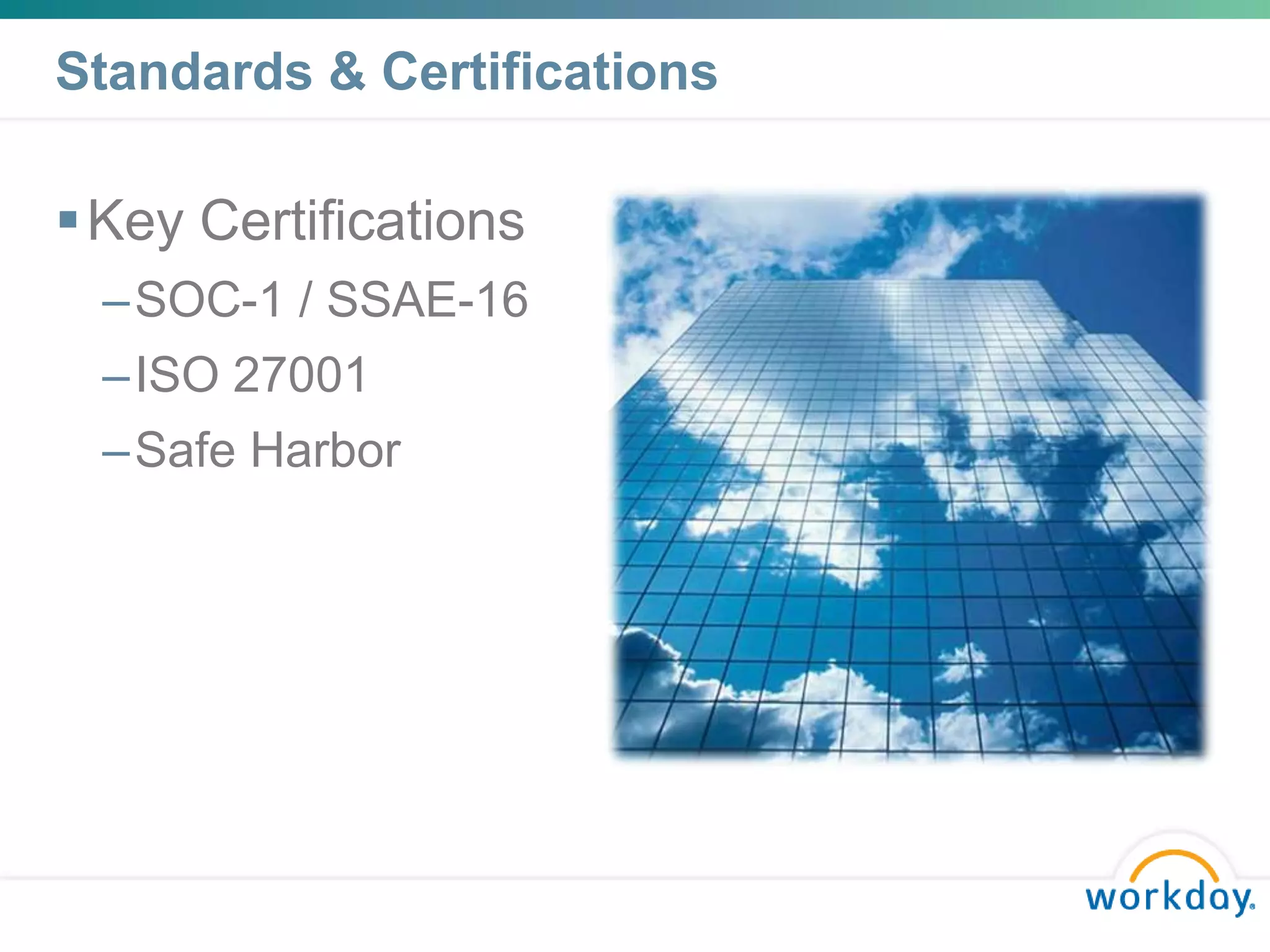
Standards & Certifications

 Key Certifications
  –SOC-1 / SSAE-16
  –ISO 27001
  –Safe Harbor
Advice to Companies Evaluating
               the Cloud
• Besides operational, functionality and pricing
  considerations, consider:
   – does the vendor's data security safeguards meet
     legal requirements and match or exceed your own
     standards?
   – does the vendor give you what you need for your
     own compliance program (information,
     contractual commitments, EU 'adequacy')?
Is Cloud Computing Bad
                   for Security?
• No, not inherently. However, it must
  be supported with a culture of
  security, but this is not specific to
  cloud computing.
• Using a cloud system doesn’t mean
  you can shirk responsibility for the
  security of your systems to vendors.
• Whether personal data is safer on a
  system secured by you or your vendor
  depends on who you and your vendor
  are and on the security measures
  deployed by each particular
  organization.
Q&A
                   Dr. Lothar Determann
              Partner, Baker & McKenzie LLP

                        John Hugo
 Vice President and Corporate Controller, Life Time Fitness

                       Stan Swete
            Chief Technology Officer, Workday

Moderator: Russ Banham, Contributing Editor, CFO magazine

Securing the Office of Finance in the Cloud -- Separating Fact from Fiction

  • 1.
    Securing the Officeof Finance in the Cloud -- Separating Fact from Fiction Dr. Lothar Determann Partner, Baker & McKenzie LLP John Hugo Vice President and Corporate Controller, Life Time Fitness Stan Swete Chief Technology Officer, Workday Moderated by: Russ Banham, Contributing Editor, CFO magazine Thursday, April 12, 2012
  • 2.
    Securing the Officeof Finance in the Cloud -- Separating Fact from Fiction According to Forrester Research, the global cloud computing market is valued at an estimated $40.7 billion. In the future, this market is expected to grow exponentially, as companies accelerate their adoption of cloud computing. It's clear that cloud computing is being widely adopted as a cost-effective strategy for deploying mission-critical applications within the enterprise. Yet, myths regarding privacy and security often cloud the decision making process.
  • 3.
    About Workday Workday isthe leader in enterprise-class, Software-as-a-Service (SaaS) solutions for managing global businesses, combining a lower cost of ownership with an innovative approach to business applications. Founded by PeopleSoft veterans Dave Duffield and Aneel Bhusri, Workday delivers unified Human Capital Management, Payroll, and Financial Management solutions designed for today's organizations and the way people work. Delivered in the cloud leveraging a modern technology platform, Workday offers a fresh alternative to legacy ERP. More than 280 customers, spanning medium-sized organizations to Fortune 50 businesses, have selected Workday. Visit us at www.workday.com.
  • 4.
    Myths About CloudSecurity • Myths about security, data privacy with Cloud Computing cloud decisions • Entrusting data to specialized service providers is not new • Cloud computing does not necessarily increase security risks
  • 5.
    On-premise vs. CloudSecurity • Whether personal data is safer on a system secured by the data controller in-house or an external vendor depends on security measures deployed by each particular organization. • Fact is that many organizations find it difficult to stay in control over modern IT systems, whether they hire service providers to provide IT infrastructure or whether they host, operate, and maintain systems themselves. • It is important for customer and vendor to reach a reasonable agreement about what level of security is appropriate for particular types of data and who should be doing what… for either type of provider.
  • 6.
    Expansion of SaaSfor B2B Sales Force Automation Payroll Human Resources Expense Management Financials Payments
  • 7.
    Key Stakeholders  Comprehensive Evaluation – IT – Legal / Procurement – Corporate Leadership  Look for vendors who: – Have successful local & global deployments – Are able to respond in detail to requirements – Invest to keep abreast of regulatory changes
  • 8.
    Questions Regarding SaaS/Cloud •Senior management and Board of Directors early concerns included: - Initially, “what is SaaS”? - Followed by, “what is the “Cloud”? - Are we comfortable operating our key financial systems this way? • Business Review Meetings and Audit Committee of BOD quarterly updates were (and still are) provided, focusing on: - Emphasis on maintaining strong internal controls - Focus on security - Physical and environmental security - Data integrity - Code and Logic security • Reliance on SSAE 16 (formerly SAS 70) reports • Reliance on success of management with prior company
  • 9.
    Business Drivers &Benefits • Initial interest was with Workday, with cloud an eventual “bonus” • The off-premise concept, including integration management was intriguing • Access to all traditional ERP applications, without traditional ERP arrangement • Currently, Workday applications in the cloud: - Human Capital Management, Expenses (reimbursement), Payroll [all live at least 2 years] - Procurement, Supplier Accounts (AP), Banking [go live during 2012] - Financials (GL), Customer Accounts (AR), Fixed Assets, Projects [go live during 2013] • Cloud strategy supports our project requirements of: - Increased efficiency (speed of system and business processes) - Improved accuracy and reporting - Lower overall cost • Managing security and data privacy with third party vs. internal - Ensure highest level of controls around cloud security (internal vs. external expertise) - Cost – Benefit of internal controls maintenance internally vs. reliance on third party - Zero tolerance for breach
  • 10.
    Standards & Certifications Key Certifications –SOC-1 / SSAE-16 –ISO 27001 –Safe Harbor
  • 11.
    Advice to CompaniesEvaluating the Cloud • Besides operational, functionality and pricing considerations, consider: – does the vendor's data security safeguards meet legal requirements and match or exceed your own standards? – does the vendor give you what you need for your own compliance program (information, contractual commitments, EU 'adequacy')?
  • 12.
    Is Cloud ComputingBad for Security? • No, not inherently. However, it must be supported with a culture of security, but this is not specific to cloud computing. • Using a cloud system doesn’t mean you can shirk responsibility for the security of your systems to vendors. • Whether personal data is safer on a system secured by you or your vendor depends on who you and your vendor are and on the security measures deployed by each particular organization.
  • 13.
    Q&A Dr. Lothar Determann Partner, Baker & McKenzie LLP John Hugo Vice President and Corporate Controller, Life Time Fitness Stan Swete Chief Technology Officer, Workday Moderator: Russ Banham, Contributing Editor, CFO magazine

Editor's Notes

  • #6 If you are already connecting your workers using tools on the internet, then there is no differenceWhether you are saas or on-prem, the key is what are you doing to secure your system? There is no difference in terms of how you should approach security regardless of approach. Approach should be the same. What access are you giving people, what’s your firewall look likeNot an issue between saas and on-prem. How you secure any system in an internet enabled world
  • #7 Where has saas grown up?Payroll – highly sensitiveSales forecast data – sensitive to businessHr – major adoption occurred here, super privateAll of it is incredibly sensitive – financials no differentNone stands head and shoulders above the others
  • #8 Compehensive – accounting, it, legal, marketing (business, legal, technical – not just technical)Vendors have experienceDepthBreadthMaturityLocal & globalLegal ramificationsOngoing Changing regulationsHave succ
  • #11 Seed questionAny areas where security can be stronger with SaaS than with on-premise?