Problem 1
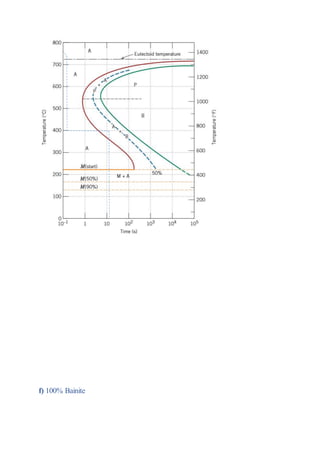
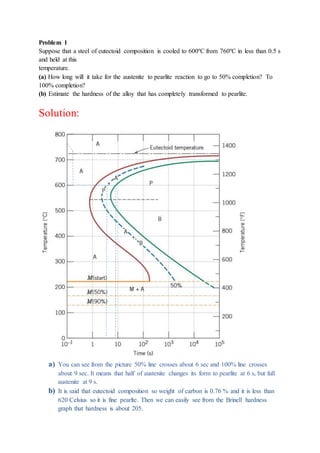
Suppose that a steel of eutectoid composition is cooled to 600ºC from 760ºC in less than 0.5 s
and held at this
temperature.
(a) How long will it take for the austenite to pearlite reaction to go to 50% completion? To
100% completion?
(b) Estimate the hardness of the alloy that has completely transformed to pearlite.
Solution:
a) You can see from the picture 50% line crosses about 6 sec and 100% line crosses
about 9 sec. It means that half of austenite changes its form to pearlite at 6 s, but full
austenite at 9 s.
b) It is said that eutectoid composition so weight of carbon is 0.76 % and it is less than
620 Celsius so it is fine pearlte. Then we can easily see from the Brinell hardness
graph that hardness is about 205.
Problem 2
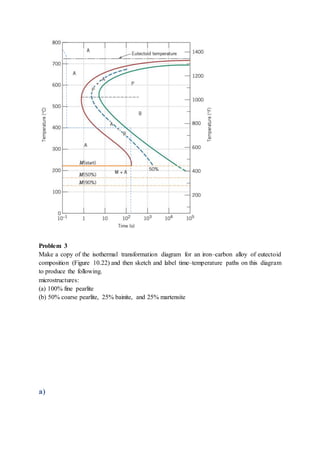
Using the isothermal transformation diagram for an iron–carbon alloy of eutectoid composition
(Figure 10.22), specify the nature of the final microstructure (in terms of microconstituents
present and approximate percentages of each) of a small specimen that has been subjected to
the following time– temperature treatments. In each case assume that the specimen begins at
760ºC and that it has been held at this temperature long enough to have achieved a complete
and homogeneous austenitic structure.
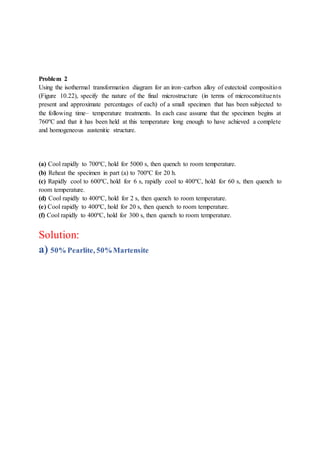
(a) Cool rapidly to 700ºC, hold for 5000 s, then quench to room temperature.
(b) Reheat the specimen in part (a) to 700ºC for 20 h.
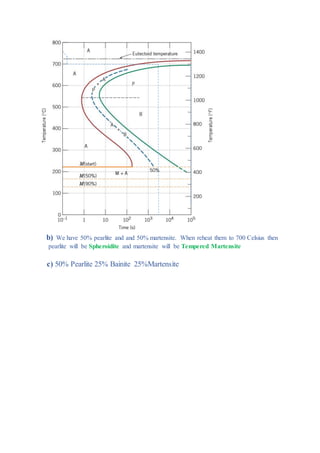
(c) Rapidly cool to 600ºC, hold for 6 s, rapidly cool to 400ºC, hold for 60 s, then quench to
room temperature.
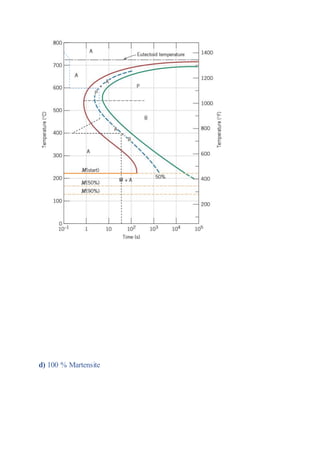
(d) Cool rapidly to 400ºC, hold for 2 s, then quench to room temperature.
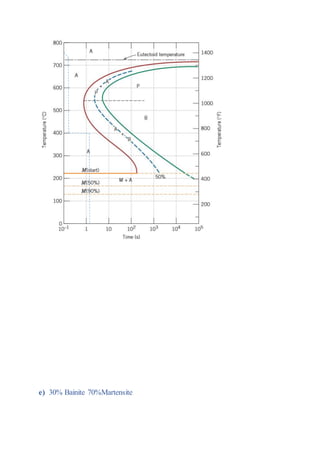
(e) Cool rapidly to 400ºC, hold for 20 s, then quench to room temperature.
(f) Cool rapidly to 400ºC, hold for 300 s, then quench to room temperature.
Solution:
a) 50% Pearlite, 50%Martensite
b) We have 50% pearlite and and 50% martensite. When reheat them to 700 Celsius then
pearlite will be Spheroidite and martensite will be Tempered Martensite
c) 50% Pearlite 25% Bainite 25%Martensite
d) 100 % Martensite
e) 30% Bainite 70%Martensite
f) 100% Bainite
Problem 3
Make a copy of the isothermal transformation diagram for an iron–carbon alloy of eutectoid
composition (Figure 10.22) and then sketch and label time–temperature paths on this diagram
to produce the following.
microstructures:
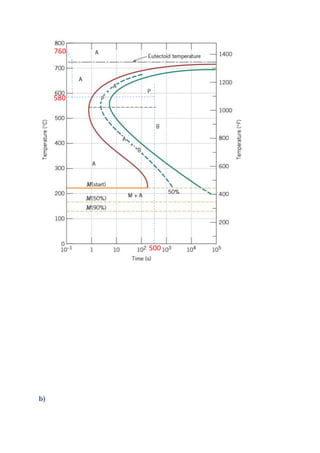
(a) 100% fine pearlite
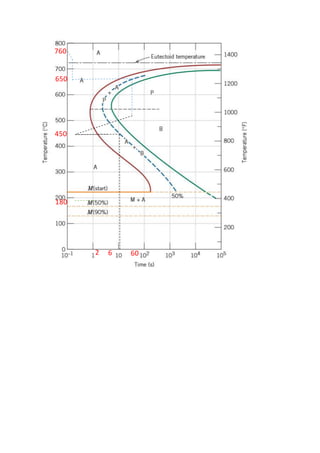
(b) 50% coarse pearlite, 25% bainite, and 25% martensite
a)
b)
760
580
500
760
650
450
180
6062

Assignment 2 solutions

  • 1.
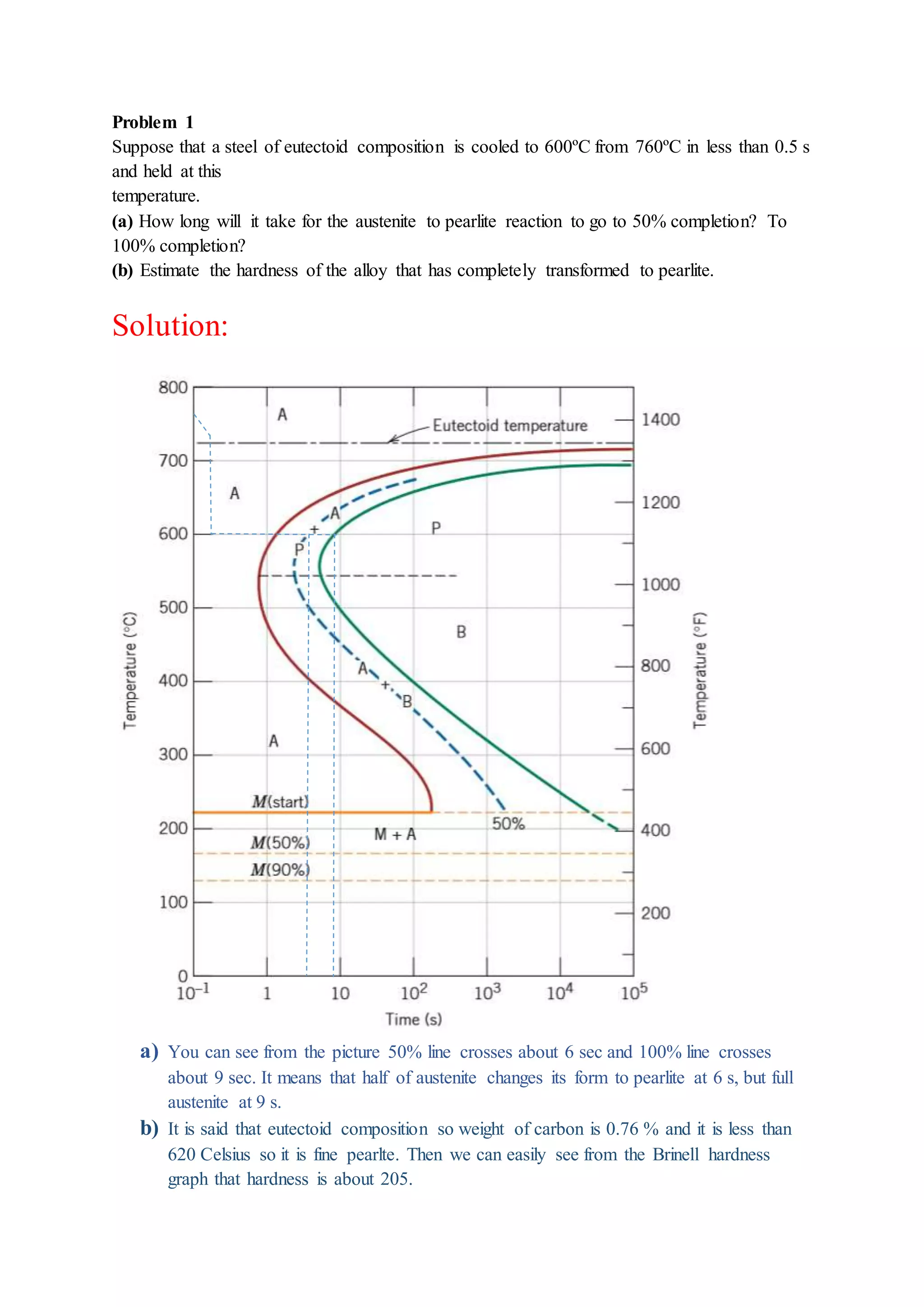
    Problem 1 Suppose thata steel of eutectoid composition is cooled to 600ºC from 760ºC in less than 0.5 s and held at this temperature. (a) How long will it take for the austenite to pearlite reaction to go to 50% completion? To 100% completion? (b) Estimate the hardness of the alloy that has completely transformed to pearlite. Solution: a) You can see from the picture 50% line crosses about 6 sec and 100% line crosses about 9 sec. It means that half of austenite changes its form to pearlite at 6 s, but full austenite at 9 s. b) It is said that eutectoid composition so weight of carbon is 0.76 % and it is less than 620 Celsius so it is fine pearlte. Then we can easily see from the Brinell hardness graph that hardness is about 205.
  • 2.
    Problem 2 Using theisothermal transformation diagram for an iron–carbon alloy of eutectoid composition (Figure 10.22), specify the nature of the final microstructure (in terms of microconstituents present and approximate percentages of each) of a small specimen that has been subjected to the following time– temperature treatments. In each case assume that the specimen begins at 760ºC and that it has been held at this temperature long enough to have achieved a complete and homogeneous austenitic structure. (a) Cool rapidly to 700ºC, hold for 5000 s, then quench to room temperature. (b) Reheat the specimen in part (a) to 700ºC for 20 h. (c) Rapidly cool to 600ºC, hold for 6 s, rapidly cool to 400ºC, hold for 60 s, then quench to room temperature. (d) Cool rapidly to 400ºC, hold for 2 s, then quench to room temperature. (e) Cool rapidly to 400ºC, hold for 20 s, then quench to room temperature. (f) Cool rapidly to 400ºC, hold for 300 s, then quench to room temperature. Solution: a) 50% Pearlite, 50%Martensite
  • 3.
    b) We have50% pearlite and and 50% martensite. When reheat them to 700 Celsius then pearlite will be Spheroidite and martensite will be Tempered Martensite c) 50% Pearlite 25% Bainite 25%Martensite
  • 4.
    d) 100 %Martensite
  • 5.
    e) 30% Bainite70%Martensite
  • 6.
  • 7.
    Problem 3 Make acopy of the isothermal transformation diagram for an iron–carbon alloy of eutectoid composition (Figure 10.22) and then sketch and label time–temperature paths on this diagram to produce the following. microstructures: (a) 100% fine pearlite (b) 50% coarse pearlite, 25% bainite, and 25% martensite a)
  • 8.
  • 9.