Joints

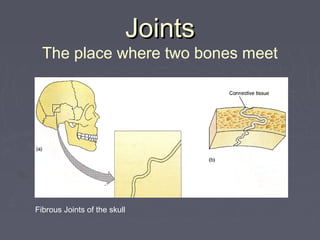
The place where two bones meet

Fibrous Joints of the skull
Joints
► Are

classified according to the degree
of movement.
►Immovable
►Slightly movable
►Freely movable
► Joints can also be grouped by the type
of tissue
►Fibrous,

cartilaginous, & synovial
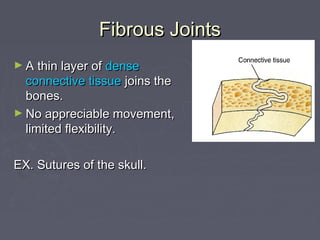
Fibrous Joints
► A thin layer of dense

connective tissue joins the
bones.
► No appreciable movement,
limited flexibility.
EX. Sutures of the skull.
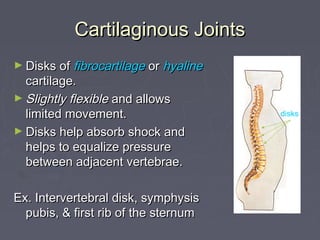
Cartilaginous Joints
► Disks of fibrocartilage or hyaline

cartilage.
► Slightly flexible and allows
limited movement.
► Disks help absorb shock and
helps to equalize pressure
between adjacent vertebrae.

Ex. Intervertebral disk, symphysis
pubis, & first rib of the sternum

disks
Synovial Joints

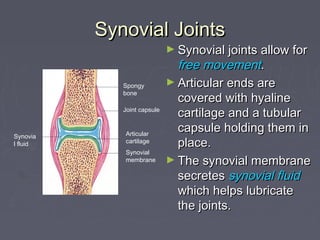
► Synovial joints allow for

Spongy
bone
Joint capsule

Synovia
l fluid

Articular
cartilage
Synovial
membrane

free movement.
► Articular ends are
covered with hyaline
cartilage and a tubular
capsule holding them in
place.
► The synovial membrane
secretes synovial fluid
which helps lubricate
the joints.
Types of Synovial Joints
► Ball

& Socket, allows a wider range of
motion than does any other kind. Permits
movement in all planes.
►Shoulder

► Gliding,

nearly flat

►Wrist,

► Hinge,

one

and Hip (movement in more than one plane)

ankle, & adjacent vertebrae

convex surface fits into a concave

►Elbow and

plane)

Phalanges (permits movement in one
Types of Synovial Joints
► Pivot

Joint, movement is limited to the
rotation around a central axis.
►neck

and proximal ends of the radius & ulna.

► Saddle

Joint, allows movement in two
directions, but without rotation.
►thumb

► Condyloid,

rotation.

movement in all planes, but no

►Metacarpals

and phalanges
Synovial Joint
► Ball & Socket Joint

 Freely movable in all
planes
► Movement in all planes
► Shoulder and hip
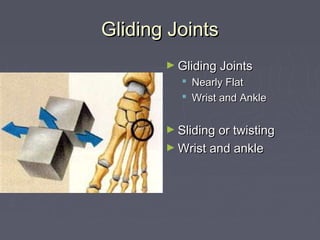
Gliding Joints
► Gliding Joints

 Nearly Flat
 Wrist and Ankle
► Sliding or twisting
► Wrist and ankle
Hinge Joint
► Convex surface

articulates with a
convex surface

► Flexion & Extension
► EX: Elbow, Knee and

Phalanges
Pivot Joint
► Cylindrical surface of

one bone articulates
with ring of another

► Rotation
► Proximal end of the

radius and ulna and
neck
Saddle Joint
► Articulating surfaces

have both concave
and convex surfaces

► Variety of movements
► thumb
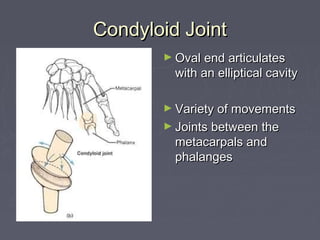
Condyloid Joint
► Oval end articulates

with an elliptical cavity

► Variety of movements
► Joints between the

metacarpals and
phalanges

Joints

  • 1.
    Joints The place wheretwo bones meet Fibrous Joints of the skull
  • 2.
    Joints ► Are classified accordingto the degree of movement. ►Immovable ►Slightly movable ►Freely movable ► Joints can also be grouped by the type of tissue ►Fibrous, cartilaginous, & synovial
  • 3.
    Fibrous Joints ► Athin layer of dense connective tissue joins the bones. ► No appreciable movement, limited flexibility. EX. Sutures of the skull.
  • 4.
    Cartilaginous Joints ► Disksof fibrocartilage or hyaline cartilage. ► Slightly flexible and allows limited movement. ► Disks help absorb shock and helps to equalize pressure between adjacent vertebrae. Ex. Intervertebral disk, symphysis pubis, & first rib of the sternum disks
  • 5.
    Synovial Joints ► Synovialjoints allow for Spongy bone Joint capsule Synovia l fluid Articular cartilage Synovial membrane free movement. ► Articular ends are covered with hyaline cartilage and a tubular capsule holding them in place. ► The synovial membrane secretes synovial fluid which helps lubricate the joints.
  • 6.
    Types of SynovialJoints ► Ball & Socket, allows a wider range of motion than does any other kind. Permits movement in all planes. ►Shoulder ► Gliding, nearly flat ►Wrist, ► Hinge, one and Hip (movement in more than one plane) ankle, & adjacent vertebrae convex surface fits into a concave ►Elbow and plane) Phalanges (permits movement in one
  • 7.
    Types of SynovialJoints ► Pivot Joint, movement is limited to the rotation around a central axis. ►neck and proximal ends of the radius & ulna. ► Saddle Joint, allows movement in two directions, but without rotation. ►thumb ► Condyloid, rotation. movement in all planes, but no ►Metacarpals and phalanges
  • 8.
    Synovial Joint ► Ball& Socket Joint  Freely movable in all planes ► Movement in all planes ► Shoulder and hip
  • 9.
    Gliding Joints ► GlidingJoints  Nearly Flat  Wrist and Ankle ► Sliding or twisting ► Wrist and ankle
  • 10.
    Hinge Joint ► Convexsurface articulates with a convex surface ► Flexion & Extension ► EX: Elbow, Knee and Phalanges
  • 11.
    Pivot Joint ► Cylindricalsurface of one bone articulates with ring of another ► Rotation ► Proximal end of the radius and ulna and neck
  • 12.
    Saddle Joint ► Articulatingsurfaces have both concave and convex surfaces ► Variety of movements ► thumb
  • 13.
    Condyloid Joint ► Ovalend articulates with an elliptical cavity ► Variety of movements ► Joints between the metacarpals and phalanges

Editor's Notes

  • #4 Also the point of attachment of the tibia & fibia.
  • #5 The vertebral disks are fibrocartilage surrounded by hyaline. (annulus fibrosus) surrounded by a gelatinous core. (nucleus pulposus)
  • #6 bur·sa fluid-filled sac: a fluid-filled body sac that reduces friction around joints or between other parts that rub against one another. Bursa may be continuous with the synovial membrane.