Articulaciones
Clasificacion Funcional
SINARTROSIS: Sin Movimiento
ANFIARTROSIS: Poco Movimiento
DIARTROSIS: Moviles
Clasificacion estructural
Fibrosas
Cartilaginosas
Sinoviales
Articulaciones fibrosas
Los huesos están unidos por tejido fibroso
La longitud del tejido fibroso determina el rango de
movimiento de las articulaciones
Tipos de articulaciones
fibrosas
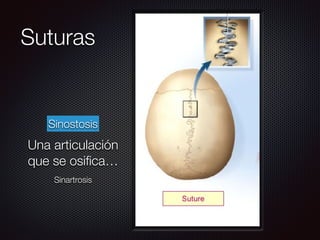
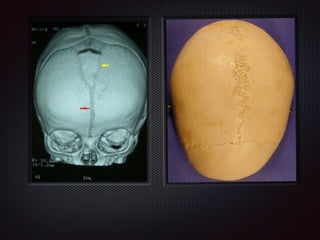
Suturas
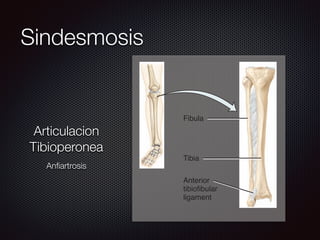
Sindesmosis
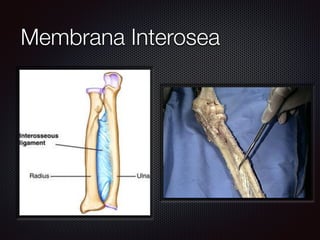
Membrana Interosea
Suturas
Sinostosis
Una articulación
que se osifica…
Sinartrosis
Sindesmosis
Fibula
Tibia
Anterior
tibiofibular
ligament
Syndesmosis between tibia and fibula
266 CHAPTER 9 • JOINTS
FIGURE 9.1 CONTINUED
Articulacion
Tibioperonea
Anfiartrosis
Membrana Interosea
Clasificacion estructural
Fibrosas
Cartilaginosas
Sinoviales
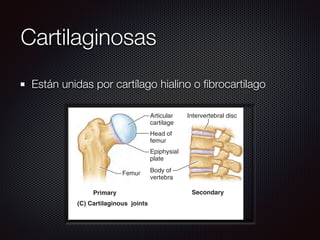
Cartilaginosas
Están unidas por cartílago hialino o fibrocartilago
ematic model Knee joint
cartilage
Tibia
Infrapatellar
fat pad
(C) Cartilaginous joints
Primary
yndesmosis
ous
e
Articular
cartilage
Intervertebral disc
Secondary
Head of
femur
Epiphysial
plate
Body of
vertebra
Femur
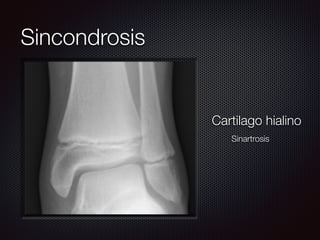
Sincondrosis
Cartilago hialino
Sinartrosis
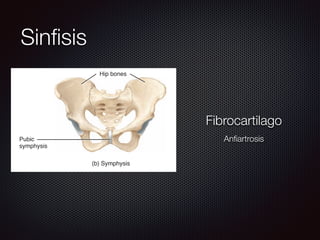
Sinfisis Diaphysis
(a) Synchondrosis
Hip bones
Pubic
symphysis
(b) Symphysis
joints are classified functiona
synovial joint are covered by
articular cartilage. The cartil
of the bones with a smooth, s
them together. Articular cartila
in the joint during movement a
Articular Capsule
A sleevelike articular (joint)
encloses the synovial cavity,
The articular capsule is compo
membrane and an inner syno
fibrous membrane usually co
tissue (mostly collagen fibers)
the articulating bones. In fact,
thickened continuation of the p
flexibility of the fibrous mem
ment at a joint, while its gr
stretching) helps prevent the bo
some fibrous membranes are
dense regular connective tissue
What is the structural difference between a synchondrosis
and a symphysis?
?
Fibrocartilago
Anfiartrosis
Clasificacion estructural
Fibrosas
Cartilaginosas
Sinoviales
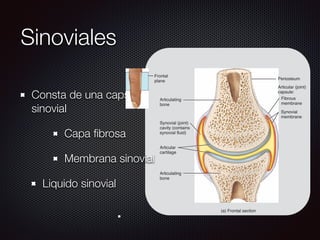
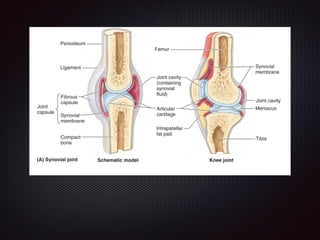
Sinoviales
Consta de una capsula
sinovial
Capa fibrosa
Membrana sinovial
Liquido sinovial
Articulating
bone
Articulating
bone
Articular
cartilage
Synovial (joint)
cavity (contains
synovial fluid)
Frontal
plane
(a) Frontal section
Articular (joint)
capsule:
Periosteum
Fibrous
membrane
Synovial
membrane
POSTERIOR
Articular (joint)
capsule
ANT
Hum
268 CHAPTER 9 • JOINTS
Figure 9.3 Structure of a typical synovial joint. Note the two layers of the articular capsule—the fibrous mem
the synovial membrane. Synovial fluid lubricates the joint cavity between the synovial membrane and
articular cartilage.
The distinguishing feature of a synovial joint is the synovial cavity between the articulating bone
Introduction to Clinically Oriented Anatomy
Schematic model(A) Synovial joint Knee joint
Periosteum
Ligament
Compact
bone
Joint cavity
(containing
synovial
fluid)
Fibrous
capsule
Synovial
membrane
Joint
capsule
Articular
cartilage
Femur
Tibia
Meniscus
Infrapatellar
fat pad
Compact
bone
Ulna
Suture
Articular
cartilage
Intervertebral disc
Head of
femur
Epiphysial
ploë (spongy
one between
wo layers of
ompact bone)
Synovial
membrane
Joint cavity
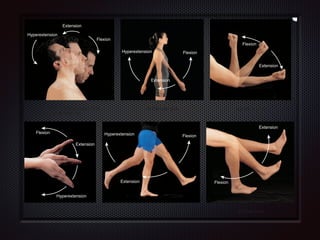
Movimientos
(a) Atlanto-occipital and cervical
intervertebral joints
(b) Shoulder joint (c) Elbow joint
(d) Wrist joint (e) Hip joint (f) Knee joint
Flexion
Flexion
Flexion
Extension
Extension
Extension
Extension
Hyperextension
Hyperextension
Flexion
Flexion
Flexion
Extension
Extension
Hyperextension
Hyperextension
following are examples of flexion (as you have probably alread
guessed, extension is simply the reverse of these movements):
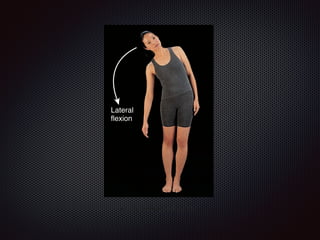
Figure 9.5 Angular movements at synovial joints—flexion, extension, hyperextension, and lateral flexion.
In angular movements, there is an increase or decrease in the angle between articulating bones.
Lateral
flexion
(d) Wrist joint (e) Hip
(g) Intervertebral joints
What are two examples of flexion that do not occur alo?
(a) Shoulder joint (b) Wrist joint (c) Hip joint
(d) Metacarpophalangeal joints of the fingers (not the thumb)
Abduction Adduction
Abduction
Adduction
Abduction Adduction
Abduction
Adduction
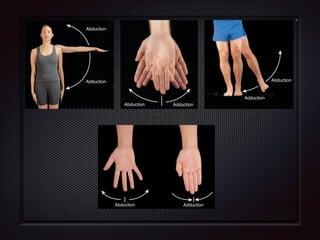
Figure 9.6 Angular movements at synovial joints—abduction and adduction.
Abduction and adduction usually occur along the frontal plane.
Is considering adduction as “adding your limb to your trunk” an effective learning device??
(a) Atlanto-axial joint
Rotation
Lateral
rotation
Medial
rotation
Medial
rotation
Lateral
rotation
(c) Hip joint(b) Shoulder joint
adduction. Therefore, circumduction does not occur along a
separate axis or plane of movement. Examples of circumduction
are moving the humerus in a circle at the shoulder joint (Figure
9.7a), moving the hand in a circle at the wrist joint, moving the
thumb in a circle at the carpometacarpal joint, moving the fin-
gers in a circle at the metacarpophalangeal joints (between the
Another is turning the trunk from side to side at the in
bral joints while keeping the hips and lower limbs in the
ical position. In the limbs, rotation is defined relativ
midline, and specific qualifying terms are used. If the
surface of a bone of the limb is turned toward the mid
movement is called medial (internal) rotation. You can m
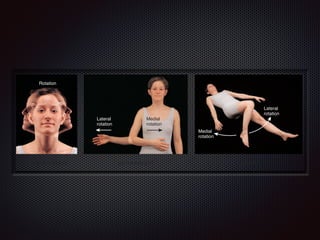
Figure 9.8 Rotation at synovial joints.
In rotation, a bone revolves around its own longitudinal axis.
How do medial and lateral rotation differ??
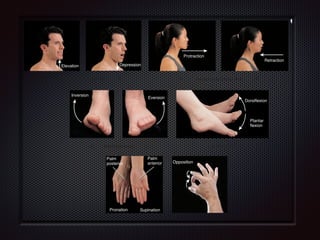
Elevation
Temporomandibular joint(a)
Depression
(b) Temporomandibular joint(c) (d)
Protraction
Retraction
(e) (f)
Inversion
Eversion
Intertarsal joints (g) Ankle joint
Dorsiflexion
Plantar
flexion
Palm
posterior
Palm
anterior Opposition
(h) Radioulnar joint (i) Carpometacarpal joint
Pronation Supination
Figure 9.9 Special movements at synovial joints.
Special movements occur only at certain synovial joints.
What movement of the shoulder girdle occurs when you bring your arms forward until the elbows touch??
Tipos de articulaciones
sinoviales
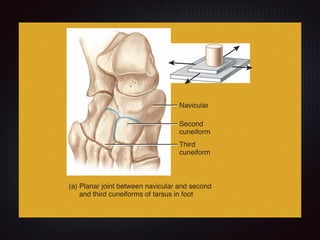
Navicular
Radius
Second
cuneiform
Third
cuneiform
Trochle
notch
(a) Planar joint between navicular and second
and third cuneiforms of tarsus in foot
(b) Hin
and
Figure 9.10 Types of synovial joints. For each type, a drawing of the actua
Synovial joints are classified into six principal types based on
Radius Ulna
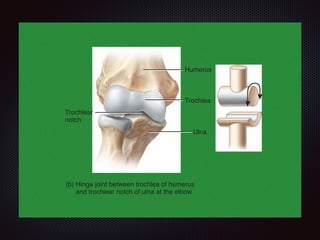
Humerus
Trochlea
Trochlear
notch
Ulna
(b) Hinge joint between trochlea of humerus
and trochlear notch of ulna at the elbow
pe, a drawing of the actual joint and a simplified diagram are shown.
rincipal types based on the shapes of the articulating bone surfaces.
Radius
Radius
Radial
notch
Scaphoid
Ulna
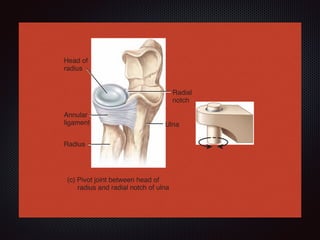
Head of
radius
(a) Planar joint between navicular and second
and third cuneiforms of tarsus in foot
(d) Condyl
and lun
Annular
ligament
(b) Hinge
and tro
(c) Pivot joint between head of
radius and radial notch of ulna
Radius Ulna
Lunate
Scaphoid
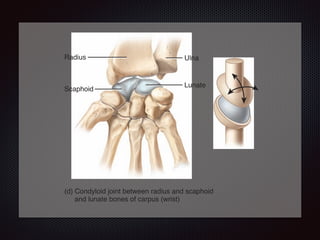
(d) Condyloid joint between radius and scaphoid
and lunate bones of carpus (wrist)
(b) Hinge joint between trochlea of humerus
and trochlear notch of ulna at the elbow
Trapezium
Metacarpal
of thumb
Head of
femur
Ulna
(f) Ball-a
femu
Radius
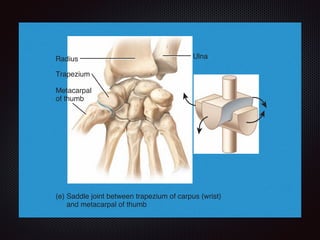
(e) Saddle joint between trapezium of carpus (wrist)
and metacarpal of thumb
Which of the joints shown here are biaxial??
Head of
femur
Acetabulum
of hip bone
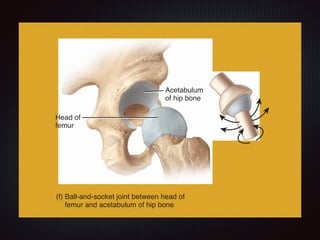
(f) Ball-and-socket joint between head of
femur and acetabulum of hip bone

Articulaciones

  • 1.
  • 2.
    Clasificacion Funcional SINARTROSIS: SinMovimiento ANFIARTROSIS: Poco Movimiento DIARTROSIS: Moviles
  • 3.
  • 4.
    Articulaciones fibrosas Los huesosestán unidos por tejido fibroso La longitud del tejido fibroso determina el rango de movimiento de las articulaciones
  • 5.
  • 6.
  • 8.
    Sindesmosis Fibula Tibia Anterior tibiofibular ligament Syndesmosis between tibiaand fibula 266 CHAPTER 9 • JOINTS FIGURE 9.1 CONTINUED Articulacion Tibioperonea Anfiartrosis
  • 9.
  • 10.
  • 11.
    Cartilaginosas Están unidas porcartílago hialino o fibrocartilago ematic model Knee joint cartilage Tibia Infrapatellar fat pad (C) Cartilaginous joints Primary yndesmosis ous e Articular cartilage Intervertebral disc Secondary Head of femur Epiphysial plate Body of vertebra Femur
  • 12.
  • 13.
    Sinfisis Diaphysis (a) Synchondrosis Hipbones Pubic symphysis (b) Symphysis joints are classified functiona synovial joint are covered by articular cartilage. The cartil of the bones with a smooth, s them together. Articular cartila in the joint during movement a Articular Capsule A sleevelike articular (joint) encloses the synovial cavity, The articular capsule is compo membrane and an inner syno fibrous membrane usually co tissue (mostly collagen fibers) the articulating bones. In fact, thickened continuation of the p flexibility of the fibrous mem ment at a joint, while its gr stretching) helps prevent the bo some fibrous membranes are dense regular connective tissue What is the structural difference between a synchondrosis and a symphysis? ? Fibrocartilago Anfiartrosis
  • 14.
  • 15.
    Sinoviales Consta de unacapsula sinovial Capa fibrosa Membrana sinovial Liquido sinovial Articulating bone Articulating bone Articular cartilage Synovial (joint) cavity (contains synovial fluid) Frontal plane (a) Frontal section Articular (joint) capsule: Periosteum Fibrous membrane Synovial membrane POSTERIOR Articular (joint) capsule ANT Hum 268 CHAPTER 9 • JOINTS Figure 9.3 Structure of a typical synovial joint. Note the two layers of the articular capsule—the fibrous mem the synovial membrane. Synovial fluid lubricates the joint cavity between the synovial membrane and articular cartilage. The distinguishing feature of a synovial joint is the synovial cavity between the articulating bone
  • 16.
    Introduction to ClinicallyOriented Anatomy Schematic model(A) Synovial joint Knee joint Periosteum Ligament Compact bone Joint cavity (containing synovial fluid) Fibrous capsule Synovial membrane Joint capsule Articular cartilage Femur Tibia Meniscus Infrapatellar fat pad Compact bone Ulna Suture Articular cartilage Intervertebral disc Head of femur Epiphysial ploë (spongy one between wo layers of ompact bone) Synovial membrane Joint cavity
  • 18.
  • 19.
    (a) Atlanto-occipital andcervical intervertebral joints (b) Shoulder joint (c) Elbow joint (d) Wrist joint (e) Hip joint (f) Knee joint Flexion Flexion Flexion Extension Extension Extension Extension Hyperextension Hyperextension Flexion Flexion Flexion Extension Extension Hyperextension Hyperextension following are examples of flexion (as you have probably alread guessed, extension is simply the reverse of these movements): Figure 9.5 Angular movements at synovial joints—flexion, extension, hyperextension, and lateral flexion. In angular movements, there is an increase or decrease in the angle between articulating bones.
  • 20.
    Lateral flexion (d) Wrist joint(e) Hip (g) Intervertebral joints What are two examples of flexion that do not occur alo?
  • 21.
    (a) Shoulder joint(b) Wrist joint (c) Hip joint (d) Metacarpophalangeal joints of the fingers (not the thumb) Abduction Adduction Abduction Adduction Abduction Adduction Abduction Adduction Figure 9.6 Angular movements at synovial joints—abduction and adduction. Abduction and adduction usually occur along the frontal plane. Is considering adduction as “adding your limb to your trunk” an effective learning device??
  • 22.
    (a) Atlanto-axial joint Rotation Lateral rotation Medial rotation Medial rotation Lateral rotation (c)Hip joint(b) Shoulder joint adduction. Therefore, circumduction does not occur along a separate axis or plane of movement. Examples of circumduction are moving the humerus in a circle at the shoulder joint (Figure 9.7a), moving the hand in a circle at the wrist joint, moving the thumb in a circle at the carpometacarpal joint, moving the fin- gers in a circle at the metacarpophalangeal joints (between the Another is turning the trunk from side to side at the in bral joints while keeping the hips and lower limbs in the ical position. In the limbs, rotation is defined relativ midline, and specific qualifying terms are used. If the surface of a bone of the limb is turned toward the mid movement is called medial (internal) rotation. You can m Figure 9.8 Rotation at synovial joints. In rotation, a bone revolves around its own longitudinal axis. How do medial and lateral rotation differ??
  • 23.
    Elevation Temporomandibular joint(a) Depression (b) Temporomandibularjoint(c) (d) Protraction Retraction (e) (f) Inversion Eversion Intertarsal joints (g) Ankle joint Dorsiflexion Plantar flexion Palm posterior Palm anterior Opposition (h) Radioulnar joint (i) Carpometacarpal joint Pronation Supination Figure 9.9 Special movements at synovial joints. Special movements occur only at certain synovial joints. What movement of the shoulder girdle occurs when you bring your arms forward until the elbows touch??
  • 25.
  • 26.
    Navicular Radius Second cuneiform Third cuneiform Trochle notch (a) Planar jointbetween navicular and second and third cuneiforms of tarsus in foot (b) Hin and Figure 9.10 Types of synovial joints. For each type, a drawing of the actua Synovial joints are classified into six principal types based on
  • 27.
    Radius Ulna Humerus Trochlea Trochlear notch Ulna (b) Hingejoint between trochlea of humerus and trochlear notch of ulna at the elbow pe, a drawing of the actual joint and a simplified diagram are shown. rincipal types based on the shapes of the articulating bone surfaces.
  • 28.
    Radius Radius Radial notch Scaphoid Ulna Head of radius (a) Planarjoint between navicular and second and third cuneiforms of tarsus in foot (d) Condyl and lun Annular ligament (b) Hinge and tro (c) Pivot joint between head of radius and radial notch of ulna
  • 29.
    Radius Ulna Lunate Scaphoid (d) Condyloidjoint between radius and scaphoid and lunate bones of carpus (wrist) (b) Hinge joint between trochlea of humerus and trochlear notch of ulna at the elbow
  • 30.
    Trapezium Metacarpal of thumb Head of femur Ulna (f)Ball-a femu Radius (e) Saddle joint between trapezium of carpus (wrist) and metacarpal of thumb Which of the joints shown here are biaxial??
  • 31.
    Head of femur Acetabulum of hipbone (f) Ball-and-socket joint between head of femur and acetabulum of hip bone