Inventory Management Numerical Problems
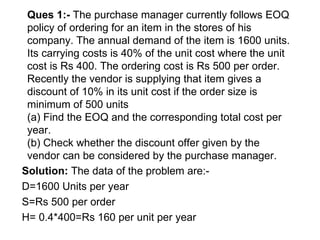
Ques 1:-  The purchase manager currently follows EOQ policy of ordering for an item in the stores of his company. The annual demand of the item is 1600 units. Its carrying costs is 40% of the unit cost where the unit cost is Rs 400. The ordering cost is Rs 500 per order. Recently the vendor is supplying that item gives a discount of 10% in its unit cost if the order size is minimum of 500 units (a) Find the EOQ and the corresponding total cost per year. (b) Check whether the discount offer given by the vendor can be considered by the purchase manager. Solution:  The data of the problem are:- D=1600 Units per year S=Rs 500 per order H= 0.4*400=Rs 160 per unit per year
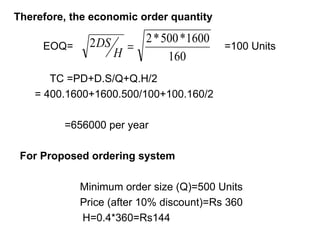
Therefore, the economic order quantity TC =PD+D.S/Q+Q.H/2 = 400.1600+1600.500/100+100.160/2 =656000 per year For Proposed ordering system Minimum order size (Q)=500 Units Price (after 10% discount)=Rs 360 H=0.4*360=Rs144 EOQ= =100 Units
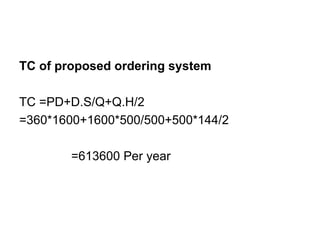
TC of proposed ordering system TC =PD+D.S/Q+Q.H/2 =360*1600+1600*500/500+500*144/2 =613600 Per year
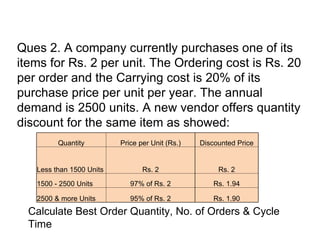
Ques 2. A company currently purchases one of its items for Rs. 2 per unit. The Ordering cost is Rs. 20 per order and the Carrying cost is 20% of its purchase price per unit per year. The annual demand is 2500 units. A new vendor offers quantity discount for the same item as showed: Calculate Best Order Quantity, No. of Orders & Cycle Time Quantity Price per Unit (Rs.) Discounted Price Less than 1500 Units Rs. 2 Rs. 2 1500 - 2500 Units 97% of Rs. 2 Rs. 1.94 2500 & more Units 95% of Rs. 2 Rs. 1.90
Ordering Cost (S) = Rs. 20 Annual Demand (D) = 2500 Units Price (P)= Rs. 2, Carrying Cost (H)= 20% * Price EOQ at P = 1.9 =  =   = 513 Units [Not Feasible] EOQ at P = 1.94  =  =  507 Units [Not Feasible] EOQ at P = 2 =    = 500 Units [Feasible]
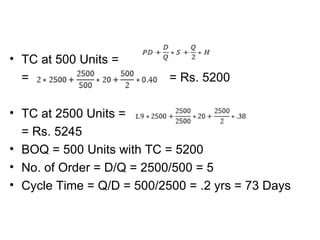
TC at 500 Units = =  = Rs. 5200 TC at 2500 Units = = Rs. 5245 BOQ = 500 Units with TC = 5200 No. of Order = D/Q = 2500/500 = 5 Cycle Time = Q/D = 500/2500 = .2 yrs = 73 Days
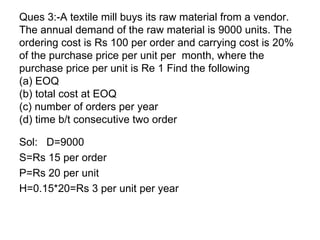
Ques 3:-A textile mill buys its raw material from a vendor. The annual demand of the raw material is 9000 units. The ordering cost is Rs 100 per order and carrying cost is 20% of the purchase price per unit per  month, where the purchase price per unit is Re 1 Find the following (a) EOQ (b) total cost at EOQ (c) number of orders per year (d) time b/t consecutive two order Sol:  D=9000 S=Rs 15 per order P=Rs 20 per unit H=0.15*20=Rs 3 per unit per year
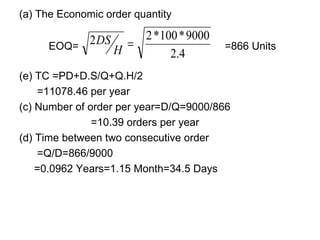
The Economic order quantity TC =PD+D.S/Q+Q.H/2 =11078.46 per year (c) Number of order per year=D/Q=9000/866 =10.39 orders per year (d) Time between two consecutive order =Q/D=866/9000 =0.0962 Years=1.15 Month=34.5 Days EOQ= =866 Units
Ques 4. The Annual demand of an item in the stores of a foundry is 9000 units. Its annual carrying cost is 15% of the purchase price of the item per year, where the purchase price is 20Rs per unit. The ordering cost is 15Rs per order. Presently the order size of the item is the average monthly demand that item. Find the EOQ and compare its cost with the ordering system and find the corresponding cost advantage if exists?
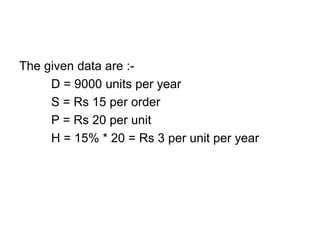
The given data are :- D = 9000 units per year S = Rs 15 per order P = Rs 20 per unit H = 15% * 20 = Rs 3 per unit per year
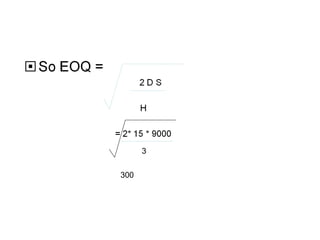
3 300
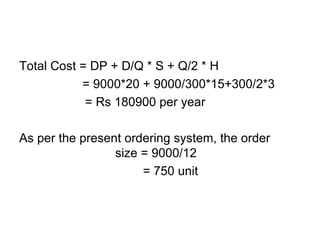
Total Cost = DP + D/Q * S + Q/2 * H   = 9000*20 + 9000/300*15+300/2*3 = Rs 180900 per year As per the present ordering system, the order  size = 9000/12   = 750 unit
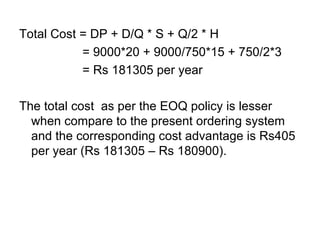
Total Cost = DP + D/Q * S + Q/2 * H   = 9000*20 + 9000/750*15 + 750/2*3   = Rs 181305 per year The total cost  as per the EOQ policy is lesser when compare to the present ordering system and the corresponding cost advantage is Rs405 per year (Rs 181305 – Rs 180900).
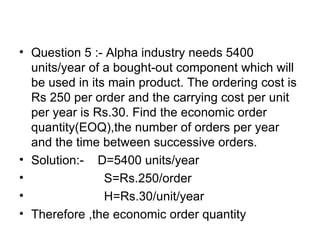
Question 5 :- Alpha industry needs 5400 units/year of a bought-out component which will be used in its main product. The ordering cost is Rs 250 per order and the carrying cost per unit per year is Rs.30. Find the economic order quantity(EOQ),the number of orders per year and the time between successive orders.  Solution:-  D=5400 units/year S=Rs.250/order H=Rs.30/unit/year Therefore ,the economic order quantity
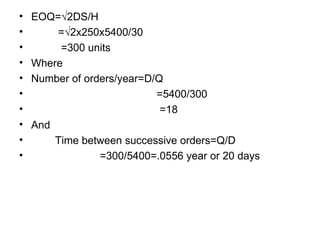
EOQ=√2DS/H =√2x250x5400/30 =300 units Where Number of orders/year=D/Q =5400/300 =18 And Time between successive orders=Q/D =300/5400=.0556 year or 20 days
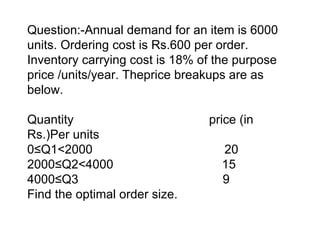
Question:-Annual demand for an item is 6000 units. Ordering cost is Rs.600 per order. Inventory carrying cost is 18% of the purpose price /units/year. Theprice breakups are as below.   Quantity  price (in Rs.)Per units 0≤Q1<2000  20 2000≤Q2<4000    15 4000≤Q3   9 Find the optimal order size.
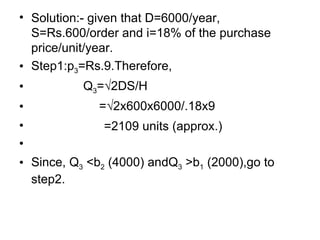
Solution:- given that D=6000/year, S=Rs.600/order and i=18% of the purchase price/unit/year. Step1:p 3 =Rs.9.Therefore, Q 3 =√2DS/H    =√2x600x6000/.18x9 =2109 units (approx.) Since, Q 3  <b 2  (4000) andQ 3  >b 1  (2000),go to step2.
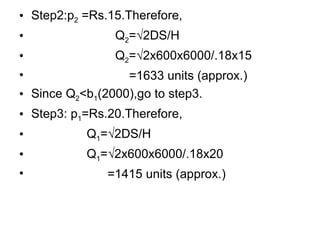
Step2:p 2  =Rs.15.Therefore, Q 2 =√2DS/H Q 2 =√2x600x6000/.18x15   =1633 units (approx.) Since Q 2 <b 1 (2000),go to step3. Step3: p 1 =Rs.20.Therefore,   Q 1 =√2DS/H   Q 1 =√2x600x6000/.18x20 =1415 units (approx.)
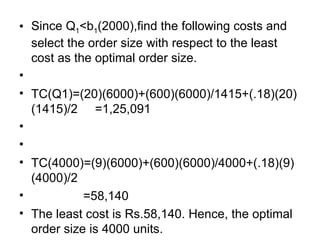
Since Q 1 <b 1 (2000),find the following costs and select the order size with respect to the least cost as the optimal order size. TC(Q1)=(20)(6000)+(600)(6000)/1415+(.18)(20)(1415)/2  =1,25,091   TC(4000)=(9)(6000)+(600)(6000)/4000+(.18)(9)(4000)/2 =58,140 The least cost is Rs.58,140. Hence, the optimal order size is 4000 units.
Thank You

Or

  • 1.
  • 2.
    Ques 1:- The purchase manager currently follows EOQ policy of ordering for an item in the stores of his company. The annual demand of the item is 1600 units. Its carrying costs is 40% of the unit cost where the unit cost is Rs 400. The ordering cost is Rs 500 per order. Recently the vendor is supplying that item gives a discount of 10% in its unit cost if the order size is minimum of 500 units (a) Find the EOQ and the corresponding total cost per year. (b) Check whether the discount offer given by the vendor can be considered by the purchase manager. Solution: The data of the problem are:- D=1600 Units per year S=Rs 500 per order H= 0.4*400=Rs 160 per unit per year
  • 3.
    Therefore, the economicorder quantity TC =PD+D.S/Q+Q.H/2 = 400.1600+1600.500/100+100.160/2 =656000 per year For Proposed ordering system Minimum order size (Q)=500 Units Price (after 10% discount)=Rs 360 H=0.4*360=Rs144 EOQ= =100 Units
  • 4.
    TC of proposedordering system TC =PD+D.S/Q+Q.H/2 =360*1600+1600*500/500+500*144/2 =613600 Per year
  • 5.
    Ques 2. Acompany currently purchases one of its items for Rs. 2 per unit. The Ordering cost is Rs. 20 per order and the Carrying cost is 20% of its purchase price per unit per year. The annual demand is 2500 units. A new vendor offers quantity discount for the same item as showed: Calculate Best Order Quantity, No. of Orders & Cycle Time Quantity Price per Unit (Rs.) Discounted Price Less than 1500 Units Rs. 2 Rs. 2 1500 - 2500 Units 97% of Rs. 2 Rs. 1.94 2500 & more Units 95% of Rs. 2 Rs. 1.90
  • 6.
    Ordering Cost (S)= Rs. 20 Annual Demand (D) = 2500 Units Price (P)= Rs. 2, Carrying Cost (H)= 20% * Price EOQ at P = 1.9 = = = 513 Units [Not Feasible] EOQ at P = 1.94 = = 507 Units [Not Feasible] EOQ at P = 2 = = 500 Units [Feasible]
  • 7.
    TC at 500Units = = = Rs. 5200 TC at 2500 Units = = Rs. 5245 BOQ = 500 Units with TC = 5200 No. of Order = D/Q = 2500/500 = 5 Cycle Time = Q/D = 500/2500 = .2 yrs = 73 Days
  • 8.
    Ques 3:-A textilemill buys its raw material from a vendor. The annual demand of the raw material is 9000 units. The ordering cost is Rs 100 per order and carrying cost is 20% of the purchase price per unit per month, where the purchase price per unit is Re 1 Find the following (a) EOQ (b) total cost at EOQ (c) number of orders per year (d) time b/t consecutive two order Sol: D=9000 S=Rs 15 per order P=Rs 20 per unit H=0.15*20=Rs 3 per unit per year
  • 9.
    The Economic orderquantity TC =PD+D.S/Q+Q.H/2 =11078.46 per year (c) Number of order per year=D/Q=9000/866 =10.39 orders per year (d) Time between two consecutive order =Q/D=866/9000 =0.0962 Years=1.15 Month=34.5 Days EOQ= =866 Units
  • 10.
    Ques 4. TheAnnual demand of an item in the stores of a foundry is 9000 units. Its annual carrying cost is 15% of the purchase price of the item per year, where the purchase price is 20Rs per unit. The ordering cost is 15Rs per order. Presently the order size of the item is the average monthly demand that item. Find the EOQ and compare its cost with the ordering system and find the corresponding cost advantage if exists?
  • 11.
    The given dataare :- D = 9000 units per year S = Rs 15 per order P = Rs 20 per unit H = 15% * 20 = Rs 3 per unit per year
  • 12.
  • 13.
    Total Cost =DP + D/Q * S + Q/2 * H = 9000*20 + 9000/300*15+300/2*3 = Rs 180900 per year As per the present ordering system, the order size = 9000/12 = 750 unit
  • 14.
    Total Cost =DP + D/Q * S + Q/2 * H = 9000*20 + 9000/750*15 + 750/2*3 = Rs 181305 per year The total cost as per the EOQ policy is lesser when compare to the present ordering system and the corresponding cost advantage is Rs405 per year (Rs 181305 – Rs 180900).
  • 15.
    Question 5 :-Alpha industry needs 5400 units/year of a bought-out component which will be used in its main product. The ordering cost is Rs 250 per order and the carrying cost per unit per year is Rs.30. Find the economic order quantity(EOQ),the number of orders per year and the time between successive orders. Solution:- D=5400 units/year S=Rs.250/order H=Rs.30/unit/year Therefore ,the economic order quantity
  • 16.
    EOQ=√2DS/H =√2x250x5400/30 =300units Where Number of orders/year=D/Q =5400/300 =18 And Time between successive orders=Q/D =300/5400=.0556 year or 20 days
  • 17.
    Question:-Annual demand foran item is 6000 units. Ordering cost is Rs.600 per order. Inventory carrying cost is 18% of the purpose price /units/year. Theprice breakups are as below. Quantity price (in Rs.)Per units 0≤Q1<2000 20 2000≤Q2<4000 15 4000≤Q3 9 Find the optimal order size.
  • 18.
    Solution:- given thatD=6000/year, S=Rs.600/order and i=18% of the purchase price/unit/year. Step1:p 3 =Rs.9.Therefore, Q 3 =√2DS/H =√2x600x6000/.18x9 =2109 units (approx.) Since, Q 3 <b 2 (4000) andQ 3 >b 1 (2000),go to step2.
  • 19.
    Step2:p 2 =Rs.15.Therefore, Q 2 =√2DS/H Q 2 =√2x600x6000/.18x15 =1633 units (approx.) Since Q 2 <b 1 (2000),go to step3. Step3: p 1 =Rs.20.Therefore, Q 1 =√2DS/H Q 1 =√2x600x6000/.18x20 =1415 units (approx.)
  • 20.
    Since Q 1<b 1 (2000),find the following costs and select the order size with respect to the least cost as the optimal order size. TC(Q1)=(20)(6000)+(600)(6000)/1415+(.18)(20)(1415)/2 =1,25,091   TC(4000)=(9)(6000)+(600)(6000)/4000+(.18)(9)(4000)/2 =58,140 The least cost is Rs.58,140. Hence, the optimal order size is 4000 units.
  • 21.